
If you’ve been told to try a low FODMAP diet for IBS, the first week can feel like learning a new language. A low FODMAP diet food list is the thing that makes it manageable, because the rules aren’t intuitive. Garlic and onion are out, but garlic-infused oil is in. Firm bananas are fine, ripe ones need care. Apples are on the avoid side, oranges are not. You need the list in front of you, at least at the start.
This guide covers two printable charts. The first is the Low FODMAP Food List, with Eat, Limit and Avoid columns and the header 100+ foods. Eat is labelled common lower-FODMAP choices, Limit says portion matters, and Avoid says common higher-FODMAP choices during restriction. I count about 188 named foods on it, so it’s a full list.
The second chart is a High Fiber Low FODMAP Food List. It solves a problem many people hit a few weeks in: cutting out wheat, beans and lots of fruit can leave you short on fiber. This chart shows pictured foods in ten numbered sections, from whole grains and berries to easy breakfast ideas, snack ideas and meal pairings, plus a simple formula for building a fiber-rich low FODMAP meal.
First, a caution. The low FODMAP diet is meant to be a short, structured process, ideally done with a dietitian, not a forever diet. Symptoms like IBS can overlap with other conditions, so get a diagnosis from your doctor before you start. And see a doctor promptly if you have blood in your stool, weight loss you can’t explain, a fever, or symptoms that wake you at night. This guide is general information only.
In this guide:
- The Low FODMAP Food List Chart, Column by Column
- Worked Grocery List: A Low FODMAP Shop From the Eat Column
- The High Fiber Low FODMAP Chart
- How to Use the Charts Through the Three Phases
- Frequently Asked Questions
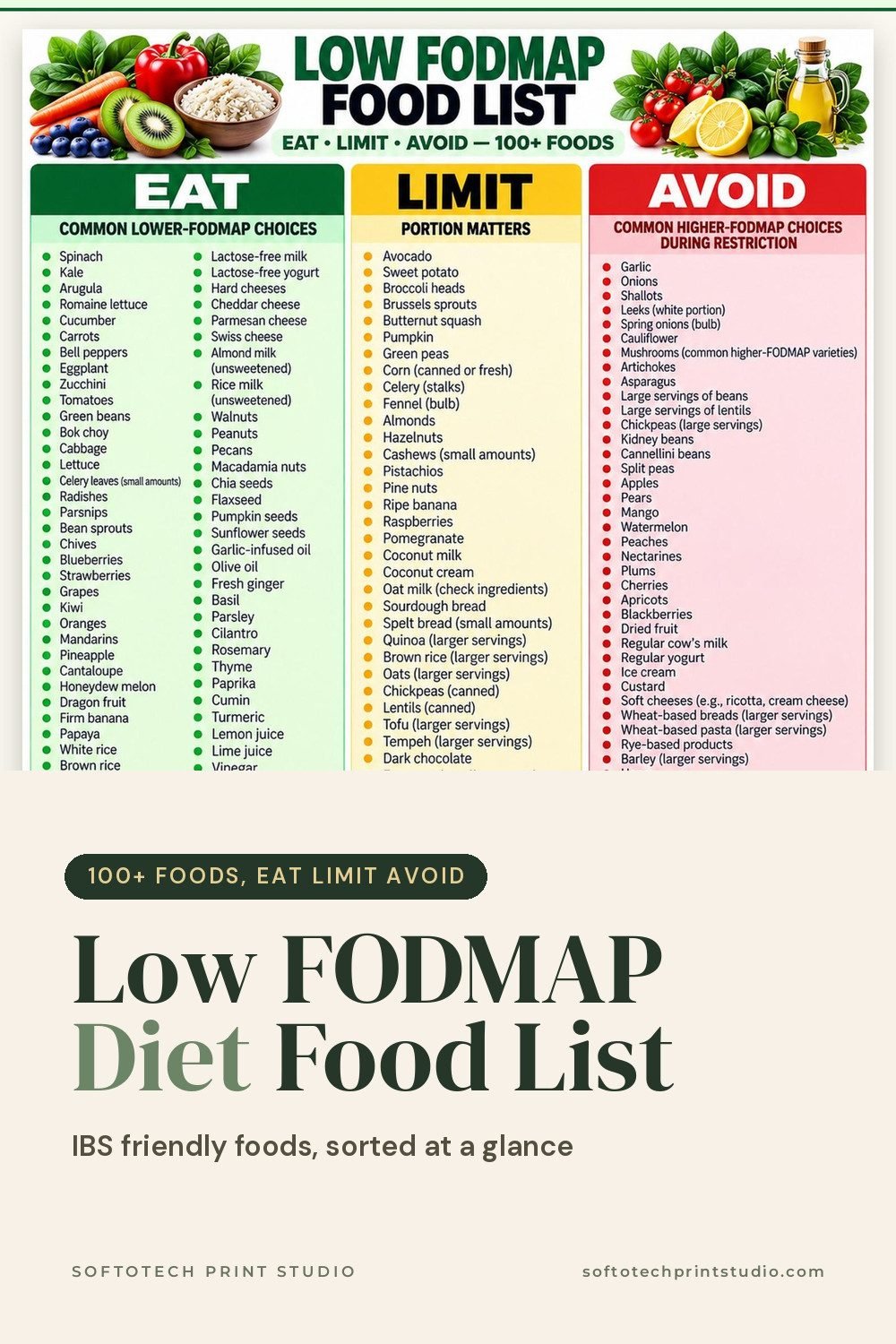
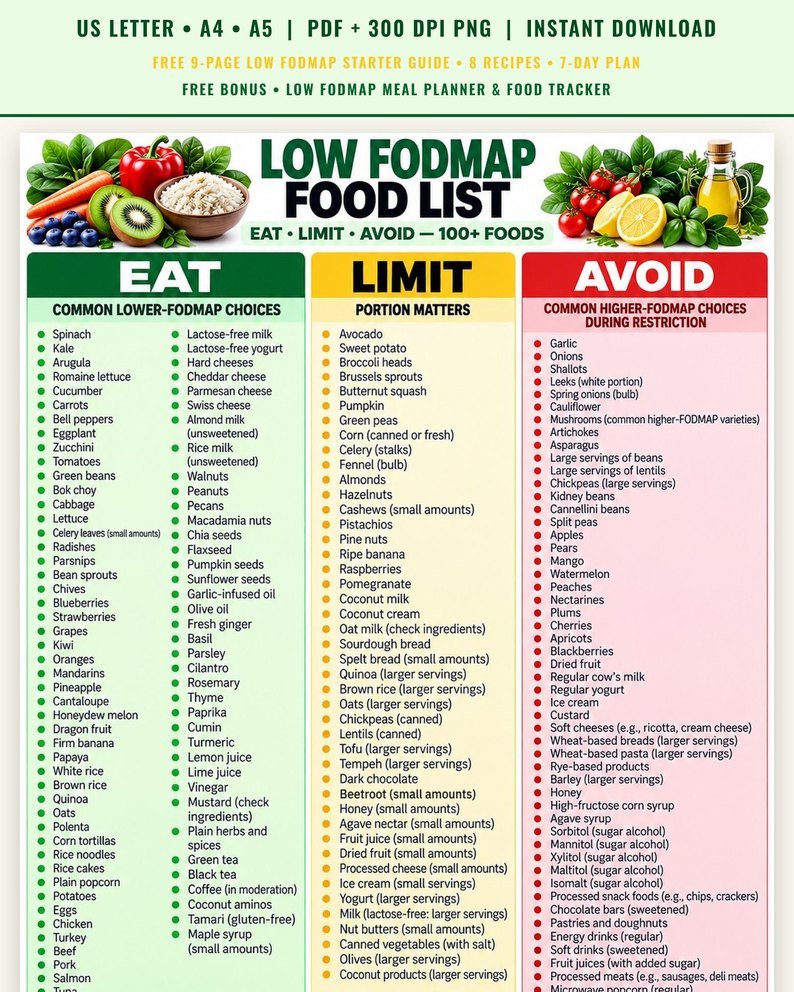
- Sorts 100+ foods into Eat (common lower-FODMAP choices), Limit (portion matters) and Avoid (common higher-FODMAP choices during restriction)
- Eat foods include carrots, zucchini, blueberries, oranges, firm banana, rice, oats, eggs, chicken and garlic-infused oil
- Limit foods include avocado, sweet potato, almonds, ripe banana, sourdough bread and canned lentils
- Avoid foods include garlic, onions, cauliflower, apples, pears, regular cow’s milk and wheat-based breads in larger servings
- Print sizes US Letter, A4 and A5, as 3 PDFs plus a 300 DPI PNG and a ZIP per the listing, with a bonus starter guide and planner
- Instant download · Print at home · US Letter · A4 · A5
Use code BLOG10 for 65% OFF at Etsy checkout!
The Low FODMAP Food List Chart, Column by Column
The Eat column is the longest, at about 90 foods in two lists. Vegetables come first: spinach, kale, arugula, romaine lettuce, cucumber, carrots, bell peppers, eggplant, zucchini, tomatoes, green beans, bok choy, cabbage, lettuce, celery leaves in small amounts, radishes, parsnips, bean sprouts and chives. Then fruit: blueberries, strawberries, grapes, kiwi, oranges, mandarins, pineapple, cantaloupe, honeydew melon, dragon fruit, firm banana and papaya.
Grains and starches in Eat are white rice, brown rice, quinoa, oats, polenta, corn tortillas, rice noodles, rice cakes, plain popcorn and potatoes. Proteins are eggs, chicken, turkey, beef, pork, salmon, tuna, cod, shrimp, firm tofu and tempeh. Plain meat, fish and eggs don’t contain FODMAPs, which is why that part of the list is so relaxed. The catch is marinades, sauces and sausages, where garlic and onion tend to hide.
The second Eat list covers dairy, nuts and flavour. Dairy: lactose-free milk, lactose-free yogurt, hard cheeses, cheddar, parmesan and Swiss cheese, plus unsweetened almond milk and unsweetened rice milk. Nuts and seeds: walnuts, peanuts, pecans, macadamia nuts, chia seeds, flaxseed, pumpkin seeds and sunflower seeds. Oils: garlic-infused oil and olive oil. Herbs and spices: fresh ginger, basil, parsley, cilantro, rosemary, thyme, paprika, cumin and turmeric. Then lemon juice, lime juice, vinegar, mustard (check ingredients), plain herbs and spices, green tea, black tea, coffee in moderation, coconut aminos, tamari (gluten-free) and maple syrup in small amounts.
Garlic-infused oil deserves a word, because it’s probably the most useful item on the chart. The FODMAPs in garlic don’t dissolve into oil, so an oil that has been infused and strained gives you the garlic flavour without the problem. Chives, and the green parts of spring onions, do a similar job for onion. Cooking without garlic and onion is the hardest adjustment for many people, and these two tricks make it bearable.
The Limit column is the “portion matters” list, about 44 foods. Vegetables: avocado, sweet potato, broccoli heads, Brussels sprouts, butternut squash, pumpkin, green peas, corn (canned or fresh), celery stalks and fennel bulb. Nuts: almonds, hazelnuts, cashews in small amounts, pistachios and pine nuts. Fruit: ripe banana, raspberries and pomegranate. Then coconut milk, coconut cream, oat milk (check ingredients), sourdough bread and spelt bread in small amounts.
The rest of Limit is mostly portion notes on foods that are fine in smaller amounts: quinoa, brown rice and oats in larger servings, canned chickpeas, canned lentils, tofu and tempeh in larger servings, dark chocolate, and beetroot, honey, agave nectar, fruit juice, dried fruit and processed cheese, all in small amounts. Ice cream in small servings, yogurt in larger servings, lactose-free milk in larger servings, nut butters in small amounts, canned vegetables with salt, olives in larger servings and coconut products in larger servings round it off. A note at the bottom says FODMAP content can change with serving size, and some foods may fit in smaller portions but become higher FODMAP at larger servings.
The Avoid column, about 54 items, is the common higher-FODMAP list during the restriction phase. The onion family: garlic, onions, shallots, leeks (white portion) and spring onions (bulb). Vegetables: cauliflower, mushrooms (common higher-FODMAP varieties), artichokes and asparagus. Legumes: large servings of beans, large servings of lentils, chickpeas in large servings, kidney beans, cannellini beans and split peas. Fruit: apples, pears, mango, watermelon, peaches, nectarines, plums, cherries, apricots, blackberries and dried fruit.
Avoid carries on with dairy: regular cow’s milk, regular yogurt, ice cream, custard and soft cheeses such as ricotta and cream cheese. Grains: wheat-based breads and pasta in larger servings, rye-based products and barley in larger servings. Sweeteners: honey, high-fructose corn syrup, agave syrup, and the sugar alcohols sorbitol, mannitol, xylitol, maltitol and isomalt. It ends with processed snack foods such as chips and crackers, sweetened chocolate bars, pastries and doughnuts, regular energy drinks, sweetened soft drinks, fruit juices with added sugar, processed meats such as sausages and deli meats, regular microwave popcorn, packaged meal kits, artificial sweeteners and highly processed foods.
A few things on this chart are worth flagging honestly. Honey, agave, dried fruit and ice cream appear in both Limit (in small amounts) and Avoid. I’d treat them as avoid during the first strict weeks, then test them later. Cashews and pistachios are in Limit here, but Monash University, which developed the diet, has generally tested both as high FODMAP even in small serves, so check the Monash app before you include them. Avocado sits in Limit too, which fits the chart’s general point that portion size changes things. The footer says FODMAP content can vary by food, serving size and preparation, that individual tolerance varies, and that a structured low-FODMAP diet is best done with a qualified healthcare professional or registered dietitian. I agree with all of that.
Worked Grocery List: A Low FODMAP Shop From the Eat Column
Here’s a sample first-week shop using only the Eat column. It’s built for the strict restriction phase, so nothing from Limit or Avoid is included. Every food is on the chart.
| Section | Buy from the Eat column | Watch out for |
|---|---|---|
| Vegetables | Carrots, zucchini, bell peppers, spinach, cucumber, tomatoes, green beans, bok choy | Onion, garlic, cauliflower, mushrooms |
| Fruit | Blueberries, strawberries, oranges, kiwi, pineapple, firm bananas | Apples, pears, mango, ripe bananas |
| Grains | Oats, white or brown rice, quinoa, rice noodles, corn tortillas, rice cakes | Wheat bread and pasta in larger servings |
| Protein | Eggs, chicken, salmon, tuna, firm tofu, tempeh | Sausages, deli meats, ready marinades |
| Dairy | Lactose-free milk and yogurt, cheddar, parmesan | Regular milk, soft cheeses, custard |
| Nuts and seeds | Walnuts, peanuts, macadamias, pumpkin seeds, chia seeds | Cashews, pistachios |
| Flavour | Garlic-infused oil, olive oil, chives, ginger, herbs, lemons, tamari | Stock cubes, spice mixes with garlic or onion |
Vegetables first. Carrots, zucchini, peppers, spinach and cucumber are cheap, easy and in almost every supermarket. Green beans and bok choy are good stir-fry vegetables. Tomatoes are in Eat too. Skip the onions and garlic this week, and buy a bunch of chives instead. If you can find garlic-infused oil, buy a bottle. It changes how much you’ll enjoy the whole first phase.
For fruit, pick two or three from the Eat list and eat one portion at a time. Blueberries, strawberries, oranges, kiwi and pineapple are all there. Buy bananas slightly green. A firm banana is in Eat and a ripe one is in Limit, so the same fruit changes column as it ripens.
Grains are easier than you might expect. Oats for breakfast, rice or quinoa for dinner, rice noodles for a stir-fry, corn tortillas for wraps, rice cakes for snacks. You don’t need special gluten-free bread on day one. Sourdough is in Limit, which some people find a relief.
Protein is straightforward as long as it’s plain. Buy fresh chicken, fish and eggs rather than marinated or breaded versions, and check sausages and stock carefully. A firm tofu is in Eat, and so is tempeh, which is handy if you don’t eat meat.
A sample day from that basket. Breakfast: oats made with lactose-free milk, topped with blueberries, a sprinkle of chia seeds and a few walnuts. Lunch: rice noodles with chicken, carrots, zucchini, bok choy and chives, cooked in garlic-infused oil with a splash of tamari and some ginger. Snack: a kiwi and a small handful of walnuts. Dinner: baked salmon with potatoes, green beans and a squeeze of lemon. Every item is from the Eat column. For a full week laid out like this, our low FODMAP diet meal plan has seven days of IBS friendly meals.
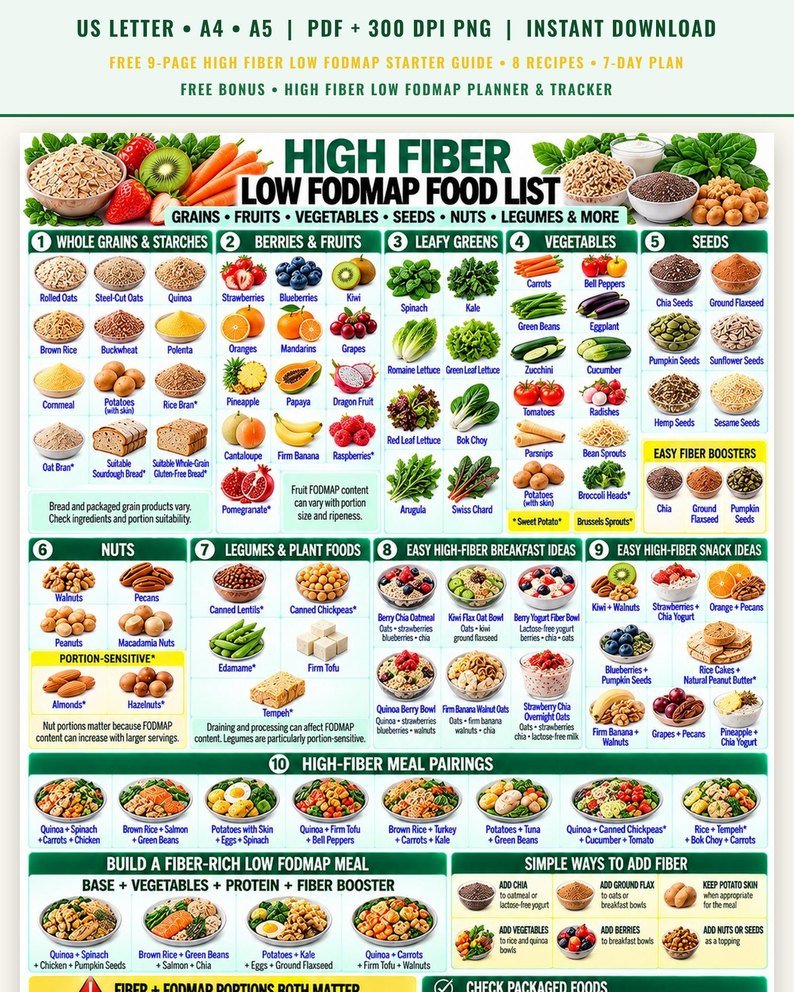
- Pictured foods in ten numbered sections: grains, fruits, leafy greens, vegetables, seeds, nuts, legumes and meal ideas
- Foods include rolled oats, quinoa, kiwi, spinach, carrots, chia seeds, walnuts, firm tofu and canned lentils
- 6 high-fiber breakfast ideas and 8 meal pairings, such as quinoa, spinach, carrots and chicken
- A build a fiber-rich low FODMAP meal formula: base, vegetables, protein and a fiber booster
- Print sizes US Letter, A4 and A5, as 3 PDFs plus a 300 DPI PNG and a ZIP per the listing
- Instant download · Print at home · US Letter · A4 · A5
Use code BLOG10 for 65% OFF at Etsy checkout!
The High Fiber Low FODMAP Chart
The second chart is titled High Fiber Low FODMAP Food List, with the strapline Grains, Fruits, Vegetables, Seeds, Nuts, Legumes and More. It’s built around pictures, with ten numbered sections. Some foods carry an asterisk. The nuts section labels its asterisked items “portion-sensitive”, and I read the asterisk that way across the chart, though I couldn’t see a separate key explaining it.
Section 1, whole grains and starches: rolled oats, steel-cut oats, quinoa, brown rice, buckwheat, polenta, cornmeal, potatoes with skin, rice bran, oat bran, suitable sourdough bread and suitable whole-grain gluten-free bread. The last four have asterisks, and a note says bread and packaged grain products vary, so check ingredients and portion suitability. Section 2, berries and fruits: strawberries, blueberries, kiwi, oranges, mandarins, grapes, pineapple, papaya, dragon fruit, cantaloupe, firm banana, and raspberries and pomegranate with asterisks. The note says fruit FODMAP content can vary with portion size and ripeness.
Section 3, leafy greens: spinach, kale, romaine lettuce, green leaf lettuce, red leaf lettuce, bok choy, arugula and Swiss chard. Section 4, vegetables: carrots, bell peppers, green beans, eggplant, zucchini, cucumber, tomatoes, radishes, parsnips, bean sprouts, potatoes with skin, and broccoli heads, sweet potato and Brussels sprouts with asterisks. Section 5, seeds: chia seeds, ground flaxseed, pumpkin seeds, sunflower seeds, hemp seeds and sesame seeds, plus an easy fiber boosters box of chia, ground flaxseed and pumpkin seeds.
Section 6, nuts: walnuts, pecans, peanuts and macadamia nuts, with almonds and hazelnuts in a portion-sensitive box and the note that nut portions matter because FODMAP content can increase with larger servings. Section 7, legumes and plant foods: canned lentils, canned chickpeas, edamame and tempeh, all with asterisks, and firm tofu without. The note says draining and processing can affect FODMAP content, and legumes are particularly portion-sensitive. Rinsing canned lentils and chickpeas is the usual tip here.
Section 8 gives six easy high-fiber breakfast ideas. Berry chia oatmeal: oats, strawberries, blueberries and chia. Kiwi flax oat bowl: oats, kiwi and ground flaxseed. Berry yogurt fiber bowl: lactose-free yogurt, berries, chia and oats. Quinoa berry bowl: quinoa, strawberries, blueberries and walnuts. Firm banana walnut oats: oats, firm banana, walnuts and chia. Strawberry chia overnight oats: oats, strawberries, chia and lactose-free milk.
Section 9 gives snack ideas: kiwi and walnuts, strawberries and chia yogurt, orange and pecans, blueberries and pumpkin seeds, rice cakes and natural peanut butter, firm banana and walnuts, grapes and pecans, and pineapple and chia yogurt. That’s eight snacks on the chart. The listing says 9 snack ideas, so either one is cut from the preview or the listing count is off by one. I’ve only used the eight I can see.
Section 10 is eight high-fiber meal pairings: quinoa, spinach, carrots and chicken; brown rice, salmon and green beans; potatoes with skin, eggs and spinach; quinoa, firm tofu and bell peppers; brown rice, turkey, carrots and kale; potatoes, tuna and green beans; quinoa, canned chickpeas, cucumber and tomato; and rice, tempeh, bok choy and carrots.
Below that sits the build a fiber-rich low FODMAP meal formula: base, plus vegetables, plus protein, plus fiber booster. The four examples are quinoa and spinach with chicken and pumpkin seeds; brown rice and green beans with salmon and chia; potatoes and kale with eggs and ground flaxseed; and quinoa and carrots with firm tofu and walnuts. A simple ways to add fiber box says to add chia to oatmeal or lactose-free yogurt, add ground flax to oats or breakfast bowls, keep potato skin on when appropriate for the meal, add vegetables to rice and quinoa bowls, add berries to breakfast bowls, and add nuts or seeds as a topping.
Two boxes at the bottom matter a lot. Fiber and FODMAP portions both matter: increasing fiber quickly may cause digestive discomfort for some people, so increase it gradually and consider fluid intake as appropriate for your needs. Check packaged foods: watch for garlic, onion, garlic powder, onion powder, inulin or chicory root, honey, agave, sorbitol, mannitol, xylitol and maltitol, and especially check fiber bars, breads, crackers, granola, flavored oatmeal and packaged snacks.
About the numbers. The listing says 75+ pictured foods. I count about 64 named foods in sections 1 to 7, and more if you include the breakfast, snack and meal pictures. The chart is still a rich, practical reference. If gut symptoms are tied to a condition like ulcerative colitis, our ulcerative colitis food list covers that separately, since fiber advice can be quite different during a flare.
How to Use the Charts Through the Three Phases
The low FODMAP diet, as Monash University describes it, has three phases. First, restriction, usually for 2 to 6 weeks, where you swap high FODMAP foods for lower FODMAP ones. Second, reintroduction, where you test FODMAP groups one at a time to see which ones you react to. Third, personalisation, where you bring back everything you tolerate and keep only your own trigger foods limited. The charts are most useful in phase one, and still handy in the other two.
In phase one, cook from the Eat column and the fiber chart’s numbered sections. Keep Limit foods to the small portions the chart describes, and leave Avoid foods out. Stick the main chart on the fridge and use the fiber chart for breakfast and snack ideas, because those are the meals where fiber tends to drop.
In phase two, the Avoid column becomes your testing list. A dietitian will usually guide you through one food group at a time, such as a little garlic, or a portion of apple, or a glass of regular milk, over a few days, and watch how you feel. Keep a short food and symptom diary. Don’t test several new foods at once, or you won’t know which one caused trouble.
In phase three, cross out the foods you’ve tested and tolerated, and keep a short personal avoid list. Many people end up eating far more widely than in phase one. The aim of the diet is to find your triggers, not to live on the Eat column for good, which would make it harder to get enough fiber and variety.
Watch for overlap with other diets. Some people with gut symptoms also follow advice for other conditions, and lists can clash. Our gastroparesis food list leans towards low fiber, easy-to-digest foods, for example, which is quite different from the fiber chart here. The low histamine diet food list also sorts some of the same foods differently. If you’ve been given more than one diet, ask your dietitian which comes first.
And add fiber slowly. The fiber chart says so itself. If you go from very little fiber to a full bowl of chia oats and a lentil salad in one day, your gut will tell you about it. Add one fiber booster at a time, drink enough water, and give it a few days before adding the next.
If your doctor is checking for gluten problems too, our celiac disease food list sorts foods into eat, check labels and avoid.
If snacks are where you get stuck, our low FODMAP snacks for IBS guide builds 30 snack ideas from this chart’s Eat column.
Frequently Asked Questions
What foods are on a low FODMAP diet food list?
The main chart sorts 100+ foods into Eat, Limit and Avoid. Eat includes carrots, zucchini, spinach, blueberries, oranges, firm bananas, rice, oats, quinoa, eggs, plain meat and fish, lactose-free dairy and garlic-infused oil. Limit includes avocado, sweet potato, almonds and sourdough bread. Avoid includes garlic, onions, cauliflower, apples, pears and regular milk.
Can I eat garlic and onion on a low FODMAP diet?
Garlic and onions are in the Avoid column during the restriction phase. Garlic-infused oil is in the Eat column, because the FODMAPs in garlic do not dissolve into oil, and chives are in Eat too. Many people test garlic and onion again in the reintroduction phase to see how much they tolerate.
How do I get enough fiber on a low FODMAP diet?
The high fiber low FODMAP chart helps here. It lists fiber foods like rolled oats, quinoa, potatoes with skin, kiwi, chia seeds, ground flaxseed and canned lentils, plus six breakfast ideas and eight meal pairings. It says to add fiber gradually and to consider fluid intake, because a fast increase can cause discomfort.
When should I see a doctor about IBS symptoms?
See a doctor before starting the diet to confirm the cause of your symptoms. Get checked promptly if you have blood in your stool, unexplained weight loss, a fever, ongoing vomiting, or symptoms that wake you at night. A registered dietitian is the best guide through the restriction and reintroduction phases.
What sizes do the low FODMAP food lists print in?
Both low FODMAP charts print in US Letter, A4 and A5, as 3 PDFs plus a 300 DPI PNG and a ZIP per the listing. They are instant downloads you can print at home or at a print shop, and each listing includes a bonus starter guide and planner.
This guide is for general wellness and is not medical advice. Check with your doctor before starting a new routine.
Related Guides
- Low FODMAP Diet Meal Plan
- Gastroparesis Food List
- Low Histamine Diet Food List
- Ulcerative Colitis Food List
Sources
Sources: Monash FODMAP, High and Low FODMAP Foods, MedlinePlus, Low FODMAP Diet
 Diet & Food ListsMediterranean Diet for Seniors: A Simple Guide With an Eat, Limit, Avoid List and a 7 Day Plan
 Diet & Food ListsHigh Protein Foods for Muscle Gain: How Much You Need, the Best Picks per Meal and a Worked Training Day
 Diet & Food ListsLow Sodium Dinner Ideas: 24 DASH Style Dinners, a Sodium Budget per Plate and Sauce and Seasoning Swaps