
Most of us eat the least protein at breakfast and the most at dinner, and then wonder why we’re hungry again by ten o’clock. The fix is simpler than it sounds: a handful of high protein foods for breakfast that actually fit a busy morning, like eggs, Greek yogurt, cottage cheese, oats, beans and fish. This guide shows you which ones work best and gives you 50 ready-made breakfast ideas built from them.
The guide is built around two printables from SoftoTech Print Studio. The first is the 50 High Protein Breakfast Ideas chart, which sorts 50 breakfasts into ten groups of five, from omelets to five-minute bowls. The second is a High Protein Foods Chart that lists 36 protein foods with a serving size and grams of protein next to each one. One gives you the meals, the other gives you the numbers.
I’ll go through all 50 breakfasts group by group, then put the gram figures from the foods chart next to the most useful breakfast foods. After that there’s a worked week of breakfasts with rough protein totals, and a last section on how much protein a breakfast really needs, using what Harvard’s Nutrition Source and MedlinePlus say.
One honest limit first. The breakfast chart gives names and key ingredients only. It doesn’t print grams of protein, calories or recipes for each idea. That’s normal for an ideas chart, and it’s why the foods chart is useful next to it. Where I give a protein total in this guide, I’ve added it up from the gram figures printed on the foods chart, and I say so.
And a plain note. Most healthy adults can eat more protein at breakfast without any problem. If you have kidney disease, or a doctor or dietitian has given you a protein limit, follow their numbers over anything here. The same goes if you’re managing diabetes, where the carbs in the bowl matter as much as the protein.
In this guide:
- The 50 High Protein Breakfasts in 10 Groups
- The Breakfast Protein Foods With Grams per Serving
- A Worked Week of High Protein Breakfasts
- How Much Protein a Breakfast Really Needs
- Frequently Asked Questions
- 50 high protein breakfasts in 10 groups of five, on one page
- Groups include eggs and omelets, Greek yogurt bowls, cottage cheese, high-protein oats, wraps, bowls and savory breakfasts
- Breakfasts such as spinach feta omelet, apple walnut overnight oats and salmon avocado breakfast bowl
- Each idea lists its key ingredients so you can shop straight from it
- US Letter, A4 and A5 PDFs plus a 300 DPI PNG, per the listing
- Instant download · Print at home · US Letter · A4 · A5
Use code BLOG10 for 65% OFF at Etsy checkout!
The 50 High Protein Breakfasts in 10 Groups
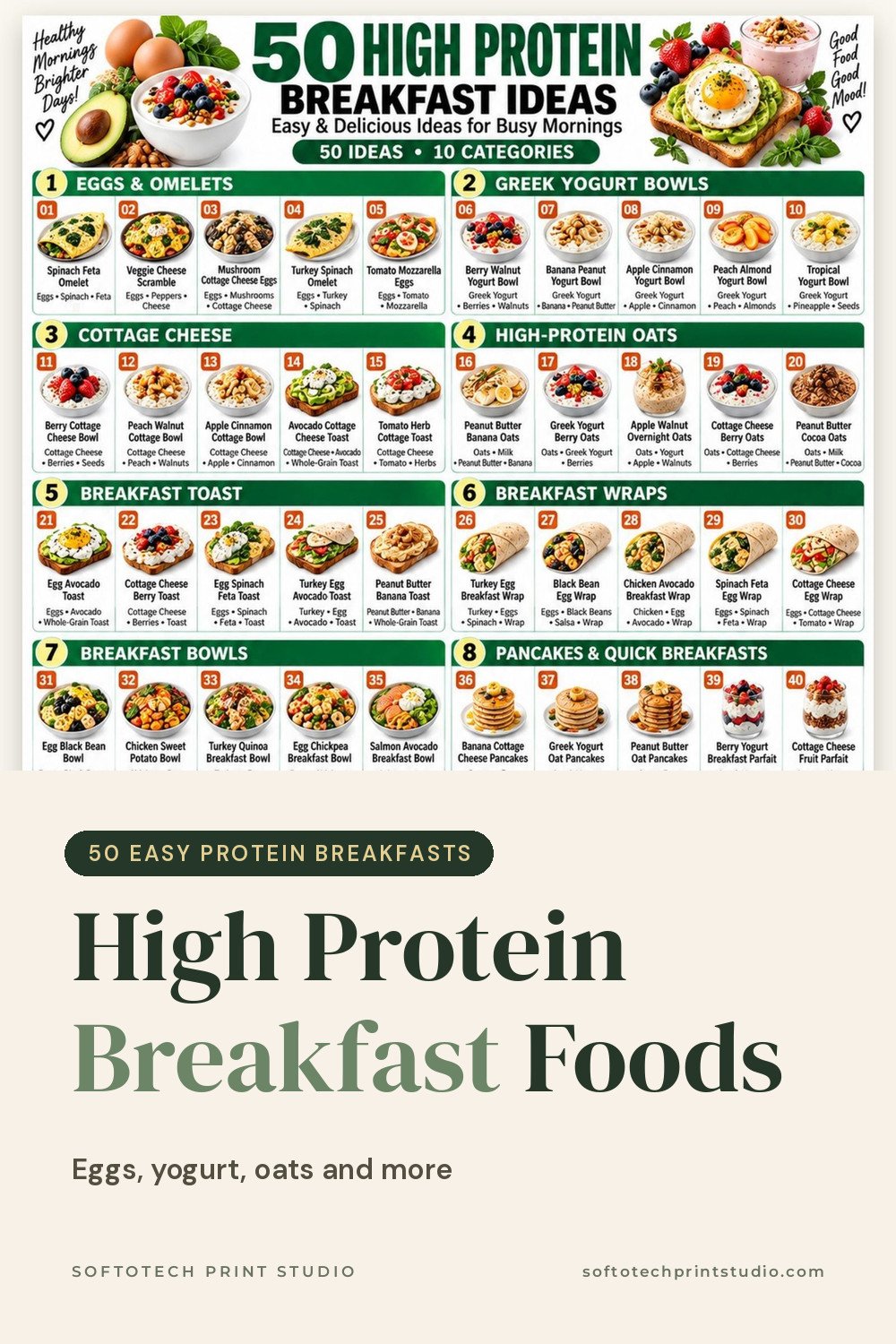
The chart is headed 50 High Protein Breakfast Ideas, with the line easy and delicious ideas for busy mornings underneath. It’s laid out as ten colored boxes, each with a small photo and five numbered breakfasts. Every breakfast has a name and a short line of key ingredients, so you can shop from it. Here’s what’s on it, group by group.
Eggs and omelets. Spinach feta omelet. Veggie cheese scramble with peppers and cheese. Mushroom cottage cheese eggs. Turkey spinach omelet. Tomato mozzarella eggs. Eggs are the obvious start, and the chart pairs them with a second protein in most of these, like feta, cottage cheese, turkey or mozzarella. That second protein is the simple trick that turns two eggs into a properly filling plate.
Greek yogurt bowls. Berry walnut. Banana peanut, with banana and peanut butter. Apple cinnamon. Peach almond. Tropical, with pineapple and seeds. These are the fastest breakfasts on the chart. Spoon yogurt into a bowl, add fruit and a handful of nuts or seeds, and you’re done. Buy plain yogurt and let the fruit do the sweetening, because flavored yogurts often carry a lot of added sugar.
Cottage cheese. Berry cottage cheese bowl with seeds. Peach walnut cottage bowl. Apple cinnamon cottage bowl. Avocado cottage cheese toast on whole-grain toast. Tomato herb cottage toast. If you’ve never had cottage cheese on toast, try the tomato herb one first. It’s savory, quick and a lot nicer than it sounds.
High-protein oats. Peanut butter banana oats made with oats and milk. Greek yogurt berry oats. Apple walnut overnight oats with oats and yogurt. Cottage cheese berry oats. Peanut butter cocoa oats. Plain oats made with water are mostly carbohydrate. This group shows how to lift them, by cooking with milk, stirring in yogurt or cottage cheese, or adding peanut butter. The overnight oats are the ones to make on a Sunday night for Monday.
Breakfast toast. Egg avocado toast. Cottage cheese berry toast. Egg spinach feta toast. Turkey egg avocado toast. Peanut butter banana toast. Toast works well when you want something to hold. The chart’s toasts all use whole-grain bread, which adds a few grams of protein and some fiber on its own.
Breakfast wraps. Turkey egg breakfast wrap with spinach. Black bean egg wrap with salsa. Chicken avocado breakfast wrap. Spinach feta egg wrap. Cottage cheese egg wrap with tomato. Wraps are the group for anyone who eats breakfast on the way to work. Make two or three at once, wrap them in foil, and keep them in the fridge.
Breakfast bowls. Egg black bean bowl with avocado. Chicken sweet potato bowl with egg. Turkey quinoa breakfast bowl with greens. Egg chickpea breakfast bowl with tomato and spinach. Salmon avocado breakfast bowl with egg and greens. These are bigger, more lunch-like breakfasts. They make sense on a weekend, or after a morning workout, or for anyone who simply likes a savory start.
Pancakes and quick breakfasts. Banana cottage cheese pancakes made with eggs and oats. Greek yogurt oat pancakes. Peanut butter oat pancakes. Berry yogurt breakfast parfait with oats. Cottage cheese fruit parfait with nuts. The pancakes are a nice weekend option because the eggs and cottage cheese or yogurt are mixed right into the batter, so they’re not just flour and syrup.
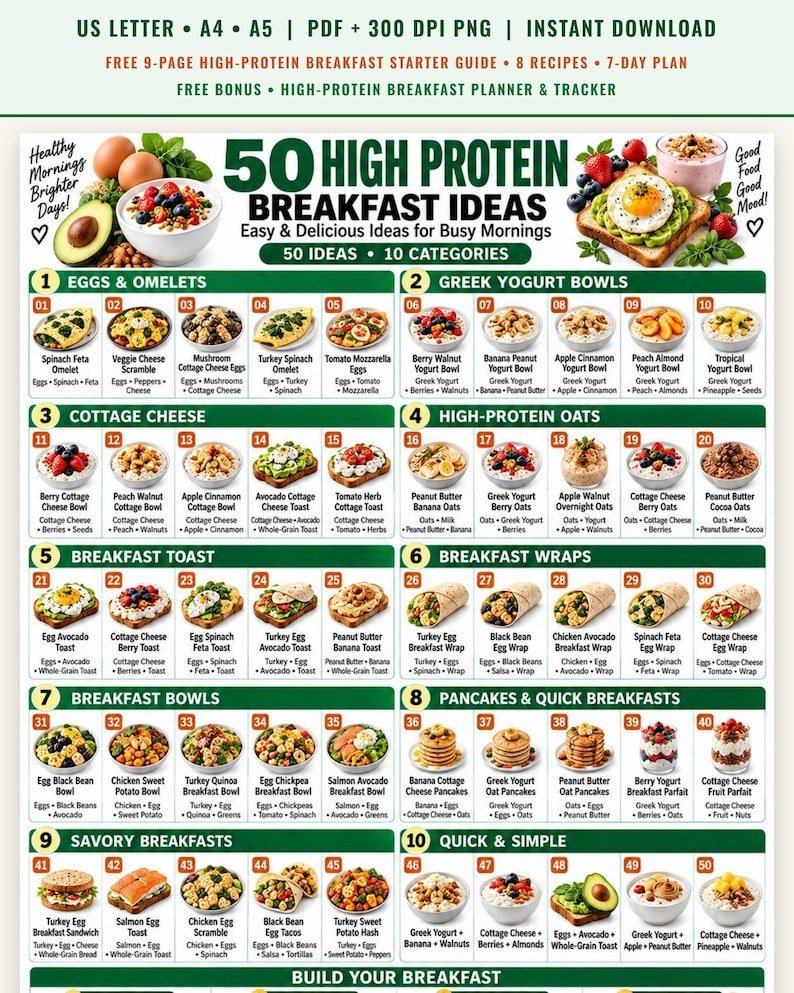
Savory breakfasts. Turkey egg breakfast sandwich with cheese on whole-grain bread. Salmon egg toast. Chicken egg scramble with spinach. Black bean egg tacos with salsa and tortillas. Turkey sweet potato hash with eggs and peppers. Leftover chicken or salmon from last night’s dinner fits straight into these, which saves you cooking twice.
Quick and simple. The last group has no recipes at all, just three foods each. Greek yogurt with banana and walnuts. Cottage cheese with berries and almonds. Eggs with avocado and whole-grain toast. Greek yogurt with apple and peanut butter. Cottage cheese with pineapple and walnuts. This is the group I’d stick on the fridge for the rushed mornings. Each one is a protein food, a fruit or a slice of toast, and something with a little fat.
Read the whole chart at once and the pattern is easy to see. Eggs, Greek yogurt and cottage cheese turn up again and again. Turkey, chicken, salmon and black beans fill in the savory side. Oats and whole-grain bread are the main carbs. That’s the whole shopping list for a month of breakfasts, really, and most of it keeps well.
The bottom row of the chart has a build-your-breakfast strip. It’s cut off in the listing photo I worked from, so I haven’t quoted it here. Check it on your download.
The Breakfast Protein Foods With Grams per Serving
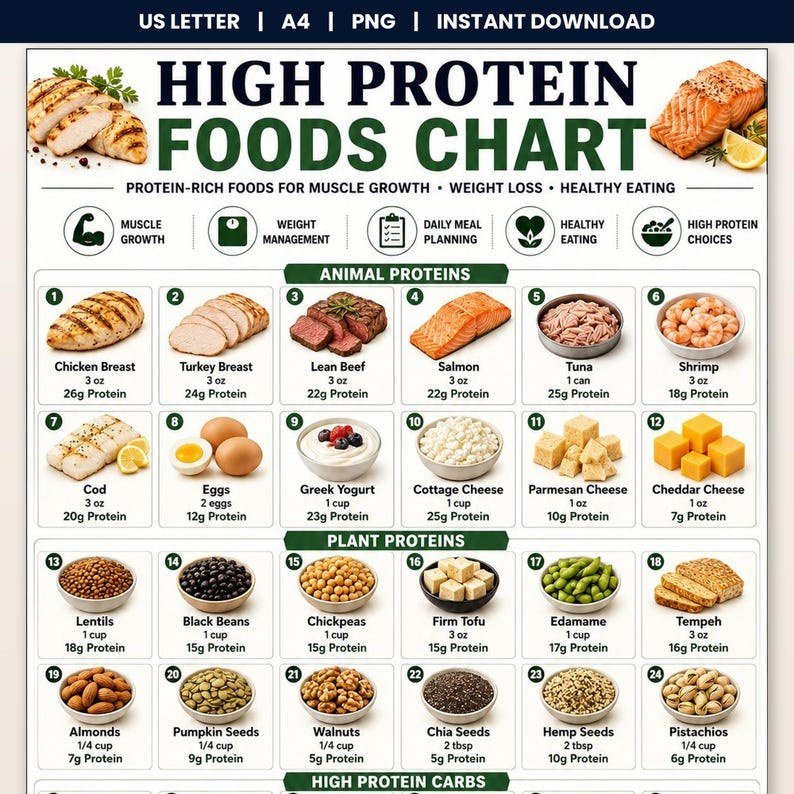
The breakfast chart tells you what to make. It doesn’t tell you how much protein is in it. For that, I went to the second printable, the High Protein Foods Chart. It lists 36 foods in five groups: animal proteins, plant proteins, high protein carbs, and protein snacks and drinks. Each has a serving size and grams of protein printed next to it.
Not all 36 are breakfast foods. Here are the ones that show up on the breakfast chart, with the figures exactly as printed.
| Breakfast food | Serving on the chart | Protein on the chart |
|---|---|---|
| Eggs | 2 eggs | 12 g |
| Greek yogurt | 1 cup | 23 g |
| Cottage cheese | 1 cup | 25 g |
| Turkey breast | 3 oz | 24 g |
| Chicken breast | 3 oz | 26 g |
| Salmon | 3 oz | 22 g |
| Black beans | 1 cup | 15 g |
| Chickpeas | 1 cup | 15 g |
| Oats | 1 cup | 10 g |
| Whole grain bread | 2 slices | 8 g |
| Quinoa | 1 cup | 8 g |
| Milk | 1 cup | 8 g |
| Kefir | 1 cup | 9 g |
| Peanut butter | 2 tbsp | 8 g |
| Almonds | 1/4 cup | 7 g |
| Walnuts | 1/4 cup | 5 g |
| Chia seeds | 2 tbsp | 5 g |
| Hemp seeds | 2 tbsp | 10 g |
| Pumpkin seeds | 1/4 cup | 9 g |
| Cheddar | 1 oz | 7 g |
A few things jump out once you see the numbers side by side.
Yogurt and cottage cheese beat eggs, cup for cup. Two eggs come to 12 grams on the chart. A cup of Greek yogurt is 23 grams and a cup of cottage cheese is 25. That’s why the chart’s quickest breakfasts lean so hard on those two. If eggs are your usual and you’re still hungry by mid-morning, adding a spoon of cottage cheese to the scramble, like the chart’s mushroom cottage cheese eggs, is the easiest fix.
Toppings add up. Walnuts, chia and almonds look small next to yogurt, but a quarter cup of almonds is 7 grams and two tablespoons of hemp seeds are 10. Hemp seeds are the surprise on the list. They’re soft, they don’t need chewing like nuts, and they disappear into oats or yogurt.
Grains help a little. Oats are 10 grams per cup on the chart, and two slices of whole grain bread are 8. Not a lot alone, but more than many people expect. MedlinePlus makes the same point, that whole-grain foods have more protein than refined grain products, so swapping white toast for whole-grain is a small, free win.
Leftovers count. Three ounces of chicken or turkey sits around 24 to 26 grams. A few slices of last night’s roast chicken in a breakfast wrap do more than any protein bar.
The foods chart also has a short list of daily protein tips along the side: include protein at every meal, choose lean protein sources, combine plant proteins, stay hydrated, and choose whole, minimally processed foods. It also carries a clear footer saying it’s for education only and not medical advice. That’s a good, sober way to present it, and the figures are general averages. Labels on your own yogurt or bread will differ a bit by brand.
If you’d like the whole protein list for other meals too, with weight loss in mind, our high protein food list for weight loss goes through it food by food.
A Worked Week of High Protein Breakfasts
Fifty ideas is a lot to choose from at 7am. So here’s one way to turn the chart into a week, mixing fast weekday breakfasts with one or two bigger ones. The protein totals are rough and added up from the foods chart figures above, so treat them as a guide, not a lab result. Your own portions and brands will change them.
| Day | Breakfast from the chart | What goes in the bowl or on the plate | Rough protein from the foods chart |
|---|---|---|---|
| Monday | Apple walnut overnight oats | 1 cup oats, 1 cup Greek yogurt, apple, 1/4 cup walnuts | About 38 g (10 + 23 + 5) |
| Tuesday | Cottage cheese with berries and almonds | 1 cup cottage cheese, berries, 1/4 cup almonds | About 32 g (25 + 7) |
| Wednesday | Egg avocado toast | 2 eggs, 2 slices whole grain bread, avocado | About 20 g (12 + 8) |
| Thursday | Banana peanut Greek yogurt bowl | 1 cup Greek yogurt, banana, 2 tbsp peanut butter | About 31 g (23 + 8) |
| Friday | Turkey egg breakfast wrap | 2 eggs, 3 oz turkey breast, spinach, tortilla | About 36 g plus the tortilla (12 + 24) |
| Saturday | Banana cottage cheese pancakes | Eggs, oats and cottage cheese in the batter | Depends on the recipe you use |
| Sunday | Salmon avocado breakfast bowl | 3 oz salmon, 1 egg, greens, avocado | About 28 g (22 + half of 12) |
A few notes on how this week works in practice.
Monday is made on Sunday night. Stir the oats, yogurt and chopped apple in a jar, put the walnuts on top in the morning so they stay crunchy. A cup of oats and a cup of yogurt is a big jar. If that’s too much for you, halve both and you’re still near 20 grams.
Tuesday takes two minutes. It’s straight from the quick and simple group. If you don’t like the texture of cottage cheese, blend it smooth with the berries and it turns into something closer to a thick yogurt.
Wednesday is the lowest day, and that’s fine. Two eggs on toast is a perfectly good breakfast at around 20 grams. Stir a spoon of cottage cheese into the eggs, or add a slice of turkey, if you want it higher.
Friday uses a batch. If you made the turkey egg wraps earlier in the week and froze them, this is a reheat. Wrap each one in foil and warm it in the oven, or in a microwave out of the foil.
The weekend is for cooking. The pancakes take longer than anything else on the chart, so they suit a slow Saturday. The chart doesn’t give a recipe, and protein varies a lot by recipe, so I’ve left that row without a number. Sunday’s salmon bowl is a good use of leftover fish from a weekday dinner.
A simple shopping list covers the whole week: eggs, a big tub of plain Greek yogurt, a tub of cottage cheese, oats, whole grain bread, tortillas, a pack of sliced turkey breast, one salmon fillet, peanut butter, walnuts, almonds, apples, bananas, berries, avocado and spinach. That’s it.
If you want the rest of the day planned in the same style, our high protein meal plan lays out seven days of breakfast, lunch, dinner and snacks, and our high protein meal ideas give you 50 more meals to swap in later in the day.
- 36 high protein foods with a serving size and grams of protein for each
- Five groups: animal proteins, plant proteins, high protein carbs, and protein snacks and drinks
- Breakfast staples like eggs, Greek yogurt, cottage cheese, oats, milk, kefir and peanut butter
- Daily protein tips and a clear not-medical-advice footer
- US Letter and A4 print sizes shown in the listing
- Instant download · Print at home · US Letter · A4
Use code BLOG10 for 65% OFF at Etsy checkout!
How Much Protein a Breakfast Really Needs
This is the part most breakfast lists skip. How much protein should a breakfast actually have? The honest answer is that there isn’t one official breakfast number, but there are useful daily figures to work from.
Start with the daily amount. Harvard’s Nutrition Source gives the standard Recommended Dietary Allowance as 0.8 grams of protein per kilogram of body weight. It puts that in plain terms too: just over 7 grams for every 20 pounds of body weight. For a 140-pound person that’s about 50 grams a day, and for a 200-pound person about 70 grams. It’s worth knowing that Harvard describes this as a minimum, not a target for everyone. Whether you need more, for example because you’re older or very active, is a question for your doctor or a dietitian.
Then think in thirds. If you need about 50 to 70 grams in a day, a breakfast of 20 to 30 grams covers a good share of it. Looking back at the worked week, every day except the pancakes lands somewhere in that range, using ordinary foods.
You don’t need a perfect amino acid mix at every meal. MedlinePlus explains that the body can’t store some of the amino acids it needs, so you need them from food, but it also says you don’t need to eat them all at every meal. The balance across the whole day matters more. That takes some pressure off. If breakfast is yogurt and fruit, and lunch is a bean salad, the day still works.
Protein comes in a package. Harvard makes a point I find useful when choosing breakfast foods. When you eat protein, you also eat whatever comes with it, the fats, fiber, sodium and so on. Its own example compares a 4-ounce ham steak, with 22 grams of protein but also about 1,500 milligrams of sodium, with a cup of cooked lentils, which has about 18 grams of protein and 15 grams of fiber with almost no sodium or saturated fat. That’s why the breakfast chart leans on eggs, yogurt, cottage cheese, beans and fish rather than bacon and sausage. Both are protein. Only one comes with a pile of salt.
A quick way to count without a calculator. MedlinePlus says 1 ounce of meat, poultry or fish has about 7 grams of protein. It also lists other foods that count as roughly an ounce of protein: one egg, a quarter cup of tofu, or half a cup of cooked beans. So a breakfast of two eggs plus a few slices of turkey is easy to estimate in your head without a chart at all.
Watch what comes with it. The most common way a high protein breakfast goes wrong is the extras. Flavored yogurt and granola can add a lot of sugar. Processed breakfast meats add a lot of salt. Protein bars can be fine in a pinch, and the foods chart lists one at 20 grams, but they’re best kept for days when there’s no time for anything else.
And keep it realistic. A breakfast you’ll actually eat beats a perfect one you won’t. If 30 grams feels like a lot, start by adding one protein food to what you already eat. A spoon of peanut butter on toast. A pot of yogurt beside the coffee. An extra egg. Then build from there.
If you’re using a GLP-1 medicine and appetite is low in the mornings, our GLP-1 diet meal plan has a week of smaller, high protein meals that may be easier to manage.
If you live with type 2 diabetes, these easy diabetic breakfast ideas use the same protein first approach with a plate guide for the carbs.
Frequently Asked Questions
What are the best high protein foods for breakfast?
Eggs, Greek yogurt, cottage cheese, lean turkey or chicken, salmon, beans, milk, kefir, nuts and seeds are all easy breakfast proteins. On the High Protein Foods Chart, a cup of cottage cheese has 25 grams, a cup of Greek yogurt 23 grams and two eggs 12 grams.
How much protein should I eat at breakfast?
There is no single official breakfast figure. Harvard’s Nutrition Source gives a daily minimum of 0.8 grams per kilogram of body weight, about 50 grams for a 140-pound person. A breakfast of 20 to 30 grams covers a good share of that. Ask your doctor or a dietitian if you have kidney disease or another reason to limit protein.
Is two eggs enough protein for breakfast?
Two eggs come to about 12 grams on the protein chart. That’s a fine breakfast, but if you want more, add whole-grain toast, a spoon of cottage cheese in the scramble, or a slice of turkey, which can take it past 20 grams.
What is a quick high protein breakfast without eggs?
Greek yogurt with banana and walnuts, cottage cheese with berries and almonds, or overnight oats made with yogurt all take a few minutes. A black bean breakfast bowl or a peanut butter banana toast also works if you don’t eat eggs.
Do I need protein shakes for a high protein breakfast?
No. Ordinary foods like yogurt, cottage cheese, eggs and leftover chicken reach 20 to 30 grams easily. Shakes and bars can help on rushed days, but whole foods also give you fiber and other nutrients, which Harvard calls the protein package.
This guide is for general wellness and is not medical advice. Check with your doctor before starting a new routine.
Related Guides
- High Protein Food List for Weight Loss
- High Protein Meal Plan
- High Protein Meal Ideas
- GLP-1 Diet Meal Plan
Sources
Sources: Harvard T.H. Chan School of Public Health, The Nutrition Source: Protein, MedlinePlus (NIH), Protein in diet
 Diet & Food ListsMediterranean Diet for Seniors: A Simple Guide With an Eat, Limit, Avoid List and a 7 Day Plan
 Diet & Food ListsHigh Protein Foods for Muscle Gain: How Much You Need, the Best Picks per Meal and a Worked Training Day
 Diet & Food ListsLow Sodium Dinner Ideas: 24 DASH Style Dinners, a Sodium Budget per Plate and Sauce and Seasoning Swaps