
A Christmas charcuterie board is the easiest festive spread you can serve: one big board of meats, cheeses, crisps, fruit and sweets that guests graze on while you stay out of the kitchen. You do not need to cook a full menu. You need a short, balanced shopping list, a simple formula for what goes together, and a board plan you can build in about 20 minutes.
The mistake most hosts make is buying at random. The board ends up heavy on cheese, short on crunch, and missing the fresh and sweet bites that make it feel like Christmas. A category plan fixes that before you spend anything: pick a few items from each group, keep the colours red, green and white, and let one or two festive shapes, like a small tree or a star, do the decorating work.
In this guide you will get the 12 categories from our printable Christmas board builder chart, with example picks for each one, the easy board formula the chart is built on, the board rules that make a spread look festive instead of crowded, a size guide for small and medium groups, and a worked example that builds a complete board for 6 guests step by step. You will also find the matching printable chart from SoftoTech Print Studio, so your Christmas board lives on paper instead of in your memory.
In this guide:
- Why a Christmas Board Works So Well
- The 12 Categories on the Chart
- The Easy Christmas Formula
- Christmas Board Rules
- How Much to Serve: The Board Size Guide
- Worked Example: A Board for 6 Guests
- Serve Smart: Timing and Food Safety
- Frequently Asked Questions


The printable from this guide
Christmas Charcuterie Board Builder Printable
- 104 festive ideas in 12 categories, from festive meats and holiday cheeses to Christmas cookies, candy and the finishing touches that make a board look complete
- The plan in this guide comes from this chart: an easy board formula, six board rules, ready-made festive combos, a board size guide and a shopping checklist
- Includes a free Christmas Hosting Countdown Planner, in A4 and US Letter
- Print sizes US Letter, A4 and A5, as PDFs plus a 300 DPI PNG
- Instant download · Print at home · US Letter · A4 · A5
Use code BLOG10 for 65% OFF at Etsy checkout!
Get the Christmas Board Builder on Etsy →
Instant download · Print at home
Why a Christmas Board Works So Well
A Christmas charcuterie board suits the way people actually gather in December. Guests arrive at different times, nobody wants a formal sit-down start, and the host has enough to do without plating individual starters. A board is ready when the first guests walk in, it refills in minutes, and it covers picky eaters, vegetarians and sweet tooths on the same surface, as long as you plan the categories instead of improvising them.
It also suits a December budget. A board built from a category list uses small amounts of many things rather than a large amount of one expensive thing. Two good cheeses, two meats, and a spread of affordable crisps, fruit, vegetables and cookies look generous without a roast-sized receipt. If you are new to boards in general, start with our charcuterie board ideas for beginners for the basic building order, then use this guide for the festive layer.
One honest note belongs at the start: a board is a grazing spread, not a full meal, unless you add warm and filling bites on purpose. The chart in this guide includes a warm appetizers category and a festive savories category for exactly that reason. Add one warm item and one filling savory, and a board happily covers an evening of drinks and conversation.
The 12 Categories on the Chart
The printable chart in this guide, titled Christmas Charcuterie Board Builder, collects 104 festive ideas in 12 categories, grouped so a shopping list writes itself: pick two to four items from the categories you need and skip the rest. The table below follows the chart’s own category order, with the style note from the chart and a few example picks for each group, in plain words.
| # | Category (from the chart) | Style | Example picks |
|---|---|---|---|
| 1 | Festive Meats | Smoky and savory | Honey ham, pepper salami, rosemary chicken, smoked sausage |
| 2 | Holiday Cheeses | Creamy and rich | Cranberry Wensleydale, truffle brie, garlic Boursin, smoked cheddar |
| 3 | Christmas Crisps | Crisp and buttery | Butter crackers, parmesan stars, sesame thins, pretzel knots |
| 4 | Winter Fruit | Juicy and bright | Clementines, green grapes, kiwi slices, pear cubes, dried cherries |
| 5 | Festive Veggies | Fresh and crunchy | Cucumber stars, broccoli florets, sugar snaps, bell pepper, celery ribbons |
| 6 | Party Skewers | Colourful and savory | Caprese trees, cheese grapes, ham and pineapple, salami pickles |
| 7 | Warm Appetizers | Golden and hearty | Mini sausages, cheese puffs, potato bites, meatball cups, cheese pinwheels |
| 8 | Festive Savories | Rich and filling | Salmon blinis, mini vol-au-vents, turkey sliders, spinach tartlets |
| 9 | Christmas Cookies | Sweet and spiced | Gingerbread men, linzer cookies, snowball cookies, sugar stars |
| 10 | Holiday Candy | Sweet and minty | Candy canes, peppermint bark, chocolate Santas, mint truffles |
| 11 | Winter Desserts | Rich and indulgent | Yule log slices, mince pies, panettone cubes, trifle cups, fruitcake bites |
| 12 | Festive Finishes | Pretty and colourful | Pomegranate jewels, sugared cranberries, candied rosemary, mint sprigs, orange curls |
You do not need all 12 categories on one board. A small board uses six or seven of them well. The categories that do the most work are meats, cheeses, crisps and winter fruit, because they set the savory base and the colour. The finishes category is the cheapest decoration you will ever buy: a handful of pomegranate seeds and a few sugared cranberries scattered at the end make a plain board read as Christmas. For deeper pairing help inside the cheese category, our cheese pairing guide matches 36 cheeses with fruit, nuts, honey, jam and crackers.

The year-round charcuterie set
Charcuterie Grazing Board Builder Bundle: 9 Printable Guides
- Nine matching board builder guides in one bundle: meat, meat and cheese pairing, condiments, crackers and bread, fruit, nuts and extras, olives and pickles, and a butter board guide
- Use it with the Christmas chart in this guide when a board needs deeper pairing help, or for grazing boards in every other season
- Print sizes US Letter, A4 and A5, instant download
- Instant download · Print at home · US Letter · A4 · A5
Use code BLOG10 for 65% OFF at Etsy checkout!
Get the Charcuterie Bundle on Etsy →
Instant download · Print at home
The Easy Christmas Formula
The chart reduces the whole board to one formula for a balanced bite: 2 savory, 1 cheese, 1 fresh, 1 sweet. Read it as a plate check rather than a building order. When a guest fills a small plate, they should be able to take something savory, something cheesy, something fresh and something sweet without hunting. If one of the four is missing, the board feels off, even when it looks full.
Use the formula in reverse when you shop. For every cheese you add, plan two savory items to sit near it. For every sweet cluster, plan a fresh item beside it, because fruit resets the palate between rich bites. The chart also lists ready-made festive combos built on the same balance, small three-item clusters you can copy directly, such as a soft truffle cheese with pear and walnut, honey ham with cheddar and mustard, or a salmon blini with dill and lemon. Copying two or three proven clusters is faster than inventing pairings on the day, and it is how a first board ends up tasting planned.
For bigger groups, scale the formula, not the variety. Eight guests do not need sixteen categories; they need more of the same balanced picks, plus a second board or a refill tray for the crisps and fruit that disappear first. Our guide to how much charcuterie per person gives exact portions for groups from 2 to 50 when your party outgrows the size guide below.
Christmas Board Rules
The chart prints six short rules, and they are worth following in order. First, work in red, green and white. Christmas colour does most of the styling for you: red from cured meats, berries and pepper, green from herbs, grapes and vegetables, white from cheeses and crisps. Second, shape one or two foods into trees. A small tree of stacked cheese slices, cucumber or skewers becomes the centrepiece guests photograph, and it costs nothing extra.
Third, mix soft and crisp on every part of the board, so no corner is all soft cheese or all crackers. Fourth, place the large bites first: cheeses, meat folds and warm items go down before the small fillers, because the layout is much harder to fix afterwards. Fifth, keep sweets in clusters instead of scattering them through the savory side; a cookie and candy corner reads as dessert and keeps chocolate away from the pickles. Sixth, fill the gaps with colour at the very end, using the finishes category: berries, pomegranate, herb sprigs and citrus curls turn empty board corners into part of the design.
Two layout habits help as well. Put anything drippy or crumbly, like a soft cheese or a trifle cup, in a small ramekin or on its own corner so it does not soak the crisps. And build the board where it will be served if you can; a full Christmas board is heavy and awkward to carry through a doorway.
How Much to Serve: The Board Size Guide
The chart’s size guide keeps small parties simple. For 2 to 4 guests, plan 5 to 6 food types and about 16 to 24 bites in total variety across the board. For 5 to 8 guests, plan 6 to 8 food types and about 30 to 48 bites. The same guide scales up in two more steps for parties of 9 to 12 and 13 to 20 guests, adding a couple more food types and a larger bite count at each step. Bites here means the count of pieces a guest can pick up across the whole board, not a per-person allowance, so treat the guide as a shopping compass: a board for 6 should look like six to eight categories with a few dozen good pieces, refilled once if the evening runs long.
Three practical notes sit behind those numbers. First, appetites shrink when a main meal follows, so the lower end of each range is right for a board before dinner, and the upper end is right when the board is the evening. Second, crisps and fruit run out first and cheese runs out last, so buy the fresh and crisp categories generously and the cheese category modestly. Third, a board for more than 8 guests is easier as two medium boards than one giant one: food stays fresher, guests are not queuing at one spot, and the second board can carry the sweet categories as a dessert board. If you are choosing the physical board itself, our charcuterie board size guide matches board dimensions to guest counts.
Worked Example: A Board for 6 Guests
Here is the chart used end to end, for a real situation: six guests, drinks at 6 pm, no main meal planned, one medium wooden board and a host who wants to be finished by 5:30. The size guide says 6 to 8 food types and roughly 30 to 48 bites, so the plan picks 8 categories and skips skewers, candy, desserts and finishes as a separate category, folding a few finish items into the gaps instead.
The shopping list, by category: festive meats: honey ham and pepper salami. Holiday cheeses: one cranberry Wensleydale and one small truffle brie. Christmas crisps: butter crackers and pretzel knots. Winter fruit: clementines and green grapes. Festive veggies: cucumber and bell pepper. Warm appetizers: one tray of cheese pinwheels, baked last. Festive savories: a pack of salmon blinis. Christmas cookies: gingerbread men and snowball cookies. Finishes for the gaps: a small tub of pomegranate seeds and a few mint sprigs. That is the whole shop: ten items plus finishes, nothing exotic, all from one supermarket run.
The build, in order: the two cheeses go down first, opposite each other, the brie with a small knife beside it. The ham is folded into loose rosettes in a curve beside the Wensleydale, and the salami is fanned in a line beside the brie, which covers the red and white colour rule in the first five minutes. Crackers and pretzel knots fill the two long edges, kept dry and away from the fruit. Clementine segments and grape clusters go into the middle gaps for the fresh element, cucumber stars and pepper strips make a green border on one side, and the cucumber offcuts are stacked into one small tree shape at the centre, the single festive shape on this board. The blinis sit in a neat row near the ham, because the chart’s salmon, dill and lemon combo cluster works beside savory meats. Cookies get their own corner at one end, clustered as the rules say, and the pinwheels come out of the oven at 5:55 and go straight onto the warm corner in a small heatproof dish. Pomegranate seeds are scattered last, over the cheese and into the gaps.
Why this board works: every plate a guest fills can follow the formula, 2 savory, 1 cheese, 1 fresh, 1 sweet, without a single extra purchase. The one warm item makes it feel like an evening spread rather than a snack. The total timed build was under 25 minutes, most of it folding ham, and the refill plan is written on the shopping list itself: more crackers, more clementines, nothing else. That is the point of building from a chart: the decisions happen once, on paper, not six times in the shop.
Serve Smart: Timing and Food Safety
The chart’s serving notes are short and sensible: keep chilled foods cold, and serve hot bites hot. Food safety guidance for parties says the same thing with numbers attached. Perishable items like sliced meats, soft cheeses and blinis should not sit at room temperature for more than 2 hours in total, and less in a warm room, so put the board out close to arrival time rather than an hour before, and plan a mid-evening moment to return leftovers to the fridge instead of leaving them out all night.
A few habits make this easy. Keep refill portions in the fridge and top the board up in small amounts, so most of the food spends the evening cold rather than on the table. Set the warm appetizers to bake in two small batches instead of one large one, so the second batch is fresh halfway through. Put small tongs or cocktail sticks at the board so guests are not handling shared food. And if anyone at the table has a food allergy, keep one category physically separate, for example nuts and nut-based sweets on their own small plate at the end of the board, and tell that guest where it is. When the evening ends, refrigerate leftovers promptly and be cautious with anything that sat out: when in doubt, throw it out.
Frequently Asked Questions
What should I put on a Christmas charcuterie board?
Start with the four groups every board needs: savory bites, cheese, something fresh and something sweet. A reliable Christmas set is two festive meats, two holiday cheeses, crackers or crisps, winter fruit like clementines and grapes, one warm appetizer, and a sweet corner of Christmas cookies, finished with red and green touches like pomegranate seeds and herb sprigs.
How many items should a Christmas board have for 6 guests?
The size guide on our printable chart suggests 6 to 8 food types and about 30 to 48 bites for 5 to 8 guests. For 6 guests that means roughly two meats, two cheeses, one or two crisp options, fruit, vegetables, one warm item and one sweet option, with a fridge refill of crisps and fruit ready if the evening runs long.
How far ahead can I build a Christmas charcuterie board?
Build the base 1 to 2 hours ahead and keep it covered in the fridge: cheeses, folded meats, vegetables and sturdy fruit all hold well. Add crisps, cookies and warm appetizers in the last 15 minutes so they stay crisp and hot, and scatter delicate finishes like pomegranate seeds and mint just before serving.
How long can a charcuterie board sit out at a party?
Food safety guidance for parties is to keep perishable foods at room temperature for no more than 2 hours in total. Put the board out close to when guests arrive, refill in small amounts from the fridge, serve warm items hot in small batches, and refrigerate leftovers promptly at the end of the evening.
What size is the printable Christmas board builder chart?
The SoftoTech Print Studio Christmas Charcuterie Board Builder is an instant download that prints at home in US Letter, A4 and A5 sizes, as PDFs plus a 300 DPI PNG. It covers 104 festive ideas in 12 categories, with a board formula, board rules, festive combos, a size guide and a shopping checklist, plus a free Christmas Hosting Countdown Planner.
This guide is for general wellness and is not medical advice. Check with your doctor before starting a new routine.
Planning the holiday before this one? Our Thanksgiving charcuterie board guide builds a fall grazing board from 104 ideas in 12 categories, plus a leftovers board for the next day.
The sweet board that follows a holiday meal is covered in our dessert charcuterie board guide, with balance rules for chocolate, cookies, fruit and dips and a worked birthday board.
Related Guides
- Charcuterie Board Ideas for Beginners
- Cheese Pairing Guide
- How Much Charcuterie Per Person: Portions for 2 to 50 Guests
- What Size Charcuterie Board Do I Need?
- Free Printables
Sources
Sources: FoodSafety.gov: Keep Food Safe, U.S. Food and Drug Administration (FDA): Buy, Store and Serve Safe Food
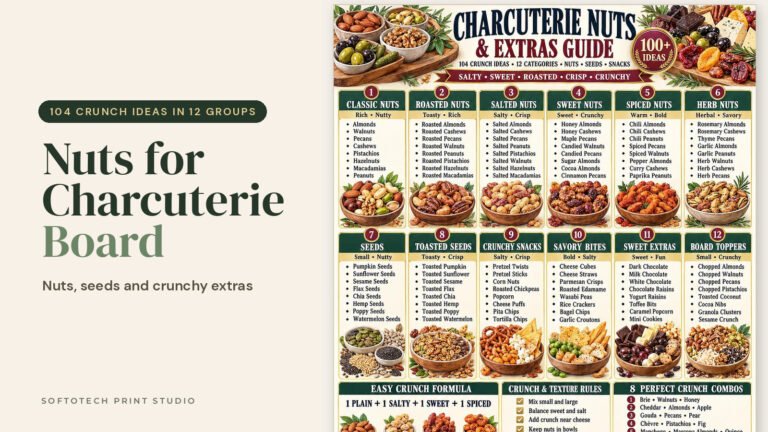 Charcuterie & EntertainingNuts for Charcuterie Board: 104 Crunchy Ideas in 12 Groups, 8 Pairings and How Much to Buy
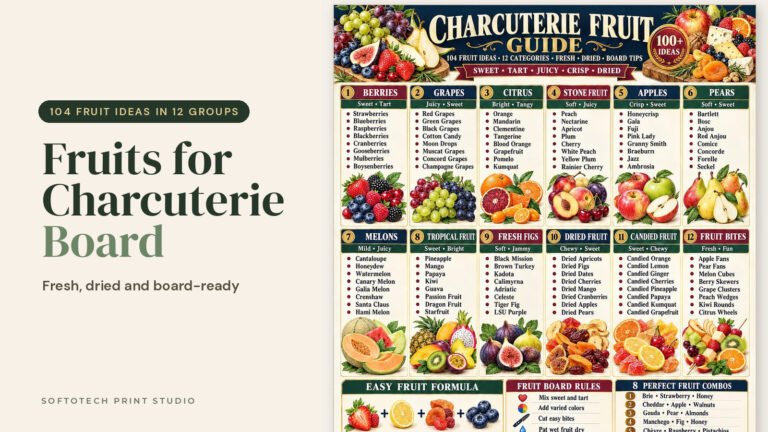 Charcuterie & EntertainingFruits for Charcuterie Board: 104 Ideas in 12 Groups, Pairings and Quantities
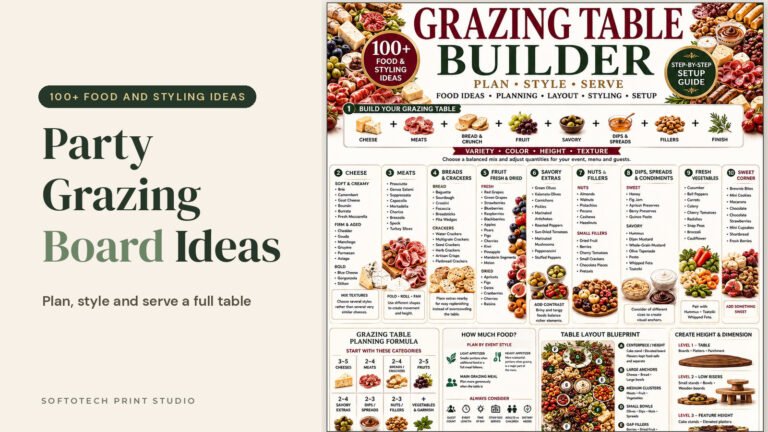 Charcuterie & EntertainingParty Grazing Board Ideas: 100+ Foods and a Simple Setup Plan