
A dumbbell leg workout at home needs only one pair of dumbbells, a clear patch of floor and a short list of moves you can repeat: squats and lunges for the front of the legs, hip hinges and hip thrusts for the glutes and the back of the legs, and a carry to finish. You do not need a gym, a rack or a leg press machine to train your legs properly at home.
Dumbbells suit leg training at home because the same pair works for every pattern: you hold them at your shoulders for squats, by your sides for lunges and step-ups, and in both hands for deadlift style hinges. Health guidance for adults, including the CDC physical activity guidelines and the National Institute on Aging, recommends muscle strengthening activities on two or more days a week, and a simple leg day covers the largest muscles in the body in one session: the thighs, glutes and calves that carry you up stairs, out of chairs and along every walk.
In this guide you will get the 16 moves from our printable dumbbell glutes and legs chart, grouped by what they train, simple form cues for the moves to learn first, a beginner leg day routine that puts the chart together in about 25 minutes, a worked example of one first week with the chart, help choosing your dumbbell weight, and clear safety rules for knees, hips and lower back. You will also find the matching printable chart from SoftoTech Print Studio, so your leg day lives on your wall instead of in your memory.
In this guide:
- Why Leg Day Matters at Home
- The 16 Dumbbell Leg Moves on the Chart
- Form First: The Moves to Learn First
- The Beginner Leg Day Routine
- Worked Example: One Week With the Chart
- How to Choose Your Dumbbell Weight
- Make It Easier or Harder
- Frequently Asked Questions

The printable from this guide
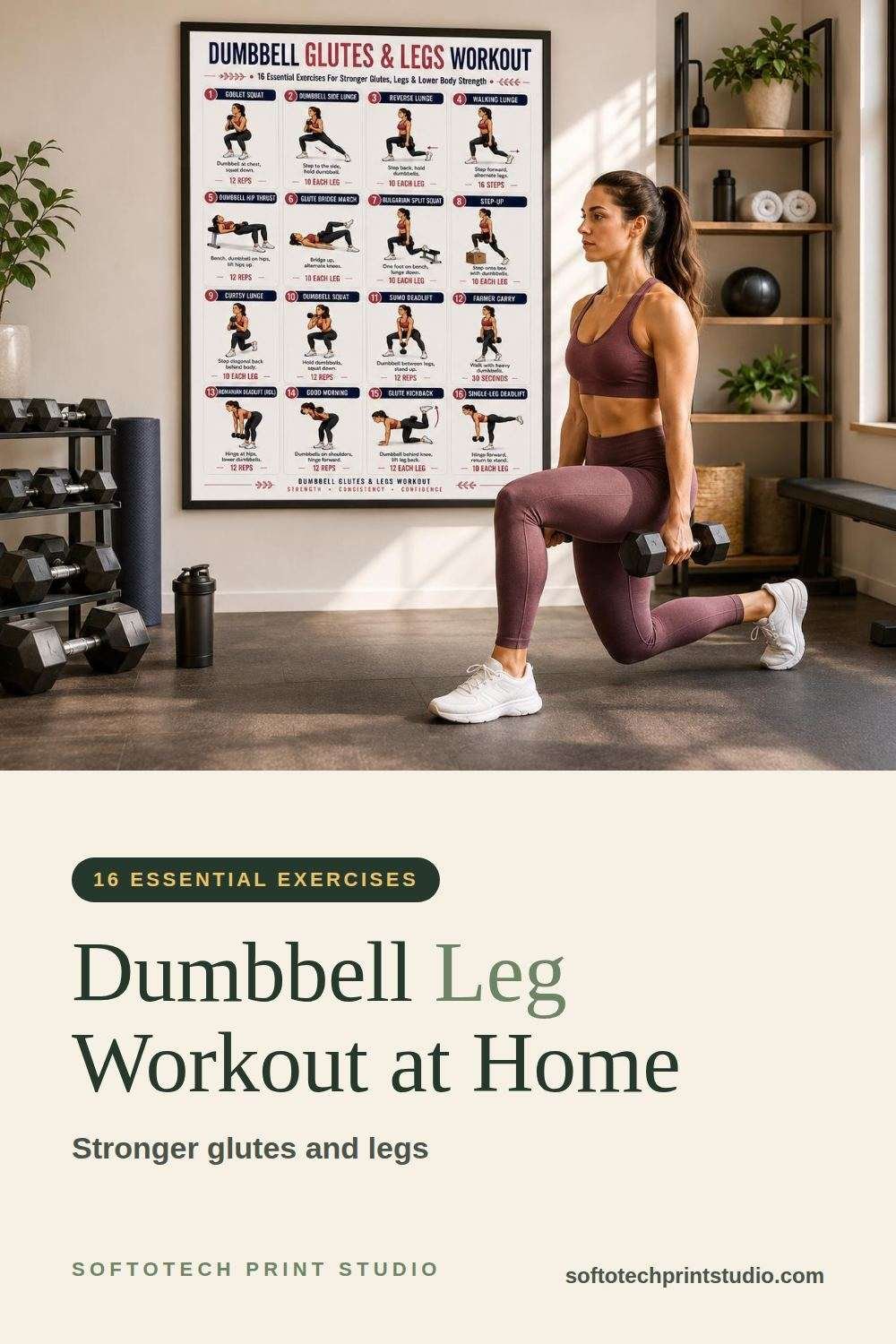
Dumbbell Glutes and Legs Workout Printable Poster
- 16 essential exercises on one wall chart, from the goblet squat and Romanian deadlift to the hip thrust and single-leg deadlift, each tile with a picture, a short cue and its printed reps
- The routine in this guide is built from this chart: goblet squat, Romanian deadlift, glute bridge march, step-up, reverse lunge and farmer carry, all with the chart printed reps
- Print sizes US Letter, A4 and A5, as a PDF plus a 300 DPI PNG
- Instant download · Print at home · US Letter · A4 · A5
Use code BLOG10 for 65% OFF at Etsy checkout!
Get the Glutes and Legs Chart on Etsy →
Instant download · Print at home
Why Leg Day Matters at Home
Legs do the work of daily life. Standing up from a low sofa, climbing stairs, carrying shopping, getting in and out of a car and keeping your balance on uneven ground all come from the same muscles a leg day trains: the quadriceps at the front of the thigh, the hamstrings at the back, the glutes, and the calves. When those muscles are stronger, the everyday tasks feel easier, and that is true at every age.
The other reason leg day gets skipped is also the reason a chart helps: choice overload. Sixteen good moves exist on our chart alone, and trying to do all of them in one session is a mistake beginners make once. A leg day works better as a small, repeatable selection: one squat pattern, one hinge pattern, one single leg move and one glute move, done well, twice a week. The routine below is built exactly that way. If you already follow our full body dumbbell workout at home, this leg day can replace one of its lower body sessions when you want extra focus on glutes and legs.
One honest warning belongs at the start: knees and lower backs complain when leg training is rushed. Depth, load and speed all come after form. Every move in this guide can be done to a chair, a step or a partial range while you learn it, and a smaller, clean movement beats a deep, wobbly one at every stage of the first month.
The 16 Dumbbell Leg Moves on the Chart
The printable chart in this guide, titled Dumbbell Glutes and Legs Workout, shows 16 essential exercises for stronger glutes, legs and lower body strength. The table below follows the chart’s own order, names, cues and printed reps, with a short plain English note on what each move trains.
| # | Exercise (from the chart) | Chart cue | Reps (from the chart) | What it trains |
|---|---|---|---|---|
| 1 | Goblet squat | Dumbbell at chest, squat down | 12 reps | Front of the legs, glutes: the first move to learn |
| 2 | Dumbbell side lunge | Step to the side, hold dumbbell | 10 reps each leg | Inner and outer thighs, glutes, side to side strength |
| 3 | Reverse lunge | Step back, hold dumbbells | 10 reps each leg | Legs and balance, one side at a time (beginner friendly single leg move) |
| 4 | Walking lunge | Step forward, alternate legs | 16 steps | Legs, glutes and balance in motion (later skill) |
| 5 | Dumbbell hip thrust | Bench, dumbbell on hips, lift hips up | 12 reps | Glutes, the strongest glute move on the chart |
| 6 | Glute bridge march | Bridge up, alternate knees | 10 reps each leg | Glutes and trunk control, floor based and joint friendly |
| 7 | Bulgarian split squat | One foot on bench, lunge down | 10 reps each leg | Front leg strength and balance (later skill) |
| 8 | Step-up | Step onto box with dumbbells | 10 reps each leg | Legs and glutes, the stair climbing pattern |
| 9 | Curtsy lunge | Step diagonal back behind body | 10 reps each leg | Glutes and outer hips, diagonal pattern |
| 10 | Dumbbell squat | Hold dumbbells, squat down | 12 reps | Front of the legs, two dumbbell squat variation |
| 11 | Sumo deadlift | Dumbbell between legs, stand up | 12 reps | Glutes, inner thighs and back, wide stance hinge |
| 12 | Farmer carry | Walk with heavy dumbbells | 30 seconds | Grip, posture and trunk: walk tall with weights at your sides |
| 13 | Romanian deadlift (RDL) | Hinge at hips, lower dumbbells | 12 reps | Back of the legs and glutes: the hinge to master |
| 14 | Good morning | Dumbbells on shoulders, hinge forward | 12 reps | Back of the legs and back (later skill, light weight only) |
| 15 | Glute kickback | Dumbbell behind knee, lift leg back | 12 reps each leg | Glutes, one side at a time, on all fours |
| 16 | Single-leg deadlift | Hinge forward, return to stand | 10 reps each leg | Balance, glutes and back of the leg (later skill) |
Be honest about the order: the chart is a full library, not a week one checklist. A sensible beginner path starts with the goblet squat, the glute bridge march, the Romanian deadlift and the step-up. Add the reverse lunge, hip thrust and farmer carry over the next few weeks. The Bulgarian split squat, single-leg deadlift, walking lunge and good morning are later skills to learn slowly, with a chair or wall nearby for balance.

The full dumbbell set
Full Body Dumbbell Workout Bundle: 5 Printable Posters
- Five matching dumbbell charts in one bundle covering arms, legs and glutes, back, chest and core, all in the same clear tile style with pictures, cues and reps
- The bundle includes a glute and leg workout poster that pairs with the leg day in this guide, plus full body, arm toning, lower abs and core charts for the rest of the week
- Print sizes US Letter and A4, instant download
- Instant download · Print at home · US Letter · A4
Use code BLOG10 for 65% OFF at Etsy checkout!
Get the Dumbbell Bundle on Etsy →
Instant download · Print at home
Form First: The Moves to Learn First
The goblet squat. Hold one dumbbell vertically at your chest, both hands under the top end, elbows pointing down. Stand with feet about shoulder width apart, sit down between your heels, keep your chest tall and your knees tracking in line with your toes, then stand by pushing the floor away. The weight at your chest acts as a counterbalance, which is why most beginners find this easier to balance than a bodyweight squat. A chair behind you, tapped lightly at the bottom of each rep, is a good depth guide for the first weeks. This is the same squat pattern used in our kettlebell workout for beginners guide, so the two routines reinforce each other.
The Romanian deadlift. This is the hinge of the chart. Hold a dumbbell in each hand in front of your thighs, soften your knees a little, then push your hips back as if closing a car door with your bottom, letting the weights slide down the front of your legs while your back stays flat. Stop when you feel a strong stretch in the back of your legs, usually around mid shin, then stand by squeezing your glutes. If you feel this mainly in your lower back, the weight is travelling too far from your legs or your hips are not pushing back far enough.
The glute bridge march. Lie on your back, knees bent, feet flat, a light dumbbell resting across your hips if you want load. Lift your hips until your body forms a straight line from shoulders to knees, then lift one foot a few centimetres off the floor without letting your hips drop or roll, replace it, and lift the other. This teaches the glutes to work while the trunk stays still, a pattern your knees and back will thank you for in every lunge that follows.
The step-up. Face a sturdy step or low bench, one dumbbell in each hand or one held at your chest. Put your whole foot on the step, push through that foot to stand tall on the step without pushing off hard with the back leg, then lower slowly. The lowering half is where the control is built, so count two seconds down. Start with a low step: height is a progression, not a starting point.
Single leg work, when you are ready. The reverse lunge is the friendliest single leg move on the chart, because stepping backwards is easier to balance than stepping forwards. Hold a wall or chair back for the first weeks if you need it, there is no prize for wobbling. The Bulgarian split squat and single-leg deadlift come later still, and both are worth learning with bodyweight only first, even if the rest of your routine already uses dumbbells. Balance support is also the theme of our seated and standing work in the 20 minute no equipment home workout for beginners, which makes a good warm up before a leg session.
The Beginner Leg Day Routine
Put the chart together twice a week, with at least one rest day between sessions and never on two days in a row: legs need recovery more than most areas. Warm up with five minutes of easy movement first: a walk around the room, some bodyweight squats to a chair and a few hip hinges with no weight. Then work through the list below, resting 60 to 90 seconds between moves. Use a weight you could lift for two or three more good reps than the set asks for.
- Goblet squat: 2 sets at the chart’s 12 reps, chest tall, chair tap if needed.
- Romanian deadlift: 2 sets at the chart’s 12 reps, hips back, back flat.
- Glute bridge march: 2 sets at the chart’s 10 reps each leg, hips level.
- Step-up: 2 sets at the chart’s 10 reps each leg, slow two second lowering.
- Reverse lunge: 2 sets at the chart’s 10 reps each leg, chair or wall for balance if needed, added from week two.
- Farmer carry: 2 walks at the chart’s 30 seconds, tall posture, steady steps, to finish.
In week one, stop any set when your form slips, even if that is before the chart’s number: the chart reps are the target you build toward over the first weeks, not a test you must pass on day one.
The whole session takes about 25 minutes. Finish while your form still feels clean: the last good rep is the right place to stop, not the first sloppy one. From week three, if the sessions feel manageable, swap the step-up for the hip thrust on one day, or add the sumo deadlift as a second hinge. Change one thing at a time. On the days between leg sessions, an easy walk keeps blood moving through sore muscles without tiring them again, and our dumbbell arm workout for women covers the upper body on its own day so the week stays balanced.
Worked Example: One Week With the Chart
Here is how a first week looks for a beginner using the printable chart pinned above a home workout corner. The dumbbells are light, the chart is at eye level, and the rule for the week is written at the top of a notebook page: form first, depth and weight later.
On Monday, the first session covers only four moves: goblet squat, Romanian deadlift, glute bridge march and step-up. The goblet squat feels wobbly for the first set, then settles once a chair is placed behind as a depth target. The Romanian deadlift clicks once the weights are kept sliding along the thighs instead of drifting forward. The session takes 22 minutes, and one honest note goes in the notebook: left leg step-ups much weaker, keep the low step for both sides.
On Wednesday, the legs are still a little stiff from Monday, so the day is a walk and nothing else. That rest day is part of the plan, not a missed session: the chart gets a pencil note, legs twice a week, walk between.
On Friday, the same four moves run again, plus the farmer carry to finish. The squat depth improves because Monday’s practice is still fresh, and the bridge march hips stay level for the full second set. By Sunday the notebook shows two leg sessions, one clear observation and one plan: keep the same moves for week two, add the reverse lunge with a chair for balance, and change nothing else. That is a complete, successful first week, measured by control and consistency rather than by how heavy anything was.
How to Choose Your Dumbbell Weight
For leg work, most beginners can start a little heavier than for arm work, because the leg muscles are larger. As a rough starting point used by many beginner programs, a pair in the region of 3 to 6 kg each suits goblet squats and deadlift patterns for many women starting out, while lunges and step-ups often need the lighter end of that range, or bodyweight only, because one leg does the work. Treat these as starting ranges, not targets.
Two simple tests help more than any number. If you can goblet squat to a chair five times with your chest tall and your heels down, the weight is reasonable for squats. If your knees cave inward, your heels lift or you have to heave the weight up, it is too heavy for that move today, whatever it felt like in a deadlift. Adjustable dumbbells make this easier, because the same handles can be light for lunges and heavier for hinges. And if you are returning to exercise after a break, are pregnant, or have a knee, hip, back or blood pressure concern, check with your doctor or a physiotherapist before starting, and consider one session with a qualified coach to check your squat and hinge in person.
Make It Easier or Harder
Easier: use lighter dumbbells or bodyweight only, take the low end of every rep range, squat to a chair, use a lower step, hold a chair or wall for every lunge and single leg move, and rest longer between moves. A partial week still counts: two short, careful sessions teach your body more than one exhausting one.
Harder: only after three to four consistent weeks, add a third set of the main moves, slow the lowering phase of each rep to three seconds, or use a slightly heavier pair for the squat and hinge while keeping the lighter pair for lunges. Change one thing at a time, and never add weight and volume in the same week.
Safety rules: train on a firm, clear floor in shoes or bare feet with grip, never in socks on a smooth floor. Keep knees tracking in line with toes, stop a set if your form breaks down, and stop altogether for sharp pain in a knee, hip or the lower back, pain that travels into a leg, or dizziness. Next day muscle stiffness in the thighs and glutes is normal for new leg training and usually eases within two or three days; joint pain that lingers is not, and it is a sign to rest, lighten the load and get checked if it persists. This guide is general wellness information, not personal coaching or a treatment plan.
Frequently Asked Questions
What is a good dumbbell leg workout at home for beginners?
A good beginner leg day uses a small set of patterns done with light dumbbells: a goblet squat, a Romanian deadlift, a glute bridge variation and a step-up, with a reverse lunge added once balance improves. Two sessions a week of about 25 minutes, built from a fixed chart of moves, is a sensible starting point for most beginners.
How heavy should dumbbells be for leg workouts at home?
Many beginners start leg patterns with a pair around 3 to 6 kg each, using the lighter end, or bodyweight only, for lunges and step-ups where one leg does the work. These are rough starting ranges. The right weight is the one you can squat and hinge with your chest tall, heels down and knees tracking in line with your toes.
How often should I train legs with dumbbells?
Twice a week with at least one rest day between sessions suits most beginners, which fits the general guidance to do muscle strengthening activities on two or more days a week. Legs use the largest muscles in the body and usually need more recovery than arms, so never train them hard on two days in a row.
Can I build glutes with dumbbells at home?
Yes. Hip thrusts, glute bridge variations, Romanian deadlifts, sumo deadlifts and step-ups all load the glutes directly, and they are all on the chart in this guide. Beginners can progress for months at home by adding reps, adding a set and slowing the lowering phase of each move before heavier dumbbells are needed.
Why do my knees hurt during lunges and squats?
Common causes are knees caving inward, heels lifting, going deeper than your current mobility allows, or using a weight that is too heavy for the move. Squatting to a chair, using a lower step, holding support for lunges and lightening the load all help. Persistent or sharp knee pain is a sign to stop and get checked by a doctor or physiotherapist rather than train through it.
This guide is for general wellness and is not medical advice. Check with your doctor before starting a new routine.
Bodyweight first, dumbbells second: our leg workout for women guide covers 16 moves from sumo squats to Bulgarian split squats, plus a 16 move dumbbell chart.
For the glute focus, try this: our glute workout for women guide covers 16 cable machine moves plus a dumbbell home version, from kickbacks to hip thrusts.
Related Guides
- Kettlebell Workout for Beginners: A Simple Home Guide
- Full Body Dumbbell Workout at Home: 5 Day Plan for Beginners
- Dumbbell Arm Workout for Women (Toned Arms)
- 20-Minute No-Equipment Home Workout for Beginners
- Free Printables
Sources
Sources: CDC: Physical Activity for Older Adults, National Institute on Aging: Exercise and Physical Activity
 Home WorkoutsVibration Plate for Seniors: What It Can and Can’t Do, Who Should Avoid It, and a Safe 10 Minute Routine
 Home WorkoutsUpper Body Home Exercises: 20 Moves for Chest, Back, Shoulders and Arms, With a 25 Minute Workout
 Home WorkoutsCore Exercises for Women Over 50: 16 Gentle Moves, Standing First, With a 15 Minute Routine and a 4 Week Plan