
Leg workout for women is a search with a lot of noise in it, so let me keep this one simple. A good leg day at home does not need a gym, a rack or a long list of equipment. It needs a few moves done well, in the right order, with reps you can count and cues you can remember. The chart in this guide gives you 16 lower body exercises to tone legs and thighs, beginner friendly and low impact, and it prints at home so you can follow it on the floor without a phone in your hand.
The chart is called the Leg Flab Workout Poster, and it comes from SoftoTech Print Studio. It prints in US Letter and A4 sizes, and it is made for home workouts. The first 12 moves come with reps and a short cue each, like keep knees aligned or push through the heel, and those cues are the most useful part. A rep count tells you how many. A cue tells you how. Both matter, and this guide copies them as printed, so you can follow the chart without guessing.
One honest note before we start. The last four moves on this chart are Inner Thigh Lift, Skater Lunge, Calf Raise and Standing Quad Stretch, and their reps were cut off, so this guide names them by title only and never states their reps. The second box below is a dumbbell legs workout, and its last four moves are also named by title only for the same reason. This is a women’s leg workout at home, distinct from the dumbbell leg workout at home post already live, which is a dumbbell plan. This guide is the bodyweight version. For a related routine, our dumbbell leg workout at home guide gives the weighted version, for days when you want to add dumbbells.
In this guide:
- What the Leg Workout for Women Chart Covers
- The First 12 Moves, in Chart Order
- The Dumbbell Legs Option, for When You Want Weights
- Worked Example: A Leg Session at Home
- Frequently Asked Questions
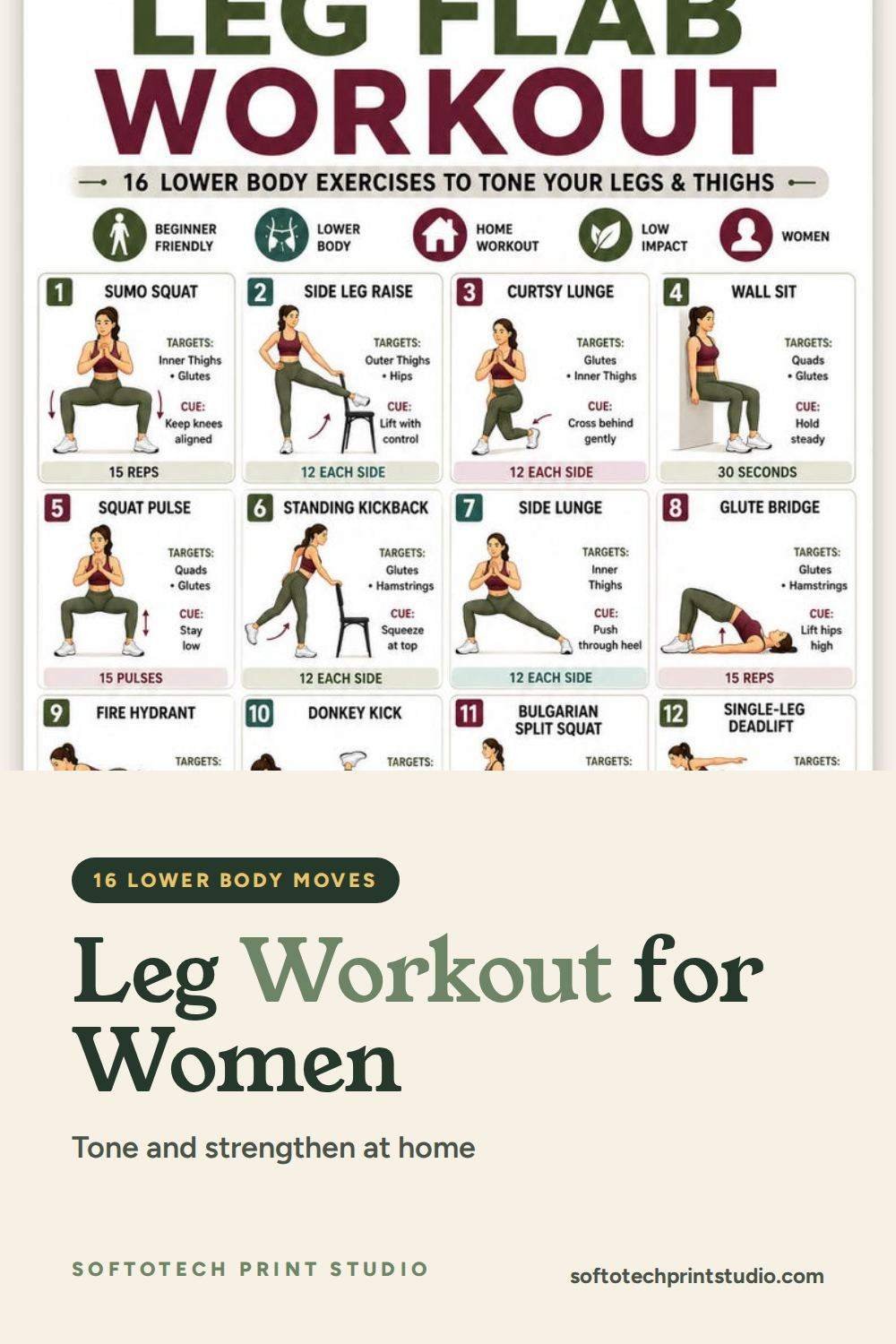
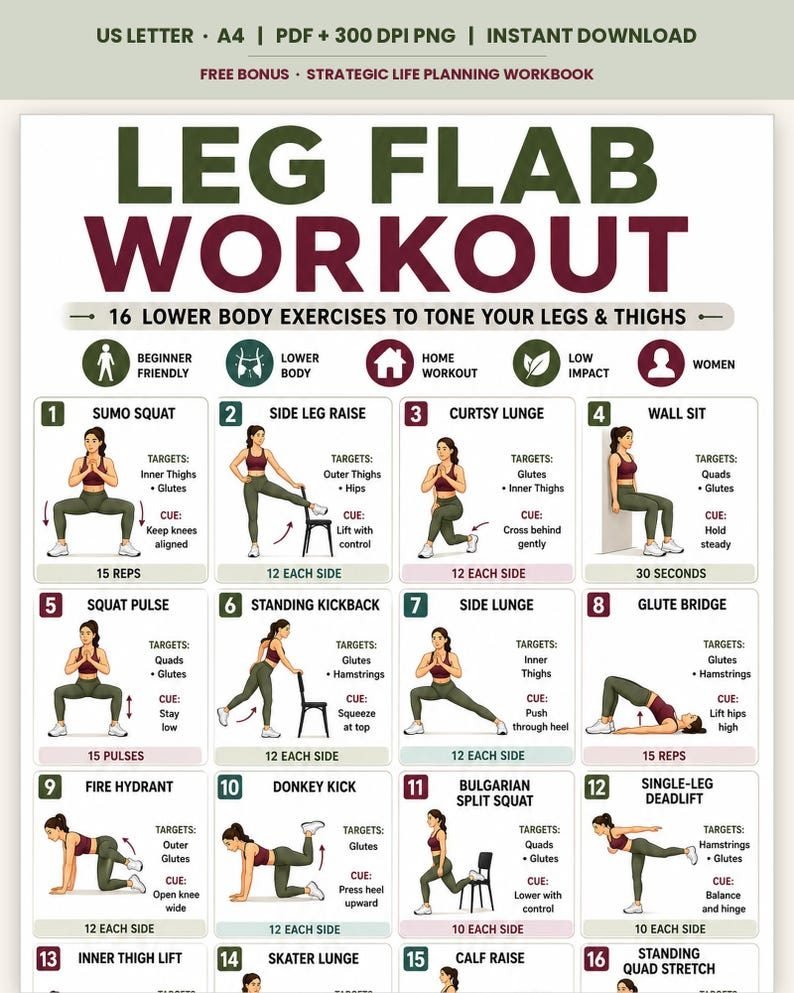
- 16 lower body exercises to tone legs and thighs, beginner friendly, low impact, for home workouts
- The first 12 moves in chart order: Sumo Squat 15 reps, Side Leg Raise 12 each side, Curtsy Lunge 12 each side, Wall Sit 30 seconds, Squat Pulse 15 pulses, Standing Kickback 12 each side
- Side Lunge 12 each side, Glute Bridge 15 reps, Fire Hydrant 12 each side, Donkey Kick 12 each side, Bulgarian Split Squat 10 each side, Single-Leg Deadlift 10 each side
- The last four moves are Inner Thigh Lift, Skater Lunge, Calf Raise and Standing Quad Stretch; their reps were cut off on the chart, so they are named by title only
- Print sizes US Letter and A4, as 2 PDFs plus a PNG and a ZIP per the listing (the listing does not state A5)
- Instant download · Print at home · US Letter · A4
Use code BLOG10 for 65% OFF at Etsy checkout!
What the Leg Workout for Women Chart Covers
The chart lists 16 lower body exercises to tone your legs and thighs. It carries five small icons at the top: beginner friendly, lower body, home workout, low impact, and women. Those five words set the tone for the whole routine. Beginner friendly means the moves are simple to learn and easy to scale. Low impact means no jumping, no pounding, and nothing that jars the knees. Home workout means no equipment is needed for the first chart. Women, in this case, means the routine was made with women in mind, with a focus on legs, thighs and glutes, but the moves themselves are useful for anyone who wants a gentle leg routine at home.
The moves cover the whole leg. Squats and lunges for the thighs and glutes. Side leg raises and fire hydrants for the outer thighs and hips. Glute bridges and donkey kicks for the glutes and hamstrings. Wall sits and squat pulses for holding strength in the quads. Bulgarian split squats and single leg deadlifts for balance and control on one leg at a time. A leg routine that only does squats misses the sides and the back of the leg, and a routine that only does glute work misses the quads. This chart tries to cover all of it, in a short list you can learn in one session.
It helps to know what tone means here, because the word gets used in a lot of ways. On this chart, tone means the legs feel stronger and steadier, the muscles work better, and the shape firms up over time with regular work. It does not mean a change in a week, and it does not mean a specific size or shape. Bodies change at their own pace, and a chart cannot promise a result in a set number of days. What it can do is give you a routine you can repeat three times a week, with reps you can count, and that is enough to ask of it. Our leg exercises for seniors guide covers a slower leg routine with a similar shape, for readers who want an even gentler pace.
| Part of the leg | What the chart works | Moves in this guide |
|---|---|---|
| Thighs and glutes | Squats, lunges and pulses | Sumo Squat, Curtsy Lunge, Squat Pulse, Side Lunge, Bulgarian Split Squat |
| Outer thighs and hips | Side and control moves | Side Leg Raise, Fire Hydrant, Standing Kickback |
| Glutes and hamstrings | Bridges and kicks | Glute Bridge, Donkey Kick, Single-Leg Deadlift |
| Holding strength | Steady holds | Wall Sit, plus the last four moves named by title only |
Print the chart and put it where you work out. A wall, a door, or the floor beside your mat all work. A chart you can see is a routine you can follow. A chart in a drawer is just paper. Keep a water bottle nearby, wear shoes with grip or go barefoot on a mat if that feels steadier, and clear enough floor to step sideways for the lunges. That is the whole setup, and it takes a minute.
The First 12 Moves, in Chart Order
The first 12 moves are printed in chart order, with reps and a short cue beside each one. Follow them in that order the first few times, so you learn the flow, then keep the order that suits your legs. The numbers and cues below are the numbers and cues on the chart, copied as printed.
Move 1 is Sumo Squat, 15 reps, for inner thighs and glutes, cue keep knees aligned. Feet wide, toes turned out a little, sit back and down, then stand. Move 2 is Side Leg Raise, 12 each side, for outer thighs and hips, cue lift with control. Stand tall, hold a chair if you need it, and lift one leg out to the side without leaning. Move 3 is Curtsy Lunge, 12 each side, for glutes and inner thighs, cue cross behind gently. Step one foot back and across, lower into a lunge, then stand. Move 4 is Wall Sit, 30 seconds, for quads and glutes, cue hold steady. Back against a wall, slide down until the knees are bent, and hold. Move 5 is Squat Pulse, 15 pulses, for quads and glutes, cue stay low. Drop into a squat and pulse up and down in small moves without standing all the way up. Move 6 is Standing Kickback, 12 each side, for glutes and hamstrings, cue squeeze at top. Stand tall, kick one leg back, squeeze the glute, and lower slowly.
Move 7 is Side Lunge, 12 each side, for inner thighs, cue push through heel. Step out to the side, bend that knee, keep the other leg straight, push through the heel to stand. Move 8 is Glute Bridge, 15 reps, for glutes and hamstrings, cue lift hips high. Lie on your back, knees bent, lift the hips until the body makes a straight line, then lower slowly. Move 9 is Fire Hydrant, 12 each side, for outer glutes, cue open knee wide. On hands and knees, lift one knee out to the side, keeping the hips level. Move 10 is Donkey Kick, 12 each side, for glutes, cue press heel upward. On hands and knees, press one heel up toward the ceiling, keeping the knee bent. Move 11 is Bulgarian Split Squat, 10 each side, for quads and glutes, cue lower with control. One foot behind you on a chair or step, lower into a lunge, then stand. Move 12 is Single-Leg Deadlift, 10 each side, for hamstrings and glutes, cue balance and hinge. Stand on one leg, hinge forward at the hips, reach toward the floor, and stand tall again.
The last four moves are Inner Thigh Lift, Skater Lunge, Calf Raise and Standing Quad Stretch. Their reps were cut off on the chart, so they are named by title only. Do not fill in the missing reps from memory or from another website, because the chart is the source here and the chart does not show them. If you want to add them, look at the printed chart, read the titles as they appear there, and use a rep count that feels right for the moment, or ask a professional how to do them safely. Our calisthenics workout for women guide covers bodyweight moves in a different order, for readers who want a second routine to rotate with this one.
A word on effort. The cues are short, but they carry the whole move. Keep knees aligned means the knees track over the toes, not inwards. Lift with control means no swinging the leg up. Push through heel means the weight stays in the heel, not the toes. Lower with control means the way down is slow, not a drop. If a move hurts in the knee, shorten the range, hold a chair, or skip it that day. The chart gives reps, but your knees give the real feedback, and the knees win every time.
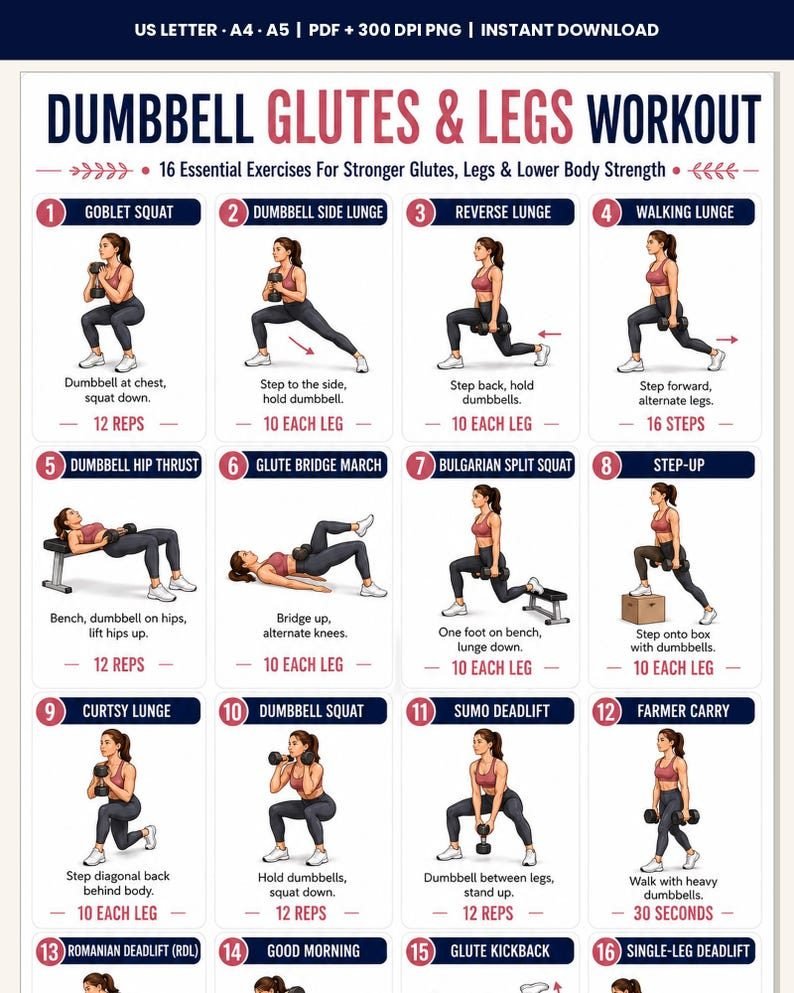
- 16 dumbbell exercises for glutes and legs, for readers who want to add weights to leg day
- The first 12 moves in chart order: Goblet Squat 12 reps, Dumbbell Side Lunge 10 each leg, Reverse Lunge 10 each leg, Walking Lunge 16 steps, Dumbbell Hip Thrust 12 reps, Glute Bridge March 10 each leg
- Bulgarian Split Squat 10 each leg, Step-Up 10 each leg, Curtsy Lunge 10 each leg, Dumbbell Squat 12 reps, Sumo Deadlift 12 reps, Farmer Carry 30 seconds
- The last four moves are Romanian Deadlift (RDL), Good Morning, Glute Kickback and Single-Leg Deadlift; their reps were cut off on the chart, so they are named by title only
- Print sizes US Letter, A4 and A5, as 3 PDFs plus a PNG and a ZIP per the listing
- Instant download · Print at home · US Letter · A4 · A5
Use code BLOG10 for 65% OFF at Etsy checkout!
The Dumbbell Legs Option, for When You Want Weights
The second box above is the Dumbbell Glutes and Legs Workout, a 16 exercise leg day chart for readers who want to add weights to leg day. It is a home gym poster, and it prints in US Letter, A4 and A5 sizes. The first 12 moves come with reps and a short cue each, and the last four are named by title only because their reps were cut off. Use it on days when you have dumbbells and want a harder leg session, and use the first chart on days when you want bodyweight only.
The first 12 dumbbell moves, in chart order, are: Goblet Squat, 12 reps, dumbbell at chest, squat down. Dumbbell Side Lunge, 10 each leg, step to the side, hold dumbbell. Reverse Lunge, 10 each leg, step back, hold dumbbells. Walking Lunge, 16 steps, step forward, alternate legs. Dumbbell Hip Thrust, 12 reps, bench, dumbbell on hips, lift hips up. Glute Bridge March, 10 each leg, bridge up, alternate knees. Bulgarian Split Squat, 10 each leg, one foot on bench, lunge down. Step-Up, 10 each leg, step onto box with dumbbells. Curtsy Lunge, 10 each leg, step diagonal back behind body. Dumbbell Squat, 12 reps, hold dumbbells, squat down. Sumo Deadlift, 12 reps, dumbbell between legs, stand up. Farmer Carry, 30 seconds, walk with heavy dumbbells.
The last four dumbbell moves are Romanian Deadlift, Good Morning, Glute Kickback and Single-Leg Deadlift. Their reps were cut off on the chart, so they are named by title only. The overlap with the first chart is worth noting. Bulgarian Split Squat, Curtsy Lunge and Single-Leg Deadlift appear in both charts, once with bodyweight and once with dumbbells. That is useful, because it means you can learn the move on the bodyweight chart, then add a dumbbell later without learning a new shape. Start with the weight that lets you finish the reps with good form, and only go heavier when the last two reps still feel controlled.
Weights change the feel of a leg day, but they do not change the rules. Warm up first, five minutes of easy movement. Rest between moves when you need it. Keep the knees aligned, the back straight, and the movement slow on the way down. A dumbbell that is too heavy turns a good move into a wobble, and a wobble is where knees complain. Our arm workout for women guide covers an upper body routine in the same style, for readers who want to pair a leg day with an arm day across the week.
Worked Example: A Leg Session at Home
Here is a worked session built from the first 12 moves on the bodyweight chart, in chart order, with reps and cues as printed, plus a weekly schedule. It takes about 20 to 25 minutes, including a warm up and a short rest between moves. Warm up first, five minutes of easy movement, marching in place, gentle squats, leg swings and a slow walk round the room.
Do the moves in order, with a short rest of 20 to 30 seconds between them. Sumo Squat, 15 reps, keep knees aligned. Side Leg Raise, 12 each side, lift with control. Curtsy Lunge, 12 each side, cross behind gently. Wall Sit, 30 seconds, hold steady. Squat Pulse, 15 pulses, stay low. Standing Kickback, 12 each side, squeeze at top. Side Lunge, 12 each side, push through heel. Glute Bridge, 15 reps, lift hips high. Fire Hydrant, 12 each side, open knee wide. Donkey Kick, 12 each side, press heel upward. Bulgarian Split Squat, 10 each side, lower with control. Single-Leg Deadlift, 10 each side, balance and hinge.
That is one round, 12 moves, and for most readers one round is a full session in the first week or two. Rest for a minute at the end, drink some water, and stretch the legs gently. In the second or third week, if the session feels easy, do the round twice, with a two minute rest between rounds. The second round will feel harder than the first, and that is normal. Keep the form clean, even if it means doing fewer reps on the second round. A clean rep counts. A wobbly rep does not.
Weekly schedule: 3 leg sessions a week, with at least one rest day between them. Monday, Wednesday and Friday works, or Tuesday, Thursday and Saturday. On the other days, a walk, a gentle stretch, or an upper body session fits well. Rest days are not wasted days. The legs adapt between sessions, not during them, and a day off lets the muscles recover. If a session leaves you sore for more than two days, take an extra rest day and do one round next time instead of two.
Track it lightly. A tick on the printed chart for each session, or a note of how many rounds you did and how it felt, is enough. After two or three weeks, look back and see whether the wall sit holds longer, whether the Bulgarian split squat feels steadier, and whether the second round feels less hard than it did at the start. That is progress, even if nothing else has changed. A routine you can repeat three times a week is worth more than a routine you do once and give up on, and a short list of 12 moves you know well is what makes this one repeatable.
Frequently Asked Questions
What is a good leg workout for women at home?
A good leg workout for women at home uses a few moves done well, with reps you can count and cues you can remember. The chart in this guide lists 16 lower body exercises, with the first 12 showing reps, from Sumo Squat at 15 reps to Single-Leg Deadlift at 10 each side. It is beginner friendly, low impact and needs no equipment for the bodyweight version.
How often should I do a leg workout for women?
Three leg sessions a week works well for a leg workout for women, with at least one rest day between them. Monday, Wednesday and Friday is a simple pattern, or Tuesday, Thursday and Saturday. One round of the 12 moves is a full session in the first week or two, and a second round can be added when the first round feels easy.
Which moves are on the leg workout for women chart?
The first 12 moves on the leg workout for women chart are Sumo Squat at 15 reps, Side Leg Raise at 12 each side, Curtsy Lunge at 12 each side, Wall Sit for 30 seconds, Squat Pulse at 15 pulses, Standing Kickback at 12 each side, Side Lunge at 12 each side, Glute Bridge at 15 reps, Fire Hydrant at 12 each side, Donkey Kick at 12 each side, Bulgarian Split Squat at 10 each side and Single-Leg Deadlift at 10 each side. The last four are Inner Thigh Lift, Skater Lunge, Calf Raise and Standing Quad Stretch, named by title only because their reps were cut off.
Can I add dumbbells to this leg workout for women?
Yes. The Dumbbell Glutes and Legs Workout in the second box above gives 16 dumbbell moves for glutes and legs, with the first 12 showing reps, from Goblet Squat at 12 reps to Farmer Carry for 30 seconds. Bulgarian Split Squat, Curtsy Lunge and Single-Leg Deadlift appear in both charts, so you can learn the move with bodyweight first and add a dumbbell later. Start light and keep the form clean.
What size is the printable leg workout for women chart?
The SoftoTech Print Studio Leg Flab Workout Poster is an instant download that prints at home in US Letter and A4 sizes, as 2 PDFs plus a PNG and a ZIP per the listing. The listing does not state A5. Put it where you work out, so the 12 moves and their reps are easy to follow.
This guide is for general wellness and is not medical advice. Check with your doctor before starting a new routine.
Legs done, now the glutes: our glute workout for women guide sets out 16 cable and dumbbell moves to build stronger glutes and legs, with sets, reps and form tips.
Legs and pelvic floor work together: our pelvic floor exercises for women guide sets out a beginner Kegel routine with 12 moves for core strength and bladder control.
Related Guides
- Dumbbell Leg Workout at Home
- Leg Exercises for Seniors
- Calisthenics Workout for Women
- Arm Workout for Women
Sources
Sources: CDC: Physical Activity Basics for Adults, Mayo Clinic: Strength Training
 Home WorkoutsVibration Plate for Seniors: What It Can and Can’t Do, Who Should Avoid It, and a Safe 10 Minute Routine
 Home WorkoutsUpper Body Home Exercises: 20 Moves for Chest, Back, Shoulders and Arms, With a 25 Minute Workout
 Home WorkoutsCore Exercises for Women Over 50: 16 Gentle Moves, Standing First, With a 15 Minute Routine and a 4 Week Plan