
Pelvic floor exercises for women are one of those things everyone has heard of and almost nobody has been shown properly. Kegels get mentioned in passing, usually with a joke and no instructions, and then the conversation moves on. This guide does the opposite. It walks through a real 12-exercise chart, move by move, with the cues and reps as printed, so you can actually follow it at home.
The chart in this guide is a beginner Kegel routine for women, with 12 pelvic floor exercises for core strength and bladder control. The chart itself says it supports pelvic health, bladder control, core strength, stability and postpartum recovery. Those are the words on the chart, and this guide does not go further than that. It does not promise results, and it does not tell you how fast anything will change. It gives you the moves, the cues and the reps, and it tells you to check with a doctor, especially after childbirth or surgery.
One thing to say plainly before anything else. The two boxes in this guide are two listings of the same 12-exercise chart. They share one image, the same moves, the same cues and the same reps. The second listing is the same chart under a bladder-leak and postpartum-titled listing. This guide never presents them as two different charts, because they are not. Pick whichever listing title fits what you are looking for. The chart inside is the same one.
Both listings are US Letter and A4 only, with no A5 stated, as 2 PDFs plus a PNG per the listing, and no ZIP stated. That is the same for both, because it is the same chart. If you print it, print it in the size that fits your space, and keep it where you will see it. A chart in a drawer does not help anyone.
In this guide:
- The 12-Exercise Pelvic Floor Chart
- Worked Session: Exercises 1 to 8 in Order
- How to Build the Routine Through the Week
- Safety Notes Before You Start
- Frequently Asked Questions
- 12 pelvic floor exercises for women, beginner friendly, with clear cues and reps on the chart
- Moves include basic Kegels, side-lying Kegels, wall squats, deep belly breathing, bridge pose, clamshell, bird dog and dead bug
- Reps on the chart: basic Kegels 10 reps with a 5 second hold, clamshell 12 reps per side, bird dog 10 reps per side
- The chart supports pelvic health, bladder control, core strength, stability and postpartum recovery
- Print sizes US Letter and A4, as 2 PDFs plus a PNG per the listing (the listing does not state A5 or a ZIP)
- Instant download · Print at home · US Letter · A4
Use code BLOG10 for 65% OFF at Etsy checkout!
The 12-Exercise Pelvic Floor Chart
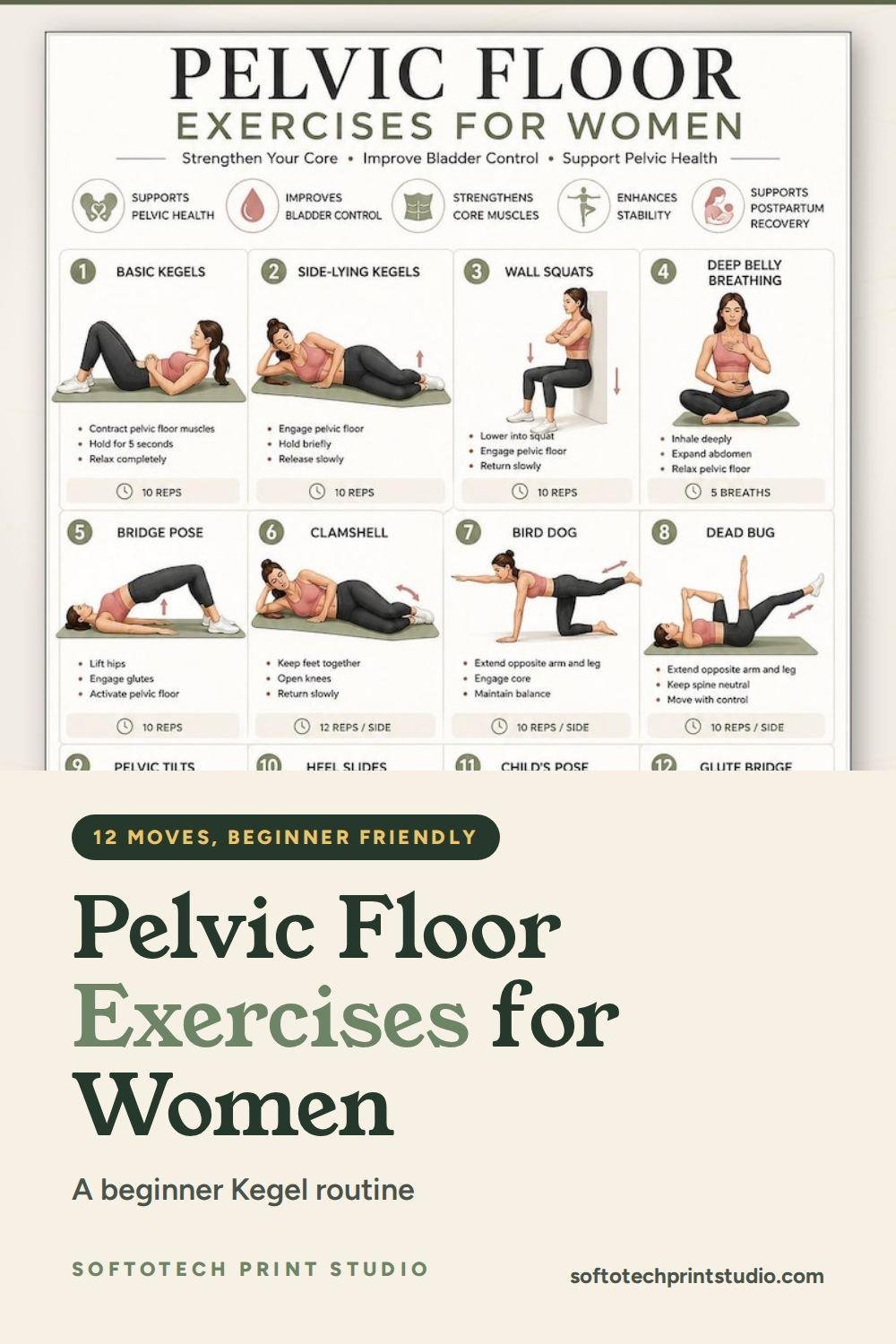
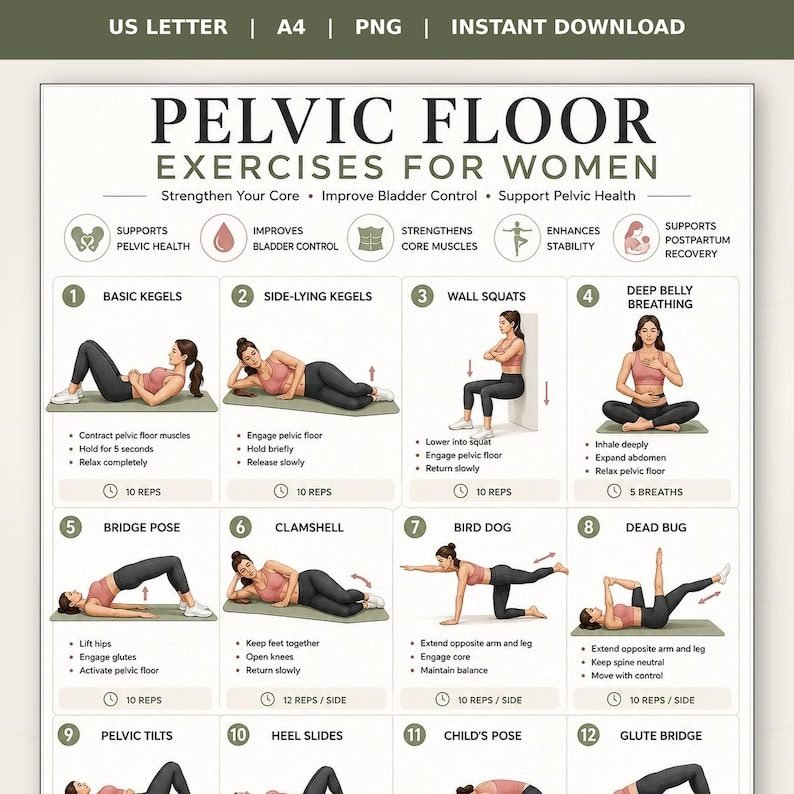
The chart is titled Pelvic Floor Exercises for Women, and its banner reads strengthen your core, improve bladder control, support pelvic health. The pills across the top say supports pelvic health, improves bladder control, strengthens core muscles, enhances stability and supports postpartum recovery. That is five benefits, and they are the chart’s own words, not this guide’s claims.
The 12 exercises on the chart are basic Kegels, side-lying Kegels, wall squats, deep belly breathing, bridge pose, clamshell, bird dog, dead bug, pelvic tilts, heel slides, child’s pose and glute bridge. The first eight come with cues and reps on the chart. The last four, exercises 9 to 12, are names only. Their cues and reps are cut off below the fold, so this guide names them and never quotes reps or how-to steps for them. That is an honest limit, and it is better than guessing.
The moves fall into a natural order. The first four are the quiet ones: two kinds of Kegels, a wall squat and deep breathing. They teach you what a pelvic floor contraction feels like before you add anything else. The next four are the strength moves: bridge pose, clamshell, bird dog and dead bug. They connect the pelvic floor to the rest of your core, your glutes and your hips. The last four are the finishing moves, pelvic tilts, heel slides, child’s pose and glute bridge, and they round out the routine.
What makes this chart useful for a beginner is that it does not assume you know what a Kegel is. The first exercise spells it out: contract your pelvic floor muscles, hold for 5 seconds, relax completely, for 10 reps. The second exercise, side-lying Kegels, gives the same idea in a different position: engage the pelvic floor, hold briefly, release slowly, for 10 reps. If you have never done a Kegel before, start there. Lie down, find the muscles, hold for five seconds, let go completely. The release matters as much as the hold. A pelvic floor that never relaxes is not a strong pelvic floor.
For more on the same kind of core work, our leg workout for women guide covers lower body strength in the same beginner friendly style, and the belly fat workout for women post works the same core area from a different angle.
Worked Session: Exercises 1 to 8 in Order
Here is a worked session from the chart, exercises 1 to 8 in order, with their cues and reps exactly as printed. Do them in this order the first few times, because the order is the teaching. It starts quiet, builds up, and finishes with the harder coordination moves.
Exercise 1 is basic Kegels. Contract your pelvic floor muscles, hold for 5 seconds, relax completely, for 10 reps. Find the muscles by imagining you are stopping the flow of urine, then squeeze and lift gently, hold for five slow seconds, and let go all the way. Do not hold your breath. Do not squeeze your thighs or your stomach. Just the pelvic floor, then a full release. Ten reps, and take your time between them.
Exercise 2 is side-lying Kegels. Lie on your side, engage the pelvic floor, hold briefly, release slowly, for 10 reps. The side position takes gravity out of the picture, which makes it easier to feel the muscles working. If the first exercise felt vague, this one often feels clearer. Hold briefly, then release slowly. The slow release is doing real work here, so do not rush it.
Exercise 3 is wall squats. Stand with your back against a wall, lower into a squat, engage the pelvic floor, return slowly, for 10 reps. Slide down the wall until your knees are bent, keep your pelvic floor engaged as you lower, then push back up slowly. Your back stays on the wall the whole time, which takes the balance worry out of the squat and lets you focus on the pelvic floor.
Exercise 4 is deep belly breathing. Inhale deeply, expand your abdomen, keep the pelvic floor, relax the pelvic floor, for 5 breaths. Breathe in and let your belly rise. As you breathe in, the pelvic floor relaxes and drops slightly. As you breathe out, it lifts gently. This is the breathing pattern that connects to everything else on the chart, and it is worth doing slowly even though it is only five breaths. Our calisthenics workout for women guide uses the same slow breathing idea in its bodyweight moves.
Exercise 5 is bridge pose. Lift your hips, engage your glutes, activate the pelvic floor, for 10 reps. Lie on your back with your knees bent and your feet flat. Press through your heels, lift your hips, squeeze your glutes, and feel the pelvic floor lift with them. Lower back down slowly. If your lower back pinches, lift less high. A small bridge done well beats a big one that hurts.
Exercise 6 is clamshell. Keep your feet together, open your knees, return slowly, for 12 reps per side. Lie on your side with your knees bent and your feet together. Open the top knee like a clamshell, keeping your feet touching, then close it slowly. Twelve reps on one side, then roll over and do the other side. This one works the hips and the outer glutes, and it supports the pelvic floor from the sides.
Exercise 7 is bird dog. Extend your opposite arm and leg, engage your core, maintain balance, for 10 reps per side. Start on all fours. Reach one arm forward and the opposite leg back, keep your core steady, hold for a breath, then bring them back. Then switch sides. If your balance wobbles, do it smaller. A short reach with a steady core is better than a long reach that tips you over.
Exercise 8 is dead bug. Extend your opposite arm and leg, keep your spine neutral, move with control, for 10 reps per side. Lie on your back with your arms up and your knees bent. Lower one arm and the opposite leg toward the floor, keeping your lower back pressed gently into the mat, then bring them back. Switch sides. Move slowly. The name is funny, the move is serious, and the control is the whole point.
Exercises 9 to 12 are pelvic tilts, heel slides, child’s pose and glute bridge. Those are the names on the chart, and this guide does not quote cues or reps for them because the chart cuts them off. If you know these moves from another routine, you can add them at the end. If you do not, stick with exercises 1 to 8 until you have the chart in front of you and can read them for yourself.
| Exercise | Move | Cues | Reps |
|---|---|---|---|
| 01 | Basic Kegels | Contract, hold 5 seconds, relax completely | 10 reps |
| 02 | Side-lying Kegels | Engage, hold briefly, release slowly | 10 reps |
| 03 | Wall squats | Lower into squat, engage, return slowly | 10 reps |
| 04 | Deep belly breathing | Inhale deeply, expand abdomen | 5 breaths |
| 05 | Bridge pose | Lift hips, engage glutes, activate pelvic floor | 10 reps |
| 06 | Clamshell | Feet together, open knees, return slowly | 12 reps per side |
| 07 | Bird dog | Opposite arm and leg, engage core, balance | 10 reps per side |
| 08 | Dead bug | Opposite arm and leg, spine neutral, control | 10 reps per side |
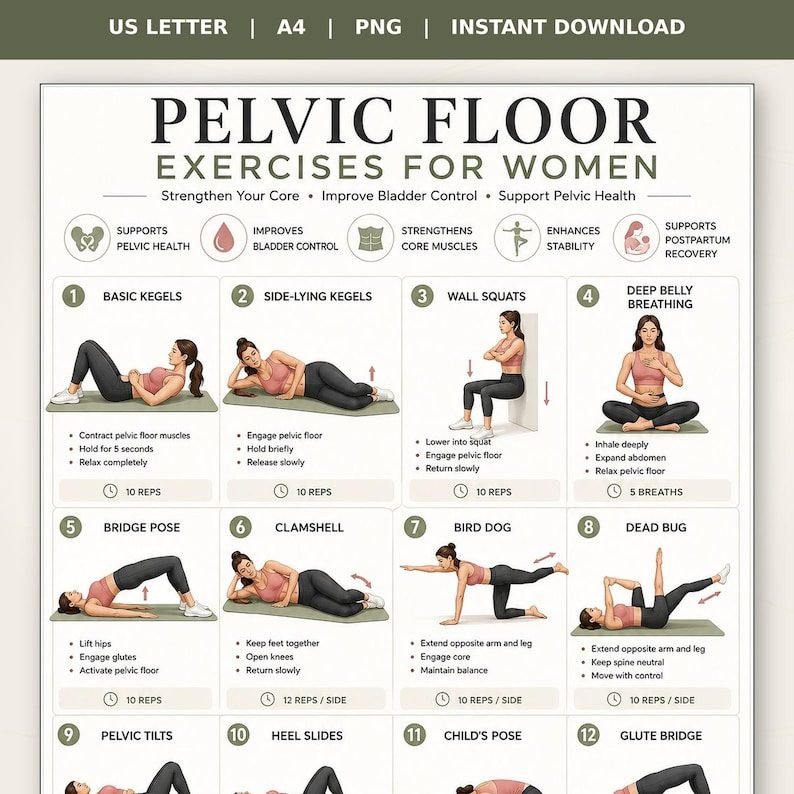
- The same 12-exercise chart, listed under a bladder-leak control and postpartum recovery title
- Same moves, same cues and reps: basic Kegels, wall squats, bridge pose, clamshell, bird dog and dead bug
- Same sizes and files: US Letter and A4, 2 PDFs plus a PNG, no ZIP stated
- Pick whichever listing title fits what you are looking for, the chart inside is the same one
- Print sizes US Letter and A4, as 2 PDFs plus a PNG per the listing (the listing does not state A5 or a ZIP)
- Instant download · Print at home · US Letter · A4
Use code BLOG10 for 65% OFF at Etsy checkout!
How to Build the Routine Through the Week
Start with the first four exercises only. Basic Kegels, side-lying Kegels, wall squats and deep belly breathing, once a day, for the first week. That is a short session, maybe ten minutes, and it teaches you the feeling of a pelvic floor contraction before you add anything harder. If you cannot feel the contraction yet, that is normal. Keep doing the breathing exercise, because the breathing is what teaches the feeling.
In the second week, add bridge pose and clamshell. Do all six exercises in order, once a day. The bridge connects the pelvic floor to the glutes, and the clamshell connects it to the hips, so the routine starts to feel like a whole-body routine instead of an isolated squeeze. Keep the reps as printed: 10 for the bridge, 12 per side for the clamshell.
In the third week, add bird dog and dead bug. Now you are doing all eight exercises with cues on the chart, in order, once a day. Bird dog and dead bug are coordination moves, and they will feel wobbly at first. That is fine. Do them smaller, do them slower, and keep your spine neutral. The control matters more than the range.
By the fourth week, the full session should take about 15 to 20 minutes. That is a reasonable daily routine, and it is short enough to do every day. If a day is busy, do just the first four exercises. A short session you actually do beats a long session you skip. And if you miss a day, do not try to make it up with double reps the next day. Just do the normal session and move on.
Keep the chart where you can see it. On the bedroom wall, in the living room, wherever you do the routine. The chart is a reminder and a checklist in one, and seeing it is half the habit. If you want a second chart for the same routine under a different title, that is what the second listing is. Same chart, same moves, same cues. Pick the title that makes sense to you and ignore the other one.
Safety Notes Before You Start
Check with a doctor before starting this routine, especially after childbirth or surgery. That is not a formality. Pelvic floor recovery after birth or an operation has its own timeline, and a general chart cannot know where you are in it. Your doctor or a pelvic floor physiotherapist can tell you when to start, which moves are safe for you, and whether you need any changes to the routine.
Stop if something hurts. A gentle effort is normal. Sharp pain is not. If you feel pain in your pelvis, your lower back or your abdomen during any move, stop that move and rest. If the pain comes back the next time you try it, leave that move out and ask your doctor about it. The chart does not ask you to push through pain, and neither does this guide.
Breathe normally through every move. Holding your breath and bearing down is the opposite of what this routine is teaching. If you catch yourself holding your breath during Kegels, slow down and do fewer reps. Five good reps with normal breathing are worth more than ten rushed ones with your breath held.
Be patient with the feeling. Some women feel the pelvic floor contraction clearly on the first day. Others take a week or two to find it. Both are normal. The breathing exercise is the best teacher, because it shows you how the pelvic floor moves with your breath. If you still cannot feel it after a couple of weeks, ask your doctor or a physiotherapist. They can check whether you are engaging the right muscles, and that check is worth more than guessing on your own. Our menopause belly workout guide covers core work for a different stage of life, and it follows the same slow, check-with-your-doctor approach.
Frequently Asked Questions
What are pelvic floor exercises for women?
Pelvic floor exercises for women are moves that strengthen the muscles that support the bladder, uterus and bowel. This guide follows a 12-exercise chart with a beginner Kegel routine: basic Kegels, side-lying Kegels, wall squats, deep belly breathing, bridge pose, clamshell, bird dog and dead bug, plus four more moves named on the chart.
Are the two posters in this guide different charts?
No, they are the same chart. Box 1 and Box 2 are two listings of the same 12-exercise chart, sharing one image, the same moves, the same cues and the same reps. Box 2 is the same chart under a bladder-leak and postpartum-titled listing. Pick whichever title fits what you are looking for.
How many reps of basic Kegels does the chart give?
Basic Kegels on the chart are 10 reps with a 5 second hold: contract the pelvic floor muscles, hold for 5 seconds, relax completely. Clamshell is 12 reps per side, and bird dog is 10 reps per side. Exercises 9 to 12 are names only on the chart, so this guide does not quote reps for them.
Should I check with a doctor before doing pelvic floor exercises?
Yes, especially after childbirth or surgery. This guide does not promise results, and a general chart cannot know your recovery timeline. Ask your doctor or a pelvic floor physiotherapist when to start, which moves are safe for you, and whether you need any changes to the routine.
What sizes does the pelvic floor poster print in?
Both listings are US Letter and A4 only, with no A5 stated, as 2 PDFs plus a PNG per the listing, and no ZIP stated. The chart is the same in both listings, so the sizes and files are the same too.
This guide is for general wellness and is not medical advice. Check with your doctor before starting a new routine.
Related Guides
- Leg Workout for Women
- Belly Fat Workout for Women
- Calisthenics Workout for Women
- Menopause Belly Workout
Sources
Sources: Mayo Clinic, Kegel Exercises, NHS, Pelvic Floor Exercises
 Home WorkoutsVibration Plate for Seniors: What It Can and Can’t Do, Who Should Avoid It, and a Safe 10 Minute Routine
 Home WorkoutsUpper Body Home Exercises: 20 Moves for Chest, Back, Shoulders and Arms, With a 25 Minute Workout
 Home WorkoutsCore Exercises for Women Over 50: 16 Gentle Moves, Standing First, With a 15 Minute Routine and a 4 Week Plan