
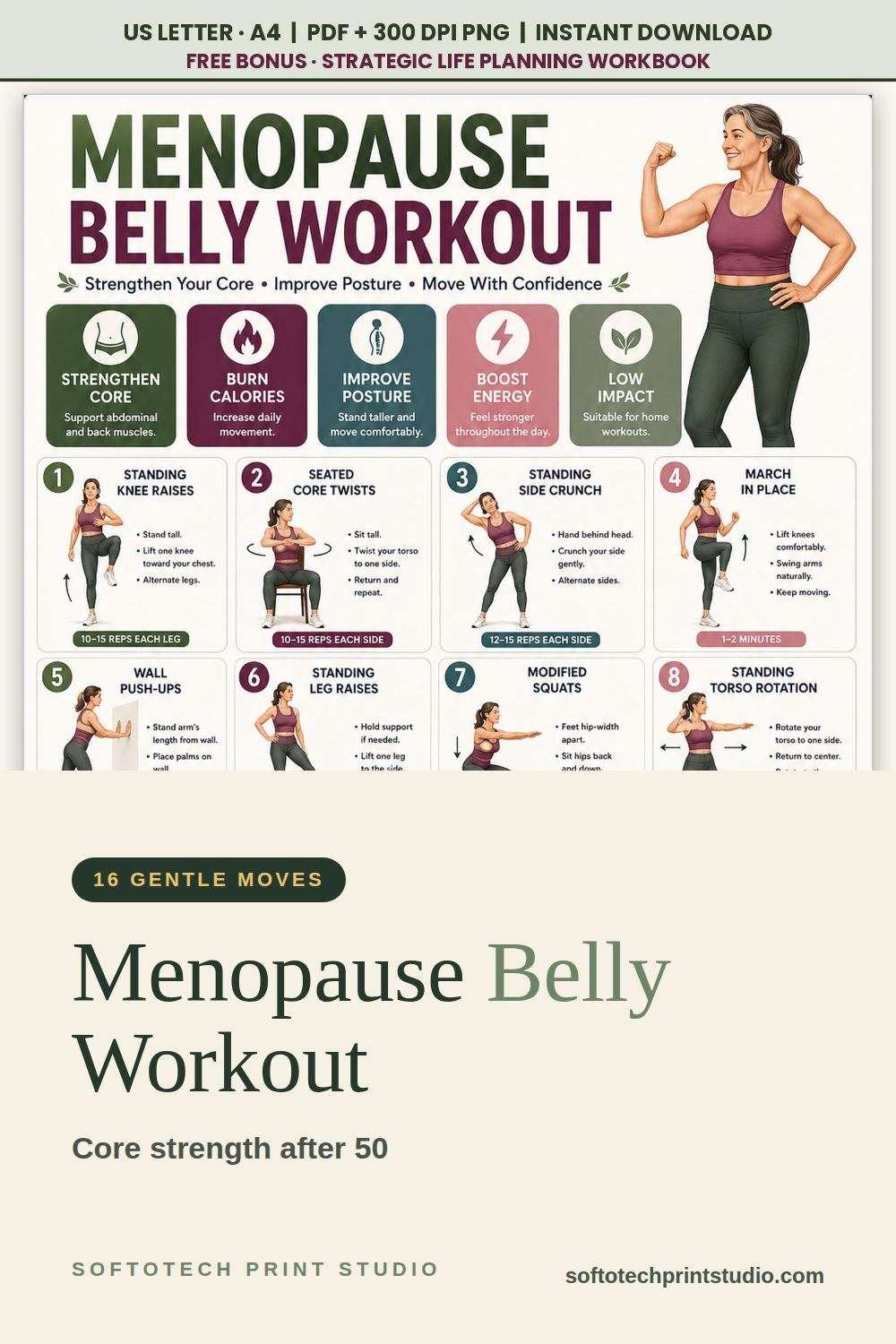
A menopause belly workout is a gentle core routine for women, and this guide follows a 16 move chart built for exactly that. The chart lists 16 gentle moves, from standing knee raises to a full body stretch, and it is built around core strength, balance and healthy movement, all at a low impact pace. Nothing on the chart asks you to jump, run, or get down on the floor and back up again in a hurry.
The middle years change how the body carries weight, and the waistline is where many women notice it first. Core work will not target fat in one spot, and this guide makes no such claim, but a stronger core supports posture, balance and everyday movement, and the chart’s own benefit boxes say the same thing: strengthen core, burn calories, improve posture, boost energy, low impact. A short, gentle session a few times a week is a realistic way to build that strength without straining joints.
This guide walks through the 16 moves on the chart, how a session works, and the low impact form rules that keep it gentle, then runs a worked session through all 16 moves in chart order, grouped by standing, seated and floor moves. Two charts go with this guide, and they are easy to confuse, so here is the honest split: Box 1 is the Home Exercise Chart listing with 16 moves, and Box 2 is the Printable Home Workout listing, a different chart with 12 legible moves. The two move lists are kept separate throughout this guide, and Box 2 moves 13 to 16 are never named, because only 12 numbered moves are visible on that chart.
In this guide:
- The 16 Moves on the Chart
- How a Menopause Belly Session Works
- Low Impact Form Rules
- Worked Example: A Gentle Core Session
- Frequently Asked Questions

The printable from this guide
Menopause Belly Workout Poster
- 16 gentle moves in chart order: Standing Knee Raises, Seated Core Twists, Standing Side Crunch, March in Place, Wall Push-Ups, Standing Leg Raises, Modified Squats, Standing Torso Rotation, Bird Dog, Glute Bridge, Dead Bug, Heel Taps, Standing Side Bends, Plank on Wall, Low Impact Mountain Climbers and Full Body Stretch
- The worked session in this guide is built from these 16 chart moves, in chart order
- Benefit boxes on the chart: Strengthen Core, Burn Calories, Improve Posture, Boost Energy, Low Impact
- Print sizes US Letter and A4, as 2 PDFs plus a PNG and a ZIP per the listing (the listing does not state A5)
- Instant download · Print at home · US Letter · A4
Use code BLOG10 for 65% OFF at Etsy checkout!
Get the Menopause Belly Workout Chart on Etsy →
Instant download · Print at home
The 16 Moves on the Chart
The printable chart in this guide, the Menopause Belly Workout Home Exercise Chart, lists 16 gentle moves in chart order. In practice the moves fall into three groups: ten standing, one seated, and five on the floor, with a closing stretch. The table below keeps the chart numbers, so you can find each move on the poster at a glance. One honest note: the small step-by-step text under each exercise was not reliably legible on the chart, so this guide describes the moves by name and group only, and never quotes that small text.
| Chart number | Move | Group |
|---|---|---|
| 01 | Standing Knee Raises | Standing |
| 02 | Seated Core Twists | Seated |
| 03 | Standing Side Crunch | Standing |
| 04 | March in Place | Standing |
| 05 | Wall Push-Ups | Standing |
| 06 | Standing Leg Raises | Standing |
| 07 | Modified Squats | Standing |
| 08 | Standing Torso Rotation | Standing |
| 09 | Bird Dog | Floor |
| 10 | Glute Bridge | Floor |
| 11 | Dead Bug | Floor |
| 12 | Heel Taps | Floor |
| 13 | Standing Side Bends | Standing |
| 14 | Plank on Wall | Standing |
| 15 | Low Impact Mountain Climbers | Standing |
| 16 | Full Body Stretch | Closing stretch |
The standing group carries most of the session, and it is built around moves that need no equipment and no floor work. Standing Knee Raises and March in Place wake up the legs and the core together, while the Standing Side Crunch and Standing Side Bends work the sides of the waist. Standing Leg Raises and Modified Squats build leg strength with the body upright, and the Standing Torso Rotation turns the trunk gently through its range. Wall Push-Ups use the wall for support while the arms and chest work, and the Plank on Wall holds the body in a straight line against the wall instead of on the floor. Low Impact Mountain Climbers close the standing group with a slow, stepping version of a move that is usually done fast on the floor.
The seated group is a single move, Seated Core Twists, and it earns its place early in the chart, at number 02. Sitting in a chair with the feet flat, you turn the trunk gently from side to side, which works the waist without asking the legs to do anything at all. It is the move to lean on when standing feels like too much on a given day, and it is also a good way to start the session, because it wakes up the core while the body is fully supported.
The floor group is where the core work gets most focused. Bird Dog, Glute Bridge, Dead Bug and Heel Taps are all done on the floor, on hands and knees or on the back, and each one works the trunk from a different angle: the bird dog for balance, the glute bridge for the hips and glutes, the dead bug for deep core control, and heel taps for the lower belly. The Full Body Stretch closes the chart at number 16, a long reach from fingers to toes that lengthens the body after the work is done. A mat or a rug makes the floor group more comfortable, and a chair nearby helps with the step from standing to the floor and back up again.
The chart’s benefit boxes sum up what the session is for: Strengthen Core, Burn Calories, Improve Posture, Boost Energy, Low Impact. None of those boxes promises a result in a set number of days, and neither does this guide. What the chart offers is a routine that is gentle enough to repeat, clear enough to follow from the wall, and complete enough to cover the core, the legs and the posture muscles in one short session. If you want more arm and upper body work alongside this core routine, our arm workout for women guide pairs well with it, and our calisthenics workout for women covers bodyweight moves in the same gentle style.
How a Menopause Belly Session Works
A menopause belly session works best when it follows the chart in order, from the standing moves through the seated twist, down to the floor group, and back up for the closing stretch. Start standing tall, with a wall or a sturdy chair within reach. The first moves are the gentlest: Standing Knee Raises and Seated Core Twists wake up the core without asking for much effort, and March in Place adds a little rhythm and warmth before the harder standing moves begin.
Move through the standing group at your own pace, and sit down between moves whenever you need to. The Wall Push-Ups and the Plank on Wall use the wall as support, so the body stays upright and the hands carry only part of the weight. Modified Squats are deliberately small: a short bend of the knees, not a deep squat, with the chair nearby if balance feels uncertain. The Standing Torso Rotation and Standing Side Bends are slow turns and bends, never jerks, and the Low Impact Mountain Climbers are done as slow, controlled steps rather than the fast floor version most people know.
Then come the floor moves: Bird Dog, Glute Bridge, Dead Bug and Heel Taps. Get down to the floor in stages, using the chair for support, and take a breath before each move. These four are the heart of the core work, and they are worth doing slowly, with the breath steady and the range kept comfortable. Finish with the Full Body Stretch, standing tall or lying down, reaching long from fingers to toes, and then sit for a minute before standing up fully. The whole session takes about 15 to 20 minutes, and the chart on the wall keeps the order in front of you so nothing is forgotten. Our mat pilates workout guide offers a floor based core routine in a similar gentle style, and our core exercises for seniors guide covers trunk work for older adults.

The second menopause belly chart
Menopause Belly Workout Poster
- 12 gentle exercises for core strength, balance and healthy movement, with counts on the chart: Side Leg Lift (15 each side), Standing Side Stretch (20 seconds), Chair Knee Raise (15 reps), Standing Knee Crunch (15 each side), Squat Hold (20 seconds), Single-Leg Deadlift (10 each side), Wide Squat (12 reps), Chair Squat (12 reps), Seated Toe Reach (20 seconds), Seated Side Stretch (20 seconds), Glute Bridge (15 reps) and Forearm Plank (20 seconds)
- The seated and chair version of the same belly workout: use it on days when standing moves feel like too much
- Print sizes US Letter, A4 and A5, as 3 PDFs plus a PNG and a ZIP per the listing
- Instant download · Print at home · US Letter · A4 · A5
Use code BLOG10 for 65% OFF at Etsy checkout!
Get the Second Menopause Belly Chart on Etsy →
Instant download · Print at home
Low Impact Form Rules
Low impact means the joints never take a jolt, and a few rules keep it that way. First, move slowly and breathe normally through every move. Holding your breath or rushing through repetitions turns a gentle routine into a strained one. Second, keep a hand near support. The wall, a chair back or a countertop should always be within reach during the standing moves, so a wobble never becomes a fall.
Third, keep the range small. A knee raise does not need to reach hip height to work, a side bend does not need to reach the floor, and a squat does not need to go deep. The chart’s moves are designed to work at a comfortable range, and the benefit comes from doing them with control, not from pushing further than the body wants to go. Fourth, stop any move that causes sharp pain, and skip it for the day rather than pushing through. Mild effort and a light stretch feeling are normal; joint pain is not part of the program.
Fifth, get up and down in stages. After the floor group, roll to your side, push up with your hands, and sit for a minute before standing. Many falls happen in the first minute after standing, when blood pressure is still adjusting, so give your body that minute. On days when the floor group feels like too much, the second chart in Box 2 is the answer: it is a seated and chair version of the same belly workout, with moves such as Chair Knee Raise, Chair Squat, Seated Toe Reach and Seated Side Stretch, each with its own count on the chart. Use it on the days when standing moves feel like too much, and return to the main chart when you feel ready. If you have a condition that affects balance, blood pressure or joints, check with your doctor before starting a new routine, even a gentle one.
Worked Example: A Gentle Core Session
Here is how the full session runs when you follow the chart in order, grouped by standing, seated and floor moves. Begin standing, with a wall or chair nearby. Standing Knee Raises open the session: lift one knee at a time, slowly, keeping the trunk tall. Then sit down for the Seated Core Twists: feet flat on the floor, turn the trunk gently from side to side, letting the waist do the work. Stand again for the Standing Side Crunch, bringing the knee and elbow toward each other in a small, controlled move, then March in Place for a minute, lifting the feet just off the floor in a steady rhythm.
Continue the standing group with Wall Push-Ups, hands on the wall at shoulder height, bending the elbows slowly and pressing back. Then Standing Leg Raises, lifting one leg at a time to the side or front, keeping the standing leg soft. Modified Squats follow: a short bend of the knees with the chest tall, using the chair back for support if needed. The Standing Torso Rotation turns the trunk slowly from side to side, arms relaxed, and then the floor group begins.
Get down to the floor in stages, using the chair for support. Bird Dog starts on hands and knees: extend one arm and the opposite leg, hold briefly, and switch sides. Glute Bridge follows, lying on the back with knees bent, pressing through the heels to lift the hips a short way and lowering slowly. Dead Bug is next, lying on the back with arms and legs raised, lowering one arm and the opposite leg in a slow, controlled move. Heel Taps finish the floor group, lying on the back with knees bent, tapping one heel at a time to the floor. Then stand again for the last three moves: Standing Side Bends, reaching one arm overhead and leaning gently to the side; Plank on Wall, holding the body in a straight line against the wall; and Low Impact Mountain Climbers, slow stepping in place with the hands on the wall or a chair. Close with the Full Body Stretch, reaching long from fingers to toes, and sit for a minute before moving on with the day.
On lighter days, a gentle tai chi routine for women is a calm way to keep moving without straining your core.
Frequently Asked Questions
What is a menopause belly workout?
A menopause belly workout is a gentle core routine for women, built around low impact moves that strengthen the core, support posture and keep the body moving. The chart in this guide lists 16 gentle moves, from standing knee raises to a full body stretch, grouped into standing, seated and floor moves.
Are these moves low impact?
Yes, every move on the chart is low impact: nothing involves jumping, running or jolting the joints. The standing moves use a wall or chair for support, the floor moves are slow and controlled, and the second chart in Box 2 offers a seated and chair version for days when standing moves feel like too much.
How often should I do this workout?
A few times a week, with rest days between sessions, is a realistic rhythm for a gentle core routine, and the CDC guidance for adults includes muscle strengthening activity on two or more days each week. Start with two or three sessions a week, listen to how your body feels the next day, and check with your doctor before starting if you have a condition that affects balance, blood pressure or joints.
What is the difference between the two charts in this guide?
The two charts look almost identical but are different listings. Box 1 is the Home Exercise Chart listing with 16 moves, and this guide’s worked session follows it. Box 2 is the Printable Home Workout listing, a different chart with 12 legible moves, including Chair Knee Raise, Chair Squat, Seated Toe Reach and Forearm Plank, each with its own count. The two move lists are never mixed in this guide.
What size is the printable menopause belly workout chart?
The SoftoTech Print Studio Menopause Belly Workout Home Exercise Chart is an instant download that prints at home in US Letter and A4 sizes, as 2 PDFs plus a PNG and a ZIP per the listing. The listing does not state A5. The second chart in Box 2 prints in US Letter, A4 and A5.
This guide is for general wellness and is not medical advice. Check with your doctor before starting a new routine.
A second belly workout for women, with standing and floor moves: our belly fat workout for women guide covers 16 core and cardio exercises, from high knees to planks.
For the core after menopause, try this: our pelvic floor exercises for women guide works through a gentle Kegel routine, beginner friendly and home based.
Related Guides
Sources
Sources: CDC: Physical Activity Guidelines for Adults, Mayo Clinic: Exercise: 7 benefits of regular physical activity
 Home WorkoutsWorkout Plan for Women Over 50: A Gentle 28 Day Start, Then a Weekly Plan for Strength, Balance and Walking
 Home WorkoutsFace Yoga for Jowls: A 10 Minute Jaw and Neck Routine From a 12 Exercise Chart, With Honest Expectations
 Home WorkoutsMilitary Workout Routine: A 3 Level Bodyweight Plan From Beginner to Advanced, With a Weekly Schedule