
A workout plan for women over 50 works best when it covers four things each week: walking or other aerobic activity, strength work for the major muscles, balance practice, and stretching. It doesn’t need a gym or long sessions. It needs a gentle start, a simple weekly rhythm, and moves you can do safely at home.
This guide is built on the Senior Fitness Exercises Bundle from SoftoTech Print Studio, a set of 19 gentle workout guides for women over 50. I’ll use its 28 Day Fitness Challenge as month one, then lay out a weekly plan that follows National Institute on Aging advice, with a leg day from the shop’s Over 50 Leg Workout poster.
If you have a heart condition, high blood pressure, osteoporosis, joint problems or balance problems, or you’re returning after illness or surgery, check with your doctor before starting.
In this guide:
- Why a Mixed Plan Matters After 50
- Month One: The 28 Day Fitness Challenge
- A Weekly Workout Plan for Month Two Onward
- Safety, Progress and Staying With It
- Frequently Asked Questions
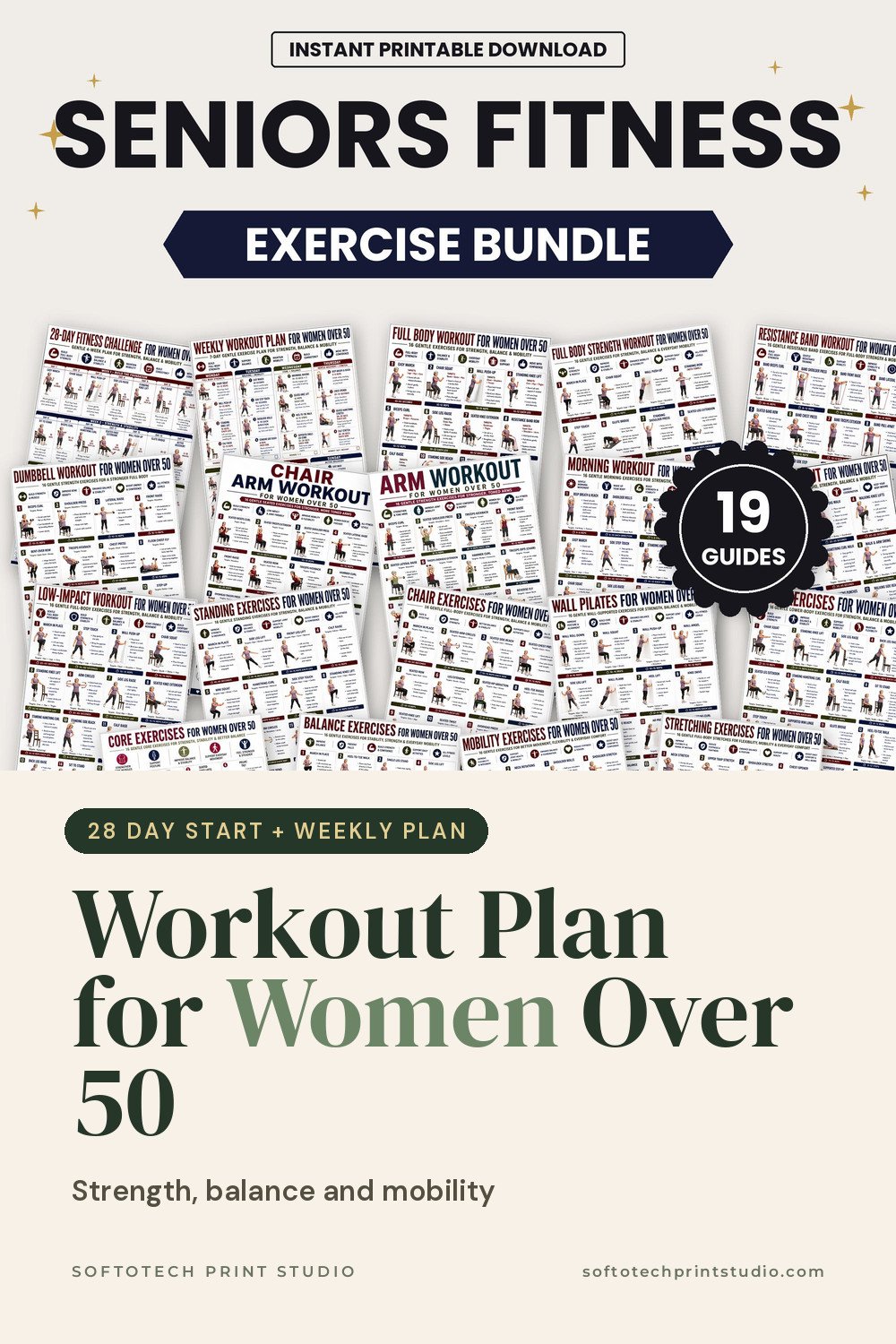
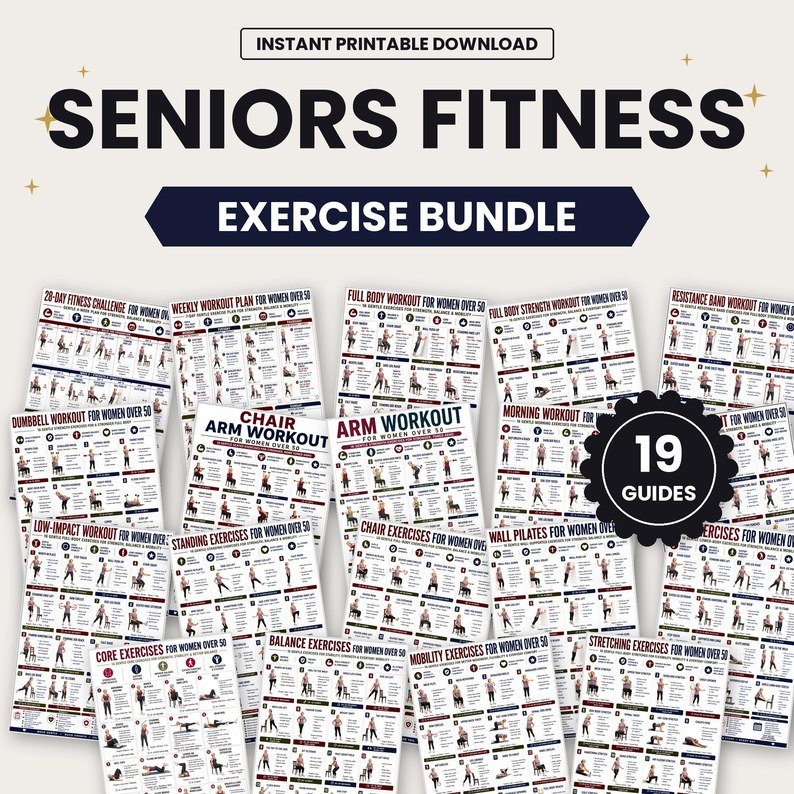
- 19 gentle workout guides in one bundle, made for women over 50
- Includes a 28 Day Fitness Challenge and a Weekly Workout Plan for building a habit
- Also Full Body, Chair, Standing, Low Impact, Core, Balance, Mobility, Stretching, Wall Pilates, Resistance Band and Dumbbell guides
- Every guide in three print sizes: US Letter, A4 and A5, per the listing
- Files: 3 ZIP per the listing
- Instant download · Print at home · US Letter · A4 · A5
Use code BLOG10 for 65% OFF at Etsy checkout!
Why a Mixed Plan Matters After 50
Many women pick one type of exercise, often walking, and stick with it. Walking is great. But on its own it leaves gaps that matter more with every decade.
The four types. The National Institute on Aging says research has shown it’s important to get aerobic, muscle strengthening and balance activity, and it also covers flexibility. Its guidance for older adults is:
- Aerobic: gradually build up to at least 150 minutes of moderate intensity activity, such as brisk walking, each week.
- Strength: at least two days a week working the legs, hips, chest, back, abdomen, shoulders and arms, but not the same muscles two days in a row.
- Balance: about three sessions a week.
- Flexibility: stretching, which makes everyday movements like tying shoes or unloading the dishwasher easier.
Why strength matters so much. The NIA says muscle strengthening improves physical function and makes everyday tasks easier, such as getting up from a chair, climbing stairs and carrying groceries. For women in particular, bones are the other big reason.
Harvard Health notes that an estimated eight million women in the United States have osteoporosis, and that bone mass is lost at a rate of about 1% a year after age 40. The good news it reports is that strength training can help slow bone loss and can even build bone. It targets the hips, spine and wrists, the sites most likely to fracture. Workouts that include power and balance also improve stability, which helps cut down on falls.
How hard is hard enough? The NIA says strength exercises should be at least moderate effort, done to the point where another repetition would be difficult. One set of 8 to 12 repetitions is effective, though two or three sets may be more effective. Beginners can start without weights or bands until the moves feel comfortable.
Month One: The 28 Day Fitness Challenge
If you’re new to exercise or coming back after a long break, the bundle’s 28 Day Fitness Challenge is the gentlest way in. It’s titled a gentle 4 week plan for strength, balance and mobility, and each day has one move with a short cue and a rep or time target.
| Week | Theme | Days and moves, per the chart |
|---|---|---|
| 1 | Build the Foundation | Easy March 45 sec, Chair Squat 10 reps, Wall Push Up 10 reps, Side Leg Raise 10 each leg, Standing Knee Lift 10 each leg, Calf Raise 12 reps, Active Recovery 5 to 10 min |
| 2 | Strength and Stability | Sit to Stand 10 reps, Biceps Curl 10 to 12 reps, Standing Hamstring Curl 10 each leg, Seated Knee Extension 10 each leg, Wall Push Up 12 reps, Glute Bridge 10 to 12 reps, Active Recovery 5 to 10 min |
| 3 | Balance and Mobility | Heel to Toe Walk 10 steps, Side Step Touch 45 sec, Standing Side Reach 8 each side, Back Leg Raise 10 each leg, Step Back and Return 8 each leg, Arm Circles and Easy March 30 sec, Active Recovery 5 to 10 min |
| 4 | Stronger Every Day | Chair Squat 12 reps, Wall Push Up 12 to 15 reps, Standing Knee Lift 12 each leg, Side Leg Raise 12 each leg, Calf Raise 15 reps, Full Body Mini Circuit, Final Full Body Routine |
How it builds. Week 1 introduces the basic moves. Week 2 adds strength moves like sit to stand and glute bridges. Week 3 is all about balance. Week 4 brings back the week 1 moves with more reps, then puts them together. Day 27’s mini circuit is a 30 second easy march, 8 chair squats, 8 wall push ups and 8 knee lifts each side. Day 28’s final routine is a 45 second easy march, 10 chair squats, 10 wall push ups, 10 side leg raises each leg and 10 calf raises.
The guidelines on the chart say begin at a comfortable level, use light resistance when appropriate, rest whenever needed, move slowly and with control, use chair support when needed, and stay hydrated. There’s a 28 day progress tracker in the corner to tick off.
Add walking. The daily move takes only a few minutes, so I’d pair it with a walk on most days, starting with whatever feels comfortable, even 10 minutes, and building up. Our walking plan for seniors guide sets out a gradual build. By the end of the month, a single move feels easy, and you’re ready for full sessions.
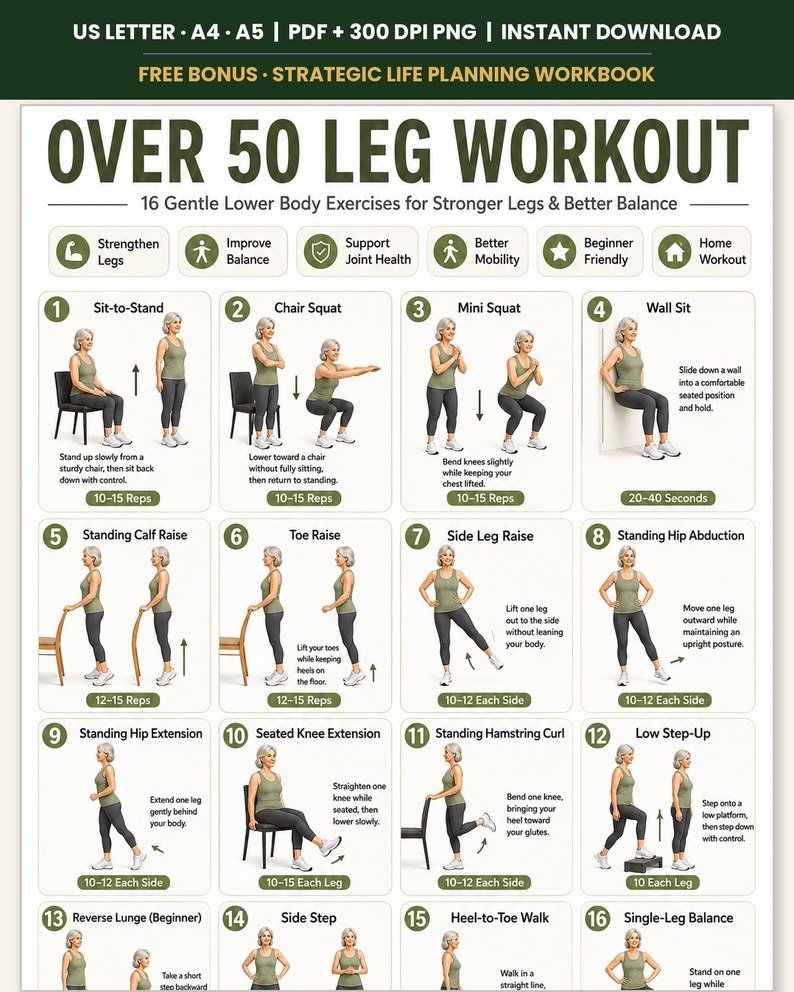
- 16 gentle lower body exercises for stronger legs and better balance
- Moves include Sit to Stand, Chair Squat, Wall Sit, Standing Calf Raise, Side Leg Raise, Low Step Up and Single Leg Balance
- Each move has a one line cue and a rep or time target, such as 10 to 15 reps or 20 to 40 seconds
- Gentle, low impact and chair supported
- US Letter, A4 and A5, PDF plus 300 DPI PNG, per the listing
- Instant download · Print at home · US Letter · A4 · A5
Use code BLOG10 for 65% OFF at Etsy checkout!
A Weekly Workout Plan for Month Two Onward
Once the challenge is done, here’s a weekly plan built on the NIA’s four types. The structure and timings are my suggestion. The moves come from the leg poster and the bundle’s guides.
| Day | Main session | Extra |
|---|---|---|
| Monday | Strength A: leg day from the Over 50 Leg Workout poster | 10 minute walk |
| Tuesday | Brisk walk, 30 minutes | 5 minutes of balance moves |
| Wednesday | Gentle stretching or pilates | 10 minute walk |
| Thursday | Strength B: upper body and core, such as wall push ups, biceps curls and glute bridges | 5 minutes of balance moves |
| Friday | Brisk walk, 30 minutes | Stretch |
| Saturday | Longer walk, or a full body routine from the bundle | 5 minutes of balance moves |
| Sunday | Rest | Gentle stroll if you like |
That gives two strength days with a gap between them, three short balance sessions, and walking that adds up toward the NIA’s 150 minutes as you build.
The leg day. The Over 50 Leg Workout poster has 16 gentle lower body exercises. The first 12 have clear targets:
- Sit to Stand, Chair Squat and Mini Squat: 10 to 15 reps each.
- Wall Sit: slide down a wall into a comfortable seated position and hold for 20 to 40 seconds.
- Standing Calf Raise and Toe Raise: 12 to 15 reps.
- Side Leg Raise, Standing Hip Abduction, Standing Hip Extension and Standing Hamstring Curl: 10 to 12 each side.
- Seated Knee Extension: 10 to 15 each leg. Low Step Up: 10 each leg.
The last row adds a beginner Reverse Lunge, Side Step, Heel to Toe Walk and Single Leg Balance, which double as your balance practice. Pick 8 moves for a 20 minute session and rotate the rest in the next week. Our leg exercises for seniors guide walks a related 16 move chart in detail.
A sample Monday, start to finish. Put on supportive shoes and place a sturdy chair by a clear wall. Warm up with three minutes of easy marching and arm circles. Then do one round of 8 moves from the poster: Sit to Stand, Wall Sit, Standing Calf Raise, Side Leg Raise, Standing Hamstring Curl, Seated Knee Extension, Low Step Up and Single Leg Balance, using the chair for support wherever you need it. Rest for a minute, then do a second round if you feel good. Finish with a few gentle stretches for the thighs, calves and hips, and a 10 minute walk later in the day. That’s about 25 minutes in total.
If you’re already active. If you walk regularly or already do classes, you can skip the 28 day challenge and start straight at the weekly plan. Do the leg poster at two full rounds from week one, and use the bundle’s Full Body Strength or Resistance Band guide for Strength B. Keep the balance sessions even if they feel easy, because balance is the skill most people stop practising.
Strength B. Wall push ups, light biceps curls, glute bridges and standing side reaches from the challenge make a simple upper body and core day. When those feel easy, the bundle’s Resistance Band or Dumbbell guide is the next step. Aim for one set of 8 to 12 reps of each move, working up to two or three sets.
Stretch day. Our stretching exercises for women over 50 guide has a full routine. If you prefer something more structured, our pilates for women over 50 guide works well on the same day.
Balance in five minutes. Heel to toe walk along a hallway, single leg balance holding a counter, side steps and step back and return. Do them near something sturdy to hold. The NIA suggests about three balance sessions a week.
Safety, Progress and Staying With It
The safety reminders on the 28 day chart are worth following all the way through: use sturdy support, wear supportive shoes, exercise on a stable surface, stay within a comfortable range, stop if you feel pain, and modify exercises when needed.
From the NIA. Listen to your body, because overdoing strength exercise can cause exhaustion, sore joints and muscle pain or injury. Warm up first. And don’t hold your breath during strength moves: breathe out during the effort and in as you relax.
Talk to your doctor or a physiotherapist first if:
- You have osteoporosis or have had a fracture, since some bending and twisting moves may need changing.
- You have high blood pressure, heart problems or diabetes.
- You’ve had a hip or knee replacement or other joint surgery.
- You’ve had a fall, feel dizzy, or have trouble with balance.
How to progress. Change one thing at a time. Add two reps, hold the wall sit five seconds longer, or add a second set. Move from chair supported to hands free once you’re steady. Add light weights or a band to strength days only when the bodyweight version feels comfortable for the full set.
Staying with it. Put the weekly plan and the leg poster on the wall where you’ll train. Schedule your two strength days like appointments. A walking friend helps on the other days. If you miss a week, pick up where you left off rather than starting over.
What progress looks like. Getting up from a low chair without pushing on your knees. Carrying shopping up the stairs. Standing on one leg to put on a sock. Those small wins are what this plan is for. Write them down on the tracker when they happen, because they’re easy to forget and they’re the best reason to keep going on the days you don’t feel like it.
Frequently Asked Questions
What is the best workout plan for women over 50?
One that mixes the types of exercise the National Institute on Aging recommends: aerobic activity building up to at least 150 minutes a week, muscle strengthening on at least two days, balance work about three times a week, and stretching. The weekly plan in this guide puts those together around walking, two strength days and short balance sessions.
How many days a week should a woman over 50 strength train?
At least two days a week, according to the National Institute on Aging, working the legs, hips, chest, back, abdomen, shoulders and arms. It advises not working the same muscle group on two days in a row, so muscles can recover.
Is strength training good for bones after 50?
Harvard Health reports that strength training can help slow bone loss and can even build bone, especially at the hips, spine and wrists, the sites most likely to fracture. Bone mass is lost at about 1% a year after age 40, so it’s worth starting.
I’ve never exercised. Where should I start?
Start with the 28 Day Fitness Challenge, which gives one simple move a day, such as an easy march for 45 seconds or 10 chair squats, with active recovery every seventh day. Add short walks on most days. Check with your doctor first if you have a health condition.
How long until I see results?
Most people notice that everyday tasks like climbing stairs or getting up from a chair feel easier within a few weeks of regular strength work. The NIA says muscle strengthening helps you stay independent and makes those tasks easier. Track your sessions so you can see the progress.
This guide is for general fitness and is not medical advice. Check with your doctor before starting, especially if you have osteoporosis, a heart condition, joint problems or balance problems.
Related Guides
- Pilates for Women Over 50
- Stretching Exercises for Women Over 50
- Leg Exercises for Seniors
- Walking Plan for Seniors
Sources
Sources: National Institute on Aging, Four types of exercise can improve your health and physical ability, Harvard Health Publishing, Strength training builds more than muscles
 Home WorkoutsFace Yoga for Jowls: A 10 Minute Jaw and Neck Routine From a 12 Exercise Chart, With Honest Expectations
 Home WorkoutsMilitary Workout Routine: A 3 Level Bodyweight Plan From Beginner to Advanced, With a Weekly Schedule
 Home WorkoutsKettlebell Exercises for Abs: 12 Core Moves From a Kettlebell Abs Chart and a 20 Minute Core Session