
You’ve got the cheese, the crackers, and a fridge full of good intentions — but one question keeps nagging you: what size charcuterie board do you actually need? Too small, and it looks picked-over twenty minutes into the party. Too big, and you’re staring at a few lonely olives rolling around an ocean of empty wood.
It’s the number-one worry I hear from fellow hosts. Nobody wants to be the one whose board runs out before the second glass of wine — or the one who bought a mountain of brie for six people.
Here’s the good news: picking the right board is simple once you match it to your guest count. This guide walks you through exactly what size to grab for 2 to 20+ guests, when to upgrade to a grazing table, which shapes work best, and the little layout tricks that make any board look generous. Let’s take the guesswork out of hosting.
Here is the short answer to what size charcuterie board you need: match the board to your guest count, not to the size of your table. For 2 to 4 guests, a small board about 10 to 12 inches long is plenty. For 6 to 10 guests, choose a medium board of 14 to 18 inches, or use two small boards if your table is long.
For 10 to 20 guests, pick a large board of about 20 inches, or two medium boards placed at opposite ends of the table. For 20 to 50 guests, skip a single board altogether and set up a grazing table, or spread three or more boards around the room so guests can graze from different spots.
Two rules make choosing easier. First, leave a little breathing room on the board: food should look generous, not crowded, and an empty-looking board usually means the board is too big for the group, not that you bought too little food. Second, when you are between sizes, go smaller and add a second board rather than one oversized board, because two boards are easier to refill, easier to reach, and look fuller for longer. Keep the printable chart below handy while you shop, and you will never have to guess again.

Printable guide
Charcuterie Board Size Guide
- Board sizes for 2 to 20+ guests — dimensions, guest counts & best uses
- Quick size reference table by guest count + round vs. rectangular shape guide
- Board size by occasion, one board vs. multiple boards & space-saving tips
- Free bonus: printable Board Size Planner & My Board Picks sheet
- A4 · US Letter · A5, instant PDF download
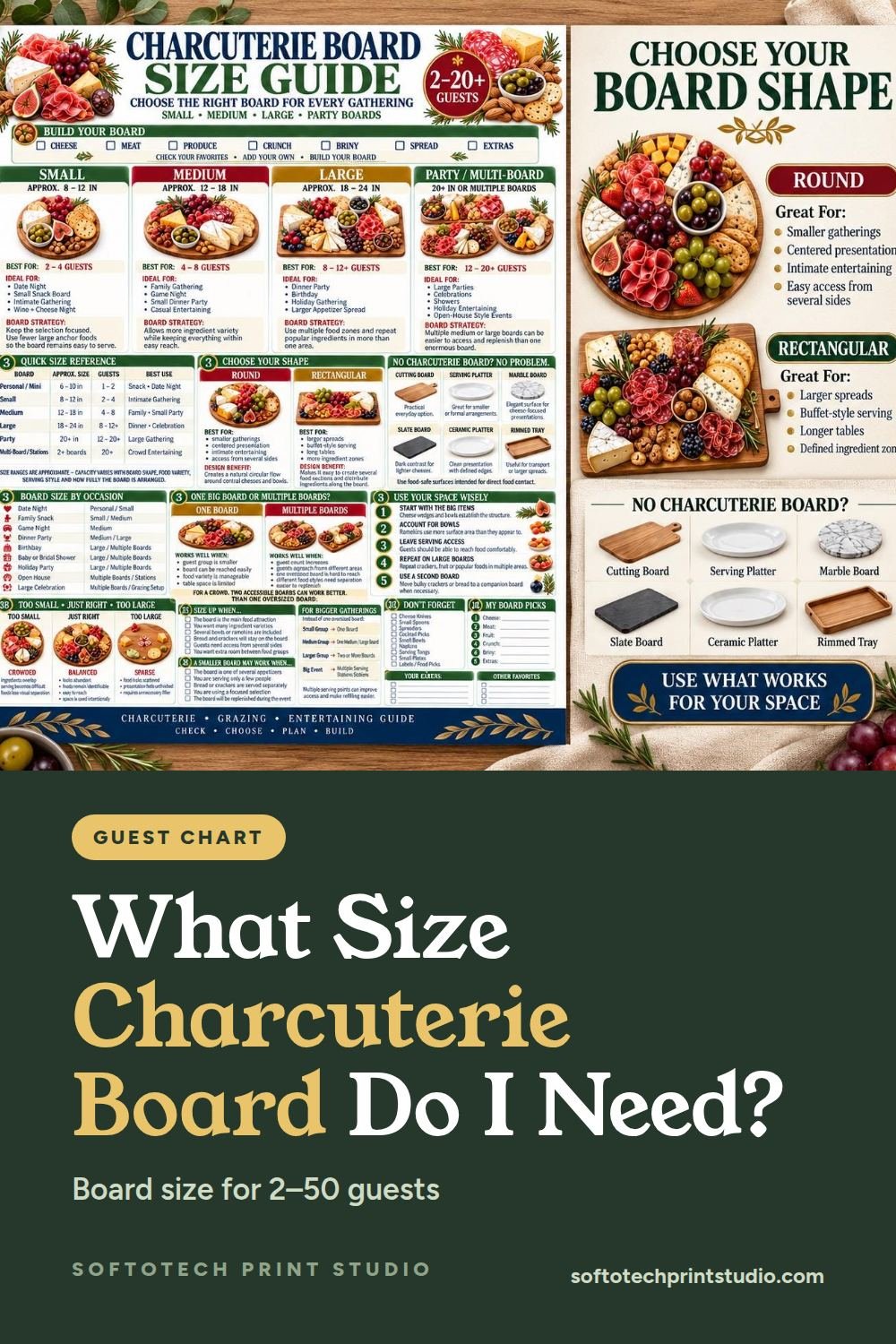
Table of Contents
What Size Charcuterie Board for 2–4 Guests?
Hosting a cozy night in? For two to four people, a small board is all you need — something around 10 to 12 inches across. A petite round board or a small paddle looks full and inviting with just a little food, which is exactly the vibe you want for date night or a quiet evening with a friend.
The trick with small groups is to keep it tight. A big board for two people makes even a lovely spread look sparse. Choose a board your food can fill edge to edge, and it will look abundant with surprisingly little effort.
Two or three cheeses, one or two cured meats, a handful of crackers, plus something sweet like grapes or fig jam — that’s a complete board for a small crowd. Simple, pretty, and zero stress.
What Size Charcuterie Board for 6–10 Guests?
This is the classic dinner-party zone, and it’s where most hosts start second-guessing themselves. For six to ten guests, reach for a medium board — roughly 14 to 18 inches long. It holds a proper variety without taking over your whole table.
Think in zones: a couple of cheeses with different textures, two meats, crackers and bread, fresh fruit, nuts, and one fun extra like olives or cornichons. Arrange foods in little clusters rather than long rows, and the board will look full from the first guest to the last.
Once you’ve nailed the board size, the natural next question is portions — our guide on how much charcuterie you actually need per person has you covered there. And if your gathering is closer to ten and the board is the main event rather than a pre-dinner nibble, size up. It’s always better to have a little extra room than a picked-clean board.
What Size Charcuterie Board for 10–20 Guests?
Once you hit double digits, one standard board won’t cut it. For ten to twenty guests, you need a large board — around 20 inches or more — or better yet, two medium boards working as a team.
Two boards are secretly the host’s best friend. Place one at each end of the table (or in two different rooms) and you instantly fix the traffic jam where everyone crowds around a single spot. Refills are easier too: refresh one board while guests graze from the other.
At this size, variety matters more than volume. Add a third or fourth cheese, mix up your meats, and include something for every taste — a spicy salami, a mild creamy cheese, fresh and dried fruit. Guests love discovering new bites.
What Size Charcuterie Board for 20+ Guests?
For twenty or more guests, stop thinking “board” and start thinking “station.” A single board — no matter how big — will look empty fast and create a bottleneck. This is grazing-table territory, and a printable board size chart with the quick guest-count reference makes planning it so much easier.
A grazing table is simply a charcuterie board without borders: cover a table or counter with kraft paper or a clean cloth, then build your spread right on top. It feeds a crowd, looks spectacular, and lets people graze from all sides.
If a full table feels like too much, use three or more boards spread across your space — savory near the drinks, sweet near the coffee, one wildcard in the middle. Multiple stations keep the party flowing and make refills painless.
Charcuterie Board vs. Grazing Table: Which One Do You Need?
The rule of thumb is simple: under 20 guests, boards win; over 20, go grazing table. Boards feel personal and pretty — perfect for dinner parties, showers, and holidays. Grazing tables feel festive and abundant — ideal for open houses, weddings, and big celebrations.
Also consider your space. A grazing table needs a dedicated surface guests can reach from at least two sides. No spare table? Several boards scattered through your party space give you the same crowd-feeding power without the footprint.
And here’s a secret: you can fake a grazing table on any kitchen island. Lay down parchment, cluster foods in generous piles, tuck in some greenery, and suddenly your counter is the star of the party.
Board Shapes and Materials: What Actually Matters
Round boards are the charmers — lovely for small gatherings and beautiful on a coffee table. Their curved edge naturally guides you into a circular arrangement that looks effortlessly pretty.
Rectangular boards are the workhorses. They hold more food per inch, sit neatly on a buffet, and make it easy to arrange foods in tidy rows or zones. For ten or more guests, rectangular is almost always the smarter pick.
As for materials, wood is the classic for a reason: sturdy, knife-friendly, and warm-looking. Marble or slate keeps cheese cool a little longer and looks elegant, though it’s heavy and tough on knife blades. Honestly? Use what you have — the printable guide even covers no-board alternatives like cutting boards, platters, and trays.
Layout Tips That Make Any Board Look Abundant
The difference between a sad board and a stunning one usually isn’t the food — it’s the layout. Start with your biggest items (cheese wedges, little bowls of olives or dips), then fill the gaps with medium players like folded meats and cracker stacks.
Finish with the small stuff: nuts, berries, and fresh herbs tucked into every empty nook. A board with no visible wood looks generous, so don’t be shy about filling it edge to edge.
A few favorite tricks: fold salami into quarters for height, fan crackers instead of stacking them flat, and add something green — rosemary sprigs or basil — for a fresh, finished look. Keep backup crackers and extra fruit in the kitchen for a quick mid-party refresh.
Who This Is For
This guide is for anyone who loves hosting but hates guessing — the holiday host juggling a houseful, the newlywed setting up her first grown-up kitchen, the bridesmaid planning a shower spread, and the girls’-night regular who wants her board to look as good as it tastes.
It’s also for you if you’ve ever stood in the kitchen wondering, “Is this enough food?” Keep the full charcuterie board size chart on your fridge, and the answer is always within arm’s reach.
Whether you’re feeding your book club or your entire extended family, knowing your board size ahead of time turns party prep from stressful to genuinely fun.
Common Mistakes to Avoid
- Grabbing a board that’s too big for your guest count. Empty wood makes even great food look stingy — match the board to the crowd.
- Putting everything out at once for a long party. Hold back a refill stash so the board looks fresh all evening.
- Forgetting the “vehicles.” Crackers, bread, and little spoons for spreads matter just as much as the cheese.
- Choosing volume over variety. Five kinds of cheese beat a mountain of one — guests graze with their eyes first.
- Crowding one board for a big group. Spread the love across multiple stations instead.
Printable guide
Charcuterie Board Size Guide
- Board sizes for 2 to 20+ guests — dimensions, guest counts & best uses
- Quick size reference table by guest count + round vs. rectangular shape guide
- Board size by occasion, one board vs. multiple boards & space-saving tips
- Free bonus: printable Board Size Planner & My Board Picks sheet
- A4 · US Letter · A5, instant PDF download
Get the printable on Etsy →Instant download · Print at home
Frequently Asked Questions
What size charcuterie board do I need for 10 guests?
For 10 guests, choose a large board around 20 inches long, or use two medium boards placed in different spots. If the board is the main food rather than an appetizer, lean toward two boards. It prevents crowding and makes refills easy.
What is a good all-purpose size for a charcuterie board?
A medium board about 14 to 18 inches long is the most versatile size. It comfortably serves 6 to 10 guests as an appetizer and works for everything from dinner parties to casual get-togethers.
Should I use one big board or several small boards?
For up to 10 guests, one well-chosen board usually works beautifully. For 10 to 20 guests, two or three medium boards beat one giant one. They reduce crowding, are easier to refill, and let you spread food across your space.
Round or rectangular: which board shape is better?
Both work, but they shine in different situations. Round boards look lovely for small, intimate gatherings. Rectangular boards hold more food, arrange more easily, and are the better pick for larger groups and buffets.
What size charcuterie board do I need for a party of 50 guests?
For 50 guests, do not use one board. Set up a grazing table, or use four or more large boards spread around the room, with a refill stash ready. That way guests can reach food from different spots and nothing looks empty halfway through the party.
At the end of the day, the “right” board is simply the one that fits your guest list and lets your food shine. Match the board to the crowd, fill it edge to edge, and keep a little backup in the kitchen — that’s the whole secret.
Want the cheat-sheet version? Grab the printable board size guide for your fridge, and you’ll never have to guess again. Happy hosting!
When the board size is settled, use our cheese pairing guide to fill it well: it matches 36 cheeses with their best fruit, nut, honey, jam and cracker pairings, including a worked example board for six guests.
Once the board size is set, fill it by category: our charcuterie board ingredients checklist gives choosing rules for each group and a worked shopping list for eight guests.
Related Guides
- Charcuterie Board Ideas for Beginners
- How much charcuterie per person — portion planning for 2–50 guests
- Anti-inflammatory food list — balanced picks for your board
- High-protein food list for weight loss — protein-rich board ideas
Sources
- U.S. Department of Agriculture, Food Safety and Inspection Service — food safety resources (fsis.usda.gov)
- FoodSafety.gov — safe food handling guidance (foodsafety.gov)
- Mayo Clinic — nutrition and healthy eating resources (mayoclinic.org)
This guide is for general wellness and is not medical advice. Check with your doctor before starting a new routine.
 Charcuterie & EntertainingNuts for Charcuterie Board: 104 Crunchy Ideas in 12 Groups, 8 Pairings and How Much to Buy
 Charcuterie & EntertainingFruits for Charcuterie Board: 104 Ideas in 12 Groups, Pairings and Quantities
 Charcuterie & EntertainingParty Grazing Board Ideas: 100+ Foods and a Simple Setup Plan