
Vibration plate exercises are ordinary exercises, squats, planks, lunges, presses and calf work, performed standing or resting on a vibrating platform, so the muscles make constant small adjustments while you hold or move through each position. A vibration plate at home turns short sessions into full body work: lower body, core and upper body in one routine, with a recovery section at the end that most people say is the part they look forward to.
The problem for beginners is rarely the machine. It is knowing which positions to use, in what order, and how long to stay in each. That is why this guide is built around one printed chart: a 16 exercise vibration plate poster that groups the moves into lower body, core, upper body and recovery, so a complete session is printed on one page.
Below you will find all 16 exercises from the chart and what each group trains, the safety and setup rules that matter on a vibrating platform, a worked example that builds a complete 12 minute starter session from the chart, and the matching printable poster from SoftoTech Print Studio.
In this guide:
- The 16 Exercises on the Vibration Plate Chart
- Setup and Safety on a Vibrating Platform
- Worked Example: A 12 Minute Starter Session
- Fitting Vibration Sessions Into a Week
- Frequently Asked Questions
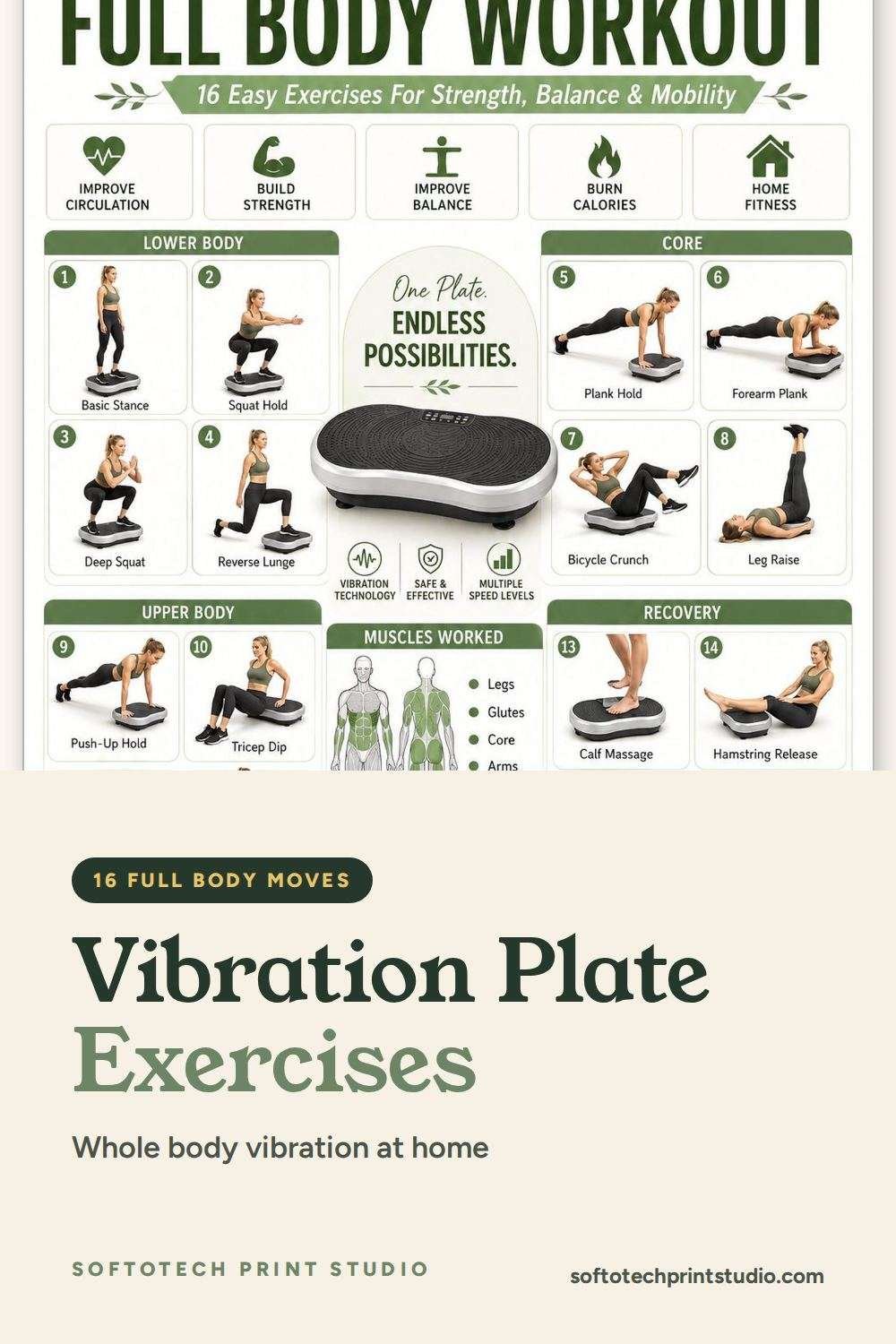
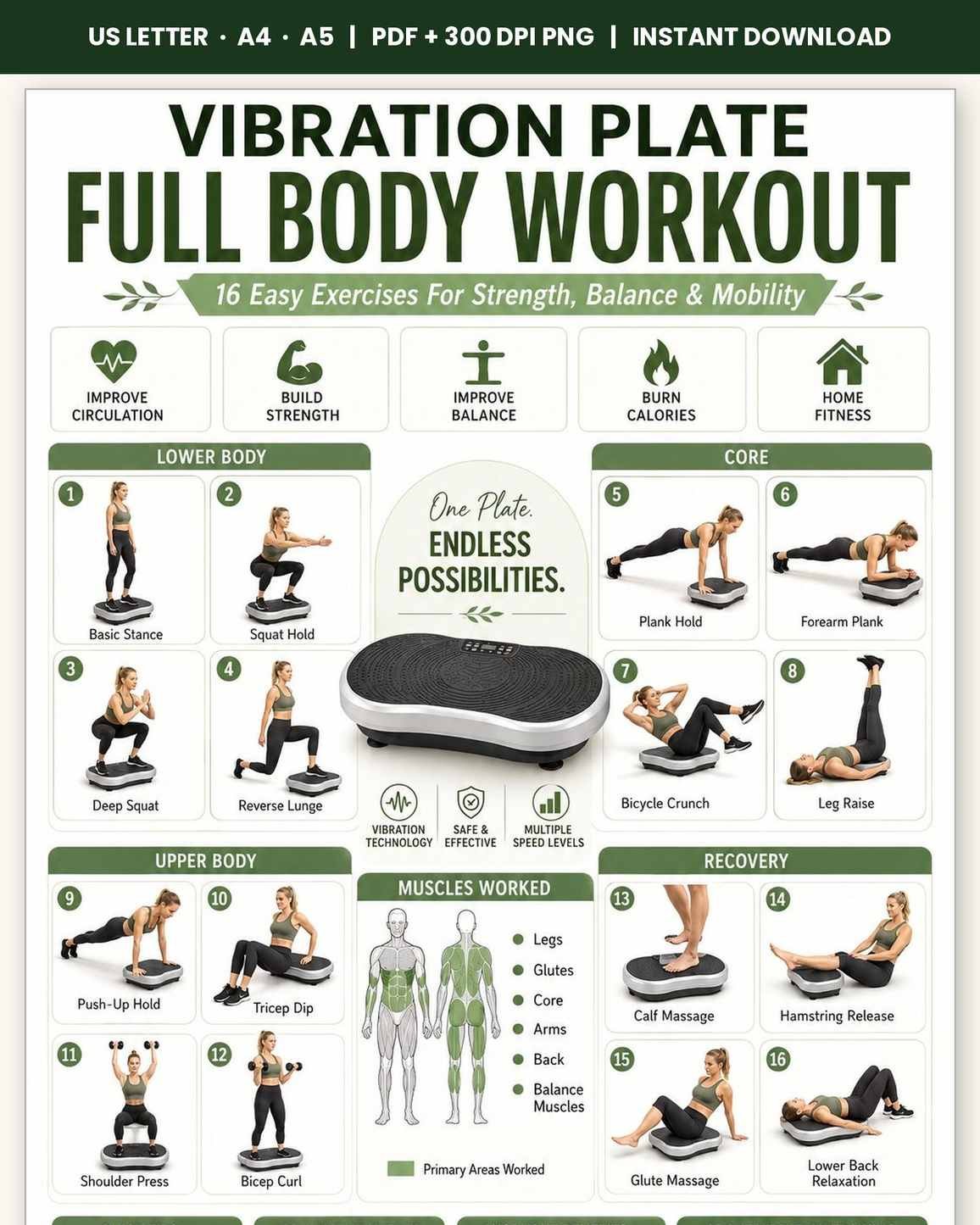
The printable from this guide
Vibration Plate Full Body Workout Poster: 16 Exercises
- 16 exercises in four groups of four on one poster: lower body (Basic Stance, Squat Hold, Deep Squat, Reverse Lunge), core (Plank Hold, Forearm Plank, Bicycle Crunch, Leg Raise), upper body (Push-Up Hold, Tricep Dip, Shoulder Press, Bicep Curl) and recovery (Calf Massage, Hamstring Release, Glute Massage, Lower Back Relaxation)
- The 12 minute starter session in this guide is built group by group from this chart
- Print sizes US Letter, A4 and A5, as 2 PDFs plus a 300 DPI PNG per the listing
- Instant download · Print at home · US Letter · A4 · A5
Use code BLOG10 for 65% OFF at Etsy checkout!
Get the Vibration Plate Poster on Etsy →
The 16 Exercises on the Vibration Plate Chart
The printable poster in this guide, the Vibration Plate Full Body Workout Poster, shows 16 exercises in four groups of four. The lower body group is Basic Stance, Squat Hold, Deep Squat and Reverse Lunge. The core group is Plank Hold, Forearm Plank, Bicycle Crunch and Leg Raise. The upper body group is Push-Up Hold, Tricep Dip, Shoulder Press and Bicep Curl. The recovery group is Calf Massage, Hamstring Release, Glute Massage and Lower Back Relaxation.
| Group | Exercises on the chart | Main job |
|---|---|---|
| Lower body | Basic Stance, Squat Hold, Deep Squat, Reverse Lunge | Legs and glutes, balance and stance control |
| Core | Plank Hold, Forearm Plank, Bicycle Crunch, Leg Raise | Trunk bracing from two plank positions plus moving core work |
| Upper body | Push-Up Hold, Tricep Dip, Shoulder Press, Bicep Curl | Pressing and arm strength with hands or feet on the plate |
| Recovery | Calf Massage, Hamstring Release, Glute Massage, Lower Back Relaxation | End of session release positions for legs, glutes and back |
The structure is the point. A session that takes one or two moves from each group covers the whole body in minutes, and the recovery group gives the session a proper ending instead of a sudden stop. The second poster in this guide, for beginners, covers the same territory from a starter angle, with moves including Basic Stance, Bodyweight Squat, Calf Raises, Side Leg Lift, Glute Kickback and Russian Twist, so the two charts pair well across a week. For leg work without a machine, our leg exercises for seniors guide builds a full routine from a chair and a wall.
Setup and Safety on a Vibrating Platform
Start lower than you think. Vibration intensity is a training load like any other: begin on a low setting, keep early sessions short, and increase one variable at a time, either the setting, the time in position, or the difficulty of the move, never all three. Keep knees soft in standing positions rather than locked straight, hold a wall or sturdy chair for balance in your first sessions, and step off the plate between exercises while you learn the routine.
Position changes the dose. Standing in the centre of the plate feels different from standing wide, and hands on the plate for a plank or push up hold deliver vibration to the arms and shoulders instead of the legs. The chart order, lower body first while you are fresh, core and upper body in the middle, recovery last, is deliberate. Follow it for your first weeks before rearranging anything.
Vibration training is not for everyone. People who are pregnant, have a pacemaker or other implant, recent surgery, or a condition affected by vibration should not use a plate without medical clearance, and anyone with joint replacements or balance problems should check first. Stop if you feel dizzy, nauseous or get a headache, and keep sessions on the plate itself short: the total time in the worked example below is a sensible ceiling for beginners.

The beginners vibration chart
Vibration Plate Exercises for Beginners: Whole Body Vibra…
- A second 16 exercise vibration plate chart written for beginners, with moves including Basic Stance, Bodyweight Squat, Calf Raises, Reverse Lunge, Side Leg Lift, Glute Kickback, Hip Hinge, Push-Up Hold, Plank Hold and Russian Twist
- Includes a circulation focused routine angle per the listing title, as a companion to the full body poster
- Print sizes US Letter and A4, as 2 PDFs plus a 300 DPI PNG per the listing
- Instant download · Print at home · US Letter · A4
Use code BLOG10 for 65% OFF at Etsy checkout!
Get the Beginners Chart on Etsy → Instant download · Print at home
Worked Example: A 12 Minute Starter Session
Here is a complete first session built from the chart. Warm up off the plate for two minutes with marching and easy squats. Lower body, about four minutes: Basic Stance to find your footing, Squat Hold, then Reverse Lunge on each side, holding support if needed. Core, about three minutes: Forearm Plank, then Bicycle Crunch with feet grounded and hands on the plate edge or the floor beside it, keeping the trunk braced. Upper body, about three minutes: Push-Up Hold with hands on the plate, then Bicep Curl standing on the plate if your machine has resistance straps, or Tricep Dip with hands on the plate edge. Recovery, about two minutes: Calf Massage and Lower Back Relaxation to finish.
Work in short holds rather than long grinds: 20 to 40 seconds per position with rest between is plenty at the start, and the vibration does more of the work than the clock suggests. Write down the setting and the holds you used. Next session, repeat the same session exactly; the session after, extend two of the holds slightly. That slow progression is what makes a chart on the wall useful: you can see the session, run it the same way twice, then progress it on purpose.
Two or three sessions like this a week is a full program for a beginner, especially alongside walking. Pair plate days with ordinary movement days, and use our seated exercises for seniors routine on days when standing work is not right for you.
Fitting Vibration Sessions Into a Week
A simple week works best: plate session on Monday, walking on Tuesday, plate session on Wednesday or Thursday, walking and ordinary activity between, and an optional third shorter plate session at the weekend built mostly from the recovery group plus your favourite two strength moves. Keep at least one easier day between plate sessions while you adapt, because the small stabilizing work is more fatiguing than it feels during the session.
Track two things only: the machine setting and how the session felt the next morning. Mild tiredness in the legs is normal at the start. Lingering joint soreness is a signal to lower the setting or shorten the holds, not to push through. Over a month, the goal is boring consistency: same chart, same groups, slightly longer holds, one setting step at a time.
Frequently Asked Questions
What exercises can you do on a vibration plate?
Most standing, plank and press positions adapt well. The chart in this guide shows 16 exercises in four groups: lower body (Basic Stance, Squat Hold, Deep Squat, Reverse Lunge), core (Plank Hold, Forearm Plank, Bicycle Crunch, Leg Raise), upper body (Push-Up Hold, Tricep Dip, Shoulder Press, Bicep Curl) and recovery positions (Calf Massage, Hamstring Release, Glute Massage, Lower Back Relaxation).
How long should a beginner vibration plate session be?
Short at first: around 10 to 12 minutes total, in holds of 20 to 40 seconds with rest between, on a low setting. The worked example in this guide builds a 12 minute starter session from the chart. Increase time, setting or exercise difficulty one at a time over weeks, and stop if you feel dizzy or unwell.
Who should not use a vibration plate?
People who are pregnant, have a pacemaker or other implanted device, recent surgery, joint replacements, or conditions that vibration may affect should not use a vibration plate without medical clearance. Anyone unsure should check with their doctor first. This guide is general wellness information, not medical advice for your situation.
How often should I do vibration plate exercises?
Two or three short sessions a week, with easier days between, is a sensible pattern for beginners. Pair plate days with walking or gentle routines on the other days. Keep the same session for at least two outings before progressing the holds or the machine setting, so your body adapts gradually.
What size is the printable vibration plate chart?
The SoftoTech Print Studio Vibration Plate Full Body Workout Poster is an instant download that prints at home in US Letter, A4 and A5 sizes, as 2 PDFs plus a 300 DPI PNG per the listing. It shows 16 exercises grouped into lower body, core, upper body and recovery, so a full session is visible on one page.
This guide is for general wellness and is not medical advice. Check with your doctor before starting a new routine.
Related Guides
- Leg Exercises for Seniors: 16 Gentle Moves
- Seated Exercises for Seniors: A Gentle Full-Body Chair Routine
- Kettlebell Workout for Beginners
- Military Calisthenics Workout: 30 Day Bodyweight Challenge
Sources
Sources: CDC: Physical Activity for Older Adults, National Institute on Aging: Exercise and Physical Activity
 Home WorkoutsWorkout Plan for Women Over 50: A Gentle 28 Day Start, Then a Weekly Plan for Strength, Balance and Walking
 Home WorkoutsFace Yoga for Jowls: A 10 Minute Jaw and Neck Routine From a 12 Exercise Chart, With Honest Expectations
 Home WorkoutsMilitary Workout Routine: A 3 Level Bodyweight Plan From Beginner to Advanced, With a Weekly Schedule