
Resistance band exercises for seniors are often the first strength training older adults actually stick with — and there is a good reason. Bands are gentle on the joints, cost almost nothing, take up no space, and let you train every major muscle group from a chair or standing with support. No gym, no heavy weights, and no getting down on the floor.
Strength matters more with every decade. Muscle mass and strength naturally decline with age, and that decline shows up in everyday life: carrying groceries gets harder, stairs feel steeper, and getting up from a low chair takes more effort. Health authorities such as the CDC recommend that older adults do muscle-strengthening activities on at least 2 days a week alongside regular aerobic activity — and a resistance band is one of the simplest ways to meet that guideline at home.
In this guide, you will find how to choose the right band, the safety rules that matter most after 60, a complete set of seated and standing resistance band exercises for seniors, a simple weekly schedule, and the printable chart from SoftoTech Print Studio that puts all 16 exercises on one wall poster.
In this guide:
- Why Resistance Bands Suit Seniors So Well
- Step 1: Choose the Right Band and Set Up Safely
- Step 2: Seated Resistance Band Exercises
- Step 3: Standing Resistance Band Exercises
- Your Simple Weekly Band Schedule
- Frequently Asked Questions
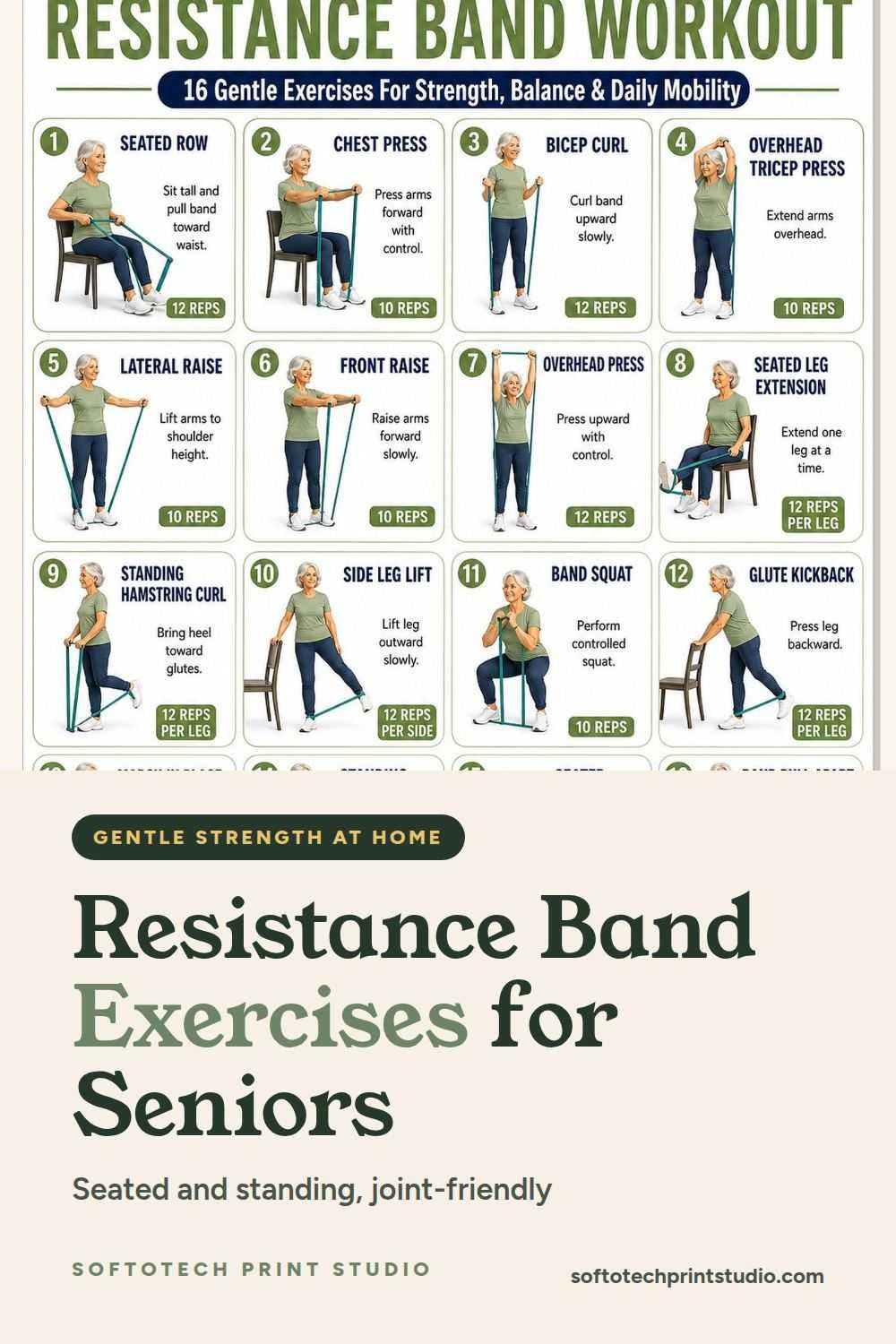
The printable from this guide
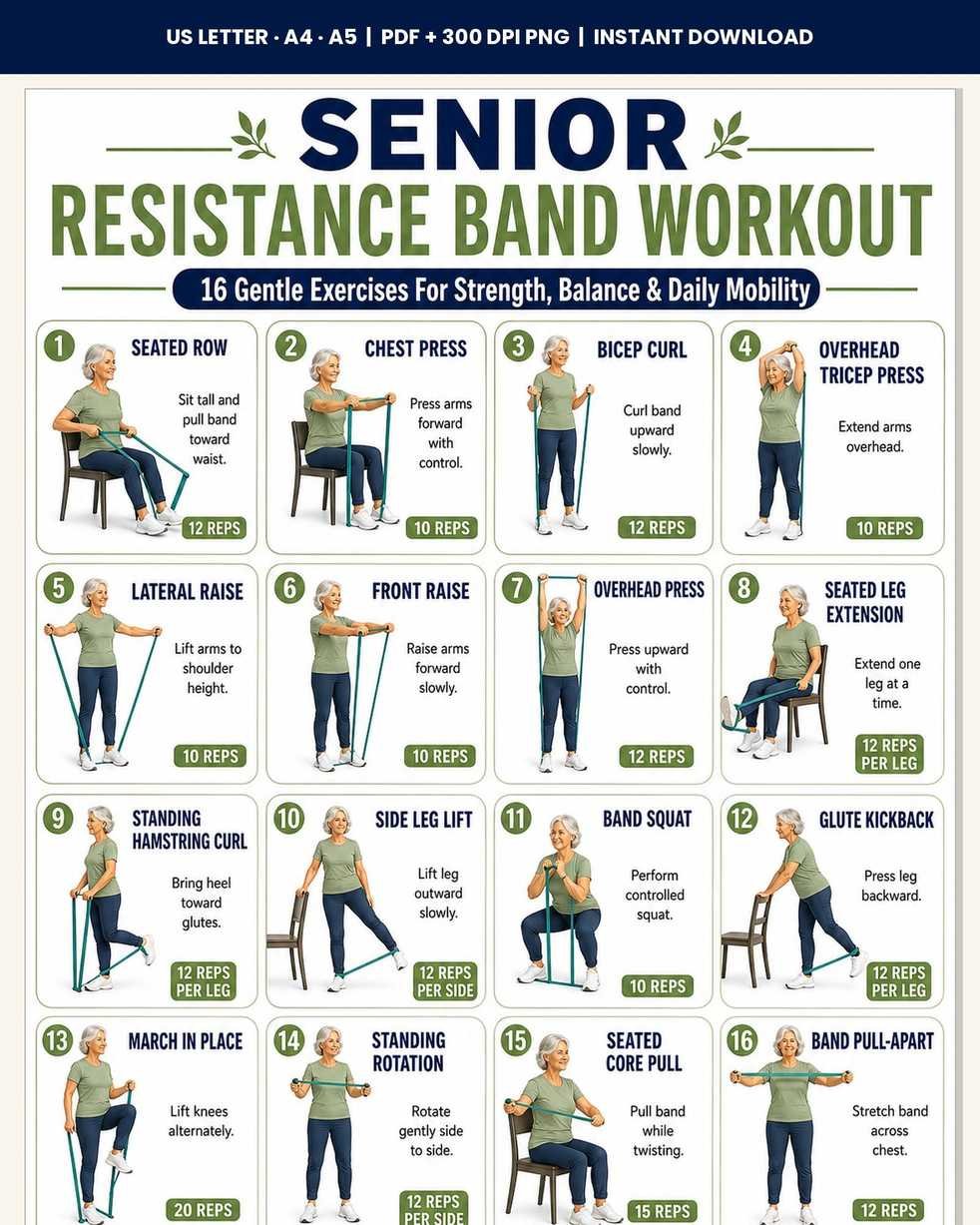
Senior Resistance Band Exercise Chart
- 16 gentle band exercises for strength, balance & daily mobility
- Seated and standing moves with clear illustrations & reps
- Instant download · Print at home · A4 · US Letter · A5
Use code BLOG10 for 65% OFF at Etsy checkout!
Get the Resistance Band Chart on Etsy →
Why Resistance Bands Suit Seniors So Well
A resistance band creates tension smoothly through the whole movement, without the joint jarring that dropping or swinging a weight can cause. The tension is also adjustable in the simplest possible way: grip the band shorter for more resistance, longer for less, or step up to a stronger band as you progress. That built-in scaling is why bands work equally well for a cautious beginner in their seventies and a fitter adult in their sixties.
Bands are also forgiving about where you exercise. A flat loop band or a long flat band with handles covers everything in this guide, and most exercises can be done seated on a sturdy chair — a real advantage on days when balance is not at its best. The printable chart this guide is built around shows 16 gentle band exercises for strength, balance and daily mobility, with seated and standing options side by side, so you can match the day to how you feel.
Step 1: Choose the Right Band and Set Up Safely
Start with a light or medium band — if the last two repetitions of a set feel challenging but your form stays clean, the resistance is right. Bands are usually colour-coded by strength, but the colours vary by brand, so always test gently rather than trusting the colour. Inspect the band before every session: small nicks and cracks are where bands snap, and a worn band should be replaced, not repaired.
Set up on a sturdy chair without wheels, ideally against a wall, on a non-slip floor. Wear firm shoes rather than socks. Anchor points must be solid — a closed door with the band secured, or your own foot with the band flat under the shoe. Never anchor a band to furniture that can tip or slide.
Warm up for 3–5 minutes first: march gently in place or seated, roll the shoulders, and circle the ankles and wrists. Then work slowly — about 2–3 seconds to move against the band and 2–3 seconds to return. Breathe out as you push or pull, and never hold your breath against the effort.
Step 2: Seated Resistance Band Exercises
These seated exercises are the heart of the routine for many seniors. Aim for 1–2 sets of 8–12 slow repetitions each, resting as needed.
- Seated row (12 reps): Band around the soles of the feet, legs extended or slightly bent; sit tall and pull the band toward your waist, squeezing the shoulder blades. Key for posture and back strength.
- Chest press (10 reps): Band behind your upper back, press the arms forward with control until nearly straight, then return slowly. Trains chest, shoulders and arms for pushing movements.
- Seated leg extension (12 reps per leg): Band anchored to a chair leg and looped at the ankle; extend one leg at a time slowly, pause, and lower. A classic for knee support and walking strength.
- Seated core pull (chart exercise 15): Hold the band out in front and pull it toward your body with a tall, braced trunk — gentle core strength without getting on the floor.
- Seated bicep curl: Band under one foot, curl the hand toward the shoulder. Everyday arm strength for lifting and carrying.

Keep training at home
Resistance Band Workout Bundle — 4 Charts
- 4 printable charts with 64 exercises: upper & lower body, senior chair
- Home gym strength routines with clear illustrations
- Instant download · Print at home · A4 · US Letter · A5
Use code BLOG10 for 65% OFF at Etsy checkout!
Get the Band Workout Bundle on Etsy → Instant download · Print at home
Step 3: Standing Resistance Band Exercises
Standing exercises add balance training to strength work. Always keep one hand on the chair back, a counter or a wall until you are fully confident — holding support is good training, not cheating.
- Bicep curl (12 reps): Band under both feet, curl the band upward slowly — the same arm strength you use for shopping bags and jars.
- Overhead tricep press (10 reps): Extend the arms overhead against the band. Keep the movement slow and stop below any range that pinches the shoulder.
- Lateral raise (10 reps): Lift the arms to shoulder height against the band for shoulder strength and reach.
- Front raise (10 reps): Raise the arms forward slowly to shoulder height, then lower under control.
- Overhead press (12 reps): Press upward with control — useful strength for shelves and cupboards, always within a comfortable range.
- Standing hamstring curl (12 reps per leg): Bring the heel toward the glutes against the band, holding the chair for balance.
- Side leg lift (12 reps per side): Lift the leg outward slowly. A key balance and hip-stability exercise for fall prevention.
- Band squat (10 reps): Perform a controlled squat against the band’s tension, with a chair behind you as your depth guide and safety net.
- Glute kickback (12 reps per leg): Press the leg backward slowly, keeping the body upright — trains the glutes used in walking and climbing.
- March in place and standing rotation: Gentle marching and controlled trunk rotation finish the standing set with mobility and balance work.
- Band pull-apart (chart exercise 16): Hold the band in front at shoulder height and stretch it apart across the chest. Excellent for shoulders and upper-back posture.
Good form beats more resistance at every age. If an exercise causes joint pain (as opposed to normal muscle effort), stop that movement, check the setup, and choose a gentler option — the chart’s seated and standing alternatives make swapping easy.
Your Simple Weekly Band Schedule
Day 1 (for example Monday): Seated set — seated row, chest press, seated leg extension, seated core pull, bicep curl.
Day 2: Rest or a walk.
Day 3 (Wednesday): Standing set — band squat, glute kickback, side leg lift, hamstring curl, pull-apart.
Day 4: Rest or gentle stretching.
Day 5 (Friday): Mixed set — repeat your favourite exercises from both days, plus the arm set: lateral raise, front raise, overhead press and tricep press.
Weekend: Rest, walking and daily activity.
This rhythm gives each muscle group recovery days, which is when strength is actually built. After 3–4 comfortable weeks, progress by adding a second set, slowing the return phase, or moving to the next band strength — one change at a time. Mild muscle tiredness for a day is normal; sharp pain, dizziness or unusual breathlessness are stop signals — rest and speak to your doctor if they recur.
Frequently Asked Questions
How often should seniors do resistance band exercises?
Two to three sessions a week on non-consecutive days suits most older adults and matches the CDC guidance for muscle-strengthening activity on at least 2 days a week. Rest days between sessions matter — muscles get stronger while recovering, not while training.
Which resistance band is best for a beginner senior?
Start with a light or medium flat band, ideally with handles for grip comfort. The right band lets you finish 8–12 slow repetitions with clean form while the last two feel challenging. Check the band for nicks or cracks before every session and replace a worn band rather than repairing it.
Can I do resistance band exercises sitting down?
Yes — many of the most useful exercises work seated on a sturdy chair: the seated row, chest press, seated leg extension, seated core pull and curls. The SoftoTech Print Studio Senior Resistance Band Exercise Chart shows seated and standing moves together, so you can train safely on days when balance feels less steady.
Are resistance bands safe for arthritic joints?
Bands are widely used with older adults because the resistance is smooth and easy to scale, with no heavy weight pressing on the joints. Work in a pain-free range, move slowly, and stop any exercise that causes joint pain. If you have arthritis, a recent joint replacement or another condition, check with your doctor or physiotherapist before starting.
How long before I notice a difference?
Most people notice everyday tasks feeling a little easier — rising from a chair, carrying shopping, climbing a few stairs — within 3 to 6 weeks of two to three sessions a week. Consistency with a light band beats occasional hard sessions with a strong one.
What size does the resistance band chart print at?
The SoftoTech Print Studio Senior Resistance Band Exercise Chart is an instant PDF download that prints at home in A4, US Letter and A5 sizes, so you can post the full chart on the wall or keep a smaller copy with your band.
Related Guides
- Walking Plan for Seniors: Beginner 4-Week Guide
- Standing Balance Exercises for Seniors
- Resistance Band Workout for Women Over 40
- Seated Leg Exercises for Seniors with Bad Knees
Sources
Sources: CDC — Physical Activity for Older Adults, National Institute on Aging (NIH) — Exercise and Physical Activity, Mayo Clinic — Strength training: Get stronger, leaner, healthier
This guide is for general wellness and is not medical advice. Check with your doctor before starting a new routine.
 Senior FitnessBreathing Exercises to Increase Lung Capacity: 8 Techniques, a 10 Minute Routine and What They Can Really Do
 Senior FitnessAnkle Exercises for Sprain Recovery: 12 Gentle Moves in 3 Stages, Once Your Clinician Says It’s Time
 Senior FitnessArm Exercises for Seniors: 16 Gentle Dumbbell Moves and 20 Seated Moves With Reps