Breathing exercises to increase lung capacity are simple techniques, mainly pursed lip breathing and belly (diaphragmatic) breathing, that train you to breathe more slowly and use your diaphragm well. The American Lung Association calls these two “the most useful breathing exercises,” and suggests practicing them for 5 to 10 minutes every day.
Let’s be honest about the promise in the title. Breathing exercises don’t make your lungs physically bigger, and no routine can promise a higher reading on a lung function test. What they can do, according to the American Lung Association, is make your lungs more efficient, help clear out stale air, and get your diaphragm back to doing its share of the work. For many people that means breathing feels easier and calmer, which is what most of us actually want.
This guide uses two printables from SoftoTech Print Studio: the Breathing Exercises 5 Poster Bundle and the Gentle Indoor Walking Routine for Seniors chart. I’ll show you the two core techniques step by step, six more from the posters, a 10 minute routine and how to add gentle walking.
If you have asthma, COPD, a heart condition or any lung disease, talk to your doctor before you start. These exercises do not replace inhalers, oxygen or any treatment you’ve been given. If you’re short of breath and it doesn’t settle, or you have chest pain, call emergency services.
In this guide:
- How Your Diaphragm and Lungs Work Together
- Eight Techniques, Starting With the Two Core Ones
- A 10 Minute Daily Breathing Routine
- Walking Builds the Reserve Behind Every Breath
- Frequently Asked Questions
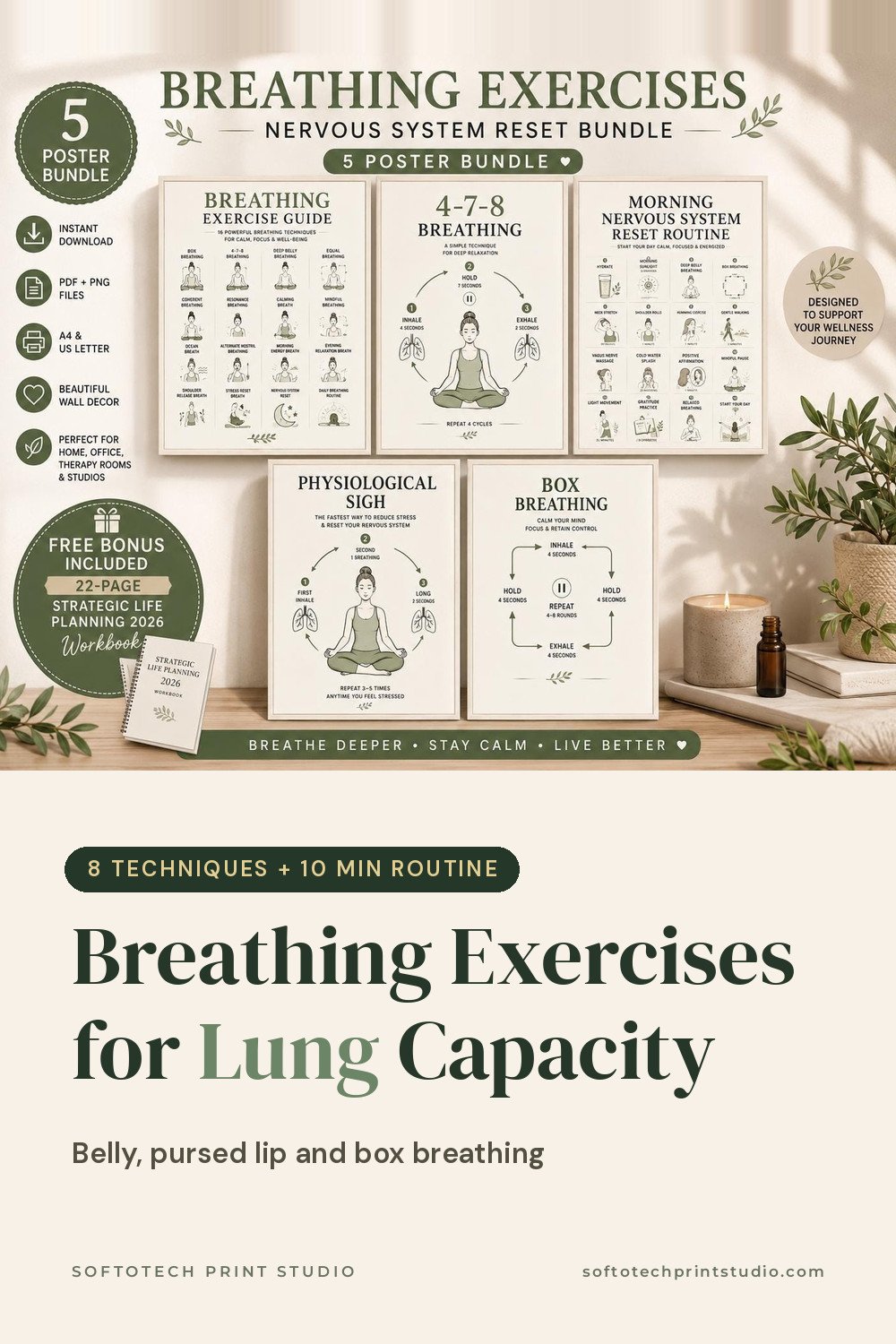
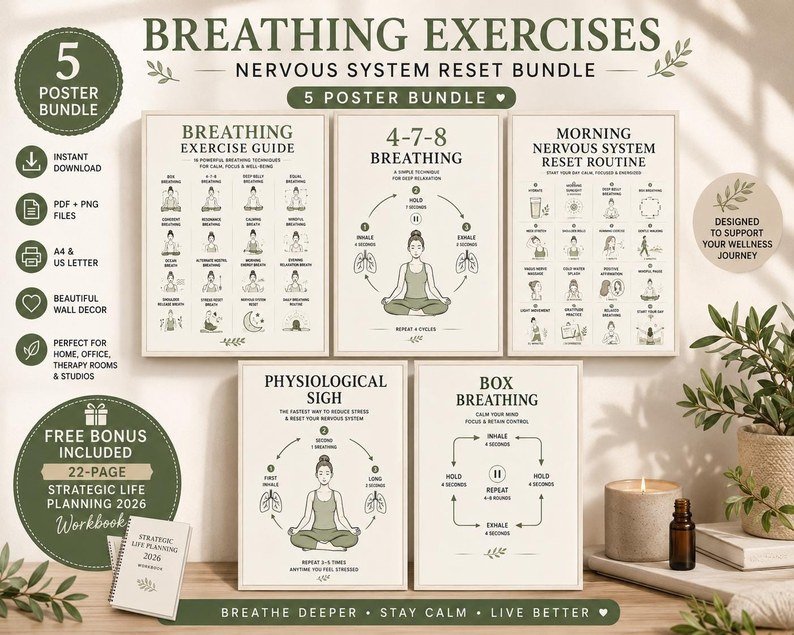
- 5 posters: Breathing Exercise Guide, 4-7-8 Breathing, Physiological Sigh, Box Breathing and Morning Nervous System Reset Routine
- The Breathing Exercise Guide shows 16 techniques, including deep belly breathing, equal breathing and alternate nostril breathing
- Box Breathing poster: inhale, hold, exhale, hold for 4 seconds each, 4 to 8 rounds
- Physiological Sigh poster: repeat 3 to 5 times, anytime you feel stressed
- PDF and PNG files; the listing photos show A4 and US Letter plus larger sizes up to A2
- Instant download · Print at home · A4 · US Letter
Use code BLOG10 for 65% OFF at Etsy checkout!
How Your Diaphragm and Lungs Work Together
The diaphragm is a large, dome shaped muscle at the base of your lungs. The American Lung Association says that with healthy lungs it does about 80 percent of the work of breathing. Cleveland Clinic calls it the most efficient muscle for breathing, and notes that your stomach muscles help move it and give you more power to empty your lungs.
The American Lung Association explains what goes wrong over time with asthma and especially COPD. The lungs lose some of their springiness and air gets trapped. Stale air builds up, which leaves less room for the diaphragm to contract and bring in fresh air. The body then leans on muscles in the neck, back and chest, which means lower oxygen levels and less reserve for activity.
Many people without lung disease also slip into shallow chest breathing, especially when stressed or sitting hunched over a screen. Cleveland Clinic puts it simply: when you breathe normally, you don’t use your lungs to their full capacity, and diaphragmatic breathing helps you use them more fully to increase efficiency.
So when people search for ways to increase lung capacity, what they can realistically train is how well they use the lungs they have: slower breaths, a working diaphragm, longer exhales and less trapped air.
Eight Techniques, Starting With the Two Core Ones
The American Lung Association’s advice is to learn these when you’re breathing comfortably, not for the first time when you’re out of breath. Once they feel natural, you can use them when you need them.
Technique 1: Pursed lip breathing
The American Lung Association says this technique reduces the number of breaths you take and keeps your airways open longer, so more air can flow in and out. Here are its steps:
- Sit in a chair and relax your neck and shoulders.
- Breathe in slowly through your nose with your mouth closed. Some people count: in, 1, 2.
- Pucker your lips as if you were going to whistle or gently blow out a candle.
- Breathe out slowly and gently through pursed lips, longer than you breathed in. Count: out, 1, 2, 3, 4.
- Repeat until your breathing settles.
Technique 2: Belly breathing (diaphragmatic breathing)
Cleveland Clinic suggests learning this lying down first:
- Lie on your back with your knees bent and your head supported. A pillow under your knees helps.
- Put one hand on your upper chest and the other just below your rib cage.
- Breathe in slowly through your nose so your stomach moves out against your hand. The hand on your chest should stay as still as possible.
- Tighten your stomach muscles so your stomach moves in as you breathe out through pursed lips. Again, keep the chest hand still.
Once that feels easy, try it sitting in a chair with your shoulders, head and neck relaxed. The American Lung Association adds that you should breathe out two to three times as long as you breathe in, and practice for 5 to 10 minutes. Cleveland Clinic warns that it may feel tiring at first, because it takes effort to use the diaphragm correctly, but with practice it becomes automatic.
| Technique | In | Out | Practice |
|---|---|---|---|
| Pursed lip breathing | Through the nose, about 2 counts | Through pursed lips, about 4 counts | Until breathing settles; 5 to 10 minutes a day (ALA) |
| Belly breathing | Through the nose, belly rises | Through pursed lips, 2 to 3 times longer | 5 to 10 minutes a day (ALA); 3 to 4 times a day to start (Cleveland Clinic) |
Six More Techniques From the Posters
The Breathing Exercise Guide poster in the bundle is headed “16 powerful breathing techniques for calm, focus and well-being.” Its tiles are box breathing, 4-7-8 breathing, deep belly breathing, equal breathing, coherent breathing, resonance breathing, calming breath, mindful breathing, ocean breath, alternate nostril breathing, morning energy breath, evening relaxation breath, shoulder release breath, stress reset breath, nervous system reset and daily breathing routine. Most of these are relaxation techniques, not lung exercises, but six pair well with the two core techniques.
- Box breathing. The Box Breathing poster shows inhale 4 seconds, hold 4 seconds, exhale 4 seconds, hold 4 seconds, repeat 4 to 8 rounds. It’s a good way to practice slow, even breaths. Skip the holds if they make you dizzy or breathless.
- 4-7-8 breathing. The poster calls it “a simple technique for deep relaxation”: inhale for 4, hold for 7, then a long exhale, repeated for 4 cycles. The long, slow exhale is the part that matters most here.
- Physiological sigh. The poster shows a first inhale, a second short top up breath, then a long exhale, repeated 3 to 5 times “anytime you feel stressed.”
- Equal breathing. Breathe in and out for the same slow count, such as 4 in and 4 out. Once that feels easy, make the out breath longer than the in breath, as the core techniques do.
- Shoulder release breath. Breathe in as you lift your shoulders gently, and let them drop as you breathe out. This helps stop the neck and shoulder muscles from taking over, which both sources warn against.
- Daily breathing routine. The poster’s last tile is simply a daily routine, and both sources stress practicing every day. A few minutes daily beats an occasional long session.
If you’d like to use these for stress rather than breathing, our breathwork for anxiety guide goes through the calming techniques in more detail.
A 10 Minute Daily Breathing Routine
This routine is my suggestion, built on the two sources’ advice. Do it sitting tall in a firm chair, at a time when you’re breathing comfortably.
| Minutes | What to do |
|---|---|
| 0 to 1 | Sit tall, feet flat. Five shoulder release breaths: lift the shoulders on the in breath, drop them on the out breath. |
| 1 to 4 | Belly breathing, one hand on the chest and one on the belly. Out breath two to three times as long as the in breath. |
| 4 to 6 | Pursed lip breathing: in through the nose for 2, out through pursed lips for 4. |
| 6 to 8 | Box breathing, 4 rounds of 4 seconds each side, or equal breathing if holds don’t suit you. |
| 8 to 10 | Back to slow belly breathing, letting the breath return to its own pace. |
How to progress. Cleveland Clinic suggests gradually increasing the time you spend and, once it’s easy, placing a book on your stomach to add a little effort. A second short session later in the day is a good next step.
Posture helps. It’s hard to belly breathe when you’re slumped. Our posture correction exercises open up the chest and upper back, which makes deeper breathing easier.
Stop if. You feel dizzy, light headed, tingly or more breathless. Go back to normal breathing and rest. Get urgent help if breathlessness doesn’t settle.
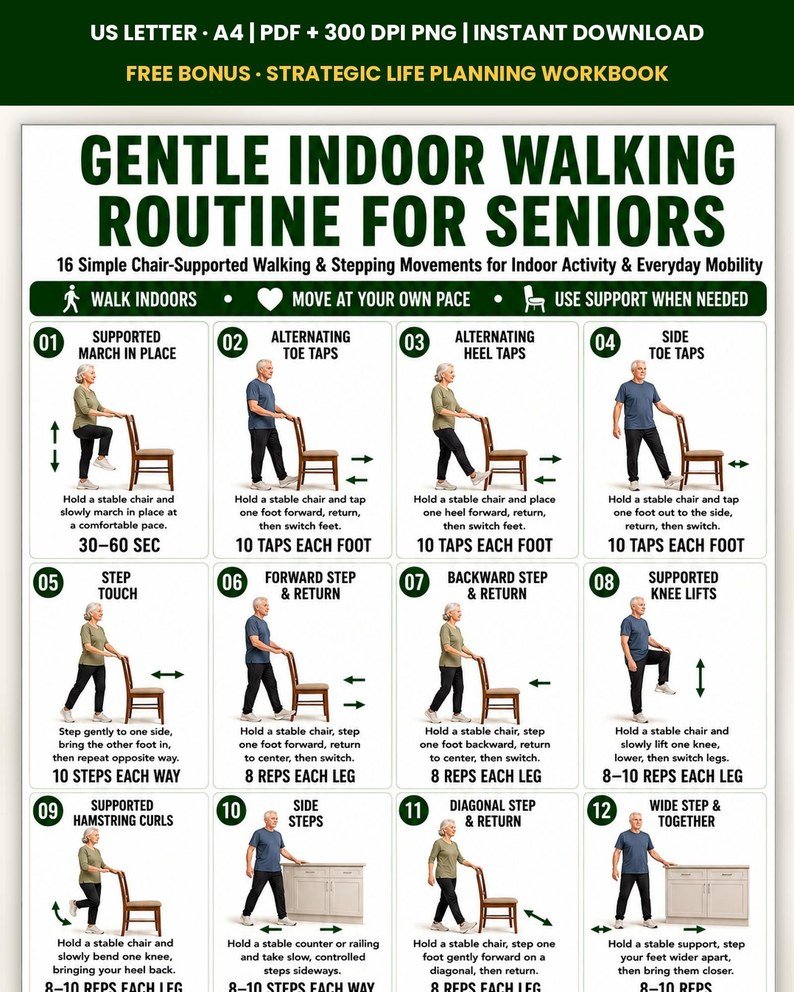
- 16 simple chair supported walking and stepping movements for indoor activity and everyday mobility
- Moves include supported march in place, toe and heel taps, step touch and side steps
- Each move has a cue and a target, such as 30 to 60 seconds of supported marching
- Banner reminders: walk indoors, move at your own pace, use support when needed
- US Letter and A4, PDF plus 300 DPI PNG, per the listing
- Instant download · Print at home · US Letter · A4
Use code BLOG10 for 65% OFF at Etsy checkout!
Walking Builds the Reserve Behind Every Breath
The American Lung Association compares breathing exercises to aerobic exercise: one makes your lungs more efficient, the other improves your heart and muscles. You want both. Gentle, regular walking can make everyday tasks feel less tiring over time, which is why the two pair so well. The association also points people with lung disease to pulmonary rehabilitation, a program of education and exercise classes that teaches you how to exercise and be more active with less shortness of breath. If you have a lung condition, ask your doctor whether it’s right for you.
The second printable is the Gentle Indoor Walking Routine for Seniors chart. It’s headed “16 simple chair-supported walking and stepping movements for indoor activity and everyday mobility,” with three reminders: walk indoors, move at your own pace, use support when needed. Here are the first 12 moves as the chart shows them. Moves 13 to 16 aren’t visible in the listing photo.
| # | Move | Chart target |
|---|---|---|
| 1 | Supported march in place | 30 to 60 seconds |
| 2 | Alternating toe taps | 10 taps each foot |
| 3 | Alternating heel taps | 10 taps each foot |
| 4 | Side toe taps | 10 taps each foot |
| 5 | Step touch | 10 steps each way |
| 6 | Forward step and return | 8 reps each leg |
| 7 | Backward step and return | 8 reps each leg |
| 8 | Supported knee lifts | 8 to 10 reps each leg |
| 9 | Supported hamstring curls | 8 to 10 reps each leg |
| 10 | Side steps | 8 to 10 steps each way |
| 11 | Diagonal step and return | 8 reps each leg |
| 12 | Wide step and together | 8 to 10 reps |
Breathe while you walk. Use pursed lip breathing during the harder parts: breathe in through the nose for 2 steps, out through pursed lips for 4 steps. If you can’t talk in short sentences, slow down.
When you’re ready to go outdoors, our walking plan for seniors builds up week by week, and our walking exercises for seniors guide walks through this chart move by move.
Frequently Asked Questions
Can breathing exercises increase lung capacity?
Breathing exercises can’t promise a bigger lung, and no one should sell them that way. What the American Lung Association says is that, like aerobic exercise for the heart, breathing exercises can make your lungs more efficient, help clear stale air and help the diaphragm do its job. Many people find breathing feels easier with practice.
What is the best breathing exercise for the lungs?
The American Lung Association calls pursed lip breathing and belly (diaphragmatic) breathing the two most useful breathing exercises. Both are taught by pulmonary rehabilitation specialists. Start with those two before trying anything else.
How long should I practice breathing exercises each day?
The American Lung Association suggests practicing pursed lip and belly breathing for about 5 to 10 minutes every day. Cleveland Clinic suggests starting diaphragmatic breathing at 5 to 10 minutes about three to four times a day and building up gradually.
Are breathing exercises safe if I have asthma or COPD?
These techniques are taught to people with asthma and COPD, but they don’t replace your inhalers or treatment plan. Cleveland Clinic advises talking to your provider about diaphragmatic breathing to see if it’s right for you. If you’re short of breath and it doesn’t settle, get urgent medical help.
What sizes does the breathing poster bundle print in?
The listing photos show PDF and PNG files in A4 and US Letter, with a size guide showing each poster at A2, 16 x 20 inches, A3, A4 and US Letter.
This guide is for general wellness and is not medical advice. Breathing exercises do not treat asthma, COPD or any lung or heart condition. Check with your doctor before starting, and seek urgent help for breathlessness that does not settle.
Related Guides
- Breathwork for Anxiety
- Walking Exercises for Seniors
- Walking Plan for Seniors
- Posture Correction Exercises
Sources
Sources: American Lung Association, Breathing Exercises, Cleveland Clinic, Diaphragmatic Breathing