
Resistance band workout for women over 40 routines have become a favorite way to build strength at home — and for good reason. A resistance band workout for women over 40 builds muscle, supports bone health, and strengthens the joints, all with a tool that costs very little, fits in a drawer, and is far gentler on your body than heavy weights.
After 40, muscle mass naturally begins to decline a little each decade, and strength training is the most practical way to slow that loss. The good news: you do not need a gym, a rack of dumbbells, or high-impact exercise. Bands create resistance by stretching, so the effort is smooth, adjustable, and available seated or standing — which makes them ideal for beginners and for anyone whose knees or shoulders prefer a kinder approach.
In this guide, you will get a complete full-body resistance band workout for women over 40: how to choose the right band, a warm-up, eight exercises with simple form cues, a ready-to-follow weekly plan, and the safety notes to read first. You will also find a printable workout chart from SoftoTech Print Studio to keep by your exercise space.
In this guide:
- Why Resistance Bands Work So Well After 40
- How to Choose the Right Band
- Warm-Up: 3 Gentle Minutes
- The Full-Body Resistance Band Workout (8 Exercises)
- Your Simple Weekly Plan
- Safety and Form Tips for Women Over 40
- Common Beginner Mistakes to Avoid
- Frequently Asked Questions


The printable from this guide
Senior Resistance Band Exercise Chart
- 16 gentle band exercises for strength, balance & daily mobility
- Seated and standing moves with clear illustrations & reps
- Instant download · Print at home · A4 · US Letter · A5
Use code BLOG10 for 65% OFF at Etsy checkout!
Get the Resistance Band Chart on Etsy →
Instant download · Print at home
Why Resistance Bands Work So Well After 40
A resistance band workout for women over 40 is not about chasing personal records — it is about keeping the muscle that makes everyday life easy: carrying groceries, climbing stairs, getting up from the floor, and steadying yourself if you trip. Resistance bands train all of that. Because the band stretches, resistance increases smoothly through each movement instead of loading your joints with a sudden heavy weight, and you can change the effort simply by shortening your grip or stepping closer to the anchor.
Bands are also forgiving for beginners. There is nothing heavy to drop, the workout is quiet enough for any room, and most exercises in this guide have a seated option if balance is a concern. If you have enjoyed our 20-minute no-equipment home workout for beginners, bands are the natural next step: same living-room setup, more strength-building options.
How to Choose the Right Band
You will see three common styles:
- Loop bands (mini bands): a continuous circle, perfect for legs and glutes — lateral walks, bridges, and knee-friendly leg work.
- Long flat bands: a long strip you can tie, anchor in a door, or hold at any length — the most versatile choice for upper-body work like rows and presses.
- Tube bands with handles: comfortable grips and door anchors included; a good all-in-one starter if you prefer handles.
Most sets include several resistance levels (often color-coded from light to heavy). Start with the lightest band that lets you finish each set with good form while feeling like you could do only two or three more repetitions. Check bands before each session: a nick or tear means it is time to retire that band, because a snapping band is the one injury this equipment can cause. Replace bands kept in hot or sunny spots sooner — heat and sunlight age the material.
Warm-Up: 3 Gentle Minutes
Never skip the warm-up — muscles and joints over 40 appreciate a gradual start. March in place for one minute, lifting your knees comfortably. Do ten slow arm circles forward and ten backward. Practice five sit-to-stands from a sturdy chair. Finish with ten gentle band pull-aparts using your lightest band (see exercise 4) at an easy effort. You should feel warm and loose, never tired, before the first working set.

Keep training at home
Resistance Band Workout Bundle — 4 Charts
- 4 printable charts with 64 exercises: upper & lower body, senior chair
- Home gym strength routines with clear illustrations
- Instant download · Print at home · A4 · US Letter · A5
Use code BLOG10 for 65% OFF at Etsy checkout!
Get the Band Workout Bundle on Etsy →
Instant download · Print at home
The Full-Body Resistance Band Workout (8 Exercises)
Do each exercise for the sets listed, resting 30–60 seconds between sets. Move slowly — about two seconds out, two seconds back — and breathe out on the effort. Stop any exercise that causes sharp pain.
- Seated Row (back and posture) — 2 sets of 10–12. Sit tall in a chair, band looped around your feet with legs extended (or anchored ahead of you). Hold an end in each hand, then pull your elbows back, squeezing your shoulder blades together. Release slowly. This is the posture exercise — practice it like you mean it.
- Chest Press (chest and arms) — 2 sets of 10–12. Run a long band behind your upper back and hold the ends at chest height. Press your hands forward until your arms are nearly straight, then return slowly. Keep your shoulders down, away from your ears.
- Band Pull-Apart (shoulders and upper back) — 2 sets of 10–12. Hold a light band in front of you at shoulder height, arms straight. Pull the band apart toward your chest by moving your arms out to the sides, then return with control. Start light — this one is harder than it looks.
- Bicep Curl (arms) — 2 sets of 10–12. Stand on the middle of a long band (or sit with it under your feet) and hold the ends. Keeping your elbows tucked at your sides, curl your hands toward your shoulders and lower slowly.
- Sit-to-Stand (legs and glutes) — 2 sets of 8–10. From a sturdy chair, stand up fully, then sit back down with control. For more challenge, place a loop band just above your knees and gently press outward as you stand. This is the most practical strength move in the whole routine.
- Glute Bridge with Loop Band (glutes and hips) — 2 sets of 10–12. Lying on your back with knees bent and a loop band above your knees, lift your hips while pressing your knees slightly outward against the band. Lower slowly. Strong hips support your back and your balance.
- Lateral Band Walk (hips and balance) — 2 sets of 8 steps each way. With a loop band above your ankles or knees, take small sideways steps, keeping tension on the band the whole time. Hold a chair or counter if balance is a concern.
- Standing Kickback (glutes) — 2 sets of 8–10 per leg. Holding a chair for balance, with a loop band around your ankles, sweep one leg straight back a short distance, squeeze the glute, and return. Small and controlled beats big and swingy.
Prefer a poster on the wall to a phone in your hand? That is exactly what the printable chart in the product box above is for — and if you also train with weights, our dumbbell arm workout for women and the full-body dumbbell workout 5-day plan follow the same gentle, beginner-first approach.
Your Simple Weekly Plan
Two or three sessions per week is a strong, sustainable rhythm in a resistance band workout for women over 40 — muscles need rest days to rebuild, and those rest days are when you actually get stronger.
| Day | Session |
|---|---|
| Monday | Full-body band workout (all 8 exercises) |
| Tuesday | Walk + gentle stretching |
| Wednesday | Rest or light activity |
| Thursday | Full-body band workout (all 8 exercises) |
| Friday | Walk + gentle stretching |
| Saturday | Optional third session, or repeat a favorite walk |
| Sunday | Rest |
Track your sessions as you go — a simple written log makes progress visible and keeps motivation honest. After three to four comfortable weeks at one band level, move to the next resistance for the exercises that feel easy, keeping the lighter band for shoulders and pull-aparts, which progress more slowly.
Safety and Form Tips for Women Over 40
Form before resistance. A lighter band with perfect form builds more strength — and far fewer aches — than a heavy band with momentum and shrugged shoulders. Film yourself once on your phone if you are unsure; it is surprisingly helpful.
Mind your joints. Keep knees tracking over toes in stands and walks, keep wrists straight during presses and curls, and never lock elbows or knees hard at the end of a movement.
Balance support is smart, not weak. Use a chair or counter for standing leg work, especially while learning. Many women over 40 pair band sessions with balance practice — our standing balance exercises using a chair fit perfectly on walk days.
Talk to your doctor first if you have osteoporosis, a joint replacement, uncontrolled blood pressure, or any condition you are unsure about — and stop and seek advice if you feel chest pain, dizziness, or sharp joint pain during a session.
You can also browse our free printables for starter workout charts to try before setting up your exercise corner.
Common Beginner Mistakes to Avoid
Letting the band snap back. The return half of each repetition is half the workout. If the band controls you, the band is too heavy — go lighter and own every inch of the movement.
Choosing the heaviest band on day one. Soreness that lasts three days is not a badge of honor; it is the fastest way to quit in week two. Start light, finish feeling capable, and progress weekly.
Holding your breath. Breathe out on the effort, in on the return. Steady breathing keeps blood pressure steadier and form cleaner.
Training every day. Strength is built during recovery. Two or three quality sessions with rest days will outperform daily rushed ones, especially after 40.
On days without the band, a standing pilates routine for women over 50 is a gentle way to keep working on core and balance.
Frequently Asked Questions
Are resistance bands effective for women over 40?
Yes. Resistance bands build strength by making your muscles work against increasing tension as the band stretches, and research on resistance training generally supports bands as an effective, joint-friendly option — especially for beginners and home workouts. Two or three full-body sessions a week with progressive resistance is a proven, practical approach.
How many times a week should I do a resistance band workout?
Two or three sessions per week, with at least one rest day between sessions, suits most women over 40. Rest days are when muscles repair and strengthen. On other days, walking and gentle stretching pair well with band training.
Which resistance band should a beginner start with?
Start with the lightest band in a multi-level set — often a light or medium loop band for legs and a light long flat band for upper body. The right band lets you finish a set with good form, feeling like you could do only two or three more repetitions. Progress to the next level when a full workout feels comfortable.
Can I do resistance band exercises seated?
Yes — seated rows, chest presses, bicep curls, and leg presses against a band can all be done from a sturdy chair. Seated versions are a good choice if balance is a concern or you are returning to exercise after a break. Use a chair without wheels, on a non-slip floor.
Do resistance bands help with bone health?
Resistance training — including band workouts — is one of the exercise types health organizations commonly recommend to support bone health as we age, alongside weight-bearing activity like walking. If you have osteoporosis or low bone density, ask your doctor which exercises and loads are appropriate for you before starting.
Training an older parent or partner? Our resistance band exercises for seniors adapt band training into a gentle senior-friendly routine.
Related Guides
- Dumbbell Arm Workout for Women (Toned Arms)
- Full-Body Dumbbell Workout at Home: 5-Day Plan for Beginners
- 20-Minute No-Equipment Home Workout for Beginners
- 7 Standing Balance Exercises Using a Chair for Support
Sources
Sources: CDC — Physical Activity for Older Adults, Mayo Clinic — Strength training: Get stronger, leaner, healthier, NIH Office of Dietary Supplements — Calcium and bone health
This guide is for general wellness and is not medical advice. Check with your doctor before starting a new routine.
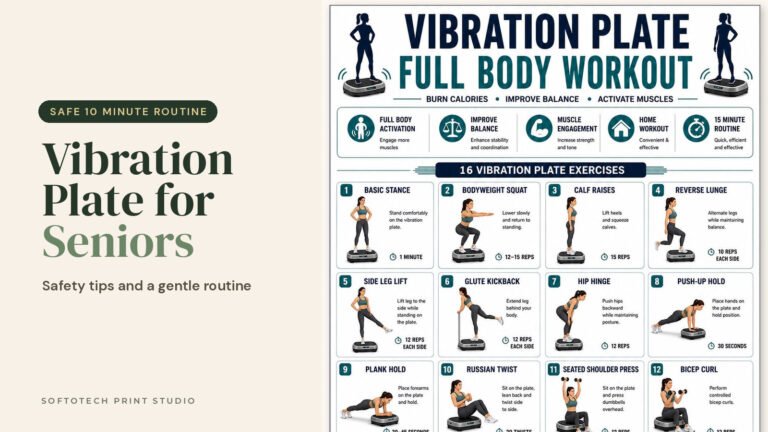 Home WorkoutsVibration Plate for Seniors: What It Can and Can’t Do, Who Should Avoid It, and a Safe 10 Minute Routine
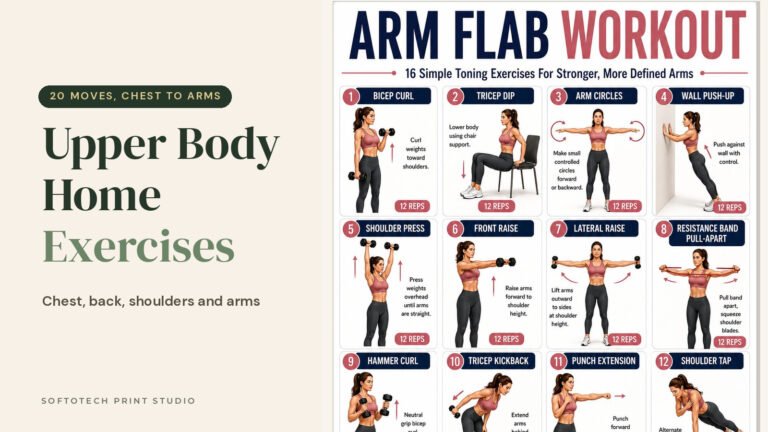 Home WorkoutsUpper Body Home Exercises: 20 Moves for Chest, Back, Shoulders and Arms, With a 25 Minute Workout
 Home WorkoutsCore Exercises for Women Over 50: 16 Gentle Moves, Standing First, With a 15 Minute Routine and a 4 Week Plan