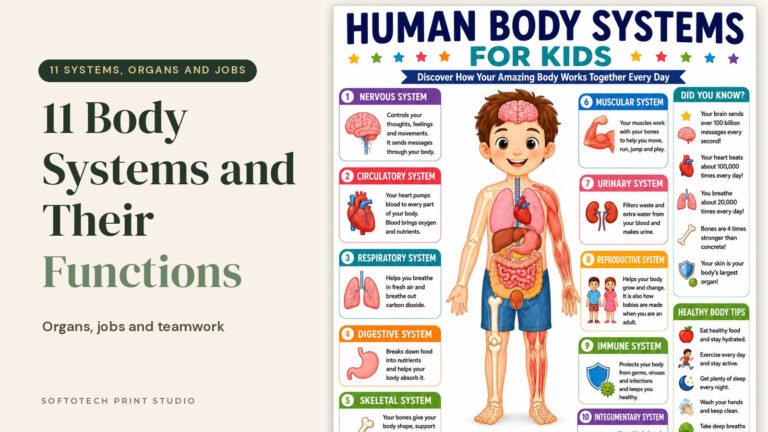
Human body anatomy for kids sounds like a school subject, but most kids learn it best when it feels like a puzzle about themselves. Where does food go after you swallow it. Why does your heart beat faster when you run. What do bones actually do all day. This guide answers those questions in plain words, one body system at a time, using a printable chart made for ages 5 to 12.
The chart in the first box below shows 10 body systems on one poster, each with a one line job a child can understand. The systems are nervous, circulatory, respiratory, digestive, skeletal, muscular, urinary, reproductive, immune and integumentary. That last word is a mouthful, so the chart explains it simply: your skin, hair and nails protect your body and help control its temperature. Kids do not need the long word first. They need the job first, and the name second.
One honest note before we start. The bottom strip of the chart, headed How Body Systems Work Together, and the Remember strip below it, are cut off on the listing image, so this guide never quotes them. The second box is an 11 poster bundle, and only the 11 poster titles on its cover are legible, so this guide names only those titles and never quotes text from inside the individual posters. The reproductive system line is quoted exactly as printed, in plain words for parents: it helps your body grow and change, and it is also how babies are made when you are an adult. For a feelings chart in the same age range, our feelings chart for kids guide pairs well with this one.
In this guide:
- The 10 Body Systems on the Chart
- Did You Know Facts Kids Remember
- Worked Plan: Teach the 10 Systems in One Week
- Healthy Body Tips and How to Use the Chart
- Frequently Asked Questions
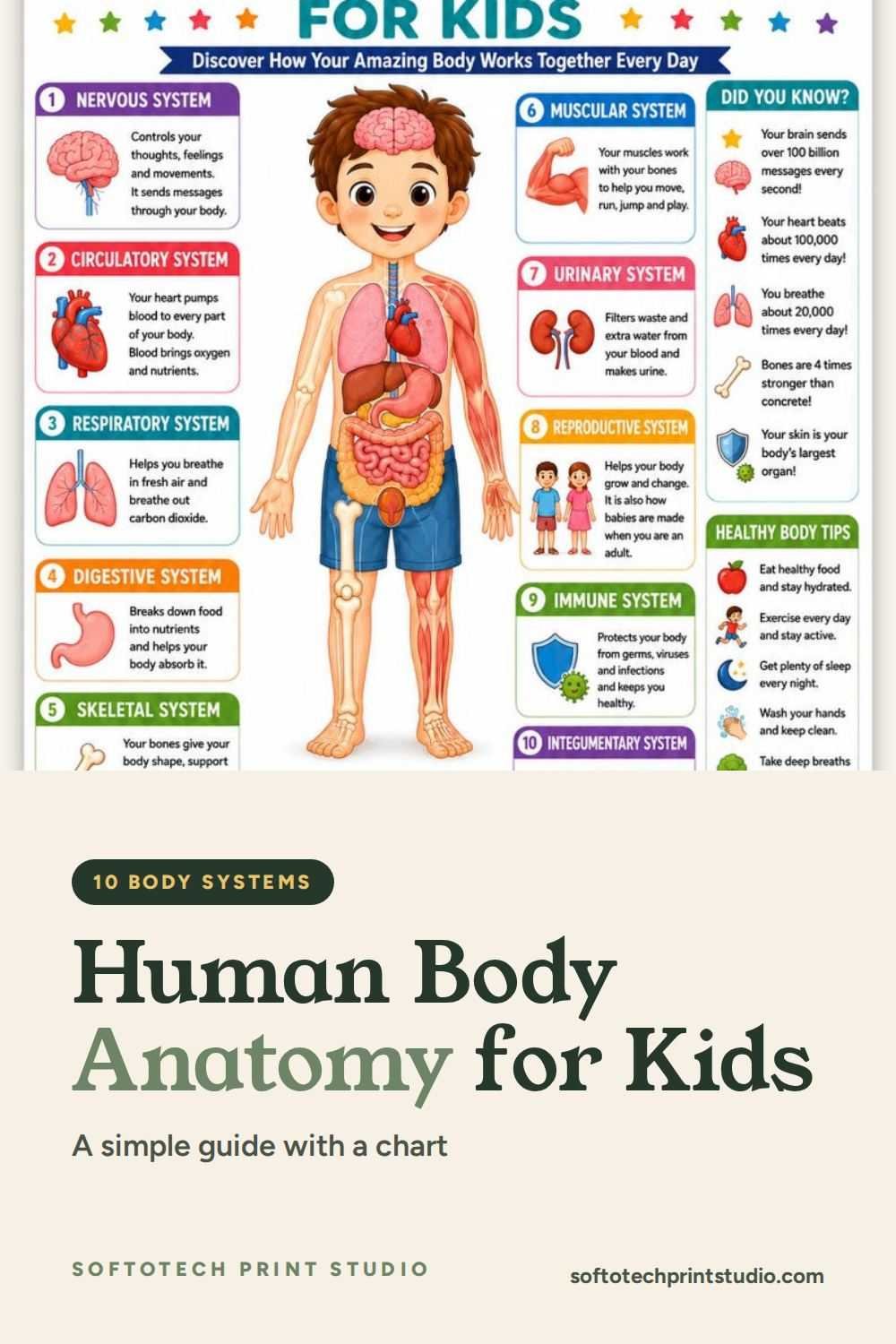
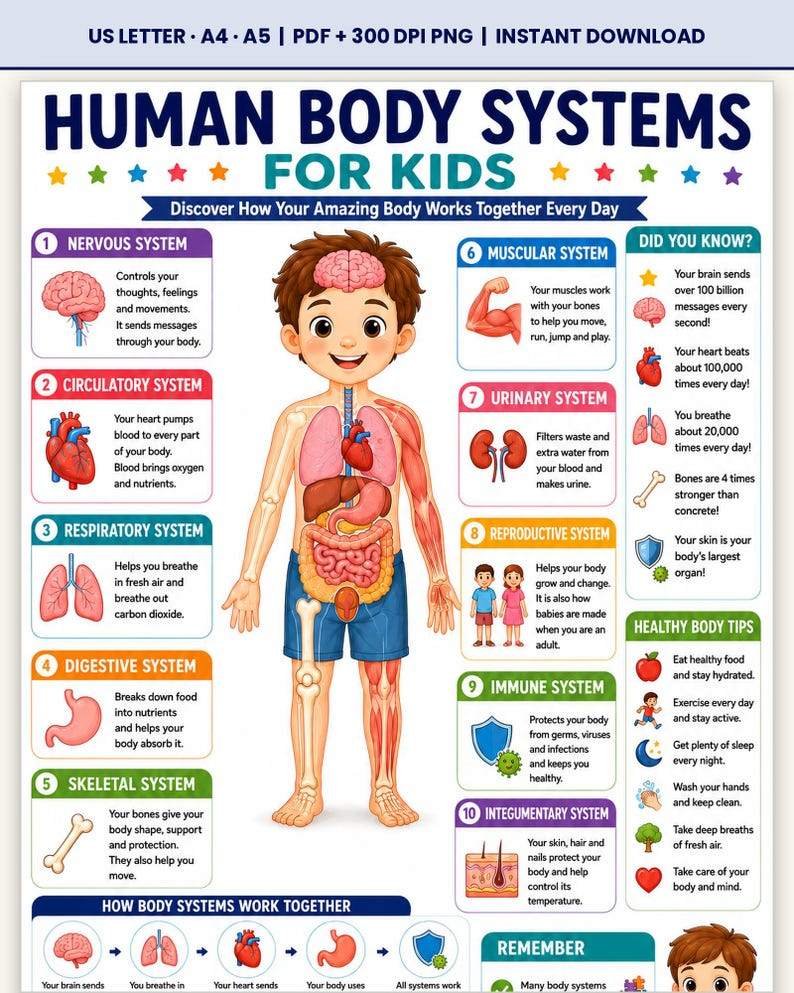
- 10 body systems on one chart, each with a one-line job a child can understand: nervous, circulatory, respiratory, digestive, skeletal, muscular, urinary, reproductive, immune and integumentary
- Did you know facts on the chart: your brain sends over 100 billion messages every second, your heart beats about 100,000 times a day, you breathe about 20,000 times a day
- Healthy body tips on the chart: eat well, stay hydrated, exercise daily, sleep plenty, wash hands, breathe fresh air
- Made for ages 5 to 12, for homeschool and classroom walls
- Print sizes US Letter, A4 and A5, as 3 PDFs plus a PNG per the listing, PDF and 300 DPI PNG
- Instant download · Print at home · US Letter · A4 · A5
Use code BLOG10 for 65% OFF at Etsy checkout!
The 10 Body Systems on the Chart
Start with the nervous system, because it is the boss. The chart says it controls your thoughts, feelings and movements, and it sends messages through your body. Tell a child to wiggle their toes without looking, and that is the nervous system at work. The brain sends the message, the nerves carry it, and the toes move. It is the fastest system to explain, because kids can test it on the spot.
The circulatory system is the delivery team. The chart says your heart pumps blood to every part of your body, and blood brings oxygen and nutrients. Put a hand on your chest after a run and feel the beat. That is the pump working harder. The respiratory system is the air team. It helps you breathe in fresh air and breathe out carbon dioxide. Breathe in slowly together, hold for a second, breathe out. That is the whole system in one breath.
The digestive system breaks down food into nutrients and helps your body absorb it. Follow a bite of food in your mind: mouth, down the tube, into the stomach, through the intestines. Kids love the journey version, and the bundle below has a poster called Digestive System Journey for Kids for exactly that reason. The skeletal system is the frame. Your bones give your body shape, support and protection, and they also help you move. Without bones, we would be a puddle. That line usually gets a laugh, and it sticks.
The muscular system works with the bones. Your muscles work with your bones to help you move, run, jump and play. Flex an arm and feel the muscle tighten. That is a muscle pulling on a bone. The urinary system filters waste and extra water from your blood and makes urine. It is the cleaning crew, and it is fine to say that plainly. The reproductive system helps your body grow and change, and it is also how babies are made when you are an adult. That is the line as printed, and it is enough for most young kids. Answer the question they asked, and leave the rest for later.
The immune system protects your body from germs, viruses and infections and keeps you healthy. It is the security guard. When a child gets a cold and then gets better, that is the immune system learning and fighting back. The integumentary system is the skin, hair and nails. It protects your body and helps control its temperature. Skin keeps germs out, sweat cools you down, and goosebumps are the body trying to warm up. Ten systems sounds like a lot, but each one has a single job, and a child can learn the jobs one at a time. Our kids exercise routine guide shows how movement uses the muscular and skeletal systems together.
| System | Its job, in one line | Try it with your child |
|---|---|---|
| Nervous | Controls thoughts, feelings and movements | Wiggle toes without looking |
| Circulatory | Heart pumps blood everywhere | Feel your heartbeat after a run |
| Respiratory | Breathes in air, breathes out carbon dioxide | Slow breath in, slow breath out |
| Digestive | Breaks down food into nutrients | Trace a bite from mouth to stomach |
| Skeletal | Bones give shape, support and protection | Feel your shin bone through skin |
| Muscular | Muscles work with bones to move you | Flex an arm and feel it tighten |
| Urinary | Filters waste and extra water | Talk about why we drink water |
| Reproductive | Helps your body grow and change | Answer only the question asked |
| Immune | Protects you from germs and infections | Talk about getting better after a cold |
| Integumentary | Skin, hair and nails protect you | Feel sweat cooling your skin |
Notice how the systems work in pairs. Muscles need bones. The heart needs lungs. The digestive system needs the circulatory system to carry nutrients away. You do not need to teach the connections on day one. Teach the jobs first, and the connections show up on their own when a child asks why running makes them breathe faster. That question links three systems at once, and it is a better lesson than any worksheet.
Did You Know Facts Kids Remember
The chart carries five did you know facts, and they are the kind kids repeat at dinner. Your brain sends over 100 billion messages every second. Your heart beats about 100,000 times a day. You breathe about 20,000 times a day. Your bones are 4 times stronger than concrete. Your skin is your body’s largest organ. Pick one fact a day and let it sit. Five facts in one sitting blur together. One fact, plus a quick test, sticks.
The brain fact is the hardest to picture, so make it physical. Ask a child to touch their nose with eyes closed, then hop on one foot, then name their favourite food. Three messages, three actions, all in seconds. Now imagine 100 billion of those every second. The number is too big to picture, and that is the point. The brain is busy even when you feel still. The heart fact is easier to test. Count heartbeats for 15 seconds, multiply by four, and you have a rough beats per minute. Do it resting, then after ten star jumps, and watch the number climb.
The breathing fact works the same way. Count breaths for a minute while sitting still. It will be far fewer than 20,000 a day sounds, because a day is long and breathing never stops. That is the lesson: the body works all day without being told. The bone fact surprises most adults too. Bones are 4 times stronger than concrete, which sounds wrong until you remember that bones are light and living, and concrete is heavy and still. A bone heals. Concrete does not. The skin fact is the easiest to see. Skin covers everything, it keeps germs out, and it is the largest organ, even though most kids think of organs as things inside the body.
Use the facts as conversation starters, not quiz questions. A child who is asked to recite a fact will forget it. A child who tests a fact will keep it. Let them count their own breaths, feel their own pulse, and flex their own arm. The chart is a poster, but the learning happens in the body. Stick the poster at eye level, not high on a wall where only adults can read it. A poster a child can point at is a poster they will use. Our healthy habits for kids guide builds on the same facts with daily habits a child can actually do.
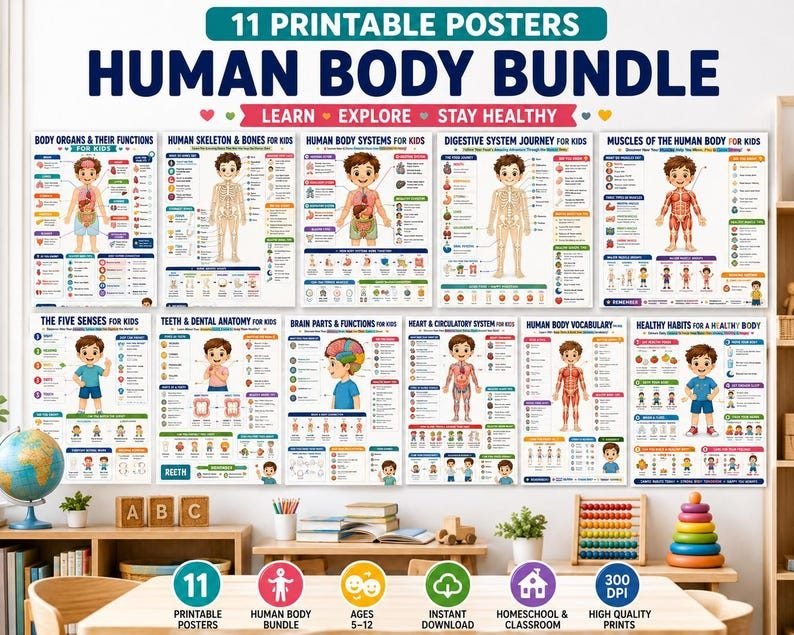
- 11 printable posters in one bundle: body organs, skeleton and bones, body systems, digestive system journey, muscles, five senses, teeth, brain parts, heart and circulation, body vocabulary and healthy habits
- Ages 5 to 12, for homeschool and classroom use, 300 DPI high quality prints
- Each poster prints in 3 sizes, so the same set fits a wall, a binder or a classroom display
- Print sizes US Letter, A4 and A5, as 3 ZIPs per the listing, with PDF and JPG files at 300 DPI PNG quality
- Instant download · Print at home · US Letter · A4 · A5
Use code BLOG10 for 65% OFF at Etsy checkout!
Worked Plan: Teach the 10 Systems in One Week
Here is a worked plan to teach the 10 systems in one week, one system a day in chart order, with the did you know fact for that day. It takes about 15 minutes a day, and it works at home or in a classroom. Each day has a system, a one line job, a quick test, and a fact where the chart gives one. Two systems share a day at the end, because ten systems across seven days needs one double day, and the last two pair naturally.
Day 1 is the nervous system. Job: it controls thoughts, feelings and movements, and sends messages through the body. Test: wiggle toes without looking, then touch your nose with eyes closed. Fact: your brain sends over 100 billion messages every second. Day 2 is the circulatory system. Job: your heart pumps blood to every part of your body, and blood brings oxygen and nutrients. Test: count heartbeats for 15 seconds, multiply by four, then repeat after ten star jumps. Fact: your heart beats about 100,000 times a day.
Day 3 is the respiratory system. Job: it helps you breathe in fresh air and breathe out carbon dioxide. Test: breathe in slowly for four counts, breathe out for four counts, and count breaths for one minute. Fact: you breathe about 20,000 times a day. Day 4 is the digestive system. Job: it breaks down food into nutrients and helps your body absorb it. Test: trace a bite of food from mouth to stomach on the poster, and talk about what happens after lunch. No did you know fact is tied to this system on the chart, so let the journey be the lesson.
Day 5 is the skeletal system. Job: your bones give your body shape, support and protection, and they also help you move. Test: feel your shin bone, your ribs and your elbow, and notice how hard they are under skin. Fact: your bones are 4 times stronger than concrete. Day 6 is the muscular system. Job: your muscles work with your bones to help you move, run, jump and play. Test: flex an arm, then do five squats and feel your leg muscles work. No chart fact is tied to this system, so the movement is the fact.
Day 7 covers the last four systems in a short round, because they are simpler to explain in one sitting. Urinary: it filters waste and extra water from your blood and makes urine. Reproductive: it helps your body grow and change, and it is also how babies are made when you are an adult. Immune: it protects your body from germs, viruses and infections and keeps you healthy. Integumentary: your skin, hair and nails protect your body and help control its temperature. Fact: your skin is your body’s largest organ. End the week by asking the child to point at each system on the poster and say its job in their own words. If they can do six out of ten, that is a good week. The other four will come with repetition.
The 11 poster bundle in the second box supports this plan well. Its 11 posters are body organs and their functions, human skeleton and bones for kids, human body systems for kids, digestive system journey for kids, muscles of the human body for kids, five senses for kids, teeth and dental anatomy for kids, brain parts and functions for kids, heart and circulatory system for kids, human body vocabulary for kids, and healthy habits for a healthy body. Use the skeleton poster on Day 5, the muscles poster on Day 6, the digestive journey poster on Day 4, and the five senses poster any day as a bonus. The bundle is made for ages 5 to 12, for homeschool and classroom use, and each poster prints in 3 sizes.
Healthy Body Tips and How to Use the Chart
The chart ends with healthy body tips, and they are refreshingly plain: eat healthy food and stay hydrated, exercise every day and stay active, get plenty of sleep every night, wash your hands and keep clean, take deep breaths of fresh air, and take care of your body and mind. None of these need a lecture. They need a routine. Water on the table at meals. A walk after school. A regular bedtime. Hands washed before eating. Fresh air on the way to school. A child who does these daily learns more about health than a child who memorises a list.
Use the poster as a reference, not a test. Hang it where the child can reach it. When a question comes up, walk to the poster together and find the answer. Why do I feel my heart beat fast. That is the circulatory system. Why am I out of breath. That is the respiratory system. Why does my arm hurt after climbing. That is the muscular system. A poster used this way becomes part of the house, and the child starts asking better questions.
For parents, the hardest part is usually the reproductive system line, and the chart keeps it simple on purpose. It helps your body grow and change, and it is also how babies are made when you are an adult. That is enough for a young child. If they ask more, answer the question they asked, in plain words, and stop there. You do not need a big talk. You need an honest short answer, and a willingness to answer again later when they ask more.
For teachers, the chart works as a week plan, as above, or as a station. Put the poster on the wall, put the bundle posters around the room, and let small groups visit each one. The five senses poster is a good station on its own, because kids can test all five senses in a minute. The teeth poster is another good one, because every child has teeth to look at. Keep the language plain, keep the tests physical, and keep the facts to one a day. Human body anatomy for kids works best when the child is the experiment, not the audience. Our facial anatomy chart guide goes deeper on one part of the body, the face, for older kids who want more detail.
Older students working toward the full textbook list can use our guide to the 11 body systems and their functions, with organs, jobs and a study plan.
Frequently Asked Questions
What is human body anatomy for kids?
Human body anatomy for kids is a simple way to learn how the body works, one system at a time. The chart in this guide shows 10 body systems: nervous, circulatory, respiratory, digestive, skeletal, muscular, urinary, reproductive, immune and integumentary. Each one has a one line job a child can understand, and the poster is made for ages 5 to 12.
How many body systems are on the chart?
The chart shows 10 body systems: nervous, circulatory, respiratory, digestive, skeletal, muscular, urinary, reproductive, immune and integumentary. The nervous system controls thoughts, feelings and movements. The circulatory system pumps blood. The respiratory system handles breathing. The digestive system breaks down food. The skeletal and muscular systems work together to move the body.
What are the did you know facts on the chart?
The chart lists five did you know facts: your brain sends over 100 billion messages every second, your heart beats about 100,000 times a day, you breathe about 20,000 times a day, your bones are 4 times stronger than concrete, and your skin is your body’s largest organ. Pick one fact a day and test it with your child, instead of teaching all five at once.
What are the healthy body tips on the chart?
The healthy body tips on the chart are eat healthy food and stay hydrated, exercise every day and stay active, get plenty of sleep every night, wash your hands and keep clean, take deep breaths of fresh air, and take care of your body and mind. They work best as a daily routine, not as a list to memorise.
What sizes does the human body systems poster print in?
The Human Body Systems for Kids Poster from SoftoTech Print Studio is an instant download that prints at home in US Letter, A4 and A5 sizes, as 3 PDFs plus a PNG per the listing, with PDF and 300 DPI PNG files. The 11 poster bundle also prints in US Letter, A4 and A5 sizes, with each poster in 3 sizes.
This guide is for general wellness and is not medical advice. Check with your doctor before starting a new routine.
Related Guides
Sources
Sources: KidsHealth, MedlinePlus Anatomy