Facial anatomy chart is a useful thing to have on the wall if you have ever wondered which muscle lifts an eyebrow, which one pulls the mouth down, or where the lymph nodes under your jaw actually sit. The poster in the first box below labels 14 major facial muscles and says what each one does. The chart in the second box labels 12 facial and neck lymph nodes, with where each one sits and what it drains. Both come from SoftoTech Print Studio, and both print at home in US Letter and A4 sizes. The listings do not state A5, so this guide does not claim it.
A face map is worth learning slowly, one group at a time, because the names look alike at first and the muscles are small and layered. Frontalis and procerus both work around the brows, but one lifts and the other draws together. Zygomaticus major and risorius both pull at the mouth corners, but one lifts and the other draws outward. Orbicularis oculi closes the eye, orbicularis oris closes the mouth, and the names tell you that once you know the pattern. This guide walks through the 14 muscles in groups, then the 12 lymph nodes in the same order as the chart, so you can follow along with the poster in front of you.
One honest note up front. No listing titled exactly “Facial Anatomy Chart” exists in the shop. The poster in the first box is the facial muscles anatomy poster, the closest face anatomy match, and this guide says so plainly. And the second box is a lymph nodes chart, an anatomy companion, not a massage routine. Its bottom strips were cut off on the listing image, so they are never quoted here beyond the two partly legible signs, Facial Puffiness and Under-Eye Swelling. For a practical follow on, our face yoga exercises guide covers gentle face exercises that use some of these same muscles.
In this guide:
- What the 14 Face Muscles on the Chart Do
- Reading the Face in Groups: Brow, Nose, Mouth, Jaw and Neck
- The 12 Lymph Nodes of the Face and Neck
- Worked Example: A Face Map Walkthrough
- Frequently Asked Questions

The printable from this guide
Facial Muscles Anatomy Poster
- 14 major facial muscles labelled, with what each one does: Frontalis, Procerus, Nasalis, Levator Labii Superioris, Zygomaticus Major, Orbicularis Oris, Depressor Labii Inferioris and Depressor Anguli Oris, plus Temporalis, Orbicularis Oculi, Masseter, Buccinator, Risorius and Platysma
- The smiling muscles include Zygomaticus Major, which lifts the corners of the mouth, and Risorius, which draws them outward; the frowning muscles include Depressor Anguli Oris, which pulls the corners downward
- The chewing muscles include Masseter, which lifts the lower jaw, and Temporalis, the fan-shaped muscle on the side of the head
- The eye muscles include Orbicularis Oculi, which closes the eyelids for blinking and squinting, and the mouth muscle Orbicularis Oris, which controls puckering and closing
- Print sizes US Letter and A4, as 2 PDFs plus a PNG and a ZIP per the listing (the listing does not state A5)
- Instant download · Print at home · US Letter · A4
Use code BLOG10 for 65% OFF at Etsy checkout!
Get the Facial Muscles Poster on Etsy →
What the 14 Face Muscles on the Chart Do
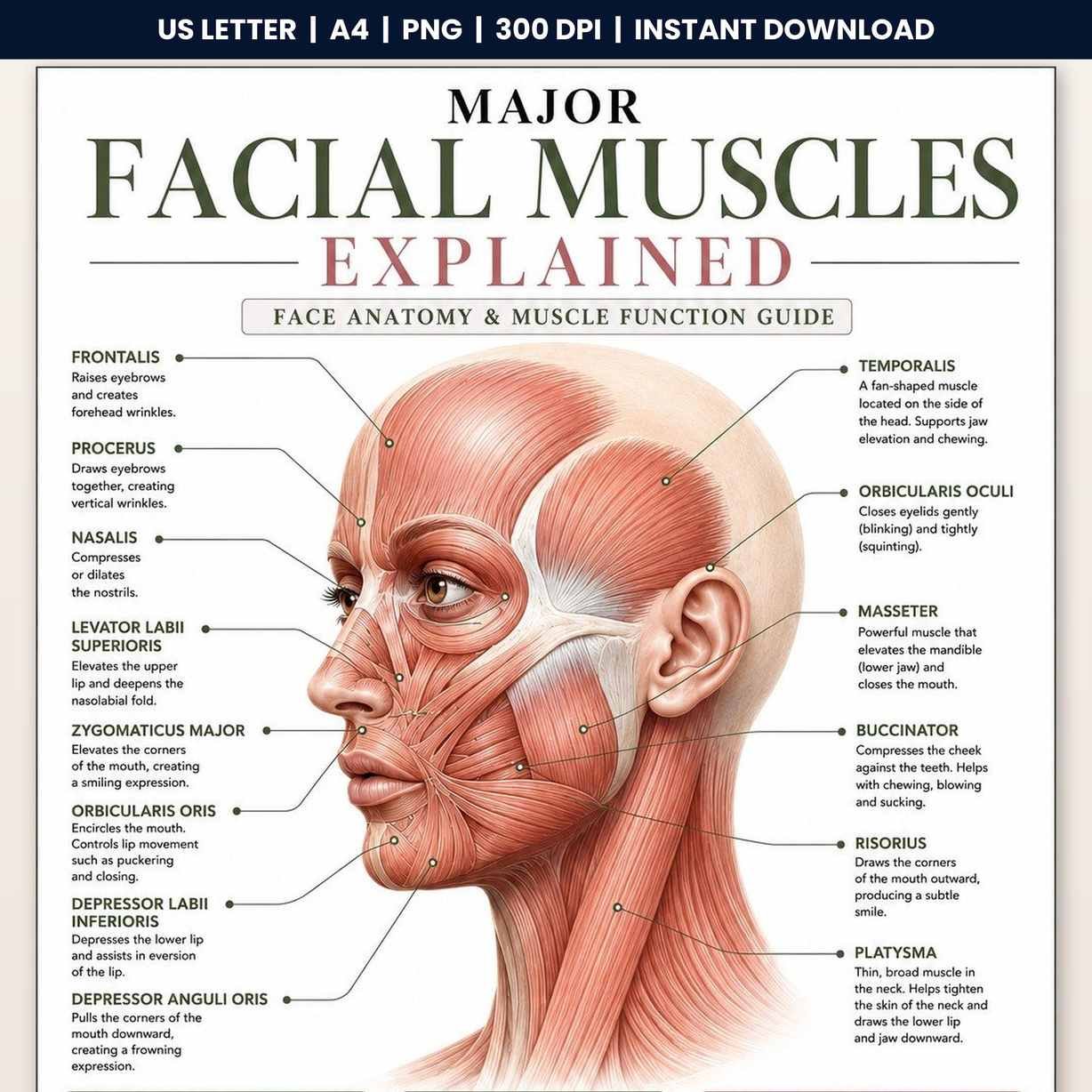
The poster is headed MAJOR FACIAL MUSCLES EXPLAINED, FACE ANATOMY AND MUSCLE FUNCTION GUIDE, and it labels 14 muscles. Eight sit on the left side of the poster and six on the right, but the muscles themselves are paired in the face, left and right, so the poster is a map of one face, not two halves of different faces. Each muscle gets a short line about what it does, and those lines are the heart of the chart.
The left side of the poster lists Frontalis, which raises the eyebrows and creates forehead wrinkles; Procerus, which draws the eyebrows together, creating vertical wrinkles; Nasalis, which compresses or dilates the nostrils; Levator Labii Superioris, which elevates the upper lip and deepens the nasolabial fold; Zygomaticus Major, which elevates the corners of the mouth, creating a smiling expression; Orbicularis Oris, which encircles the mouth and controls lip movement such as puckering and closing; Depressor Labii Inferioris, which depresses the lower lip and assists in eversion of the lip; and Depressor Anguli Oris, which pulls the corners of the mouth downward, creating a frowning expression.
The right side lists Temporalis, the fan-shaped muscle on the side of the head, which supports jaw elevation and chewing; Orbicularis Oculi, which closes the eyelids gently, for blinking, and tightly, for squinting; Masseter, the powerful muscle that elevates the mandible, the lower jaw, and closes the mouth; Buccinator, which compresses the cheek against the teeth and helps with chewing, blowing and sucking; Risorius, which draws the corners of the mouth outward, producing a subtle smile; and Platysma, the thin, broad muscle in the neck, which helps tighten the skin of the neck and draws the lower lip and jaw downward.
| Muscle | Where it sits | What it does |
|---|---|---|
| Frontalis | Forehead | Raises eyebrows, creates forehead wrinkles |
| Procerus | Between the brows | Draws eyebrows together |
| Orbicularis Oculi | Around the eye | Closes eyelids, blinking and squinting |
| Zygomaticus Major | Cheek to mouth corner | Lifts mouth corners, smiling |
| Risorius | Cheek to mouth corner | Draws mouth corners outward, subtle smile |
| Depressor Anguli Oris | Below mouth corner | Pulls mouth corners down, frowning |
| Masseter | Jaw | Lifts lower jaw, closes mouth |
| Temporalis | Side of the head | Supports jaw elevation and chewing |
| Platysma | Neck | Tightens neck skin, draws lower lip down |
Two patterns make the list easier to remember. Muscles with “orbicularis” in the name circle an opening: orbicularis oculi circles the eye, orbicularis oris circles the mouth. Muscles with “depressor” in the name pull down: depressor labii inferioris pulls the lower lip down, depressor anguli oris pulls the mouth corners down. And the smiling muscles have their own pair: zygomaticus major lifts the corners of the mouth, and risorius draws them outward. The frowning muscle, depressor anguli oris, does the opposite job. Once those patterns click, the chart stops looking like a list of Latin names and starts looking like a map. For the lymph side of the face, our face lymphatic massage for beginners guide covers gentle lymphatic massage, and the lymph nodes below are the anatomy behind it.
Reading the Face in Groups: Brow, Nose, Mouth, Jaw and Neck
Read the face in groups and the chart gets much easier. Start at the brow and eyes. Frontalis raises the eyebrows and creates forehead wrinkles, the movement you make when you are surprised or trying to see something far away. Procerus draws the eyebrows together, creating vertical wrinkles, the movement that comes with concentration or a frown. Orbicularis oculi closes the eyelids gently for blinking and tightly for squinting. Three muscles, three small jobs, all around the same small area, and they work together every time you react to light, look closely at something, or blink.
Move down to the nose and cheeks. Nasalis compresses or dilates the nostrils. Levator labii superioris elevates the upper lip and deepens the nasolabial fold, the line that runs from the nose to the mouth corner. Buccinator compresses the cheek against the teeth and helps with chewing, blowing and sucking. These are the muscles that shape the middle of the face when you eat, blow out a candle, or press your lips together. They are easy to miss on the chart because they are small, but they do a lot of ordinary work every day.
The mouth has the most muscles of any part of the face, because it talks, eats, smiles and frowns. Zygomaticus major elevates the corners of the mouth and creates a smiling expression. Risorius draws the corners of the mouth outward and produces a subtle smile. Orbicularis oris encircles the mouth and controls lip movement such as puckering and closing. Depressor labii inferioris depresses the lower lip and assists in eversion of the lip. Depressor anguli oris pulls the corners of the mouth downward and creates a frowning expression. Five muscles around one opening, each pulling in a different direction, which is why the mouth can make so many expressions with such small movements.
Finish with the jaw and neck. Masseter is the powerful muscle that elevates the mandible, the lower jaw, and closes the mouth. Temporalis is the fan-shaped muscle on the side of the head, and it supports jaw elevation and chewing. Platysma is the thin, broad muscle in the neck, which helps tighten the skin of the neck and draws the lower lip and jaw downward. These three are the workhorses. Masseter and temporalis close the jaw every time you chew, and platysma is the one you can see in the neck when you pull your mouth down hard. If your jaw feels tight, our gentle neck shoulder stretches for seniors guide covers gentle stretches for the neck and shoulders, which sit right beside these muscles.
The face and neck lymph nodes chart
Facial Lymphatic Nodes Poster
- 12 facial and neck lymph nodes labelled, with where each one sits and what it drains: Preauricular, Parotid, Submental, Submandibular, Anterior Cervical, Posterior Auricular, Occipital, Superficial Cervical, Tonsillar, Posterior Cervical, Deep Cervical and Supraclavicular nodes
- The nodes under the jaw and chin drain the cheeks, lips, nose, lower eyelids, lower lip, chin and tip of the tongue
- The nodes at the back of the head and neck drain the scalp and posterior neck, and the supraclavicular nodes above the collarbone drain lymph from the neck, chest and upper limbs
- Print sizes US Letter and A4, as 2 PDFs plus a PNG and a ZIP per the listing (the listing does not state A5)
- Instant download · Print at home · US Letter · A4
Use code BLOG10 for 65% OFF at Etsy checkout!
Get the Lymph Nodes Poster on Etsy → Instant download · Print at home
The 12 Lymph Nodes of the Face and Neck
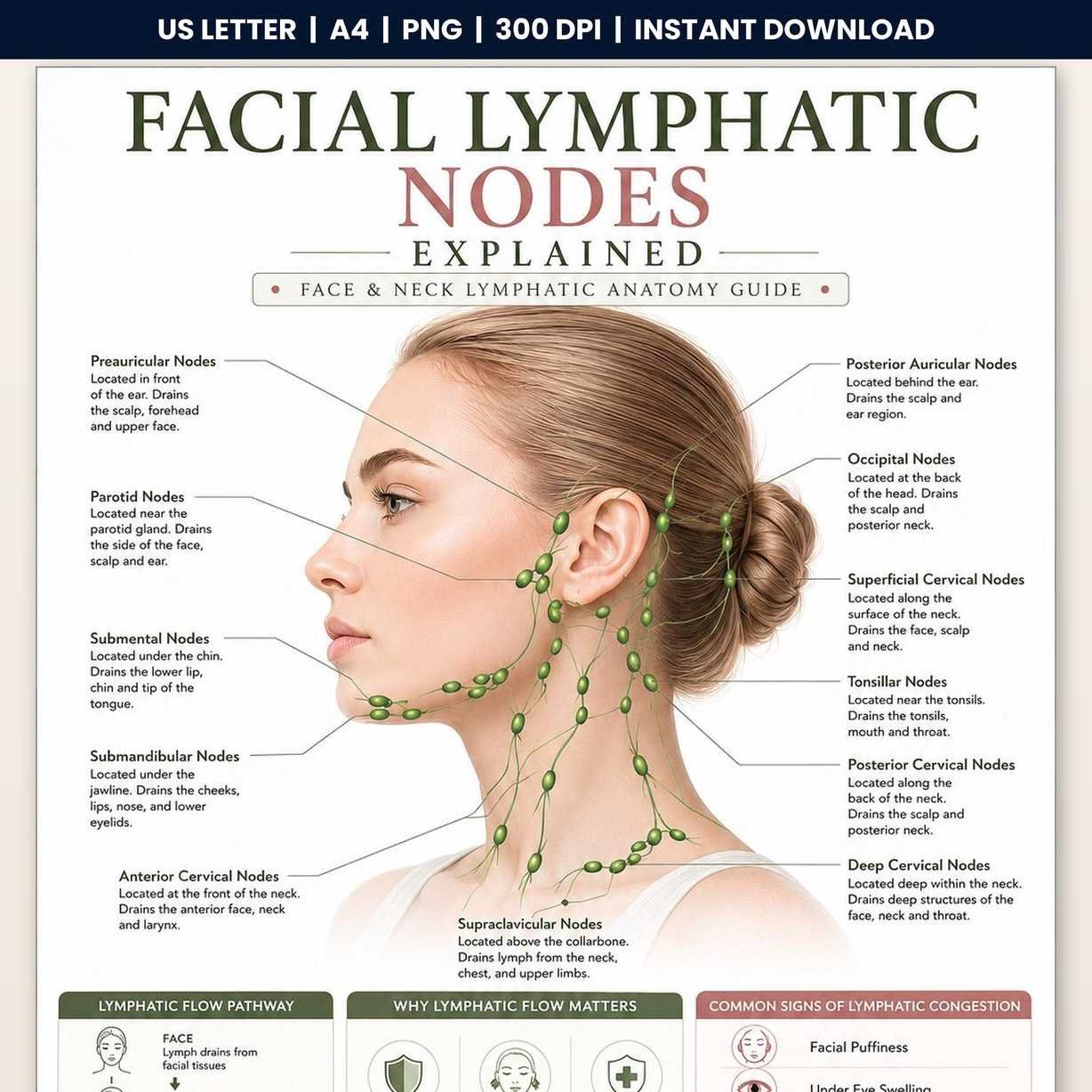
The lymph nodes chart is headed FACIAL LYMPHATIC NODES EXPLAINED, FACE AND NECK LYMPHATIC ANATOMY GUIDE, and it labels 12 nodes. Five sit on the left side of the poster, six on the right, and one, the supraclavicular nodes, sits at the bottom centre. Each node gets a short line about where it sits and what it drains, and those lines are the heart of this chart too.
The left side lists Preauricular Nodes, in front of the ear, which drain the scalp, forehead and upper face; Parotid Nodes, near the parotid gland, which drain the side of the face, scalp and ear; Submental Nodes, under the chin, which drain the lower lip, chin and tip of the tongue; Submandibular Nodes, under the jawline, which drain the cheeks, lips, nose and lower eyelids; and Anterior Cervical Nodes, at the front of the neck, which drain the anterior face, neck and larynx.
The right side lists Posterior Auricular Nodes, behind the ear, which drain the scalp and ear region; Occipital Nodes, at the back of the head, which drain the scalp and posterior neck; Superficial Cervical Nodes, along the surface of the neck, which drain the face, scalp and neck; Tonsillar Nodes, near the tonsils, which drain the tonsils, mouth and throat; Posterior Cervical Nodes, along the back of the neck, which drain the scalp and posterior neck; and Deep Cervical Nodes, deep within the neck, which drain deep structures of the face, neck and throat. The bottom centre lists Supraclavicular Nodes, above the collarbone, which drain lymph from the neck, chest and upper limbs.
The nodes under the jaw and chin deserve a closer look, because they are the ones most people can actually feel. The submental nodes under the chin drain the lower lip, chin and tip of the tongue. The submandibular nodes under the jawline drain the cheeks, lips, nose and lower eyelids. The tonsillar nodes near the tonsils drain the tonsils, mouth and throat. Together they cover the lower face and the mouth, which is why a sore throat or a mouth infection often shows up as tenderness under the jaw. The nodes at the back of the head and neck drain the scalp and posterior neck, and the supraclavicular nodes above the collarbone drain lymph from the neck, chest and upper limbs. A swollen lymph node is a reason to talk to a doctor, not a reason to press on it harder, and this guide makes no claim about treating anything. For calm breathing alongside face care, our breathwork for anxiety guide covers simple breathing exercises.
The bottom strips on this chart, Lymphatic Flow Pathway, Why Lymphatic Flow Matters, and Common Signs of Lymphatic Congestion, were cut off on the listing image, and only Facial Puffiness and, partly, Under-Eye Swelling were legible. This guide quotes nothing more from those strips, because guessing at a health chart is worse than leaving a gap. What is legible is enough: 12 nodes, each with a place and a drainage area, and a map that shows how the face and neck connect.
Worked Example: A Face Map Walkthrough
Here is a worked face map walkthrough, reading the 14 muscles in groups, then the 12 lymph nodes in the same order as the chart. It is a slow read through the poster, and it works best with the printed chart in front of you, so you can point at each label as you go. Start at the top and work down, the way you would read a face.
Begin at the brow and eyes. Find frontalis across the forehead, the muscle that raises the eyebrows and creates forehead wrinkles. Below it, between the brows, find procerus, which draws the eyebrows together and creates vertical wrinkles. Around the eye, find orbicularis oculi, which closes the eyelids gently for blinking and tightly for squinting. Three muscles, and you can feel all three by raising your brows, frowning, and blinking hard. That is the brow and eye group, and it is the smallest group on the chart.
Move to the nose and cheeks. Find nasalis around the nose, which compresses or dilates the nostrils. Find levator labii superioris, which elevates the upper lip and deepens the nasolabial fold. Find buccinator in the cheek, which compresses the cheek against the teeth and helps with chewing, blowing and sucking. Try it: press your lips together, puff out a cheek, and feel the cheek muscle work. That is buccinator, and it is one of the easiest muscles on the chart to feel in your own face.
Now the mouth, the busiest part of the map. Find zygomaticus major, which lifts the corners of the mouth and creates a smiling expression, and risorius beside it, which draws the corners outward and produces a subtle smile. Smile in a mirror and you can see both working. Find orbicularis oris, which encircles the mouth and controls puckering and closing, and try puckering your lips to feel it. Find depressor labii inferioris, which depresses the lower lip, and depressor anguli oris, which pulls the corners of the mouth downward and creates a frowning expression. Pull the corners of your mouth down and you can feel that last one. Five muscles, five directions, one small opening.
Finish the muscles with the jaw and neck. Find temporalis, the fan-shaped muscle on the side of the head, which supports jaw elevation and chewing. Find masseter, the powerful muscle that elevates the mandible and closes the mouth, and clench your teeth gently to feel it bulge at the jaw. Find platysma, the thin, broad muscle in the neck, which helps tighten the skin of the neck and draws the lower lip and jaw downward. That is all 14 muscles, in four groups: brow and eyes, nose and cheeks, mouth, jaw and neck.
Now read the lymph nodes in the same order as the chart. Start at the front of the ear with the preauricular nodes, which drain the scalp, forehead and upper face, and the parotid nodes near the parotid gland, which drain the side of the face, scalp and ear. Move under the chin to the submental nodes, which drain the lower lip, chin and tip of the tongue, and under the jawline to the submandibular nodes, which drain the cheeks, lips, nose and lower eyelids. At the front of the neck, find the anterior cervical nodes, which drain the anterior face, neck and larynx. Behind the ear, find the posterior auricular nodes, which drain the scalp and ear region. At the back of the head, find the occipital nodes, which drain the scalp and posterior neck. Along the surface of the neck, find the superficial cervical nodes, which drain the face, scalp and neck, and near the tonsils, the tonsillar nodes, which drain the tonsils, mouth and throat. Along the back of the neck, find the posterior cervical nodes, which drain the scalp and posterior neck, and deep within the neck, the deep cervical nodes, which drain deep structures of the face, neck and throat. Finish above the collarbone with the supraclavicular nodes, which drain lymph from the neck, chest and upper limbs. Twelve nodes, read in chart order, and the map is complete.
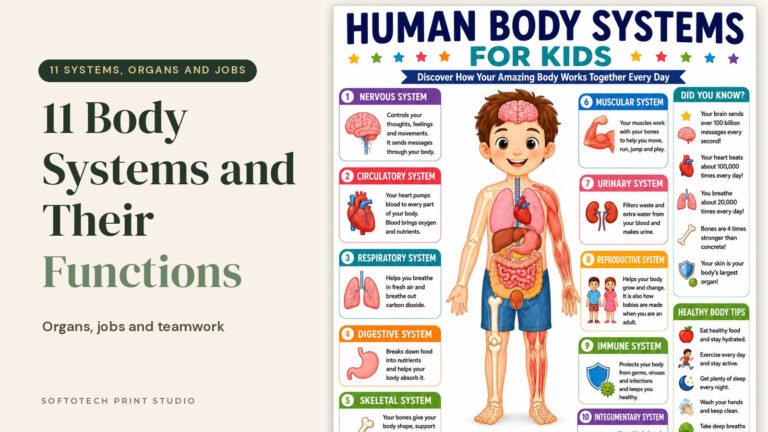
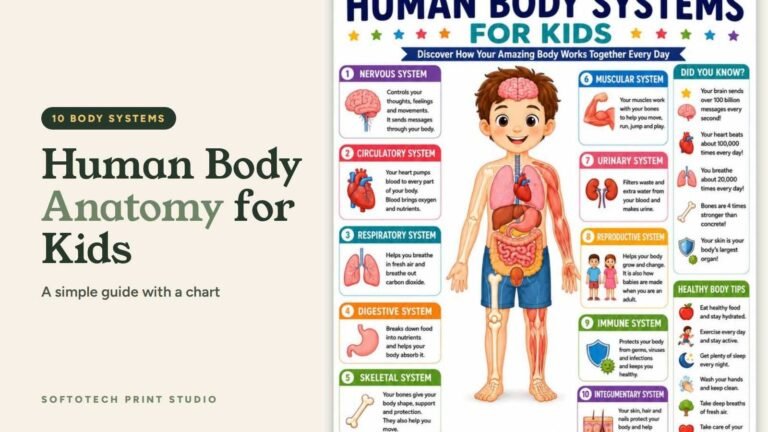
For the bigger picture beyond the face, our overview of the body systems and their functions explains how all 11 organ systems fit together.
Frequently Asked Questions
What is a facial anatomy chart?
A facial anatomy chart is a poster that labels the muscles of the face and says what each one does. The chart in this guide labels 14 major facial muscles, from frontalis on the forehead to platysma in the neck. It is a study and reference poster, not a medical diagnosis tool, and it is useful for students, estheticians, and anyone curious about how the face moves.
Which muscles make you smile?
The smiling muscles on this facial anatomy chart include zygomaticus major, which lifts the corners of the mouth, and risorius, which draws them outward. The frowning muscle is depressor anguli oris, which pulls the corners of the mouth downward. Orbicularis oculi closes the eyelids, and it works when a real smile reaches the eyes.
Which muscles do you chew with?
The chewing muscles on this facial anatomy chart include masseter, which lifts the lower jaw, and temporalis, the fan-shaped muscle on the side of the head. Buccinator in the cheek helps too, by compressing the cheek against the teeth during chewing, blowing and sucking. Orbicularis oris controls the lips while you eat.
Where are the lymph nodes of the face and neck?
The lymph nodes chart in this guide labels 12 nodes: preauricular, parotid, submental, submandibular, anterior cervical, posterior auricular, occipital, superficial cervical, tonsillar, posterior cervical, deep cervical and supraclavicular nodes. The nodes under the jaw and chin drain the cheeks, lips, nose, lower eyelids, lower lip, chin and tip of the tongue. The supraclavicular nodes above the collarbone drain lymph from the neck, chest and upper limbs.
What size are the printable facial anatomy charts?
The SoftoTech Print Studio Facial Muscles Anatomy Poster is an instant download that prints at home in US Letter and A4 sizes, as 2 PDFs plus a PNG and a ZIP per the listing. The listing does not state A5. The lymph nodes poster in the second box prints in US Letter and A4 as well, as 2 PDFs plus a PNG and a ZIP per the listing.
This guide is for general wellness and is not medical advice. Check with your doctor before starting a new routine.
Related Guides
- Face Yoga Exercises
- Face Lymphatic Massage for Beginners
- Gentle Neck Shoulder Stretches for Seniors
- Breathwork for Anxiety
Sources
Sources: Kenhub: Muscles of Facial Expression, TeachMeAnatomy: Muscles of Facial Expression