
Most lists of high protein foods low calorie hand you names and leave you to guess which is best. This guide does the arithmetic. It takes the serving sizes, protein grams and calories printed on one chart and works out grams of protein per 100 calories for 25 of the foods, so you can see which really pay their way.
The chart is the High Protein Low Calorie Food List from SoftoTech Print Studio, headed 50 plus protein-rich foods with serving sizes and calories. It’s laid out in seven groups, with a photo, a serving size and a protein and calorie figure for each food. The second printable is the shop’s 12-guide High Protein Food List Bundle, which covers meal plans and grocery lists.
The chart’s figures carry a tilde, so they’re approximate, and I’ve treated them that way. The ranking is my own arithmetic from them: protein divided by calories, times 100. The numbers are the chart’s. The ranking and the advice around it are mine, and the two NIH and Harvard sources at the end give the bigger picture on how much protein people need.
If you want a protein list built around weight loss with more detail on food groups, our high protein food list for weight loss covers that. This guide is the calorie-first view.
In this guide:
- 25 Foods Ranked by Protein per 100 Calories
- The 7 Groups on the Chart and What Stands Out
- A Worked Day of Protein Anchors, and Smart Swaps
- How Much Protein, and What the Sources Say
- Frequently Asked Questions
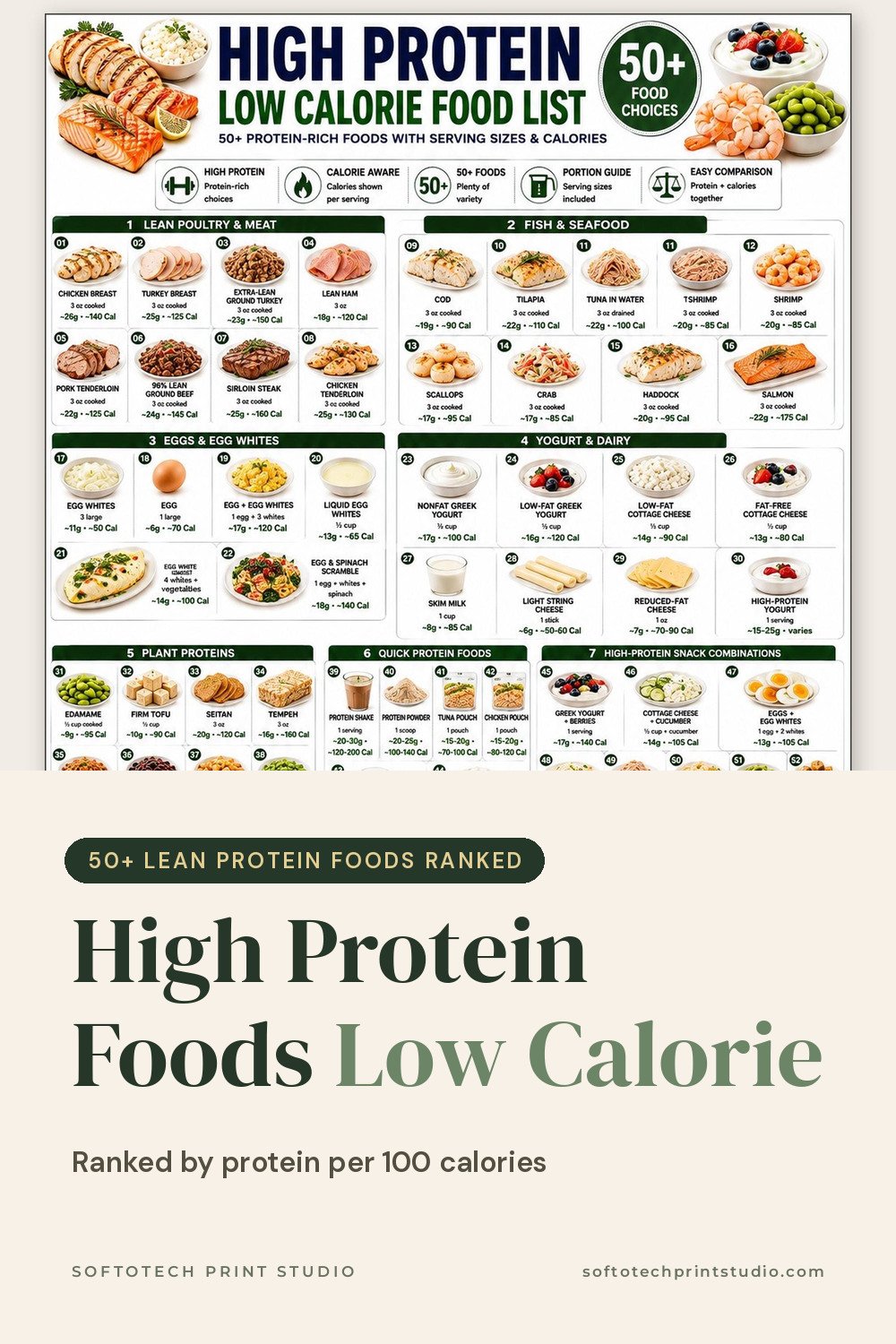

- 50+ lean protein foods with serving sizes, protein grams and calories
- Seven groups, from lean poultry and fish to plant proteins and snack combinations
- Header icons for high protein, calorie aware, portion guide and easy comparison
- Soft foods like cod, haddock, cottage cheese, Greek yogurt and egg whites
- US Letter and A4 print-ready PDFs, per the listing
- Instant download · Print at home · US Letter · A4
Use code BLOG10 for 65% OFF at Etsy checkout!
25 Foods Ranked by Protein per 100 Calories
Here is the ranking. Each row gives the food, the serving size on the chart, the protein and calories printed beside it, and the grams of protein per 100 calories I worked out. Higher is leaner. A figure of 20 means that for every 100 calories you eat, 20 grams are protein.
| Rank | Food | Serving on the chart | Protein | Calories | Protein per 100 calories |
|---|---|---|---|---|---|
| 1 | Shrimp | 3 oz cooked | about 20 g | about 85 | 23.5 g |
| 2 | Egg whites | 3 large | about 11 g | about 50 | 22.0 g |
| 3 | Tuna in water | 3 oz drained | about 22 g | about 100 | 22.0 g |
| 4 | Cod | 3 oz cooked | about 19 g | about 90 | 21.1 g |
| 5 | Haddock | 3 oz cooked | about 20 g | about 95 | 21.1 g |
| 6 | Turkey breast | 3 oz cooked | about 25 g | about 125 | 20.0 g |
| 7 | Tilapia | 3 oz cooked | about 22 g | about 110 | 20.0 g |
| 8 | Crab | 3 oz cooked | about 17 g | about 85 | 20.0 g |
| 9 | Liquid egg whites | 1/2 cup | about 13 g | about 65 | 20.0 g |
| 10 | Chicken tenderloin | 3 oz cooked | about 25 g | about 130 | 19.2 g |
| 11 | Chicken breast | 3 oz cooked | about 26 g | about 140 | 18.6 g |
| 12 | Scallops | 3 oz cooked | about 17 g | about 95 | 17.9 g |
| 13 | Pork tenderloin | 3 oz cooked | about 22 g | about 125 | 17.6 g |
| 14 | Nonfat Greek yogurt | 3/4 cup | about 17 g | about 100 | 17.0 g |
| 15 | Seitan | 3 oz | about 20 g | about 120 | 16.7 g |
| 16 | 96% lean ground beef | 3 oz cooked | about 24 g | about 145 | 16.6 g |
| 17 | Fat-free cottage cheese | 1/2 cup | about 13 g | about 80 | 16.2 g |
| 18 | Sirloin steak | 3 oz cooked | about 25 g | about 160 | 15.6 g |
| 19 | Low-fat cottage cheese | 1/2 cup | about 14 g | about 90 | 15.6 g |
| 20 | Salmon | 3 oz cooked | about 22 g | about 175 | 12.6 g |
| 21 | Tofu, firm | 1/2 cup | about 10 g | about 90 | 11.1 g |
| 22 | Tempeh | 3 oz | about 16 g | about 160 | 10.0 g |
| 23 | Edamame | 1/2 cup cooked | about 9 g | about 95 | 9.5 g |
| 24 | Skim milk | 1 cup | about 8 g | about 85 | 9.4 g |
| 25 | Egg | 1 large | about 6 g | about 70 | 8.6 g |
What the table shows. The top group, shrimp, egg whites, tuna in water, cod, haddock, turkey breast, tilapia and crab, all sit around 20 to 24 grams per 100 calories. These are the leanest proteins on the chart. They’re mostly white fish, shellfish and egg whites, plus turkey breast, and they’re also low in fat.
The middle. Chicken breast, scallops, nonfat Greek yogurt, pork tenderloin, 96 percent lean ground beef, seitan, cottage cheese and sirloin land between about 15 and 19 grams per 100 calories. They’re still excellent choices, and a few of them, like Greek yogurt and cottage cheese, need no cooking.
The lower end. Salmon at about 12.6 grams per 100 calories is lower because it’s an oily fish, and MedlinePlus lists fish among healthy sources of protein. Whole egg, tofu, tempeh, edamame and skim milk are lower per calorie too, but they bring other things: healthy fats, fiber, calcium or plant variety. Low protein per calorie doesn’t mean a bad food. It means the food is doing more than one job.
A fair warning about the figures. I could read most of the numbers on the listing photo, but a few were small. The values above are the ones I could read clearly. Real values vary with the cut, the brand and how you cook, and the chart marks them with a tilde. If you’re tracking calories closely, check labels or a nutrition database for the food you actually buy.
Why per 100 calories? Because it’s the fairest way to compare foods of different sizes. A cup of skim milk and three ounces of cod have different weights and calories, but per 100 calories you can see that the cod gives more than twice the protein. It’s also a good fit for anyone eating a set number of calories and wanting each one to count.
The 7 Groups on the Chart and What Stands Out
The chart’s header shows icons for high protein, calorie aware, 50 plus foods, portion guide and easy comparison. Foods are in seven numbered groups. Here is what each holds and what’s worth noticing.
1. Lean poultry and meat (8 foods). Chicken breast, turkey breast, extra-lean ground turkey, lean ham, pork tenderloin, 96 percent lean ground beef, sirloin steak and chicken tenderloin. All are listed at 3 ounces cooked, with protein between about 18 and 26 grams. Lean ham is the lowest at about 18 grams, and it’s a processed meat, so it’s the one to eat less often.
2. Fish and seafood (8 foods). Cod, tilapia, tuna in water, shrimp, scallops, crab, haddock and salmon, all at 3 ounces. This is the leanest group on the chart, with every food between about 85 and 110 calories except salmon at about 175.
3. Eggs and egg whites (6 items). Three egg whites at about 11 grams and 50 calories, one large egg at about 6 grams and 70 calories, an egg plus egg whites at about 17 grams and 120 calories, half a cup of liquid egg whites at about 13 grams and 65 calories, an egg white omelet with vegetables at about 14 grams and 100 calories, and an egg and spinach scramble at about 18 grams and 140 calories. Mixing whites with one whole egg is a common way to keep the flavor and cut the calories.
4. Yogurt and dairy (8 items). Nonfat Greek yogurt, low-fat Greek yogurt, low-fat and fat-free cottage cheese, skim milk, light string cheese, reduced-fat cheese and high-protein yogurt. Protein ranges from about 6 grams for a stick of light string cheese to 17 grams for three quarters of a cup of nonfat Greek yogurt.
5. Plant proteins (8 foods). Edamame, firm tofu, seitan, tempeh, lentils, black beans, chickpeas and green peas. The ones I could read clearly are edamame at about 9 grams for 95 calories, firm tofu at about 10 grams for 90, seitan at about 20 grams for 120 and tempeh at about 16 grams for 160.
6. Quick protein foods (6 items). Protein shake, protein powder, tuna pouch, chicken pouch, Greek yogurt and cottage cheese. The chart prints ranges here, such as about 20 to 30 grams and 120 to 200 calories for a shake, and about 15 to 20 grams for a tuna or chicken pouch. These are the emergency options for a busy day.
7. High-protein snack combinations (about 8 combos). Greek yogurt with berries, cottage cheese with cucumber, eggs with egg whites, and several tuna, turkey, shrimp, edamame and tofu pairings. They turn single foods into snacks you can actually eat at your desk.
So the chart lists 50 plus foods and shows protein and calories on each. That’s the real selling point of this printable, since you can compare at a glance. Our high protein foods for seniors guide uses the same chart’s leaner picks for people with a smaller appetite.
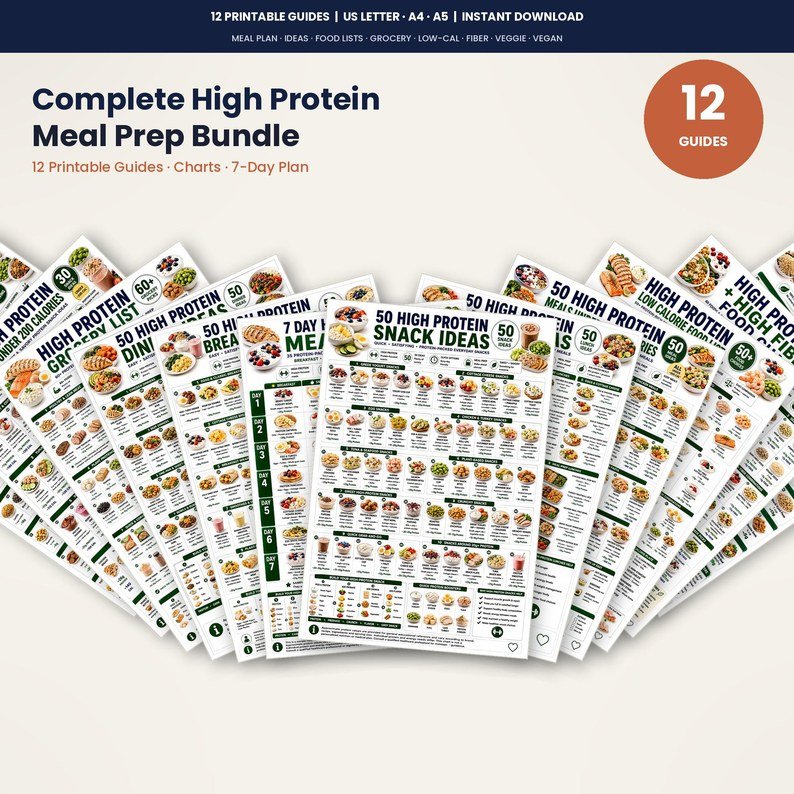
- 12 printable guides in one set
- 50 high protein breakfast, lunch, dinner and snack ideas
- A 7 day high protein meal plan with 35 meals and snacks
- High protein low calorie, grocery, vegetarian and vegan food lists
- Instant download · Print at home · US Letter · A4 · A5
Use code BLOG10 for 65% OFF at Etsy checkout!
A Worked Day of Protein Anchors, and Smart Swaps
Here’s a day built around six protein anchors from the chart. It adds the chart’s own protein and calorie figures for those foods only. Vegetables, grains, fruit, oil and everything else you’d eat alongside come on top and aren’t counted. It’s an example of the arithmetic, not a diet.
| Meal | Protein anchor from the chart | Protein | Calories |
|---|---|---|---|
| Breakfast | 1 egg plus 3 egg whites, scrambled | about 17 g | about 120 |
| Mid-morning | Nonfat Greek yogurt, 3/4 cup | about 17 g | about 100 |
| Lunch | Tuna in water, 3 oz drained | about 22 g | about 100 |
| Afternoon | Low-fat cottage cheese, 1/2 cup | about 14 g | about 90 |
| Dinner | Chicken breast, 3 oz cooked | about 26 g | about 140 |
| With dinner | Edamame, 1/2 cup cooked | about 9 g | about 95 |
| Total from the anchors | about 105 g | about 645 |
That’s a generous day of protein for about 645 calories from those foods alone, which shows how efficient lean proteins are. It’s also more protein than many adults need. Harvard’s Nutrition Source gives a minimum of about 50 grams a day for a 140-pound person, so most people would choose three or four of these anchors, not all six, and fill the rest of the plate with vegetables, whole grains and fruit.
Smart swaps. Swap salmon for cod on some nights, which saves about 85 calories for similar protein. Use egg whites in place of a second whole egg. Choose nonfat Greek yogurt over low-fat. Pick turkey breast instead of ground turkey. Choose pork tenderloin over sirloin. Each swap trims calories and keeps protein nearly the same.
When to keep the fat. Don’t chase the lowest calories at every meal. Salmon, whole eggs and nuts give fats your body can use, and they keep you full. If you’re underweight, losing weight without trying or eating very little, you may need more calories, not fewer. It’s a chat for your doctor.
Adding fiber. Lean protein is satisfying but has no fiber. Pair it with vegetables, beans or whole grains. Our high protein foods with fiber guide has pairings, and the 12-guide bundle in the shop includes a protein and fiber chart too.
Snacking. Lean protein makes a good snack, and our healthy snacks for weight loss guide has more ideas for between meals.
Cooking lean. The chart’s figures assume plain cooking. Frying, breading and creamy sauces add calories fast, so grill, bake, poach or pan-sear with a light spray. A tablespoon of oil adds well over 100 calories, which is more than a serving of cod.
How Much Protein, and What the Sources Say
The numbers from Harvard. The Nutrition Source at Harvard says the National Academy of Medicine recommends adults get a minimum of 0.8 grams of protein for every kilogram of body weight per day, which works out to about 50 grams for a 140-pound person and about 70 grams for a 200-pound person. It also notes the Academy’s acceptable range of 10 to 35 percent of calories from protein, and says that beyond that there is relatively little solid information on the ideal amount. Individual needs vary with age, exercise level, health conditions and overall diet, and a registered dietitian can help work out yours.
The numbers from MedlinePlus. MedlinePlus says the recommended intake for healthy adults is 10 to 35 percent of total calories, and that one gram of protein supplies 4 calories. A person eating 2,000 calories could eat 100 grams of protein, which would be 400 calories and 20 percent of their total. It says one ounce of most protein-rich foods holds about 7 grams of protein, and lists a large egg, a quarter cup of tofu and half a cup of cooked beans or lentils as equal to one ounce of meat for protein.
Lean choices. MedlinePlus names skinless turkey or chicken, lean cuts of beef or pork such as round, top sirloin or tenderloin, fish and shellfish, beans and lentils, tofu and tempeh, and low-fat dairy as healthy sources. It adds that you don’t need animal products to get all the protein you need. It also warns that nuts are high in fat, so portion sizes matter, and that eating calories in excess of your needs may lead to weight gain.
Who should be careful. If you have kidney disease, your protein needs may be lower or higher depending on your stage, and you should follow your own team’s advice, not a chart. People with liver conditions, gout or certain other conditions may also have specific advice. Pregnant and breastfeeding women, growing children and older adults often have different needs too.
Putting it to use. Print the chart, circle the foods you like from the top of the ranking, and make a shopping list from them. Use the table above to pick one lean anchor for each meal, add vegetables and a whole grain, and you have a plan. It’s also a quick way to spot snacks, since a tub of nonfat Greek yogurt or a half cup of cottage cheese gives about 14 to 17 grams of protein for 90 to 100 calories.
Lean protein is a tool, not a goal in itself. Enough protein spread through the day, from foods you enjoy, and not so little food that you’re hungry and tired. That’s the whole idea behind the chart.
Frequently Asked Questions
What are the best high protein foods that are low in calo…
Going by the chart’s own numbers, shrimp, egg whites, tuna in water, cod, haddock, turkey breast and tilapia give the most protein per calorie, at roughly 20 to 24 grams per 100 calories. Nonfat Greek yogurt, chicken breast and low-fat cottage cheese are close behind.
How much protein do I need per day?
Harvard’s Nutrition Source says the National Academy of Medicine recommends a minimum of 0.8 grams of protein per kilogram of body weight per day, about 50 grams for a 140-pound person, and sets an acceptable range of 10 to 35 percent of calories. Needs vary with age, activity and health, and a dietitian can work out yours.
How many calories are in a gram of protein?
MedlinePlus says one gram of protein supplies 4 calories. So 100 calories of pure protein would be 25 grams, which is why no whole food reaches that figure. Even shrimp and egg whites in the table are a little under it.
Are plant proteins worth including if I’m counting calories?
Yes, though they carry more calories per gram of protein. On the chart, firm tofu has about 10 g for 90 calories and edamame about 9 g for 95 calories, so they are less efficient than fish or egg whites but bring fiber and variety. Seitan is a strong plant option at about 20 g for 120 calories.
Is eating more protein a good way to lose weight?
Protein can help you feel full, but there is no magic number. Harvard says there is little solid information on the ideal amount of protein in the diet, and MedlinePlus notes that eating calories in excess of your needs may lead to weight gain even with healthy foods. Talk to your doctor or dietitian about your own goals.
This guide is for general nutrition information and is not medical advice. Check with your doctor or dietitian about your protein and calorie needs, especially if you have kidney disease, are pregnant or have another health condition.
Related Guides
- High Protein Food List for Weight Loss
- High Protein Foods for Seniors
- High Protein Foods With Fiber
- Healthy Snacks for Weight Loss
Sources
Sources: MedlinePlus (NIH), Protein in diet, Harvard T.H. Chan School of Public Health, The Nutrition Source: Protein
 Diet & Food ListsMediterranean Diet for Seniors: A Simple Guide With an Eat, Limit, Avoid List and a 7 Day Plan
 Diet & Food ListsHigh Protein Foods for Muscle Gain: How Much You Need, the Best Picks per Meal and a Worked Training Day
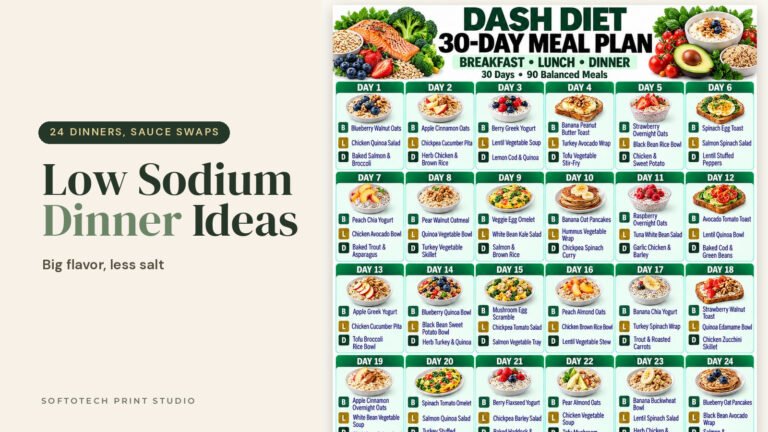 Diet & Food ListsLow Sodium Dinner Ideas: 24 DASH Style Dinners, a Sodium Budget per Plate and Sauce and Seasoning Swaps