
A vibration plate for seniors can be a gentle way to add a little balance and muscle work at home, as long as you choose the right moves, start on the lowest setting and hold on. It is not a shortcut to fitness, and it isn’t for everyone. Harvard Health’s expert says balance is the one benefit with research behind it, and that a plate could be a starting point for older adults who can’t walk far or get to a gym.
Vibration plates are everywhere on social media, with big promises attached. Some of those promises hold up and many don’t. If you’re an older adult, or you’re thinking of buying one for a parent, it’s worth knowing what the plate can really do and who should skip it before you step on.
This guide uses two charts from SoftoTech Print Studio: the Vibration Plate Exercises for Beginners chart and the Vibration Plate Full Body Workout poster. Each shows 16 moves, but not all of them suit older bodies. I’ll pick the safest ones, build a 10 minute routine and go through the safety rules.
Talk to your doctor before using a vibration plate, especially if you have a pacemaker or other implant, heart disease, balance problems, joint replacements, osteoporosis, recent surgery, or pain in your joints, neck or back.
In this guide:
- What a Vibration Plate Can and Can’t Do
- Who Should Avoid a Vibration Plate
- The Safest Moves on the Charts for Older Adults
- A Gentle 10 Minute Routine
- Frequently Asked Questions
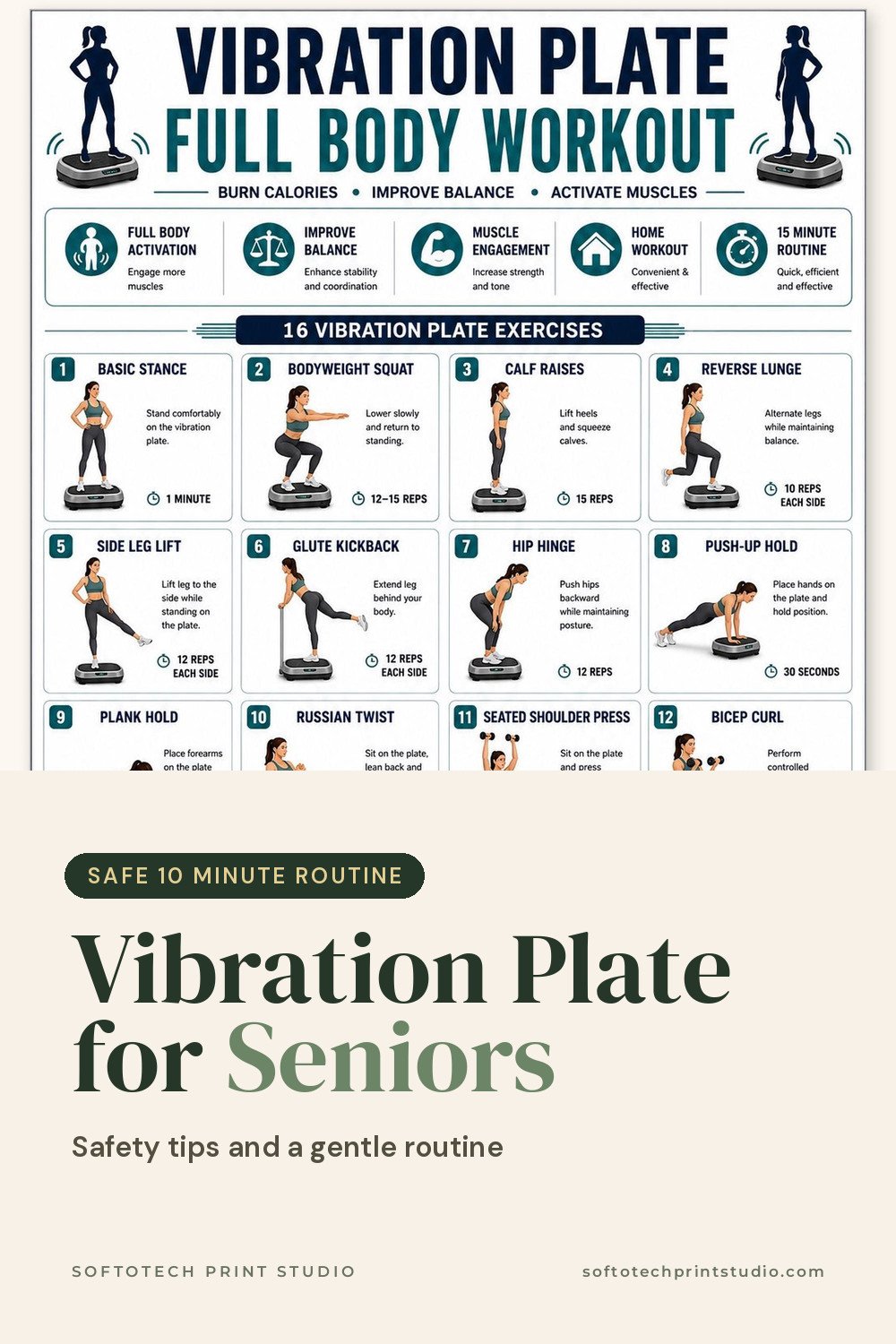

- 16 vibration plate exercises, each with an illustration, a short cue and a time or rep target
- Starts with basic stance (1 minute), bodyweight squat (12 to 15 reps) and calf raises (15 reps)
- Includes standing, seated and floor moves such as glute kickback, hip hinge, seated shoulder press and plank hold
- Header panel: full body activation, improve balance, muscle engagement, home workout, 15 minute routine
- US Letter and A4, PNG, per the listing photo
- Instant download · Print at home · US Letter · A4
Use code BLOG10 for 65% OFF at Etsy checkout!
Get the Vibration Plate Exercises for Beginners Chart on Etsy →
What a Vibration Plate Can and Can’t Do
A vibration plate is a platform you stand, sit or exercise on that shakes rapidly. Harvard Health explains that the vibrations make your muscles contract and relax many times each second, “essentially adding a small extra challenge to standing or moving.” Cleveland Clinic compares it to “a massage gun but for your entire body.”
Both sources are cautious about the claims. Cleveland Clinic notes there isn’t a lot of research, and that the FDA hasn’t approved vibration plates for treating injuries or other conditions. Harvard’s expert, Dr. Elizabeth Matzkin of Brigham and Women’s Hospital, says many of the claimed benefits “represent hype, not facts.” Here’s how the main claims stack up, according to the two sources.
| Claim | What the sources say |
|---|---|
| Balance | Harvard: may be the only benefit backed by research; appears to bolster balance in some older adults |
| Muscle strength | Harvard: no evidence it makes you stronger, but could be useful for older adults unable to do conventional strength training; “definitely not a substitute” |
| Bones | Harvard: evidence is spotty; minimal improvements in lower spine bone density in some studies of postmenopausal women. Cleveland Clinic: no real difference compared to regular exercise |
| Circulation | Harvard: blood flow rises only while the plate is moving, like walking, with no proven long term vascular benefit |
| Weight loss | Harvard: no research backs up claims that simply standing on one burns significant calories |
What that means for you. A vibration plate is best seen as a balance and muscle “wake up” tool. For an older adult who struggles with standing strength or confidence, a few minutes of holding a squat or doing calf raises on a plate, with hands on the handles, can be a reasonable addition. For bones and heart health, Dr. Matzkin says she’d rather see people walking and lifting weights. Our walking plan for seniors is a good partner to any plate routine.
Who Should Avoid a Vibration Plate
Cleveland Clinic says that because vibration plates create an unstable surface, you may want to avoid them if you:
- are pregnant
- have trouble maintaining balance
- have an ankle or leg injury
- have pain in your joints, neck or back
- have certain cardiovascular conditions, like heart disease
Cleveland Clinic’s sports medicine specialist, Dr. Lauren Wichman, adds that if you have neck or back pain or trouble balancing, high frequency vibrations could lead to dizziness, nausea or vertigo. Harvard Health adds two more cautions: if you have balance problems, using the device might cause a fall, and people with stress incontinence should be wary.
That’s a long list, and many older adults will tick at least one box. That doesn’t automatically rule you out, but it does mean a conversation with your doctor or physiotherapist first. If they say yes, the safety rules below matter even more.
Safety rules for every session
- Lowest setting first. Cleveland Clinic advises starting at the lowest frequency and amplitude to get used to how it feels.
- No jumping. Dr. Wichman doesn’t recommend exercises that have you jumping on and off while it’s vibrating, because that can raise the risk of a fall. Step on and off only when the plate is stopped.
- Hold on. Use a plate with handles, or set it beside a sturdy counter or wall rail.
- Soft knees. Never lock your knees, so the vibration isn’t passed straight up into your hips, back and head.
- Short and stop. Keep each move short and stop at once if you feel dizzy, sick, short of breath or any pain.
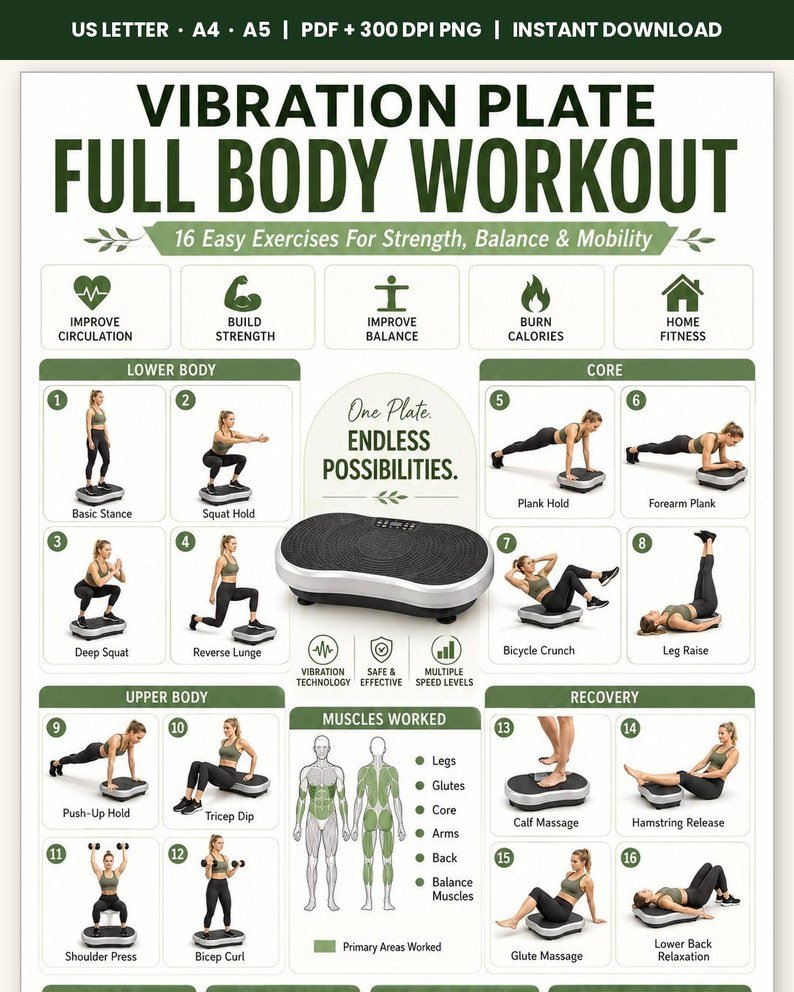
- 16 easy exercises for strength, balance and mobility, grouped into Lower Body, Core, Upper Body and Recovery
- Lower body: basic stance, squat hold, deep squat and reverse lunge
- Upper body: push-up hold, tricep dip, shoulder press and bicep curl
- Recovery: calf massage, hamstring release, glute massage and lower back relaxation
- US Letter, A4 and A5, PDF plus 300 DPI PNG, per the listing
- Instant download · Print at home · US Letter · A4 · A5
Use code BLOG10 for 65% OFF at Etsy checkout!
The Safest Moves on the Charts for Older Adults
The beginner chart is headed “Vibration Plate Full Body Workout” with a header panel listing full body activation, improve balance, muscle engagement, home workout and a 15 minute routine. Its 16 moves each come with a short cue and a target. Here are the first eight, exactly as the chart shows them, with my note on each for older adults.
| # | Move and chart cue | Chart target | For seniors |
|---|---|---|---|
| 1 | Basic stance: stand comfortably on the vibration plate | 1 minute | The best place to start; hold the handles |
| 2 | Bodyweight squat: lower slowly and return to standing | 12 to 15 reps | Good; keep it shallow and hold on |
| 3 | Calf raises: lift heels and squeeze calves | 15 reps | Good for ankle strength; hold on |
| 4 | Reverse lunge: alternate legs while maintaining balance | 10 reps each side | Only if your balance is good; many should skip |
| 5 | Side leg lift: lift leg to the side while standing on the plate | 12 reps each side | Skip unless very steady; single leg moves raise fall risk |
| 6 | Glute kickback: extend leg behind your body | 12 reps each side | The chart shows it holding a handle; keep it small |
| 7 | Hip hinge: push hips backward while maintaining posture | 12 reps | Good with a light hold |
| 8 | Push-up hold: place hands on the plate and hold position | 30 seconds | Hard on wrists and shoulders; most should skip |
Moves 9 to 12 are plank hold, Russian twist, seated shoulder press and bicep curl; the rest of the chart sits below the edge of the listing photo. Of those, the seated shoulder press and bicep curl, done sitting on the plate, are the most senior friendly, since sitting removes the fall risk. The plank and Russian twist are floor moves that many older adults will find hard to get into and out of.
The full body poster is headed “16 easy exercises for strength, balance and mobility.” It sorts its moves into four groups: Lower Body (basic stance, squat hold, deep squat, reverse lunge), Core (plank hold, forearm plank, bicycle crunch, leg raise), Upper Body (push-up hold, tricep dip, shoulder press, bicep curl) and Recovery (calf massage, hamstring release, glute massage, lower back relaxation). For older adults the most useful are the squat hold, the seated shoulder press and bicep curl, and the calf massage from the Recovery group, which I’d do sitting in a chair with your feet resting on the plate.
If you’d like to see all 16 beginner moves in order, our vibration plate exercises guide walks through both charts.
A Gentle 10 Minute Routine
This routine is my suggestion for a first few weeks, using moves from the charts. Keep the plate on its lowest setting, hold the handles or a counter for every standing move, and step off for each rest.
| Minutes | Move | How |
|---|---|---|
| 0 to 1 | Basic stance | Stand with soft knees, hands on the handles, for up to 1 minute (chart target) |
| 1 to 2 | Rest | Step off and sit down |
| 2 to 3 | Bodyweight squat | A shallow squat, lowering slowly; 8 to 10 reps to start, building toward the chart’s 12 to 15 |
| 3 to 4 | Rest | Step off and sit down |
| 4 to 5 | Calf raises | Lift your heels and squeeze, 10 reps building toward the chart’s 15 |
| 5 to 6 | Rest | Step off and sit down |
| 6 to 7 | Hip hinge | Small range, hands on the handles, 8 to 10 reps |
| 7 to 9 | Seated shoulder press and bicep curl | Sit on the plate (or a chair with feet on the plate) with very light weights or none, 10 of each |
| 9 to 10 | Calf massage | Sit in a chair with your feet resting on the plate to finish |
Getting on and off. Most falls with any home equipment happen in the moment of stepping on or off. Put the plate on a flat, non slip floor next to a sturdy chair, a counter or a wall. Check the plate is switched off. Hold the handles or counter with both hands, step on one foot at a time, and only then start the plate. When you finish, stop the plate completely, wait a few seconds for any dizziness to settle, and step off one foot at a time onto the floor beside the chair. If someone else is in the house, ask them to be nearby for the first few sessions.
How often. Two or three times a week is a sensible start. If you feel fine the next day, you can add a minute of basic stance or a few more reps. If anything aches, rest for a few days and go back a step.
Pair it with balance and leg work off the plate. The plate is the extra, not the main course. Our balance exercises for seniors to prevent falls and leg exercises for seniors build the strength that keeps you steady in everyday life, and they need no equipment at all.
Buying tips. If you’re shopping for an older adult, look for a plate with handles or a support column, a low starting speed, a non slip surface and a weight limit well above the user’s weight. A remote control saves bending down to change settings.
Frequently Asked Questions
Is a vibration plate safe for seniors?
Harvard Health says using a vibration plate is harmless for most people, but people with certain health problems should be cautious, and balance problems can lead to a fall. Cleveland Clinic suggests avoiding them if you have trouble balancing, an ankle or leg injury, joint, neck or back pain, or certain heart conditions. Ask your doctor first, use a plate with handles, and start on the lowest setting.
What are the benefits of a vibration plate for older adults?
Balance is the benefit with the most research behind it. Harvard Health reports that vibration plates appear to bolster balance in some older adults, and that they could be useful for people who can’t do conventional strength training. Claims about weight loss, bones and long term circulation are much weaker.
How long should a senior stand on a vibration plate?
Start short. The beginner chart in this guide begins with 1 minute of basic stance. A 10 minute session, including rests off the plate, is plenty to start, and Cleveland Clinic advises starting at the lowest frequency and amplitude.
Can a vibration plate replace walking or strength training?
No. Cleveland Clinic says vibration plates aren’t a replacement for traditional cardio and strength training, and Harvard Health’s expert says a plate is definitely not a substitute for strength training. Treat it as an extra, not the main event.
What sizes do the vibration plate charts print in?
The beginner chart’s listing photo shows US Letter and A4 as a PNG. The full body poster shows US Letter, A4 and A5 as a PDF plus a 300 DPI PNG. Both are instant downloads.
This guide is for general wellness and is not medical advice. Check with your doctor before using a vibration plate, especially if you have a heart condition, an implant, balance problems, osteoporosis or joint, neck or back pain.
Related Guides
- Vibration Plate Exercises
- 8 Balance Exercises for Seniors to Prevent Falls
- Leg Exercises for Seniors
- Walking Plan for Seniors
Sources
Sources: Harvard Health Publishing, Using a vibration plate: What it can and can’t do for your body, Cleveland Clinic, Vibration Plate Benefits
 Home WorkoutsUpper Body Home Exercises: 20 Moves for Chest, Back, Shoulders and Arms, With a 25 Minute Workout
 Home WorkoutsCore Exercises for Women Over 50: 16 Gentle Moves, Standing First, With a 15 Minute Routine and a 4 Week Plan
 Home WorkoutsWorkout Plan for Women Over 50: A Gentle 28 Day Start, Then a Weekly Plan for Strength, Balance and Walking