High protein foods for muscle gain are foods that give you a lot of protein in a normal serving, such as chicken, fish, eggs, Greek yogurt, cottage cheese, lentils, tofu and edamame, eaten alongside regular strength training. The training builds the muscle. The protein gives your body the raw material to do it.
Most people who want to build muscle don’t need exotic foods or a cupboard full of tubs. They need enough protein, spread across the day, from foods they’ll actually keep eating. And they need to lift, push or pull something heavy enough at least twice a week.
We already have a full guide to the foods on SoftoTech Print Studio’s High Protein Foods Chart, so this one won’t list all 36 again. Instead, it answers the muscle gain questions: how much protein you need per kilogram, how to hit that number meal by meal, which foods give the best return, and what a training day looks like on a plate. The second printable, a 7 day high protein meal plan, gives you a ready week to start from.
A quick health note. Higher protein diets aren’t right for everyone. If you have kidney disease, or a doctor has told you to watch protein, check with them before you raise your intake.
In this guide:
- How Much Protein You Need for Muscle Gain
- The Best Protein Foods per Serving From the Chart
- Worked Training Day: Protein Meal by Meal
- Pairing Protein With Strength Training
- Frequently Asked Questions
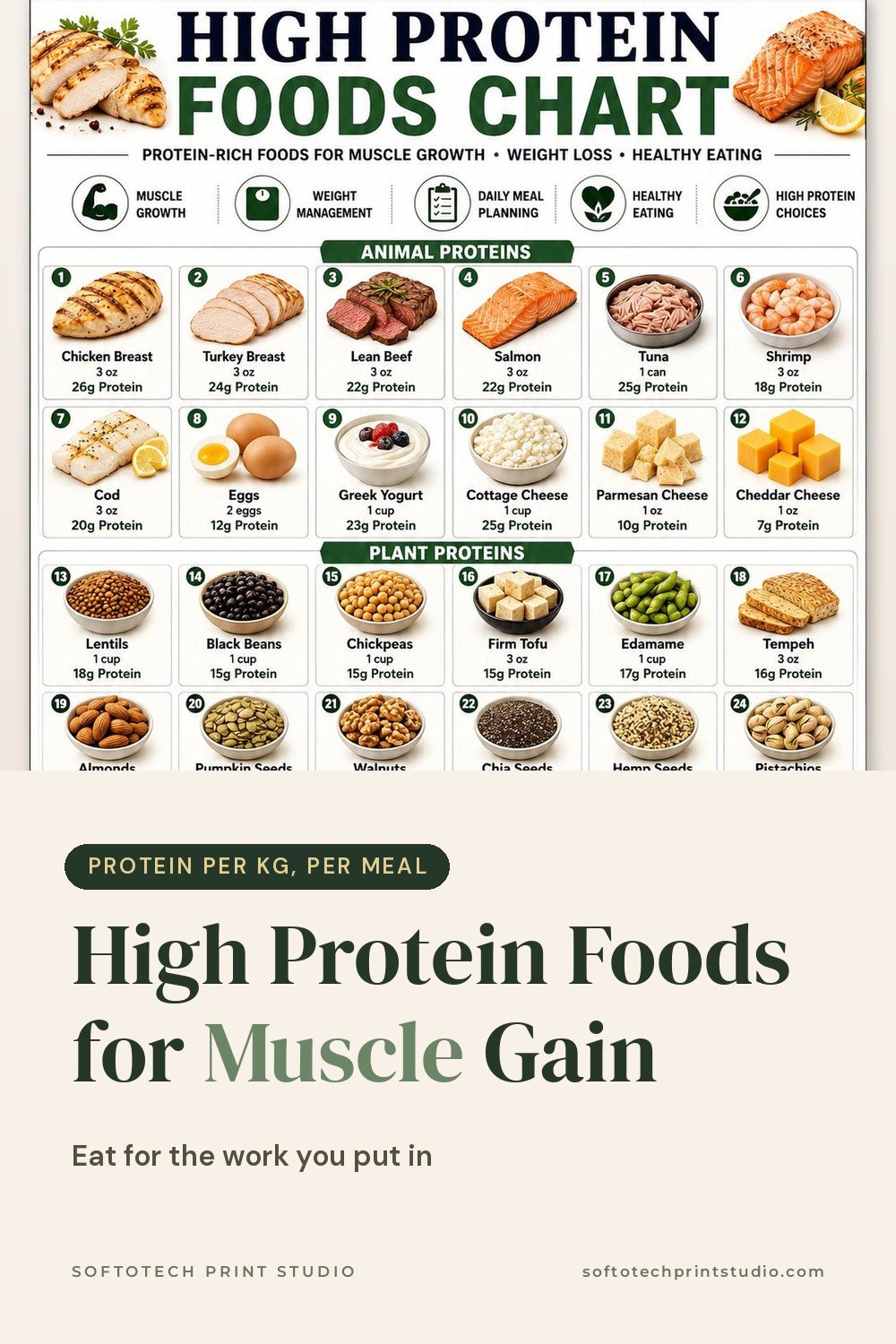
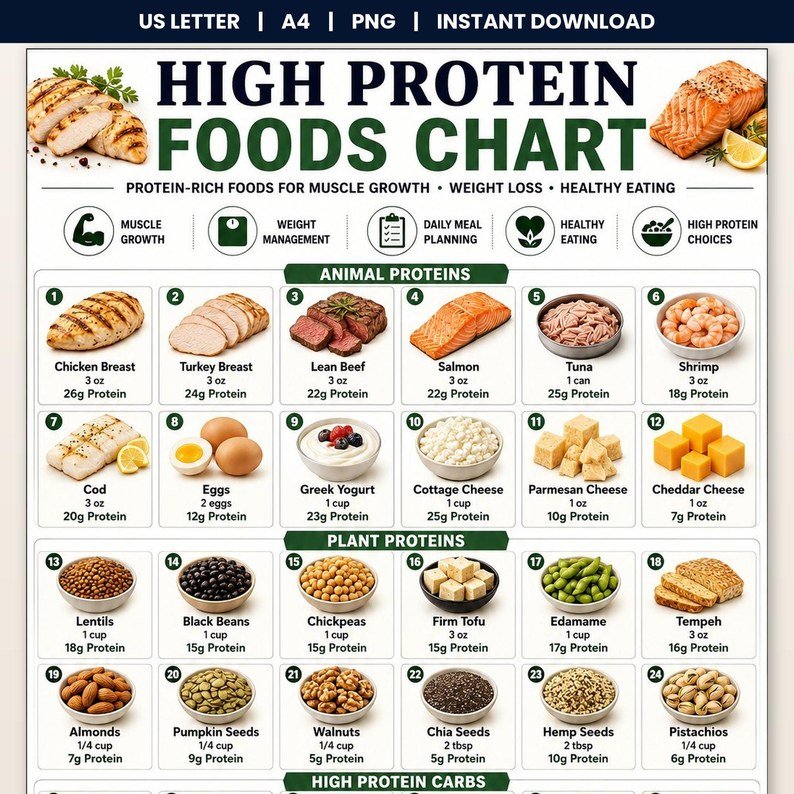
- 36 high protein foods, each with a photo, a serving size and grams of protein
- Grouped into animal proteins, plant proteins, high protein carbs, and snacks and drinks
- Examples from the chart: chicken breast 3 oz 26 g, Greek yogurt 1 cup 23 g, cottage cheese 1 cup 25 g, lentils 1 cup 18 g
- Headed protein rich foods for muscle growth, weight loss and healthy eating
- US Letter and A4 PDFs plus a high resolution PNG, per the listing
- Instant download · Print at home · US Letter · A4
Use code BLOG10 for 65% OFF at Etsy checkout!
How Much Protein You Need for Muscle Gain
The minimum. Harvard’s Nutrition Source quotes the National Academy of Medicine figure: adults should get a minimum of 0.8 grams of protein for every kilogram of body weight per day, or just over 7 grams for every 20 pounds. That’s the baseline to stay healthy, not a target for building muscle.
The ceiling for gains. A 2018 review in the British Journal of Sports Medicine pooled 49 studies with 1,863 people doing resistance training. Protein supplementation increased gains in strength and in muscle size. But the authors found that above total intakes of about 1.6 g per kg a day, extra protein gave no further gains in lean mass. They also found the effect of extra protein on lean mass got smaller with age, and was larger in people who were already trained.
So a practical range for someone lifting regularly sits between those two numbers. Here’s what that looks like at a few body weights. These are simple multiplications, not personal advice.
| Body weight | Minimum (0.8 g per kg) | Upper useful level in the 2018 review (about 1.6 g per kg) |
|---|---|---|
| 55 kg (121 lb) | 44 g a day | 88 g a day |
| 65 kg (143 lb) | 52 g a day | 104 g a day |
| 75 kg (165 lb) | 60 g a day | 120 g a day |
| 85 kg (187 lb) | 68 g a day | 136 g a day |
Split it across meals. Big numbers like 120 g look scary until you divide them. Over three meals and two snacks, 120 g is about 30 g per meal and 15 g per snack. On the chart, that’s one serving of chicken, tuna or cottage cheese per meal and a cup of milk or a few tablespoons of hemp seeds per snack. The even split is my suggestion. It’s easier for most people than one huge protein dinner.
The protein package matters too. Harvard’s Nutrition Source makes the point that when you eat protein, you also eat everything that comes with it, the fats, fiber and sodium. It suggests choosing fish, poultry, beans and nuts, limiting red meat and cheese, and avoiding bacon, cold cuts and other processed meats. That’s worth remembering when you scale up, because doubling your protein from processed meat isn’t the same as doubling it from lentils and fish.
The Best Protein Foods per Serving From the Chart
The High Protein Foods Chart is headed protein rich foods for muscle growth, weight loss and healthy eating, and it gives a serving size and grams of protein for each of its 36 foods. For muscle gain, the useful question is which foods give you a big hit in one ordinary serving. Here they are, sorted by the chart’s own numbers.
| Tier | Foods (chart serving and protein) | Best use |
|---|---|---|
| 20 g or more | Chicken breast 3 oz 26 g, tuna 1 can 25 g, cottage cheese 1 cup 25 g, protein shake 1 serving 25 g, turkey breast 3 oz 24 g, Greek yogurt 1 cup 23 g, lean beef 3 oz 22 g, salmon 3 oz 22 g, cod 3 oz 20 g, protein bar 1 bar 20 g | The anchor of each main meal |
| 15 to 19 g | Shrimp 3 oz 18 g, lentils 1 cup 18 g, edamame 1 cup 17 g, tempeh 3 oz 16 g, black beans 1 cup 15 g, chickpeas 1 cup 15 g, firm tofu 3 oz 15 g | Plant anchors, or a second protein at a meal |
| 8 to 14 g | Eggs 2 eggs 12 g, jerky 1 oz 11 g, Parmesan 1 oz 10 g, hemp seeds 2 tbsp 10 g, oats 1 cup 10 g, kefir 1 cup 9 g, pumpkin seeds 1/4 cup 9 g, milk 1 cup 8 g, peanut butter 2 tbsp 8 g, quinoa 1 cup 8 g, whole wheat pasta 1 cup 8 g, whole grain bread 2 slices 8 g | Snacks and top ups |
What I’d lean on. For muscle gain on a normal budget, the hard workers are chicken, canned tuna, eggs, Greek yogurt, cottage cheese and lentils. They’re cheap per gram, easy to cook in batches, and they work at breakfast, lunch and dinner. The protein shake and bar are on the chart and they do the job, but Harvard notes that protein powders aren’t regulated by the FDA for safety and can contain added sugars and other ingredients. Food first, shakes when you’re short on time.
Plant based? Lentils, edamame, tempeh and tofu cover a lot of ground. Harvard suggests mixing up plant sources when most of your protein comes from plants, so no essential components are missing. A lentil and quinoa bowl, or tofu with edamame and brown rice, does that naturally.
Watch the jerky. It’s on the chart at 11 g per ounce, but it’s processed meat and usually salty. Keep it for the odd hike rather than a daily snack.
Our other protein guides cut the same chart for different goals: the high protein food list for weight loss, high protein foods low calorie for lean picks, and high protein foods with fiber for plant heavy plates.
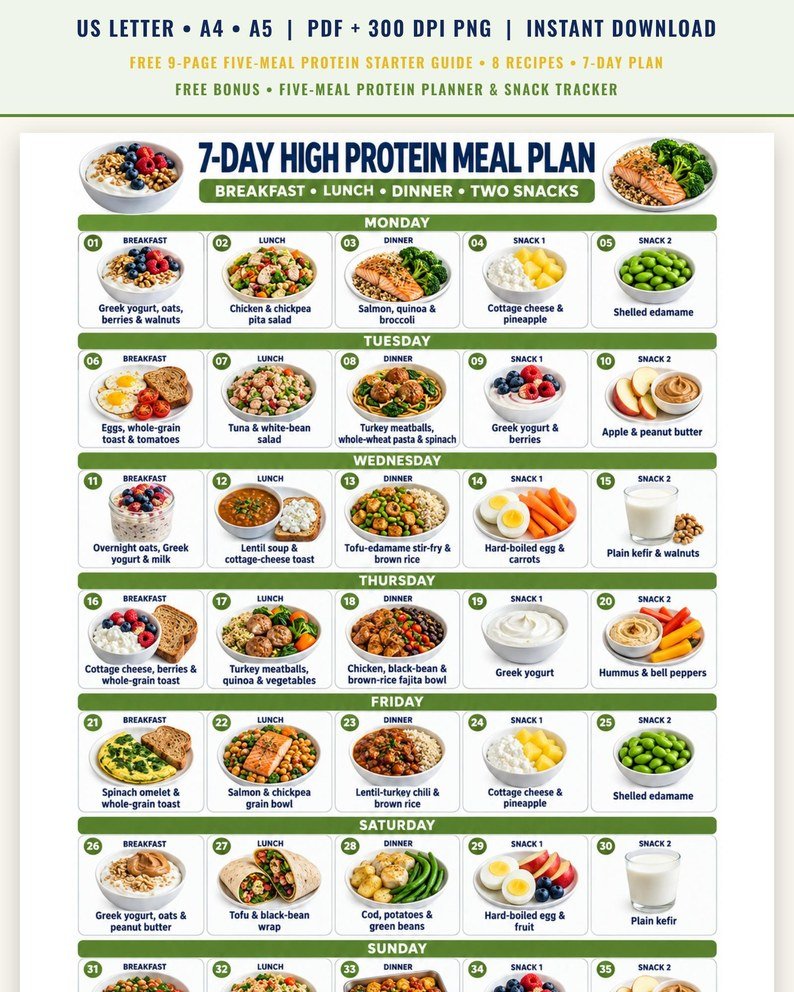
- 35 numbered meals Monday to Sunday: breakfast, lunch, dinner and two snacks each day, each with a photo
- Monday: Greek yogurt, oats, berries and walnuts; chicken and chickpea pita salad; salmon, quinoa and broccoli
- Thursday: cottage cheese, berries and whole grain toast; turkey meatballs, quinoa and vegetables; a chicken, black bean and brown rice fajita bowl
- Snacks include cottage cheese and pineapple, shelled edamame, hard boiled egg and carrots, and hummus and bell peppers
- US Letter, A4 and A5 PDFs plus a PNG, with a 9-page starter guide and a 4-page planner and snack tracker, per the listing
- Instant download · Print at home · US Letter · A4 · A5
Use code BLOG10 for 65% OFF at Etsy checkout!
Worked Training Day: Protein Meal by Meal
The second printable is a 7 Day High Protein Meal Plan with 35 numbered meals: breakfast, lunch, dinner and two snacks every day. Monday is Greek yogurt, oats, berries and walnuts; a chicken and chickpea pita salad; salmon, quinoa and broccoli; cottage cheese and pineapple; and shelled edamame. Tuesday is eggs, whole grain toast and tomatoes; tuna and white bean salad; turkey meatballs, whole wheat pasta and spinach; Greek yogurt and berries; and apple and peanut butter.
Wednesday is overnight oats with Greek yogurt and milk; lentil soup and cottage cheese toast; a tofu and edamame stir fry with brown rice; a hard boiled egg and carrots; and plain kefir and walnuts. Thursday is cottage cheese, berries and whole grain toast; turkey meatballs, quinoa and vegetables; a chicken, black bean and brown rice fajita bowl; Greek yogurt; and hummus and bell peppers. Friday is a spinach omelet and whole grain toast; a salmon and chickpea grain bowl; lentil turkey chili with brown rice; cottage cheese and pineapple; and shelled edamame. Saturday is Greek yogurt, oats and peanut butter; a tofu and black bean wrap; cod, potatoes and green beans; a hard boiled egg and fruit; and plain kefir. Sunday’s meals are cut off on the listing photo, so I haven’t named them.
The meal plan doesn’t print grams. So here’s Monday, with rough protein totals worked out from the High Protein Foods Chart’s numbers for the main protein in each meal. These are estimates for a 75 kg person aiming at the upper end, and the portions are mine.
| Time | Meal (Monday on the plan) | Main protein, chart figures | Approx. protein |
|---|---|---|---|
| Breakfast | Greek yogurt, oats, berries and walnuts | Greek yogurt 1 cup 23 g, oats 1 cup 10 g, walnuts 1/4 cup 5 g | 38 g |
| Snack 1 | Cottage cheese and pineapple | Cottage cheese 1 cup 25 g | 25 g |
| Lunch | Chicken and chickpea pita salad | Chicken breast 3 oz 26 g, chickpeas half a cup (half of 15 g) | about 33 g |
| Training | Strength session, for example squats, push ups, rows and lunges | ||
| Snack 2 | Shelled edamame | Edamame 1 cup 17 g | 17 g |
| Dinner | Salmon, quinoa and broccoli | Salmon 3 oz 22 g, quinoa 1 cup 8 g | 30 g |
| Day total | about 143 g | ||
Read that total carefully. At about 143 g, this day sits above 1.6 g per kg for a 75 kg person (120 g). The 2018 review found no extra lean mass gains above that level, so you could trim a snack or the second cup of cottage cheese and lose nothing. For a 55 kg person, half portions at breakfast and snack 1 would bring it close to 100 g. The meal plan is a template. Adjust the portion sizes to your own number.
Post workout. Snack 2 lands after training in this layout. Edamame, Greek yogurt, a glass of milk or kefir, or eggs on toast all work. You don’t need a special drink. You just need a proper meal or snack in the hours after your session.
For more breakfasts in this style, our high protein foods for breakfast guide has a full week.
Pairing Protein With Strength Training
Protein without training won’t build muscle. The 2018 review looked at protein alongside prolonged resistance training. That’s the combination that worked. The NHS guideline for adults aged 19 to 64 is strengthening activities that work all the major muscle groups, legs, hips, back, abdomen, chest, shoulders and arms, on at least 2 days a week, plus at least 150 minutes of moderate activity or 75 minutes of vigorous activity.
Train hard enough. The NHS says that to get the benefit from strength exercises, you should do them to the point where you need a short rest before repeating. That applies to a barbell, dumbbells or body weight moves like push ups and squats.
A simple weekly pattern. Three strength sessions on non consecutive days, for example Monday, Wednesday and Friday, with walking or easy cardio between. Eat your protein every day, not only on training days, because muscle repair carries on through the rest days too. This pattern is my suggestion, a common starting point that fits the NHS minimum.
Age and protein. The 2018 review found that the effect of extra protein on lean mass shrank with age. That doesn’t mean older adults should give up. It means training matters even more, and protein should be spread through the day. Our high protein foods for seniors guide covers soft, easy options for older lifters.
Don’t forget the rest of the plate. Training hard needs energy. Oats, quinoa, brown rice, whole grain bread and potatoes are all on the chart or the meal plan, and they fuel your sessions. Fruit and vegetables bring fiber and the vitamins you need to recover. If you’re not gaining after a few months of steady training and good protein, it’s often total calories, not protein, that’s short.
Track for two weeks. Write down what you eat on a normal training week and add up the protein using the chart. Most people find one meal, usually breakfast or lunch, is well below the rest. Fix that one meal first. It’s the easiest win.
Frequently Asked Questions
What are the best high protein foods for muscle gain?
Lean meat, fish, eggs and dairy give a lot of protein per serving: on the chart, 3 oz of chicken breast has 26 g, a cup of cottage cheese 25 g, a can of tuna 25 g and a cup of Greek yogurt 23 g. Lentils (18 g a cup), edamame (17 g) and tempeh (16 g per 3 oz) are the strongest plant picks.
How much protein do I need to build muscle?
The minimum for adults is 0.8 g per kg of body weight a day, according to the National Academy of Medicine figure quoted by Harvard’s Nutrition Source. A 2018 review of 49 studies found that, with resistance training, protein intakes above about 1.6 g per kg a day gave no further gains in lean mass. Your needs depend on your health, so check with your doctor if you have kidney disease.
Do I need protein shakes to gain muscle?
No. Shakes are convenient, and the chart lists one serving at 25 g, but food can do the same job. Harvard’s Nutrition Source notes that protein powders are not regulated by the FDA for safety and can contain added sugars and other ingredients. A cup of Greek yogurt or cottage cheese gives a similar amount.
Should I eat protein right after a workout?
A protein rich meal or snack within a few hours of training is a sensible habit, and spreading protein over the day is easier than eating it all at dinner. What matters most is your total for the day and that you keep training regularly.
What sizes does the high protein foods chart print in?
The listing offers a US Letter PDF, an A4 PDF and a high resolution PNG. The weekly meal plan adds an A5 size.
This guide is general information and is not medical advice. Check with your doctor before raising your protein intake, especially if you have kidney disease or another health condition.
Related Guides
- High Protein Food List for Weight Loss
- High Protein Foods for Seniors
- High Protein Foods Low Calorie
- High Protein Foods With Fiber
- High Protein Foods for Breakfast
Sources
Sources: Harvard T.H. Chan School of Public Health, The Nutrition Source, Protein, Morton and others, protein supplementation and resistance training gains in muscle mass and strength, British Journal of Sports Medicine 2018 (PMC)
 Diet & Food ListsMediterranean Diet for Seniors: A Simple Guide With an Eat, Limit, Avoid List and a 7 Day Plan
 Diet & Food ListsLow Sodium Dinner Ideas: 24 DASH Style Dinners, a Sodium Budget per Plate and Sauce and Seasoning Swaps
 Diet & Food ListsHigh Fiber Foods With Low Carbs: 30 Vegetables, Seeds, Nuts and Berries, With a Sample Day and Easy Swaps