The 11 body systems and their functions are the integumentary, skeletal, muscular, nervous, endocrine, cardiovascular, lymphatic, respiratory, digestive, urinary and reproductive systems. Each is a group of organs that work together on one main job, from protecting the body and holding it up to moving it, controlling it, feeding it and cleaning it. Learn the eleven jobs and the rest of anatomy has somewhere to hang.
This guide gives each system’s main organs and function in one table, explains how the systems work together, adds memory tricks, and finishes with a one week study plan. It uses the SoftoTech Print Studio Kids Human Body Bundle and its Human Body Systems for Kids poster as visual aids, and the free OpenStax Anatomy and Physiology textbook and NCI SEER training modules as references.
It’s written for middle and high school students, homeschool families and anyone revising the basics. The kids poster simplifies to 10 systems, and I’ll explain the difference.
In this guide:
- From Cells to Systems: Where Organ Systems Fit
- The 11 Body Systems, Their Organs and Functions
- How the Body Systems Work Together
- Memory Tricks and a One Week Study Plan
- Frequently Asked Questions

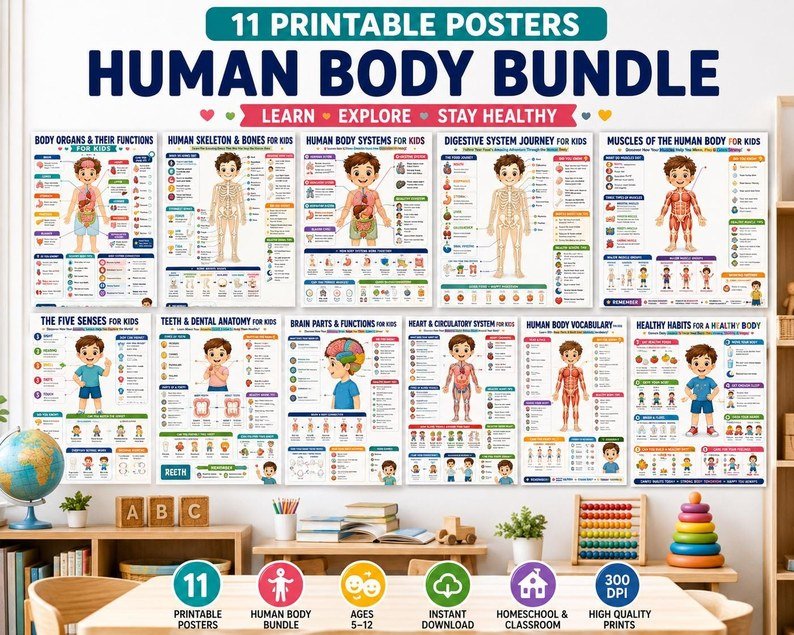
- 11 printable posters in one bundle: body organs, skeleton and bones, body systems, a digestive system poster, muscles, five senses, teeth, brain parts, heart and circulation, body vocabulary and healthy habits
- Ages 5 to 12, for homeschool and classroom use, 300 DPI high quality prints
- Each poster prints in 3 sizes, so the same set fits a wall, a binder or a classroom display
- US Letter, A4 and A5, as 3 ZIPs per the listing
- Instant download · Print at home · US Letter · A4 · A5
Use code BLOG10 for 65% OFF at Etsy checkout!
From Cells to Systems: Where Organ Systems Fit
OpenStax describes the body’s organization in six levels of increasing complexity, from the smallest chemical building blocks to the whole human. It helps to see where systems sit before learning them.
- Chemical: atoms and molecules.
- Cellular: OpenStax calls the cell the smallest independently functioning unit of a living organism. In humans, cells perform all the functions of life.
- Tissue: a group of many similar cells working together on a specific function.
- Organ: a distinct structure made of two or more tissue types, with one or more specific jobs.
- Organ system: a group of organs that work together.
- Organism: the whole living person, in which all cells, tissues, organs and systems work together to keep you alive and healthy.
Follow one example up the levels. Take the stomach. Its lining is made of cells, which group into tissues: a lining tissue that makes digestive juices, smooth muscle tissue that churns the food, and connective tissue that holds it together. Those tissues together form one organ, the stomach. The stomach then works with the mouth, oesophagus, intestines, liver and pancreas as the digestive system. And the digestive system works with every other system to keep the whole organism, you, alive. Walking one organ up the ladder like this makes the levels easy to remember.
One honest caveat. OpenStax points out that assigning organs to systems can be imprecise, and that most organs contribute to more than one system. The pancreas makes digestive juices and hormones. The male urethra carries urine and is part of the reproductive system too. So don’t worry if you see an organ listed in two places. That’s how the body really works.
Why “11” isn’t universal. OpenStax covers eleven distinct systems, which is the list most courses use. Some books split the immune system out from the lymphatic system, or treat the cardiovascular system as part of a wider circulatory system. Check which list your course uses, then stick with it.
The 11 Body Systems, Their Organs and Functions
Here’s the core table. The system names follow OpenStax. The organs and functions are the standard textbook summary, kept short enough to memorise.
| System | Main organs and parts | Main function |
|---|---|---|
| Integumentary | Skin, hair, nails, sweat glands | Protects the body, helps control temperature, senses touch |
| Skeletal | Bones, cartilage, ligaments, joints | Supports and protects the body, allows movement with muscles, stores minerals, makes blood cells in bone marrow |
| Muscular | Skeletal muscles and tendons | Moves the body, keeps posture, produces heat |
| Nervous | Brain, spinal cord, nerves, sense organs | Detects changes and controls the body’s response with fast electrical signals |
| Endocrine | Pituitary, thyroid, adrenal glands, pancreas, ovaries, testes | Controls the body with hormones, slower and longer lasting than nerve signals |
| Cardiovascular | Heart, blood vessels, blood | Pumps blood to carry oxygen, nutrients, wastes and hormones around the body |
| Lymphatic | Lymph nodes, lymph vessels, spleen, thymus, tonsils | Returns fluid to the blood and helps defend the body against infection |
| Respiratory | Nose, trachea, lungs | Brings oxygen into the blood and removes carbon dioxide |
| Digestive | Mouth, oesophagus, stomach, intestines, liver, pancreas | Breaks down food, absorbs nutrients, removes solid waste |
| Urinary | Kidneys, ureters, bladder, urethra | Filters waste from the blood and controls water and salt balance |
| Reproductive | Ovaries, uterus, testes and related organs | Produces sex cells and hormones and makes new life possible |
Grouping them makes it easier. I find it helps to learn them in four groups rather than as one list of eleven.
- Cover, support and move: integumentary, skeletal, muscular. The outside, the frame and the motors.
- Control: nervous and endocrine. One is fast, using nerve signals. The other is slow, using hormones.
- Transport and defence: cardiovascular and lymphatic. The delivery network and the drainage and defence network.
- Exchange with the outside world: respiratory, digestive, urinary, reproductive. Gases in and out, food in and waste out, water balance, and the next generation.
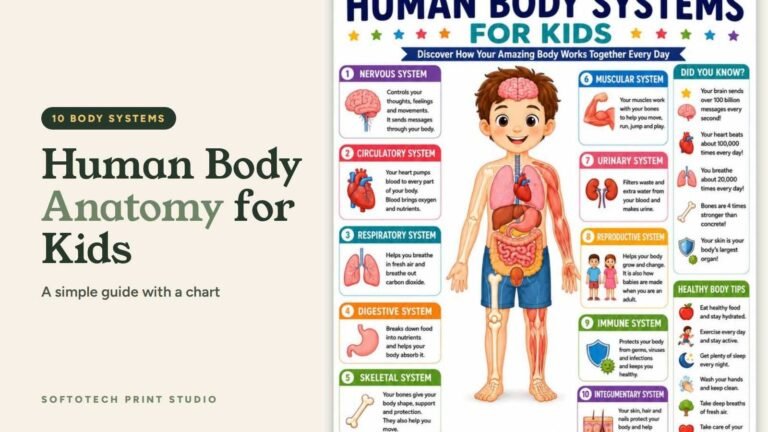
How the kids poster compares. The Human Body Systems for Kids poster shows 10 systems, each with a one line job: nervous, circulatory, respiratory, digestive, skeletal, muscular, urinary, reproductive, immune and integumentary. It has no separate endocrine panel, and it shows immune where textbooks show lymphatic. That’s a sensible simplification for ages 5 to 12, and a good starting point for younger brothers and sisters. Our human body anatomy for kids guide walks that poster for younger children.
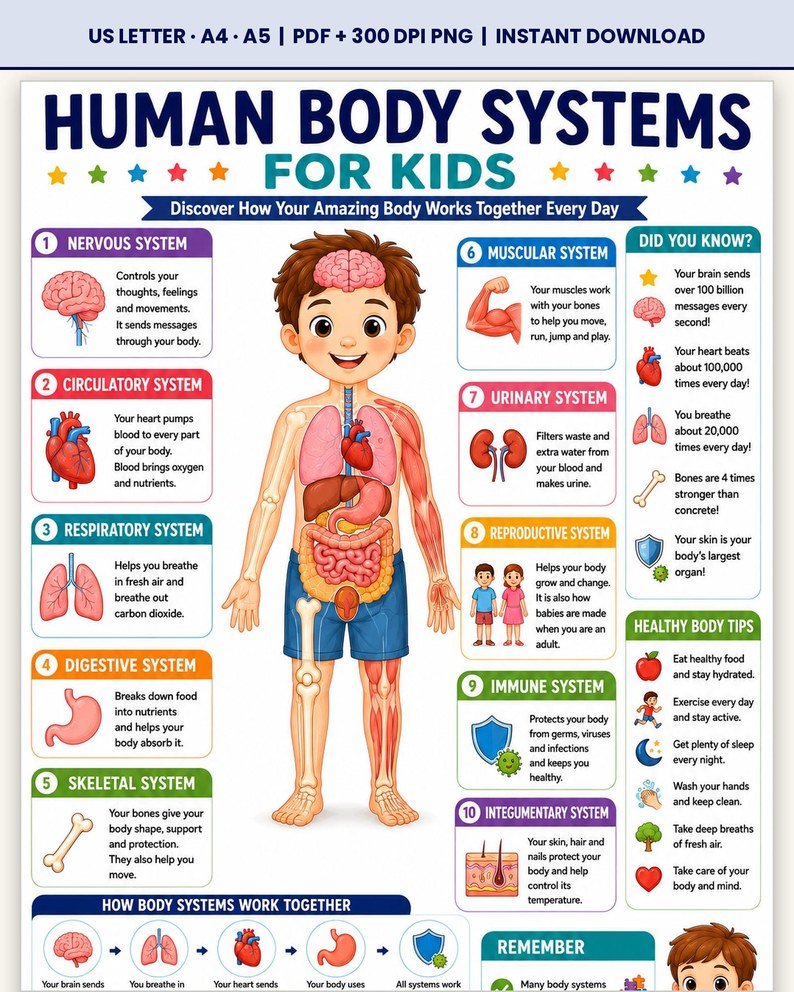
- 10 body systems on one chart, each with a one line job a child can understand: nervous, circulatory, respiratory, digestive, skeletal, muscular, urinary, reproductive, immune and integumentary
- Did you know facts, such as your heart beats about 100,000 times a day and you breathe about 20,000 times a day
- Healthy body tips: eat well, stay hydrated, exercise daily, sleep plenty, wash hands, breathe fresh air
- Made for ages 5 to 12, for homeschool and classroom walls
- US Letter, A4 and A5, as PDF and 300 DPI PNG, per the listing
- Instant download · Print at home · US Letter · A4 · A5
Use code BLOG10 for 65% OFF at Etsy checkout!
How the Body Systems Work Together
The table makes the systems look separate. They aren’t. SEER’s training module puts it plainly: no part of the body, from the smallest cell to a complete body system, works in isolation. They all function together, in fine tuned balance, to maintain life.
Homeostasis is the shared goal. SEER explains that survival depends on maintaining or restoring homeostasis, a state of relative constancy in the body’s internal environment. The word comes from Greek words meaning staying the same. As the physiologist Walter Cannon stressed, it doesn’t mean fixed. It means a condition that may vary but stays relatively constant. Body temperature, blood sugar and water balance all move a little and are pulled back.
Three examples to learn. These are the kind of linked answers exam questions like.
- Going for a run. The nervous system signals the muscles. Muscles pull on bones to move you. Muscles need more oxygen, so breathing speeds up (respiratory) and the heart beats faster (cardiovascular). You warm up, so the skin sweats to cool you (integumentary).
- Eating a meal. The digestive system breaks food into nutrients. The cardiovascular system carries them to cells. The pancreas releases hormones to manage blood sugar (endocrine). The kidneys filter out waste products from the blood (urinary).
- Fighting a cut. Skin is the first barrier (integumentary). Blood brings clotting factors and white blood cells (cardiovascular). The lymphatic system helps fight any infection.
The life processes. SEER also lists the basic processes of life: organization, metabolism, responsiveness, movement and reproduction, plus, in humans, growth, differentiation, respiration, digestion and excretion. Try matching each process to the systems that carry it out. Movement is muscular and skeletal. Excretion is urinary, plus the lungs and digestive system. It’s a good revision exercise.
Keeping the systems healthy. The kids poster’s healthy body tips work at any age: eat well, stay hydrated, exercise daily, sleep plenty, wash hands and breathe fresh air. Our healthy habits for kids guide turns those into a daily routine, our kids exercise routine guide puts the muscular and skeletal systems to work, and our calcium rich foods for bone health guide covers what bones need.
Memory Tricks and a One Week Study Plan
A mnemonic. Take the first letters of the eleven systems and make a silly sentence. One option: “Ice Skating Makes Nervous Elephants Clumsy, Leaving Real Damage Under Rinks.” That’s Integumentary, Skeletal, Muscular, Nervous, Endocrine, Cardiovascular, Lymphatic, Respiratory, Digestive, Urinary, Reproductive. Make up your own; the sillier, the better it sticks.
One body, one job. For each system, learn one organ and one function first, which is exactly the OpenStax learning objective for this section. Only add detail once all eleven pairs are solid.
A one week study plan. About 20 minutes a day. The plan is my suggestion.
| Day | Systems | Task |
|---|---|---|
| 1 | Integumentary, skeletal, muscular | Learn organ and function. Feel your own bones and muscles as you name them. |
| 2 | Nervous, endocrine | Compare fast nerve signals with slow hormones in a two column table. |
| 3 | Cardiovascular, lymphatic | Draw the heart and a simple loop of blood vessels; add lymph nodes. |
| 4 | Respiratory, digestive | Trace a breath and a bite of food through the body on a body outline. |
| 5 | Urinary, reproductive | Learn organ and function; link kidneys to water balance. |
| 6 | All 11 | Write the three teamwork examples from memory. |
| 7 | All 11 | Blank table test: fill in all organs and functions, check, redo the gaps. |
Use the posters. Hang the body systems poster and the organs poster from the bundle where you study. When you test yourself on day 7, turn them to the wall first, then check against them afterwards. Younger siblings can follow along with the 10 system version, which keeps the jobs simple. The bundle’s skeleton, muscles, digestive, brain and heart posters fit days 1, 3 and 4 neatly.
Common mix ups to watch for. These are the errors I see most often in revision notes.
- Muscular versus skeletal. Bones don’t move themselves. Muscles pull on bones through tendons. Ligaments join bone to bone at joints. Getting tendons and ligaments the wrong way round is a classic slip.
- Nervous versus endocrine. Both control the body. The difference is speed and method: nerves send fast electrical signals to specific places, while hormones travel in the blood and act more slowly over a longer time.
- Respiratory versus cardiovascular. The lungs swap gases with the blood. The heart and vessels carry that oxygen to the rest of the body. Breathing and circulation are partners, not the same thing.
- Digestive versus urinary waste. Solid waste leaves through the digestive system. The kidneys filter waste out of the blood and make urine. They handle different waste.
- Lymphatic versus immune. The lymphatic system is the network of vessels and nodes. Immunity is the job of defending the body, which involves white blood cells from several systems. That’s why some books list them separately.
Organs that belong to two systems. Since OpenStax notes most organs contribute to more than one system, it’s worth knowing a few examples by heart. The pancreas is digestive and endocrine. The ovaries and testes are reproductive and endocrine. The bone marrow inside the skeleton makes blood cells. The diaphragm is a muscle that powers breathing. Writing one line on each of these shows an examiner you understand that systems overlap.
Exam answer pattern. When a question asks for a system’s function, give the organ, the job and a short example. “The urinary system, made up of the kidneys, ureters, bladder and urethra, filters waste from the blood and controls water balance; for example, you make less urine when you’re dehydrated.” Three parts, one sentence, full marks more often than not.
Going further. When you’re ready for more depth, the free OpenStax Anatomy and Physiology 2e textbook covers every system chapter by chapter, and the SEER training modules have clear, short pages on each system.
Frequently Asked Questions
What are the 11 body systems?
OpenStax Anatomy and Physiology covers eleven organ systems: integumentary, skeletal, muscular, nervous, endocrine, cardiovascular, lymphatic, respiratory, digestive, urinary and reproductive. Some textbooks group them slightly differently, for example naming the immune system alongside the lymphatic system.
What is the main function of each body system?
In short: skin protects, bones support, muscles move, nerves control, glands send hormones, the heart and blood vessels transport, the lymphatic system returns fluid and defends, the lungs exchange gases, the digestive system breaks down food, the urinary system removes waste and balances water, and the reproductive system produces offspring.
How do the body systems work together?
No system works alone. SEER’s anatomy module says no part of the body, from the smallest cell to a complete body system, works in isolation. Running, for example, uses the nervous system to signal muscles, the skeletal and muscular systems to move, and the respiratory and cardiovascular systems to deliver oxygen.
Why does the kids chart show 10 systems instead of 11?
The Human Body Systems for Kids poster simplifies for ages 5 to 12. It doesn’t have a separate endocrine panel, and it shows an immune system panel where textbooks list the lymphatic system. That’s a normal simplification for younger children.
What is homeostasis?
Homeostasis is the body keeping its internal conditions, such as temperature and chemical balance, relatively constant. SEER explains the word comes from Greek for staying the same, and that survival depends on maintaining or restoring it. All 11 systems help.
This guide is for general education and study. It is not medical advice; ask a doctor or nurse about any health question.
Related Guides
- Human Body Anatomy for Kids
- Healthy Habits for Kids
- Kids Exercise Routine
- Calcium Rich Foods for Bone Health
Sources
Sources: OpenStax, Anatomy and Physiology 2e, 1.2 Structural Organization of the Human Body, NCI SEER Training Modules, Body Functions and Life Process