
If you wake up feeling stiff, you’re not alone. After 60, joints and muscles naturally need a little more time to “warm up” in the morning — and a few minutes of gentle stretching can make the whole day feel easier. You don’t need special equipment, a gym membership, or even to get on the floor.
This guide walks you through 10 simple morning stretches for seniors, designed to be done in about 10 minutes, most of them seated or with a sturdy chair for support. Do them daily, and mornings start to feel less creaky and more capable.
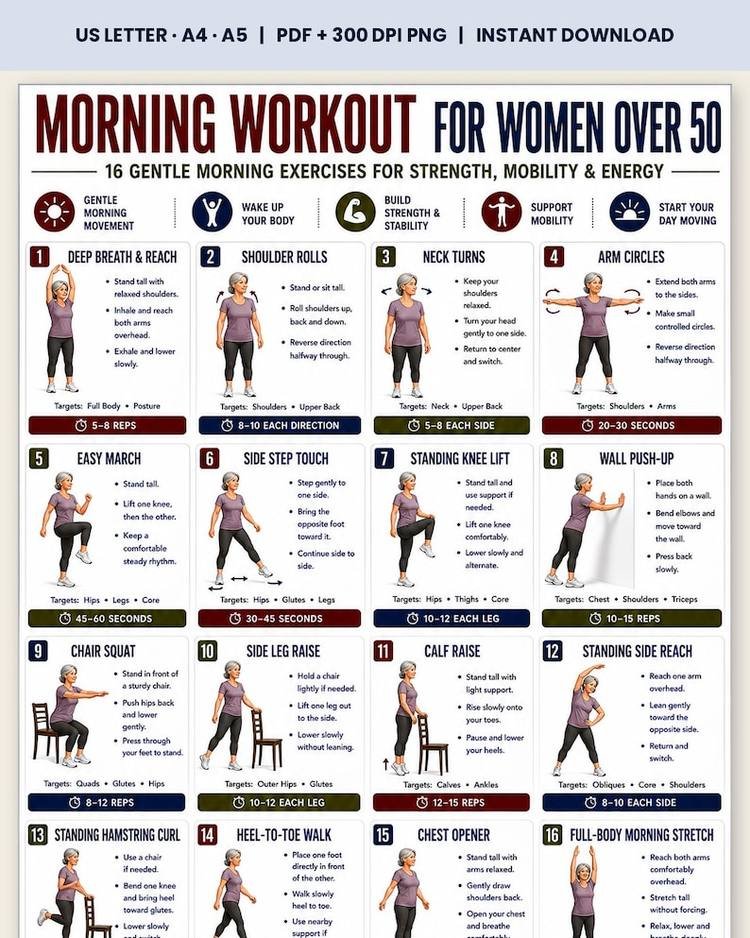
The printable from this guide
Morning Stretch Routine for Seniors
- Gentle wake-up stretches laid out step by step
- Clear illustrations with simple cues for each move
- A4 · US Letter · A5, instant PDF download
Get the morning stretch chart on Etsy →
Instant download · Print at home
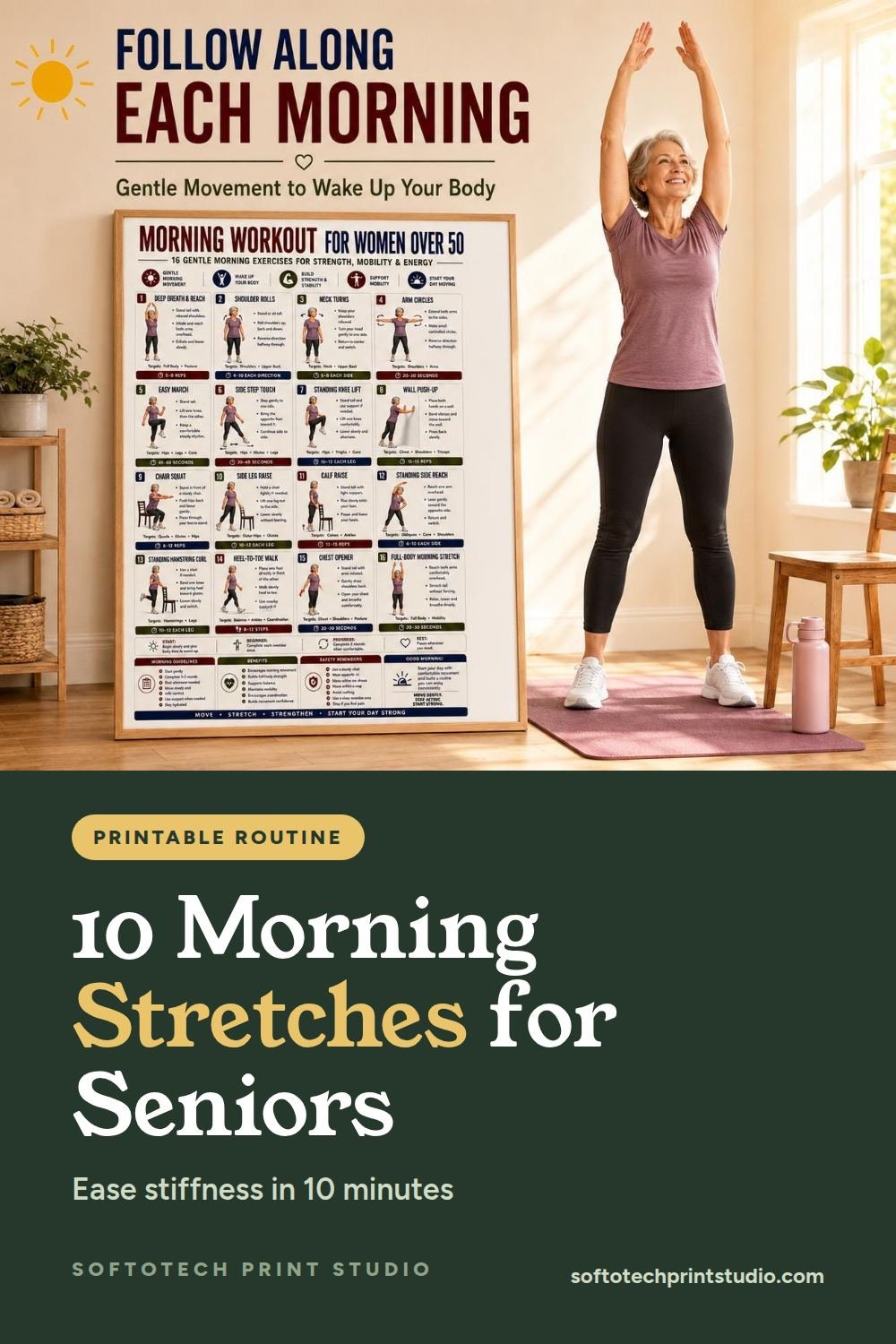
Why Stretching First Thing Matters After 60
Overnight, your body stays still for hours. Joint fluid thickens slightly, muscles cool down, and connective tissue tightens — which is why that first half hour of the day can feel the stiffest. Gentle morning stretching:
- Eases morning stiffness by warming up muscles and getting joints moving through their range of motion.
- Supports balance — flexible ankles, hips, and calves all contribute to steadier footing during the day.
- Improves posture by opening the chest and shoulders, countering the rounded position many of us hold while sleeping or sitting.
- Gets blood flowing, which can help you feel more awake and alert without reaching for a second cup of coffee.
You don’t need to be flexible to start. These stretches meet you where you are — small, comfortable movements count.
How to Stretch Safely: 6 Ground Rules
- Never bounce. Move slowly into each stretch and hold still. Bouncing can strain muscles.
- Stay in the comfort zone. You should feel a gentle pull, never sharp pain. Pain is a stop signal.
- Breathe deeply. Exhale as you ease into the stretch; steady breathing helps muscles relax.
- Use support. Keep a sturdy chair nearby for standing stretches. There’s no prize for wobbling.
- Hold 20–30 seconds per stretch, per side. Two slow breaths is a good rhythm.
- Warm up first. March gently in place or roll your shoulders for a minute before stretching cold muscles.
The 10 Morning Stretches
Do these in order — they flow from neck to ankles so nothing gets skipped. The whole sequence takes about 10 minutes.
1. Neck Tilts
How: Sit tall. Slowly tilt your right ear toward your right shoulder until you feel a gentle stretch on the left side of your neck. Hold 20 seconds. Repeat on the left. Do 2 rounds each side.
Why it helps: Releases overnight neck tension from sleeping positions.
2. Shoulder Rolls
How: Lift both shoulders up toward your ears, roll them back and down in a slow circle. Do 8–10 circles, then reverse direction.
Why it helps: Loosens the upper back and shoulders where many people hold tension.
3. Seated Cat-Cow
How: Sit on the front half of a sturdy chair, hands on knees. Inhale: arch your back gently and lift your chest (cow). Exhale: round your back, tucking your chin (cat). Flow between the two for 6–8 breaths.
Why it helps: Wakes up the entire spine and eases lower-back stiffness.
4. Chest Opener
How: Sit or stand tall. Clasp your hands behind your back and gently straighten your arms, lifting your hands slightly as you open your chest. Hold 20–30 seconds, breathing deeply.
Why it helps: Counteracts rounded shoulders and opens up breathing.
5. Seated Spinal Twist
How: Sit tall, feet flat. Place your right hand on your left knee and gently twist your torso to the left, looking over your left shoulder. Hold 20 seconds. Switch sides.
Why it helps: Keeps the mid-back mobile and can ease that “locked up” feeling.
6. Seated Side Bends
How: Sit tall. Raise your right arm overhead and lean gently to the left, feeling a stretch along your right side. Hold 20 seconds. Switch sides. Repeat twice each.
Why it helps: Stretches the obliques and the muscles between the ribs, supporting easier breathing and trunk mobility.
7. Hip Flexor Stretch (Standing, Chair for Support)
How: Stand behind a sturdy chair, holding the back. Step your right foot back about two feet, keeping both feet flat and your torso upright. You should feel a stretch at the front of your right hip. Hold 20–30 seconds. Switch legs.
Why it helps: Sitting shortens the hip flexors; this stretch restores comfortable stride length for walking.
8. Wall Calf Stretch
How: Face a wall, hands on it at shoulder height. Step your right foot back, pressing the heel toward the floor while keeping the leg straight. Hold 20–30 seconds. Switch legs.
Why it helps: Flexible calves support ankle mobility — a quiet contributor to steady balance.
9. Ankle Circles
How: Sit and extend one leg slightly, or stand holding the chair and lift one foot. Slowly draw circles with your toes — 8 in each direction. Switch feet.
Why it helps: Keeps ankles mobile for safer steps on uneven ground.
10. Standing Hamstring Stretch (Chair Support)
How: Stand behind the chair. Extend your right leg forward, heel on the floor, toes pointing up. Hinge slightly forward at the hips until you feel a gentle stretch behind your thigh. Hold 20–30 seconds. Switch legs.
Why it helps: Eases tight hamstrings that can pull on the lower back.
Your 10-Minute Morning Flow
Here’s how the stretches fit together as one smooth routine:
- March in place gently — 1 minute
- Neck tilts — 1 minute
- Shoulder rolls — 1 minute
- Seated cat-cow — 1 minute
- Chest opener + seated twist — 2 minutes
- Side bends — 1 minute
- Hip flexor + calf stretch — 2 minutes
- Ankle circles + hamstring stretch — 1 minute
That’s it — ten minutes that can genuinely change how the rest of your morning feels.
Tips for Making It Stick
- Anchor it to something you already do — stretch right after brushing your teeth or while the kettle boils.
- Keep the chart visible — print the routine and leave it where you’ll see it in the morning.
- Start with 5 minutes if 10 feels like a lot. Consistency beats duration.
- Track your streak — a simple calendar checkmark is surprisingly motivating.
- Stretch with someone — a partner or friend makes it social and harder to skip.
Take this routine with you
Morning Stretch Routine for Seniors — Printable Chart
- All 10 stretches illustrated with clear step-by-step cues
- Print it once, follow along every morning
- A4 · US Letter · A5, instant PDF download
Get the printable routine on Etsy →
Instant download · Print at home
Morning Stretches for Seniors: Your 7-Day Schedule
Doing all 10 stretches every day is great — but if you’d like a little variety through the week, this schedule rotates the focus so each area gets extra attention twice a week. Every day still takes about 10 minutes.
| Day | Focus | What to do | Time |
|---|---|---|---|
| Monday | Full-body reset | All 10 stretches, about 1 minute each | 10 min |
| Tuesday | Neck, shoulders & spine | Neck tilts, shoulder rolls, seated cat-cow, chest opener, spinal twist — an extra round of each | 10 min |
| Wednesday | Hips & legs | Hip flexor stretch, wall calf stretch, ankle circles, hamstring stretch — an extra round of each | 10 min |
| Thursday | Full-body reset | All 10 stretches, about 1 minute each | 10 min |
| Friday | Posture & breathing | Chest opener, seated cat-cow, side bends, shoulder rolls — slow and deep | 10 min |
| Saturday | Balance & ankles | Ankle circles, wall calf stretch, hip flexor stretch, hamstring stretch | 10 min |
| Sunday | Gentle recovery | Pick your 5 favorites and move slowly — or repeat Monday’s full routine | 5–10 min |
Print this schedule next to your stretch chart. Checking off each day keeps the habit visible — and visible habits stick. For a fully seated alternative on low-energy days, try our chair yoga routine for seniors over 70.
Modifications for Limited Mobility
Every stretch in this guide can be adapted. Here is how to make the routine work if standing is difficult, balance is shaky, or a joint needs extra care:
- Do the whole routine seated. The hip flexor stretch, calf stretch, and hamstring stretch all have seated versions.
- Shorten the range of motion. A small, comfortable movement done daily beats a deep stretch done once.
- Use more support. Keep the sturdy chair within arm’s reach for every standing stretch.
- Split it into two mini-sessions. Five stretches after breakfast and five before lunch still add up.
- Skip and substitute. If one stretch bothers a joint, skip it and spend the extra minute on one that feels good.
Related: desk stretches for office workers.
Frequently Asked Questions
How long should morning stretching take for seniors?
About 10 minutes is ideal for a full routine like this one. If you’re just starting out, even 5 minutes of gentle stretching makes a difference — consistency matters more than duration.
Is it safe to stretch every morning after 60?
Gentle daily stretching is generally safe for most older adults. Move slowly, never force a stretch, and stop if you feel pain. If you have arthritis, osteoporosis, joint replacements, or other conditions, check with your doctor or physical therapist first.
Should I stretch before or after getting out of bed?
Either works. Some people like a few gentle stretches in bed first (ankle circles, knee hugs), then do the full standing/seated routine after getting up. The key is to warm up slightly before deeper stretches — even a minute of marching in place helps.
What if I can’t do all 10 stretches?
Start with the ones that feel comfortable — even 3 or 4 stretches done daily will help. Add more as your mobility improves. Every stretch in this guide can be done seated or with chair support, so choose the version that feels safe for you.
This guide is for general wellness and is not medical advice. Check with your doctor before starting a new routine.
Found this helpful? Save it to your “Senior Fitness” Pinterest board — and explore our full collection of printable wellness guides on Etsy.
Start even earlier, before you stand up: our bed exercises for seniors guide covers 16 gentle moves you can do in bed, from warm-up to relaxation.
Related Guides
- 10-Minute Morning Routine for Older Adults
- 10 Gentle Chair Yoga Poses for Seniors (With Printable Routine Chart)
- 8 Balance Exercises for Seniors to Prevent Falls
- 16 Chair Exercises for Belly Fat You Can Do Seated
- Gentle Neck and Shoulder Stretches for Seniors
Sources
Sources: CDC, NIH, Mayo Clinic
 Senior FitnessBreathing Exercises to Increase Lung Capacity: 8 Techniques, a 10 Minute Routine and What They Can Really Do
 Senior FitnessAnkle Exercises for Sprain Recovery: 12 Gentle Moves in 3 Stages, Once Your Clinician Says It’s Time
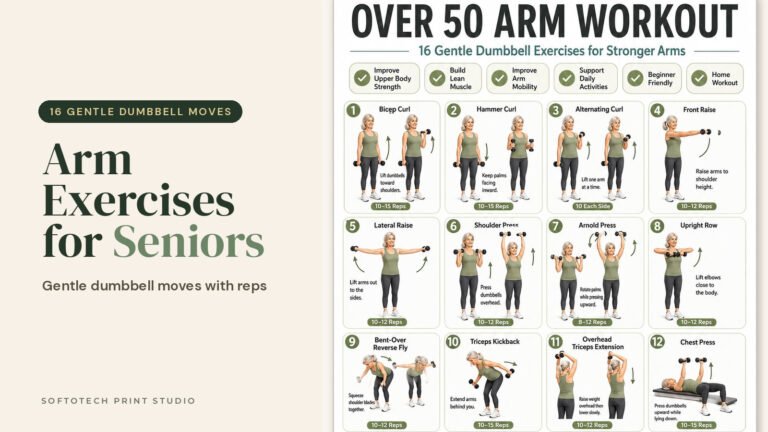 Senior FitnessArm Exercises for Seniors: 16 Gentle Dumbbell Moves and 20 Seated Moves With Reps