
The best mobility exercises for hips are simple ones you’ll actually do: slow circles, a lunge with a twist, a seated rotation, a supported squat and a wide-knee rock. Your hips move in more directions than almost any joint you have, forward, back, out to the side and around, and most days we use a tiny part of that range. Sitting at a desk, driving and sleeping curled up all keep the hip bent in one position.
This guide is built on the Daily Mobility Exercises poster from SoftoTech Print Studio. The chart has 30 moves in eight panels, and the biggest panel is the hip one, with five moves. Four more from the lower body panel work the hips as well, so that’s nine hip moves in total. I’ll go through each one, then put them together into a 10 minute routine, show easier and harder versions, and finish with safety rules from Cleveland Clinic and the NHS.
The chart shows the moves but doesn’t print reps or hold times on the tiles. Where I suggest reps, seconds or an order, that’s my suggestion, not the chart’s, and I’ll say so.
In this guide:
- The 9 Hip Moves on the Chart, One by One
- A 10 Minute Hip Mobility Routine You Can Print
- Easier and Harder Versions of Each Move
- Hip Mobility Safety and When to Get Advice
- Frequently Asked Questions


- 30 mobility movements on one chart, grouped by body area: neck, shoulders, thoracic spine, hips, ankles, core, lower body and full body
- The hip panel has 5 moves: hip circles, world’s greatest stretch, 90/90 hip rotation, deep squat hold and frog stretch
- The lower body panel adds walking lunges, leg swings front to back, leg swings side to side and the hamstring sweep
- A daily mobility plan on the chart, starting with a 5 minute morning mobility reset, plus tips like move slowly and control every rep
- US Letter, A4 and A5, as PDF plus a 300 DPI PNG, per the listing
- Instant download · Print at home · US Letter · A4 · A5
Use code BLOG10 for 65% OFF at Etsy checkout!
The 9 Hip Moves on the Chart, One by One
The poster is called Daily Mobility Exercises, with the line 30 essential mobility movements for better movement and joint health. Five aims run across the top: improve joint mobility, move better, reduce stiffness, improve athletic performance and support healthy aging. The moves are numbered 1 to 30, and the numbers below are the chart’s own. The model is a young man in a vest, but none of these needs a gym, just a mat and a wall or chair to hold.
The hip panel, moves 12 to 16.
- 12. Hip circles. Stand on one leg, hold a wall if you need to, lift the other knee and draw a slow circle with it. Go both ways. This is the gentlest move on the list and a good way to find out which direction feels tight. I’d do 5 circles each way, each leg.
- 13. World’s greatest stretch. Step into a deep lunge, put the hand on the same side as your front foot down on the floor inside it, then turn and reach the other arm up to the ceiling. It opens the front of the back hip and turns the upper back at the same time. Try 3 slow reps per side.
- 14. 90/90 hip rotation. Sit on the floor with both knees bent at right angles, one leg in front of you and one out to the side. Then rotate both knees over to the other side, so the legs swap roles. One hip turns in and the other turns out, which is the range most of us lose first. Start with 5 slow switches. Lean back on your hands if sitting upright is too hard.
- 15. Deep squat hold. Feet a bit wider than your hips, toes turned out a little, lower as far as is comfortable and stay there. Holding a door frame or a heavy table is fine, and it’s what I’d suggest at first. Try 20 to 30 seconds and breathe.
- 16. Frog stretch. On hands and knees, or face down on your forearms as the chart shows, widen your knees and let your hips sink back. You’ll feel it on the inner thighs. Rock gently back and forward rather than forcing a long hold. 8 slow rocks is enough.
The lower body panel, moves 23 to 26. These are listed as lower body mobility, but every one of them moves the hip.
- 23. Walking lunges. Step forward into a lunge, push up and step through into the next one. Keep the steps short at first. 6 steps each leg is a good start.
- 24. Leg swings front to back. Hold a wall or chair and swing one straight-ish leg forward and back like a pendulum. Let the swing get a little bigger each time, without throwing it. 10 each leg.
- 25. Leg swings side to side. Face the wall, hold it with both hands, and swing one leg across your body and out to the side. 10 each leg.
- 26. Hamstring sweep. Put one heel out in front with the toes up, hinge forward from the hips with a flat back and sweep your hands down towards that foot, then stand tall. The hip hinge is the point here. 5 each side.
The bottom of the chart has a muscles and joints focus map, which ticks the hips along with the neck, shoulders, spine, core, knees and ankles, plus a daily mobility plan and a tips box. The plan’s first line is a 5 minute mobility reset in the morning, and the first two tips are move slowly and control every rep. Those two tips matter more than any rep count I give you.
If you want the other 21 moves on the poster explained too, our stretching and mobility exercises guide covers the whole chart, from the neck down to the ankles.
A 10 Minute Hip Mobility Routine You Can Print
This is my order, not the chart’s. It goes from standing to the floor and back up, so you warm up before the deeper positions. Times are rough. Nobody needs a stopwatch for this.
| Step | Move (chart number) | Suggested amount | About |
|---|---|---|---|
| 1 | Hip circles (12) | 5 each way, each leg | 1 min |
| 2 | Leg swings front to back (24) | 10 each leg | 1 min |
| 3 | Leg swings side to side (25) | 10 each leg | 1 min |
| 4 | Hamstring sweep (26) | 5 each side | 1 min |
| 5 | World’s greatest stretch (13) | 3 slow reps each side | 1.5 min |
| 6 | 90/90 hip rotation (14) | 5 to 8 switches | 1.5 min |
| 7 | Frog stretch (16) | 8 slow rocks | 1 min |
| 8 | Deep squat hold (15) | 2 holds of 20 to 30 seconds | 1 min |
| 9 | Walking lunges (23) | 6 steps each leg | 1 min |
When to do it. The chart’s daily plan puts a short reset first thing in the morning, and that’s a good slot, because hips are often stiffest after a night in bed. If mornings are rushed, the end of the workday works too. The routine also makes a decent warm-up before a walk, a run or a leg workout.
How often. I’d start with three or four days a week and see how your hips feel. Most people can do this daily once they’re used to it, because none of the moves is heavy. The NHS suggests doing its home flexibility exercises at least twice a week and building up the reps slowly over time, and short sessions are easier to keep up than long ones.
If you sit all day. You don’t need the whole routine at work. Stand up once an hour and do hip circles and both leg swings next to your desk. That’s two minutes. Then do the floor moves at home in the evening. Our desk stretches for office workers guide has more moves you can do without leaving your chair.
A 3 minute version. Short on time? Do hip circles, the world’s greatest stretch and the 90/90 rotation, and stop. Those three take the hip forward, back and around, which covers most of it.
A worked week. Here’s what a first week could look like. Monday, Wednesday and Friday, the full 10 minutes in the morning. Tuesday and Thursday, the 3 minute version after work, plus desk breaks with circles and swings. Saturday, a walk with the full routine as the warm-up. Sunday off. By the second week, try adding a rep or two to the moves that felt easy, and leave the ones that felt tight where they are.
Tracking it. One way to see progress is to note how low your deep squat goes, or how far you can lean forward in the 90/90 without strain, once a week. Changes are slow and small. If something gets worse rather than better, that’s worth noticing too.
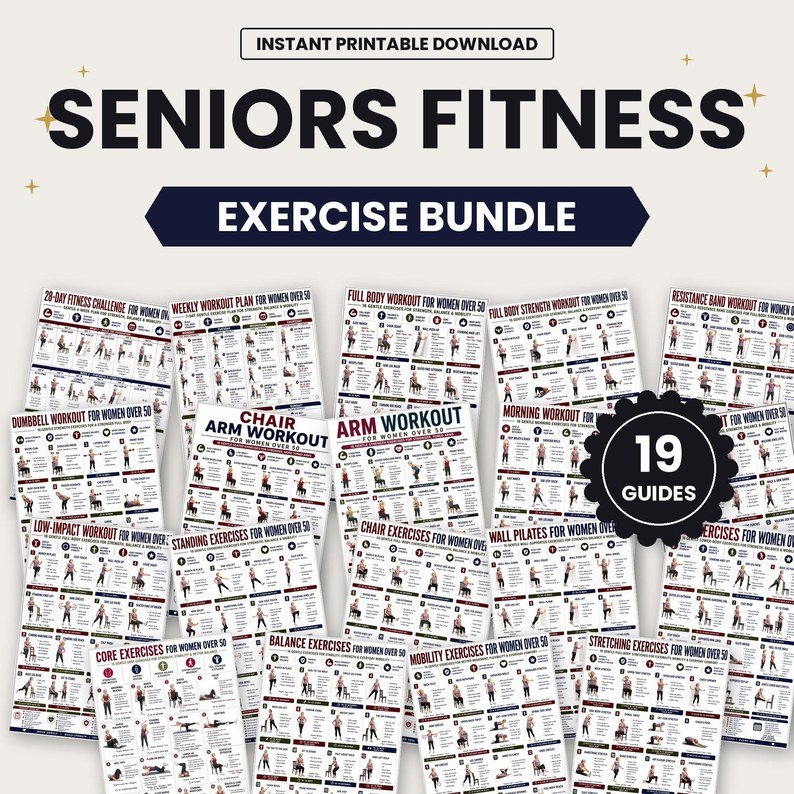
- 19 gentle workout guides in one bundle, made for women over 50
- Includes Mobility Exercises, Stretching Exercises, Balance Exercises, Chair Exercises, Core Exercises and Wall Pilates guides
- Also has a 28-Day Fitness Challenge and a Weekly Workout Plan for building a habit
- A good next step if floor moves like the frog stretch are hard and you want chair and standing versions
- Instant download · Print at home
Use code BLOG10 for 65% OFF at Etsy checkout!
Easier and Harder Versions of Each Move
The chart shows one version of each move. Here are some ways to make them gentler or a little harder. These are common adjustments, not something printed on the poster.
Hip circles. Easier: keep a hand on the wall and make small circles. Harder: let go of the wall, or make the circles bigger and slower.
World’s greatest stretch. Easier: put the back knee down on a cushion, and skip the twist until the lunge feels fine. Harder: hold the top position for a few breaths and add a reach of the elbow towards the front foot first.
90/90 hip rotation. Easier: sit on a folded blanket or a yoga block, and lean back on your hands. You can also do the switch lying on your back with feet on the floor, letting both knees fall side to side. Harder: sit upright with no hands, or lean your chest gently over the front shin.
Deep squat hold. Easier: hold a door frame and only go halfway, or squat down to a low step or box. Putting a rolled towel under your heels helps if they lift. Harder: no hands, and gently push your knees out with your elbows.
Frog stretch. Easier: keep the knees closer together and put a cushion under them. Harder: let the knees go wider and slow the rocks down. Never push the knees so wide that you feel it in the knee joint itself.
Walking lunges. Easier: do a static split squat holding a chair, small range. Harder: longer steps, or hold light weights. If lunges bother your knees, our glute workout for women guide has hip-strength moves like bridges that are kinder to the knees.
Leg swings. Easier: smaller swings with a firm grip. Harder: bigger swings, but stay in control. A swing should never feel like a kick.
Hamstring sweep. Easier: bend the standing knee more and only sweep to the knee. Harder: sweep slowly to the floor while keeping the back long.
Why both mobility and strength. Mobility is range you can control. Stretching helps you find the range, and strength lets you use it. That’s why the chart mixes holds like the frog stretch with active moves like lunges and leg swings. If one hip feels weaker or wobblier than the other, a few strength moves for the glutes help the mobility work stick.
For older adults. Getting down to the floor and back up can be the hardest part. If that’s you, do the standing moves and the chair versions, and look at the chair and standing guides in the senior bundle above. Our mobility exercises for seniors guide also has a gentle seated routine for the shoulders and neck.
Hip Mobility Safety and When to Get Advice
Mobility work is low risk for most people, but hips can be grumpy, and a few rules keep it that way.
Go by feel, not by a picture. Cleveland Clinic’s advice on hip stretches is to work gently into your range of motion and to notice what hurts or doesn’t feel right. Your 90/90 or squat may never look like the drawing. That’s fine.
Know the difference between a stretch and pain. The same Cleveland Clinic article says some dull soreness or minor discomfort is normal when you first start, because the muscles aren’t used to being lengthened. Sharp, pinpoint pain, or pain that lasts more than a few hours, is the signal to stop and get it checked by a healthcare provider or physical therapist.
Start gently and build up. The NHS advice for its flexibility routine is to wear loose, comfortable clothes, build up slowly and add repetitions gradually. The standing moves at the start of the routine are an easy way in, and a short walk first helps too.
Don’t bounce. Rock gently in the frog stretch and move slowly in and out of the squat. Bouncing into the end of a range is where people strain things.
Breathe. It sounds obvious, but people hold their breath in deep positions. Slow breathing helps you relax into the move.
Talk to someone first if:
- You’ve had a hip replacement or hip surgery. There are often rules on how far you can bend or turn the hip, and some of these moves may not be allowed yet.
- You have hip arthritis, a labral tear, hip dysplasia or osteoporosis.
- Your hip pain came on after a fall or an injury.
- You have pain in the groin, numbness or tingling down the leg, or pain at night.
- You’re pregnant. Some deep hip positions feel different in pregnancy, and a midwife or physio can tell you what’s fine.
A note on clicking. A painless click or pop in the hip during a move is common and usually nothing to worry about. A click that comes with pain or a feeling of catching is worth mentioning to a doctor or physio.
Make it stick. Print the chart and put it somewhere you’ll pass every morning, like the bedroom or bathroom door. Tick off the days. If you do 10 minutes on most days for a month, you’ll know whether it’s helping. Keep the moves small, slow and regular, and let the range come with time.
Frequently Asked Questions
What are the best mobility exercises for hips?
Moves that take the hip through all its directions: hip circles, the world’s greatest stretch, the 90/90 hip rotation, a supported deep squat and the frog stretch, which are the five in the hip panel of the Daily Mobility Exercises chart. Leg swings front to back and side to side, also on the chart, are good warm-up partners.
How often should I do hip mobility exercises?
Little and often works better than one long session. The chart’s daily plan suggests a 5 minute morning reset, and a short routine most days is a sensible starting point. If a move leaves your hip sore the next day, do fewer reps or a smaller range next time.
Can I do hip mobility exercises if I sit all day?
Yes, and that is one of the best reasons to do them. Long sitting keeps the hips bent for hours. A few standing moves at a break, like hip circles and leg swings, and a short routine at the end of the day help you move through the range you don’t use at a desk.
Should hip mobility exercises hurt?
No. Cleveland Clinic says some dull soreness is normal when you first start stretching, but sharp, pinpoint pain, or pain that lasts more than a few hours, is a reason to stop and see a healthcare provider or physical therapist.
Are these hip moves safe after a hip replacement?
Not without your surgical team’s OK. After a hip replacement there are often limits on how far you bend, cross your legs or turn your hip, and moves like the frog stretch, deep squat and 90/90 may be off the list for a while. Ask your surgeon or physical therapist which moves are allowed.
This guide is for general fitness and is not medical advice. Check with your doctor or a physical therapist before starting, especially if you have had hip surgery or a hip replacement, or have hip arthritis, osteoporosis or hip pain.
Related Guides
- Stretching and Mobility Exercises
- Desk Stretches for Office Workers
- Glute Workout for Women
- Mobility Exercises for Seniors
Sources
Sources: Cleveland Clinic, Tight Hips? Try These 11 Hip-Opening Stretches, NHS, Flexibility exercises
 Home WorkoutsWorkout Plan for Women Over 50: A Gentle 28 Day Start, Then a Weekly Plan for Strength, Balance and Walking
 Home WorkoutsFace Yoga for Jowls: A 10 Minute Jaw and Neck Routine From a 12 Exercise Chart, With Honest Expectations
 Home WorkoutsMilitary Workout Routine: A 3 Level Bodyweight Plan From Beginner to Advanced, With a Weekly Schedule