
Low potassium food list is the shopping tool that makes a kidney friendly diet easier to follow at home. Instead of guessing which foods are lower in potassium and which ones need a portion check, you have 106 foods sorted into two clear columns: LOWER, foods to choose more often with a portion check, and HIGHER, foods to watch, limit or avoid. The chart in this guide comes from SoftoTech Print Studio, and it prints at home in US Letter, A4 and A5 sizes, so you can keep it on the fridge or inside a cupboard door and check it before you shop or cook.
Potassium matters in kidney care because healthy kidneys help balance potassium in the blood, and when kidneys work less well that balance can be harder to keep. Food is one of the main sources of potassium, so the foods you choose, and the portions you serve, are part of the everyday routine. A list does not replace the advice of your doctor or dietitian, and it does not set a potassium limit for you. What it does is give you a clear, printed starting point for grocery shopping, so the choices at the store are calmer and the meals at home follow the same pattern week after week.
This guide walks through the 106 foods on the chart, explains how the LOWER and HIGHER columns work, sets out the grocery and portion rules that make the list useful, and finishes with a worked grocery list built from the LOWER column, with the HIGHER rules applied as portion checks. You will also find the matching printable chart from SoftoTech Print Studio, and a kidney friendly companion chart in the second box below. For another kidney friendly list in the same style, our fatty liver diet food list guide shows how eat, limit and avoid groups work on a different chart.
In this guide:
- What the 106 Food Low Potassium List Covers
- How to Shop With a Low Potassium Food List
- Portion Checks and Everyday Rules
- Worked Example: A Low Potassium Grocery List
- Frequently Asked Questions
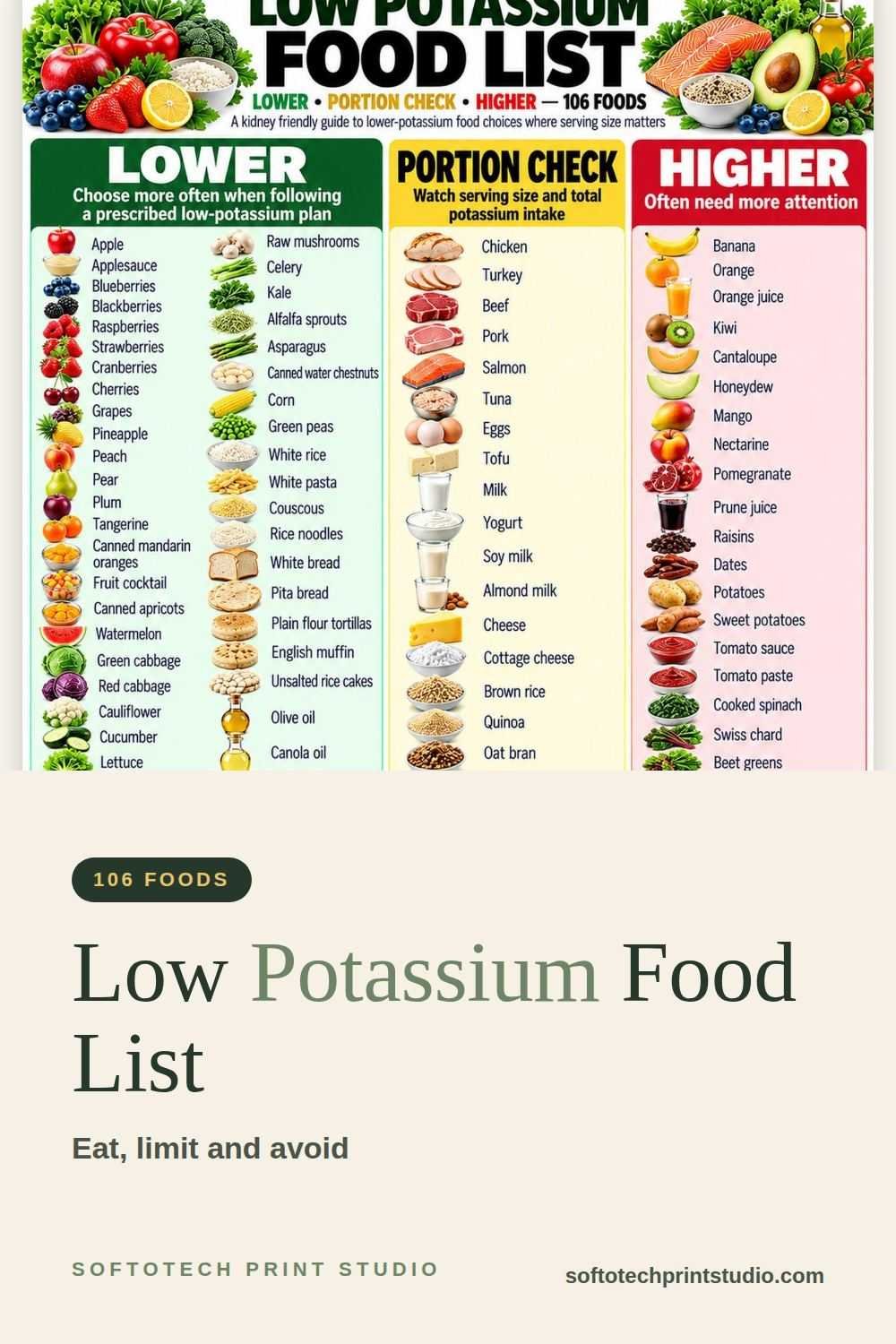

The printable from this guide
Low Potassium Food List Printable
- 106 foods in two columns: LOWER, choose more often with a portion check, and HIGHER, watch portions or limit and avoid
- LOWER foods include apples, blueberries, raspberries, strawberries, cranberries, cherries, grapes, pineapple, peach, pear, plum, tangerine, watermelon, cabbage, cauliflower, cucumber, lettuce, bell pepper, onion, radish, zucchini, green beans, asparagus, corn, green peas, white rice, white pasta, couscous, white bread, pita bread, olive oil and lemon juice
- HIGHER foods include pork, salmon, tuna, eggs, tofu, milk, yogurt, cheese, cottage cheese, brown rice, quinoa, granola, raw carrots, cooked broccoli, avocado, kiwi, cantaloupe, mango, raisins, dates, potatoes, sweet potatoes, tomato sauce, cooked spinach, pumpkin, coconut water and dried beans
- The grocery list in this guide is built from the LOWER column, with the HIGHER rules applied
- Print sizes US Letter, A4 and A5, as 3 PDFs plus a PNG and a ZIP per the listing
- Instant download · Print at home · US Letter · A4 · A5
Use code BLOG10 for 65% OFF at Etsy checkout!
Get the Low Potassium Food List on Etsy →
Instant download · Print at home
What the 106 Food Low Potassium List Covers
The chart is headed LOW POTASSIUM FOOD LIST, EAT, LIMIT, AVOID, 106 FOODS, and it sorts all 106 foods into two columns. The LOWER column is headed choose more often with a portion check, and the HIGHER column is headed watch portions or limit and avoid. That wording matters, because the chart does not call any food good or bad. It calls some foods lower in potassium and some foods higher, and it asks you to check the portion on both sides. A lower potassium food in a very large portion can still add up, and a higher potassium food in a small, occasional portion may fit a plan that your dietitian has agreed with you.
The LOWER column covers fruits, vegetables, grains and pantry staples. The fruits include apples, blueberries, raspberries, strawberries, cranberries, cherries, grapes, pineapple, peach, pear, plum, tangerine, watermelon, canned mandarin oranges, fruit cocktail and canned apricots. The vegetables include cabbage, cauliflower, cucumber, lettuce, bell pepper, onion, radish, zucchini, yellow squash, eggplant, green beans, asparagus, canned water chestnuts, corn and green peas. The grains include white rice, white pasta, couscous, rice noodles, white bread, pita bread, plain flour tortillas, English muffin and unsalted rice cakes. The pantry staples include olive oil, canola oil, unsalted butter, mayonnaise, garlic powder, dried basil and lemon juice.
| Column on the chart | What it means | Examples from the chart |
|---|---|---|
| LOWER | Choose more often, with a portion check | Apples, blueberries, cabbage, cauliflower, cucumber, white rice, white pasta, white bread, olive oil, lemon juice |
| HIGHER | Watch portions, or limit and avoid | Pork, salmon, tuna, eggs, milk, yogurt, cheese, brown rice, quinoa, avocado, potatoes, sweet potatoes, tomato sauce, coconut water, dried beans |
The HIGHER column covers proteins, dairy, whole grains and a long list of fruits and vegetables that are higher in potassium. The proteins and dairy include pork, salmon, tuna, eggs, tofu, milk, yogurt, soy milk, almond milk, cheese and cottage cheese. The grains include brown rice, quinoa, oat bran and granola. The vegetables and fruits include raw carrots, cooked broccoli, cooked mushrooms, avocado, kiwi, cantaloupe, honeydew, mango, nectarine, pomegranate, prune juice, raisins, dates, potatoes, sweet potatoes, tomato sauce, tomato paste, cooked spinach, Swiss chard, beet greens, winter squash, pumpkin, artichoke and beets. The column also lists coconut water, dried beans cooked, and potassium chloride salt substitutes, which deserve a careful read of the label before use. If you are building a wider kidney friendly pantry, our anti-inflammatory food list guide covers another eat, limit and avoid chart with a different set of foods.
Two details on the chart are easy to miss and worth noting. First, the same food can appear in a different form on each side, so the form matters as much as the name. Raw carrots sit in the HIGHER column, while many other raw vegetables sit in the LOWER column, and cooked broccoli and cooked spinach sit in the HIGHER column even though other cooked vegetables are gentler choices. Second, the bottom rows of the chart were partly cut off on the listing view, so this guide names only the foods that were clearly legible. The count on the chart is 106 foods, and the two columns together hold that full count, even where a few bottom row names were not readable in the listing image.
How to Shop With a Low Potassium Food List
A food list works best when it is used before the shop, not only during it. The simplest routine is to plan three or four meals for the week, write the shopping list from the LOWER column first, and then check anything from the HIGHER column against the portion rule on the chart. That order keeps the trolley full of lower potassium foods by default, and the higher potassium foods become deliberate choices rather than habits. Print the chart, keep a pen beside it, and circle the foods you actually buy that week, so the list becomes a record of what worked as well as a plan for what to buy.
Start in the produce section with the LOWER fruits and vegetables. Apples, blueberries, raspberries, strawberries, cranberries, cherries, grapes, pineapple, peach, pear, plum, tangerine and watermelon give you a wide choice of fruit without leaving the LOWER column. Cabbage, cauliflower, cucumber, lettuce, bell pepper, onion, radish, zucchini, green beans, asparagus, corn and green peas give you the same range in vegetables. Buy a mix of colours and textures, and buy only what you will use in a few days, because fresh produce that goes soft in the fridge is wasted food and a wasted trip.
Move on to the grains and pantry staples. White rice, white pasta, couscous, white bread and pita bread are the LOWER grains on this chart, which surprises some shoppers who are used to whole grains being the healthier choice in general. For a low potassium plan the chart places brown rice and quinoa in the HIGHER column, so the white grains are the regular choice here, and the whole grains are the portion check choice. Olive oil and lemon juice are useful pantry staples for flavour, and garlic powder and dried basil add flavour without salt. Our GLP-1 diet food list guide shows another chart where the grain choices are sorted the same way, by column, so the shopping habit transfers across lists.
Finish with the HIGHER column, and treat it as a short, deliberate list. If you buy pork, salmon, tuna, eggs, tofu, milk, yogurt, cheese or cottage cheese, buy the amount the plan allows and no more, and decide before you get home how it will be used. The same applies to avocado, kiwi, cantaloupe, mango, raisins, dates, potatoes, sweet potatoes, tomato sauce and coconut water. A small amount, bought on purpose and used on purpose, is easier to manage than a large amount bought out of habit and then used up because it is in the fridge. Keep the chart visible while you unpack, and put the LOWER foods where you can see them first.

The kidney friendly companion
Kidney Friendly Food List Printable
- A kidney friendly food list with 60+ foods, a portion guide and smarter renal diet choices, in 12 sections
- Section headings include Lean Proteins, Fruits, Vegetables, Snacks and Extras, Smart Kidney-Friendly Swaps, Flavor Without Lots of Salt, Build Your Plate and Your Kidney Diet Checklist
- Foods on the chart include chicken breast, turkey breast, cod, tilapia, shrimp, tuna in water, eggs, egg whites, lean beef, pork tenderloin, apple, blueberries, strawberries, raspberries and pineapple
- The companion to the low potassium chart: the same kidney friendly approach, with portion guidance
- Print sizes US Letter, A4 and A5, as 3 PDFs plus a PNG and a ZIP per the listing
- Instant download · Print at home · US Letter · A4 · A5
Use code BLOG10 for 65% OFF at Etsy checkout!
Get the Kidney Friendly Food List on Etsy →
Instant download · Print at home
Portion Checks and Everyday Rules
The portion check is the part of the low potassium food list that turns a poster into a habit. The chart says LOWER foods should be chosen more often with a portion check, and HIGHER foods should be watched, limited or avoided. In practice that means a serving is a decision, not a habit. Serve the amount the plan allows, eat slowly enough to notice it, and resist the second helping of a HIGHER food simply because it is on the table. A measuring cup, a small bowl, or a kitchen scale used for a week or two can teach your eye what a portion looks like, and after that the check becomes quick and automatic.
Labels matter as much as portions, especially for the HIGHER column. Potassium chloride salt substitutes sit in the HIGHER column on this chart, so a salt substitute is not a free swap. Read the label on any salt substitute, seasoning blend, sauce or processed food before you buy it, and check with your doctor or dietitian if you are unsure whether a product fits your plan. The same care applies to tomato sauce and tomato paste, which are in the HIGHER column, and to dried beans, which are listed as dried beans cooked in the HIGHER column. Cooking method and portion both count, so a food that is higher in potassium needs both checks, not just one.
Everyday rules keep the list working between shops. Cook at home more often than you eat out, because a home cooked meal lets you choose the ingredients and the portions. Keep the LOWER foods at the front of the fridge and the cupboard, so they are the first thing you reach for. Plan one or two meals ahead rather than deciding at the moment you are hungry, because hunger makes portion checks harder. And keep the companion kidney friendly chart beside this one, because the companion chart adds a portion guide and a checklist, and the two charts together cover more of the weekly routine than either one alone. For fibre and gut health alongside a kidney friendly plan, our high fiber foods list for gut health guide is a useful companion read, with its own eat, limit and avoid groups.
None of this is a promise about a lab result or a health outcome. A low potassium food list is a shopping and cooking aid, and the potassium target, if you have one, comes from your care team. Bring the printed chart to an appointment if it helps the conversation, and ask your dietitian which HIGHER foods, if any, fit your plan in small portions, and which ones are better avoided for now. A list that is discussed with a professional is far more useful than a list that is followed alone, because the professional can match the columns to your blood results, your medicines and the rest of your diet.
Worked Example: A Low Potassium Grocery List
Here is a worked grocery list built only from the LOWER column of the chart, with the HIGHER rules applied as portion checks. It is a one week shop for one person cooking at home, and it shows how the list works in practice rather than in theory. The list is organised by section, so you can walk the store in order and check each item off the printed chart as you go.
Fruit first: apples, blueberries, raspberries, strawberries, cranberries, cherries, grapes, pineapple, peach, pear, plum, tangerine and watermelon. Choose three or four of these for the week rather than all of them, and pick the ones that are in season and reasonably priced. Canned mandarin oranges, fruit cocktail and canned apricots are the canned options on the LOWER column, useful when fresh fruit is short. A small bowl of fruit with breakfast, and a piece of fruit as a snack, covers the fruit for the day without needing a large portion at any one meal.
Vegetables next: cabbage, cauliflower, cucumber, lettuce, bell pepper, onion, radish, zucchini, green beans, asparagus, corn and green peas, with yellow squash and eggplant as extra choices from the chart. Plan one salad vegetable, one cooked vegetable and one soup or stir fry vegetable for the week, and buy enough for three or four dinners. Canned water chestnuts sit in the LOWER column too, for a stir fry or a salad where a little crunch helps. Keep the portions modest and the cooking simple, so the vegetables stay the easy part of the meal rather than a second cooking project.
Grains and pantry staples finish the list: white rice, white pasta, couscous, white bread and pita bread, plus olive oil, canola oil, unsalted butter, mayonnaise, garlic powder, dried basil and lemon juice. These are the foods that turn the fruit and vegetables into meals: rice with vegetables, pasta with a light sauce, a sandwich on white bread, or a wrap in a pita. Rice noodles, plain flour tortillas, English muffin and unsalted rice cakes are the other LOWER grain options on the chart, so there is room to vary the base through the week without leaving the column.
Now apply the HIGHER rules as portion checks. If a HIGHER food is on the list for the week, write the portion beside it before you shop: a small piece of salmon or a few eggs, a small amount of cheese or yogurt, a small serving of potatoes or sweet potatoes, a spoonful of tomato sauce rather than a jug of it. Buy that amount and no more, cook it as planned, and leave the rest of the HIGHER column off the list for the week. The worked list works because the LOWER foods do the heavy lifting and the HIGHER foods are guests, not residents, in the trolley. Keep the printed chart on the fridge, tick off the foods as you use them, and build next week from the foods that were easy to cook and easy to enjoy.
For salt rather than potassium, our low sodium food list is the matching printable chart.
For between meals, see our list of kidney friendly snack ideas built from the lower potassium fruit and vegetables on this list.
Frequently Asked Questions
What is a low potassium food list?
A low potassium food list is a chart that sorts foods into lower and higher potassium groups, so shopping and cooking follow the same pattern. The chart in this guide lists 106 foods in two columns, LOWER and HIGHER, with a portion check on the lower column and a watch, limit or avoid rule on the higher column. It is a shopping aid, not a medical prescription, and your own potassium target comes from your doctor or dietitian.
Which foods are lower in potassium on this list?
The LOWER column on this low potassium food list includes apples, blueberries, raspberries, strawberries, cranberries, cherries, grapes, pineapple, peach, pear, plum, tangerine, watermelon, cabbage, cauliflower, cucumber, lettuce, bell pepper, onion, radish, zucchini, green beans, asparagus, corn, green peas, white rice, white pasta, couscous, white bread, pita bread, olive oil and lemon juice. Choose these more often, and still check the portion.
Which foods are higher in potassium on this list?
The HIGHER column on this low potassium food list includes pork, salmon, tuna, eggs, tofu, milk, yogurt, cheese, cottage cheese, brown rice, quinoa, granola, raw carrots, cooked broccoli, avocado, kiwi, cantaloupe, mango, raisins, dates, potatoes, sweet potatoes, tomato sauce, cooked spinach, pumpkin, coconut water and dried beans. Watch the portion on these, or limit and avoid them, as your care team advises.
Can I eat white rice and white bread on a low potassium plan?
On this chart, white rice, white pasta, couscous, white bread and pita bread sit in the LOWER column, while brown rice and quinoa sit in the HIGHER column. That is the chart grouping, and it is why the white grains are the regular choice on this particular list. Your dietitian can confirm whether that grouping fits your wider diet, including fibre and blood sugar needs.
What size is the printable low potassium food list?
The SoftoTech Print Studio Low Potassium Food List is an instant download that prints at home in US Letter, A4 and A5 sizes, as 3 PDFs plus a PNG and a ZIP per the listing. It shows all 106 foods in the LOWER and HIGHER columns, so you can keep it on the fridge and check it before you shop or cook.
This guide is for general wellness and is not medical advice. Check with your doctor before starting a new routine.
Phosphorus is the next label to watch on a kidney friendly diet: our low phosphorus food list guide sorts 100 foods into eat, limit and avoid groups, with phosphate additive rules.
One more kidney friendly list, with 126 foods: our kidney diet food list guide sorts foods into eat, limit and avoid groups, with a worked grocery list.
Another kidney friendly guide: our kidney diet meal plan sets out balanced, lower-sodium meals, from blueberry oats to herb-baked cod.
Related Guides
- Fatty Liver Diet Food List
- Anti-Inflammatory Food List
- GLP-1 Diet Food List
- High Fiber Foods List for Gut Health
Sources
Sources: National Institute of Diabetes and Digestive and Kidney Diseases: Eating Right for Chronic Kidney Disease, National Kidney Foundation: Diet and Nutrition
 Diet & Food ListsMediterranean Diet for Seniors: A Simple Guide With an Eat, Limit, Avoid List and a 7 Day Plan
 Diet & Food ListsHigh Protein Foods for Muscle Gain: How Much You Need, the Best Picks per Meal and a Worked Training Day
 Diet & Food ListsLow Sodium Dinner Ideas: 24 DASH Style Dinners, a Sodium Budget per Plate and Sauce and Seasoning Swaps