
Chair pilates for seniors is pilates done entirely from a chair: slow, controlled seated moves that build posture, core stability, leg strength and flexibility without getting down on the floor or standing for long stretches. The 16 exercises on the chart in this guide are grouped in fours, so a session has a clear shape: upper body and posture first, then core and stability, then lower body and strength, then flexibility and stretch to finish.
That structure matters for older adults, because a workout that is easy to follow is a workout that gets repeated. You sit in a sturdy chair with your feet flat, you work through one group at a time, and you finish with breathing and a gentle stretch. There is no mat work, no kneeling and no balancing on one leg without support. If a move feels too much on a given day, you can do it smaller, slower or with fewer repetitions and still keep the shape of the session.
Below you will find the 16 chair pilates moves in their four groups, the breathing and posture rules that make pilates different from ordinary stretching, a simple way to build the habit week by week, a worked 20 minute session built group by group from the chart, and the matching printable chart from SoftoTech Print Studio.
In this guide:
- The 16 Chair Pilates Moves in Four Groups
- Breathing and Posture Rules
- How to Build a Chair Pilates Habit
- Worked Example: A 20 Minute Seated Session
- Frequently Asked Questions

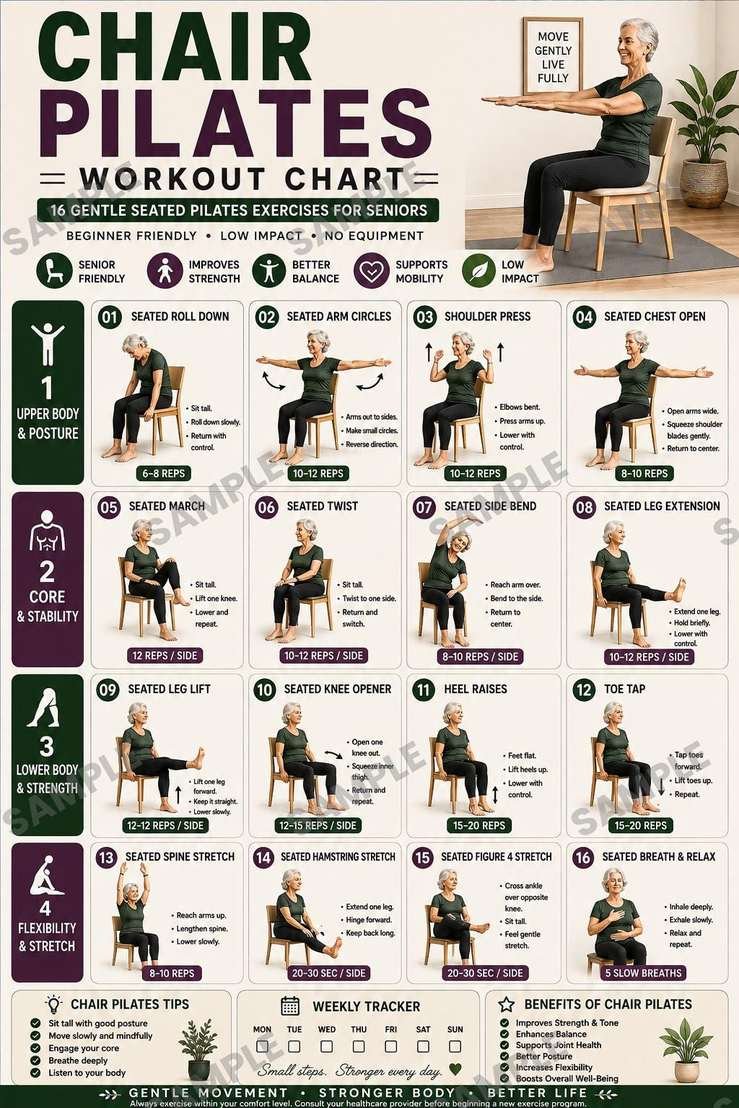
The printable from this guide
Chair Pilates Workout Chart for Seniors Printable
- 16 gentle seated chair pilates exercises in four groups: upper body and posture (Seated Roll Down, Seated Arm Circles, Shoulder Press, Seated Chest Open), core and stability (Seated March, Seated Twist, Seated Side Bend, Seated Leg Extension), lower body and strength (Seated Leg Lift, Seated Knee Opener, Heel Raises, Toe Tap) and flexibility and stretch (Seated Spine Stretch, Seated Hamstring Stretch, Seated Figure 4 Stretch, Seated Breath and Relax)
- Includes pilates tips, a weekly practice tracker and benefits of pilates on the chart
- The seated session in this guide is built group by group from these 16 chart moves
- Print sizes US Letter, A4 and A5, as 3 PDFs plus a 300 DPI PNG per the listing
- Instant download · Print at home · US Letter · A4 · A5
Use code BLOG10 for 65% OFF at Etsy checkout!
Get the Chair Pilates Chart on Etsy →
Instant download · Print at home
The 16 Chair Pilates Moves in Four Groups
The printable chart in this guide, the Chair Pilates Workout Chart for Seniors, lists 16 gentle seated exercises in four groups of four. The first group is upper body and posture: Seated Roll Down, Seated Arm Circles, Shoulder Press and Seated Chest Open. These four open the chest, move the shoulders through a full circle and teach the tall seated posture that the rest of the session depends on. Start here every time, even on days when you are short of time, because posture sets up everything that follows.
The second group is core and stability: Seated March, Seated Twist, Seated Side Bend and Seated Leg Extension. Seated March lifts one knee at a time while the trunk stays still, which is gentle core work with the chair taking your weight. Seated Twist and Seated Side Bend move the spine in rotation and sideways bending, two directions that stiffen quickly when we sit most of the day. Seated Leg Extension straightens one leg at a time and holds it briefly, which works the front of the thigh while the core holds you steady.
| Group | Moves from the chart | Main job |
|---|---|---|
| Upper body and posture | Seated Roll Down, Seated Arm Circles, Shoulder Press, Seated Chest Open | Posture, shoulder movement and chest opening |
| Core and stability | Seated March, Seated Twist, Seated Side Bend, Seated Leg Extension | Trunk control and gentle core strength |
| Lower body and strength | Seated Leg Lift, Seated Knee Opener, Heel Raises, Toe Tap | Leg strength, hip movement and ankle mobility |
| Flexibility and stretch | Seated Spine Stretch, Seated Hamstring Stretch, Seated Figure 4 Stretch, Seated Breath and Relax | Flexibility, calm breathing and a slow finish |
The third group is lower body and strength: Seated Leg Lift, Seated Knee Opener, Heel Raises and Toe Tap. Seated Leg Lift and Seated Knee Opener work the hips and thighs from the chair, Heel Raises lift the heels to work the calves, and Toe Tap lifts the toes to move the ankles and shins. Together they keep the legs active without standing, which is useful on days when standing balance feels uncertain. If you want more seated leg work in the same gentle format, our leg exercises for seniors guide covers more moves you can do from a chair or with support.
The fourth group is flexibility and stretch: Seated Spine Stretch, Seated Hamstring Stretch, Seated Figure 4 Stretch and Seated Breath and Relax. This is the cool down group, and it is part of the workout, not an optional extra. Seated Spine Stretch lengthens the back, Seated Hamstring Stretch eases the backs of the thighs, Seated Figure 4 Stretch opens the hip, and Seated Breath and Relax closes the session with slow breathing. The chart also carries pilates tips, a weekly practice tracker and a benefits of pilates section, so you can tick off each session and see the habit build over the weeks.
Breathing and Posture Rules
Pilates is as much about breathing and posture as it is about the moves. Sit tall at the front half of the chair with both feet flat on the floor, knees roughly above the ankles, and hands resting on your thighs until a move asks for them. Imagine a string pulling the top of your head gently upward, shoulders relaxed and away from your ears, and ribs settled down rather than pushed forward. That tall seat is your home position, and you return to it between moves.
Breathe in through the nose to prepare, and breathe out slowly through the mouth as you do the effort part of a move. Keep the breath moving through the whole session. Holding your breath makes the neck and shoulders tense up, which is the opposite of what chair pilates is for. If you notice your breath has stopped, pause, take two slow breaths, and then continue at a smaller range. The CDC guidance for older adults puts muscle strengthening and balance activity at the centre of a weekly routine, and a seated session like this one is a gentle way to cover strengthening work on days when a standing workout feels too much.
Move slowly and stay in control. Pilates moves are small and precise, and a slow Seated Arm Circle done with a tall spine does more than a fast, sloppy one. Stop a move if you feel sharp pain, dizziness or chest discomfort, and check with your doctor before starting a new routine, especially if you have a heart condition, low blood pressure, osteoporosis or a recent surgery. A sturdy chair with no wheels, placed on a flat surface with space around it, is the only equipment you need. Our seated exercises for seniors guide uses the same chair setup if you want a second seated routine to alternate with this one.

The senior fitness bundle
Senior Fitness Exercises Bundle Over 50
- 19 gentle workout guides in one bundle, including Chair Pilates and Wall Pilates, Chair Exercises, Balance Exercises, Mobility Exercises, Stretching Exercises, Core Exercises, Standing Exercises and a 28-Day Fitness Challenge
- The bundle to use when chair pilates becomes a habit and you want the next guides in the same gentle format
- Files: 3 ZIP per the listing
- Instant download · Print at home
Use code BLOG10 for 65% OFF at Etsy checkout!
Get the Senior Fitness Bundle on Etsy →
Instant download · Print at home
How to Build a Chair Pilates Habit
A habit beats a heroic week. Start with three sessions a week on non-consecutive days, at the same time of day, in the same chair. Mornings work well for many people, because the session wakes up stiff joints before the day begins, but the best time is the time you will actually keep. Put the printed chart where you can see it, tick each session on the weekly practice tracker, and keep the streak visible. A ticked box is a small reward, and small rewards are what carry a habit through week three.
Build the session gradually. In the first week, do each move for a short count and rest between groups. In the second week, add a few more repetitions to the moves that feel comfortable, and keep the moves that feel hard at the easier count. By the third and fourth weeks you will know which group is your weakest, and that group deserves your attention, not your frustration. Gentle progress, a few more repetitions or a slightly longer hold, is still progress. There is no test at the end, and no one is grading your Seated Roll Down.
When chair pilates becomes a habit and you want the next guides in the same gentle format, the Senior Fitness Exercises Bundle in this guide is the natural next step. It holds 19 gentle workout guides in one bundle, including Chair Pilates and Wall Pilates, Chair Exercises, Balance Exercises, Mobility Exercises, Stretching Exercises, Core Exercises, Standing Exercises and a 28-Day Fitness Challenge, so you can move on to balance or stretching work without learning a new format. If balance is the area you want to work on next, our chair yoga for seniors over 70 guide and the 10 gentle chair yoga poses for seniors guide both use the same chair-supported approach.
Worked Example: A 20 Minute Seated Session
Here is a worked 20 minute session built group by group from the 16 chart moves, in chart order. Minutes 0 to 5 are the upper body and posture group. Start with Seated Roll Down, curling forward slowly and then uncurling back to tall, for 4 slow repetitions. Follow with Seated Arm Circles, 5 small circles forward and 5 backward, then Shoulder Press, pressing both arms up and lowering them with control for 6 repetitions, and finish the group with Seated Chest Open, opening the arms wide and then returning them, for 6 slow repetitions. By the end of this group your shoulders should feel looser and your seat should feel taller.
Minutes 5 to 11 are the core and stability group. Do Seated March for 10 slow alternating lifts, keeping the trunk still. Then Seated Twist, turning gently to each side for 4 repetitions per side, followed by Seated Side Bend, bending to each side for 4 repetitions per side. Finish with Seated Leg Extension, straightening one leg, holding it for a slow count of three, and lowering it, for 5 repetitions per leg. Rest for 30 seconds between moves if you need to, and keep breathing steadily through the whole group.
Minutes 11 to 16 are the lower body and strength group. Do Seated Leg Lift for 6 repetitions per leg, then Seated Knee Opener for 6 repetitions per leg, opening the knee gently outward and returning it. Then Heel Raises for 10 slow lifts, feeling the calves work, and Toe Tap for 10 alternating taps to finish the legs. Minutes 16 to 20 are the flexibility and stretch group: Seated Spine Stretch for 4 slow repetitions, Seated Hamstring Stretch held for 20 seconds per leg, Seated Figure 4 Stretch held for 20 seconds per leg, and finally Seated Breath and Relax for 5 slow breaths with eyes soft and shoulders down. Tick the session on the tracker, note which group felt hardest, and use that note to choose where to add a repetition next time.
Frequently Asked Questions
What is chair pilates for seniors?
Chair pilates for seniors is pilates done entirely from a chair. The chart in this guide lists 16 gentle seated exercises in four groups: upper body and posture, core and stability, lower body and strength, and flexibility and stretch. It builds posture, core stability, leg strength and flexibility without floor work or long standing.
Do I need any equipment for chair pilates?
No equipment is needed beyond a sturdy chair with no wheels, placed on a flat surface. The 16 moves use bodyweight and the chair for support. The printable chart is the only tool the routine asks for, and it also carries pilates tips and a weekly practice tracker.
How long does a chair pilates session take?
The worked session in this guide takes about 20 minutes: 5 minutes for the upper body and posture group, about 6 minutes for core and stability, 5 minutes for lower body and strength, and 4 minutes for flexibility and stretch. Shorten any group on a busy day and keep the shape of the session.
Is chair pilates safe for older adults with stiff joints?
The moves are gentle, seated and low impact, and every move can be done smaller or slower. Move through the range you can control, keep breathing, and stop if you feel sharp pain or dizziness. Check with your doctor before starting a new routine, especially after surgery or with a heart condition, low blood pressure or osteoporosis.
What size is the printable chair pilates chart?
The SoftoTech Print Studio Chair Pilates Workout Chart for Seniors is an instant download that prints at home in US Letter, A4 and A5 sizes, as 3 PDFs plus a 300 DPI PNG per the listing. It shows all 16 seated exercises in four groups, with pilates tips, a weekly practice tracker and benefits of pilates.
This guide is for general wellness and is not medical advice. Check with your doctor before starting a new routine.
Seated movement, a slower pace: our chair tai chi for seniors guide sets out 16 gentle seated moves, with a 10 minute routine.
For a back focused routine in the chair, our back pain exercises for seniors guide sets out 12 gentle seated moves for mobility and flexibility.
Related Guides
- Chair Yoga for Seniors Over 70
- 10 Gentle Chair Yoga Poses for Seniors With Printable Routine Chart
- Seated Exercises for Seniors
- Leg Exercises for Seniors
Sources
Sources: CDC: Physical Activity for Older Adults, National Institute on Aging: Exercise and Physical Activity
 Senior FitnessBreathing Exercises to Increase Lung Capacity: 8 Techniques, a 10 Minute Routine and What They Can Really Do
 Senior FitnessAnkle Exercises for Sprain Recovery: 12 Gentle Moves in 3 Stages, Once Your Clinician Says It’s Time
 Senior FitnessArm Exercises for Seniors: 16 Gentle Dumbbell Moves and 20 Seated Moves With Reps