
Core exercises for seniors are gentle movements that strengthen the muscles around your stomach, back and hips, the muscles that help you stand up from a chair, carry shopping, climb stairs and keep your balance. You do not need to get down on the floor, and you do not need crunches. The core exercises for seniors in this guide are all done seated in a sturdy chair or standing while holding one, so they fit real bodies, stiff joints and small living rooms.
Many older adults skip core work because the word core makes them think of sit-ups and planks. Those are not the starting point here. Seated knee lifts, gentle torso turns, abdominal bracing and standing knee raises all train the same deep support muscles at a level you control. Done two or three times a week, they support the everyday strength that the CDC and the National Institute on Aging link with staying active and independent for longer.
In this guide you will get eight core exercises with simple form cues, a ready to use 10 minute routine, a worked example of one week using the printable chart, ways to make every move easier or harder, and clear safety rules for backs and joints. You will also find the matching printable chart from SoftoTech Print Studio, so the routine lives on your wall instead of in your memory.
In this guide:
- Why Core Strength Matters More After 60
- 8 Core Exercises for Seniors, Seated and Standing
- The 10 Minute Core Routine
- Worked Example: One Week With the Chart
- Make It Easier or Harder
- Frequently Asked Questions
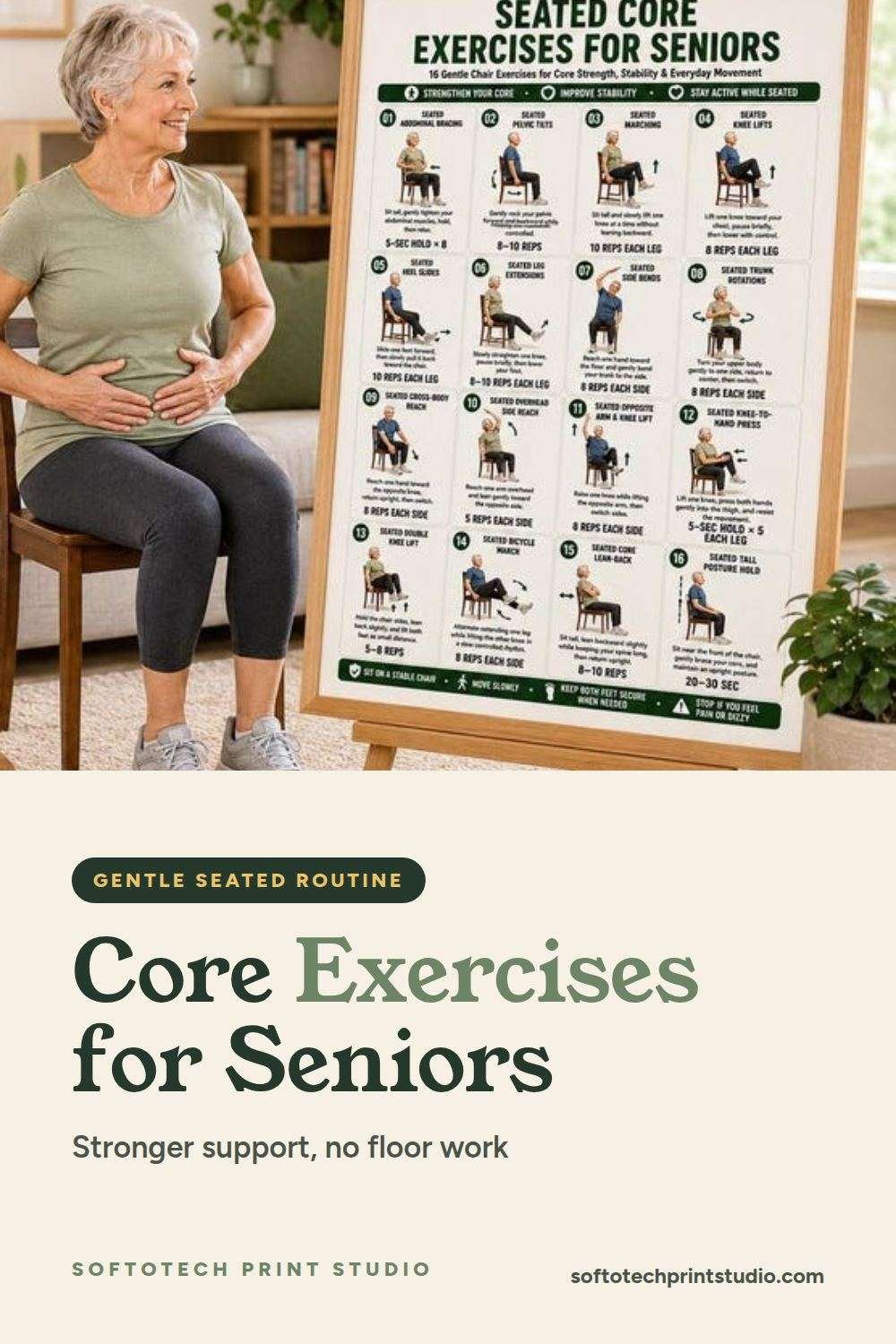
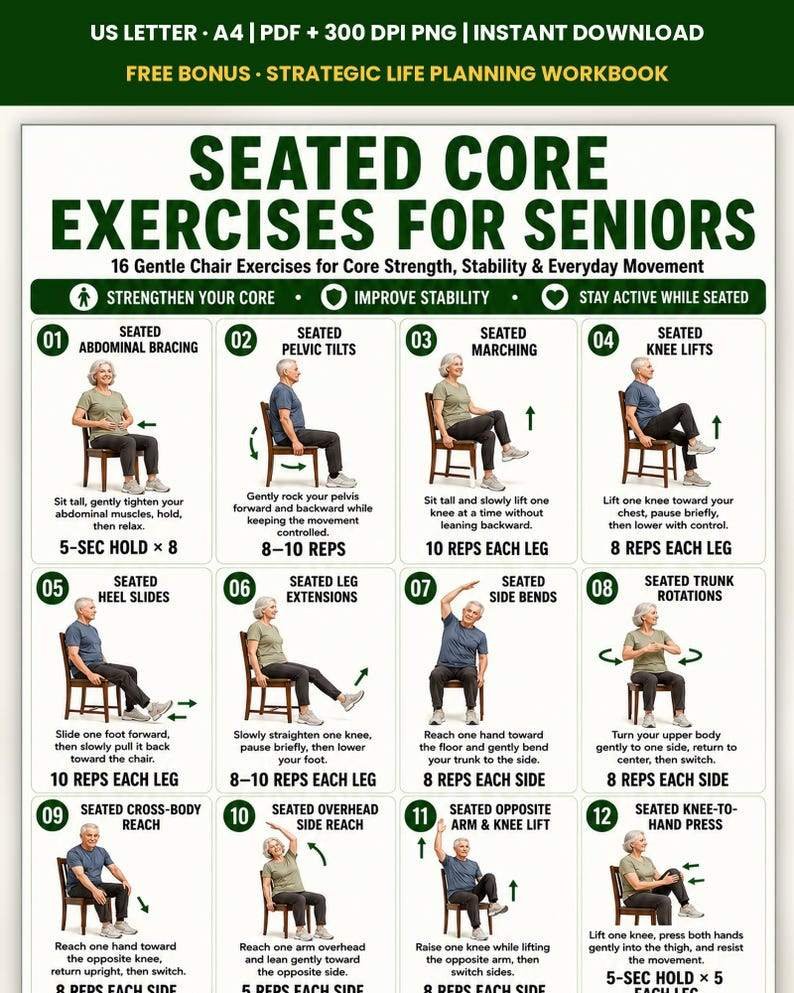
The printable from this guide
Seated Core Exercises for Seniors: 16 Gentle Chair Exercises
- 16 gentle seated chair exercises made for seniors, grouped for core activation, legs and lower core, rotation and reach, and stability and posture
- Every move has a clear illustration and its reps or hold time on one chart: bracing, pelvic tilts, marching, knee lifts, leg extensions, trunk rotations and more
- Low impact and chair based, with no floor work and no equipment
- Instant download · Print at home · A4 · US Letter
Use code BLOG10 for 65% OFF at Etsy checkout!
Get the Seniors Core Chart on Etsy →
Instant download · Print at home
Why Core Strength Matters More After 60
Your core is not just your stomach. It is the group of muscles around your trunk and pelvis, including the deep abdominal muscles, the muscles along your spine, your obliques at the sides, and the hip and pelvic floor muscles. Together they act like a natural support belt. Every time you reach for a shelf, turn to check traffic, get out of bed or recover from a small trip, your core is doing the quiet work.
Muscle strength naturally declines with age if it is not used, and a weaker core shows up in ordinary moments: pushing up from a low chair takes two attempts, standing to cook makes your back ache, or you feel unsteady turning quickly. Gentle, regular core exercises for seniors address exactly those moments. They are not about appearance. They are about making daily movement feel steadier and easier.
Core work also supports balance training rather than replacing it. If balance is your main concern, pair this routine with our 8 balance exercises for seniors to prevent falls on alternate days, and keep a chair or counter within reach for every standing move in both routines.
8 Core Exercises for Seniors, Seated and Standing
The printable chart in this guide shows 16 seated core exercises. Start with the eight below, which cover the deep core, the lower stomach, the sides and rotational control, then add the other chart moves as you get stronger. Do these moves slowly, breathe out on the effort, and never hold your breath. A sturdy chair without wheels is your only equipment. Stop any move that causes sharp pain.
| Exercise | Position | Sets and reps | Main benefit |
|---|---|---|---|
| Seated abdominal bracing | Seated | 5 second hold x 8 | Wakes up the deep core muscles |
| Seated pelvic tilts | Seated | 2 x 8 to 10 | Deep core and gentle lower back movement |
| Seated marching | Seated | 2 x 10 each leg | Core endurance and coordination |
| Seated knee lifts | Seated | 2 x 8 each leg | Lower stomach and hip strength |
| Seated leg extensions | Seated | 2 x 8 to 10 each leg | Front of thigh and lower core control |
| Seated trunk rotations | Seated | 2 x 8 each side | Side muscles and gentle rotation |
| Seated cross-body reach | Seated | 2 x 8 each side | Core control across the body |
| Seated knee-to-hand press | Seated | 5 second hold x 5 each leg | Full core stiffness to finish |
1. Seated abdominal bracing. Sit tall, feet flat. Gently tighten your abdominal muscles as if you are about to be nudged, hold for five seconds while breathing, then relax. This is move 1 on the chart and the foundation for everything else: learn it first and use it inside every other exercise.
2. Seated pelvic tilts. Gently rock your pelvis forward and back, keeping the movement small and controlled. Your lower back softly rounds, then returns to neutral. This wakes up the deep core connection without any strain.
3. Seated marching. Sit tall and slowly lift one knee at a time in a steady marching rhythm, without leaning back. Keep your trunk as still as you can: the stillness is the core work, the legs are just the lever.
4. Seated knee lifts. Lift one knee toward your chest, pause briefly, then lower it with control and switch sides. The chart allows 8 reps each leg; start lower if you need to, and hold the chair sides if it helps you stay tall.
5. Seated leg extensions. Slowly straighten one knee, pause, then lower your foot back down. Eight to ten reps each leg. Your trunk should not rock as the leg moves, which is what turns a leg exercise into core practice.
6. Seated trunk rotations. Turn your upper body gently to one side, return to the centre, then switch. Keep your hips facing forward and the range small and pain free, and skip this move entirely if rotation bothers your back.
7. Seated cross-body reach. Reach one hand toward the opposite knee, return tall, then switch sides. Move slowly: control matters more than how far you reach.
8. Seated knee-to-hand press. Lift one knee and press both hands gently into the thigh, resisting with your leg so nothing moves. Hold five seconds, then switch. It looks like nothing is happening, but your whole core is working. Prefer a standing option on some days? Sit to stands beside the chair train the same support muscles, and our seated leg exercises for seniors with bad knees guide pairs well with this routine for leg strength.
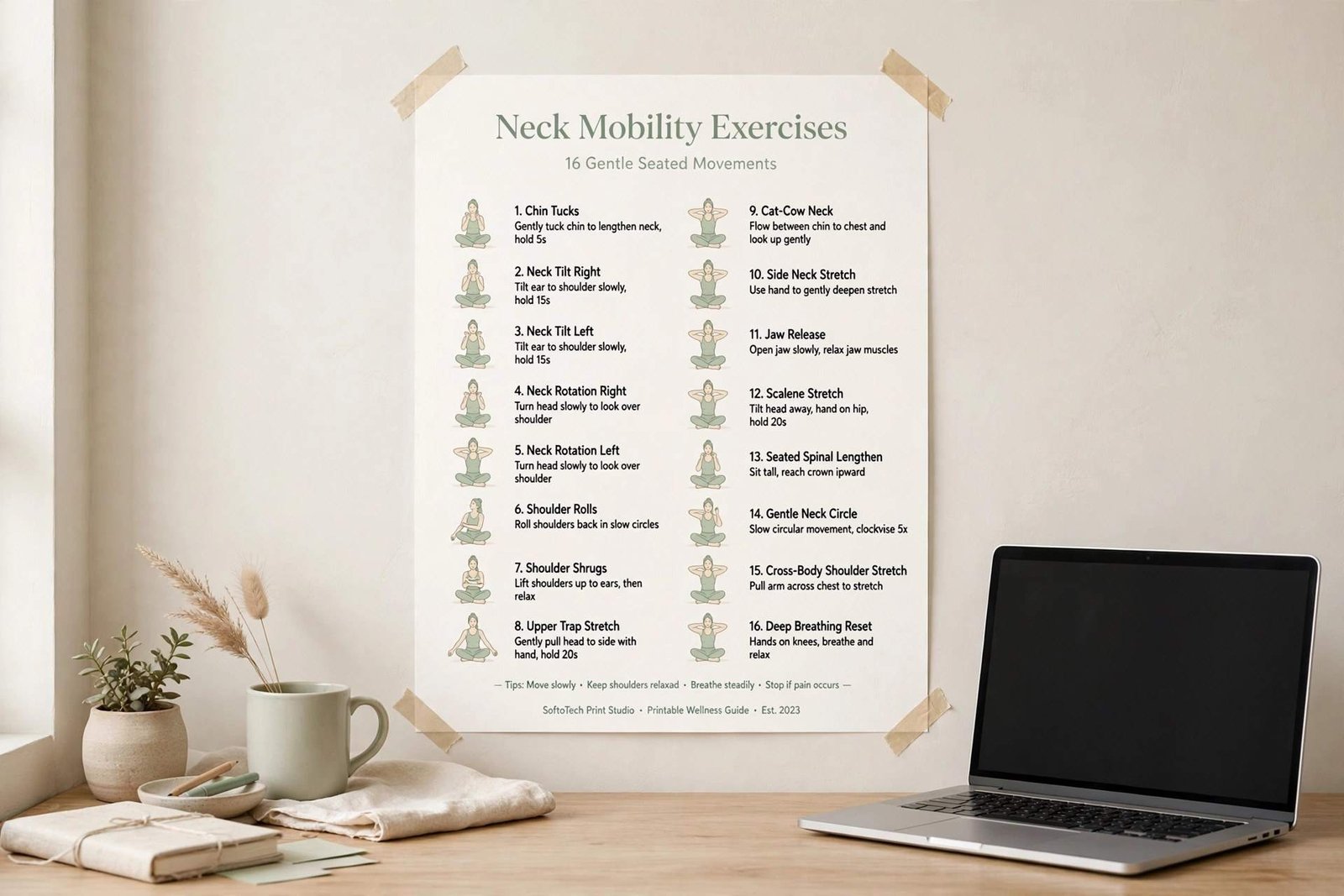
Pair it with gentle neck mobility
Neck Mobility Exercises for Seniors
- 16 gentle seated movements for neck stiffness and posture, from chin tucks to shoulder rolls
- Clear illustrations with simple reps or timing for every movement, plus safety reminders
- Instant download · Print at home · A4 · US Letter
Use code BLOG10 for 65% OFF at Etsy checkout!
Get the Neck Mobility Chart on Etsy →
Instant download · Print at home
The 10 Minute Core Routine
Put the eight moves together two or three non consecutive days a week. Warm up first with one minute of marching on the spot and a few shoulder rolls.
- Seated abdominal bracing: 8 holds of 5 seconds to switch the core on.
- Seated pelvic tilts and seated marching: 2 sets each, alternating sides.
- Seated knee lifts and seated leg extensions: 2 sets each, resting as long as you need between sets.
- Seated trunk rotations and seated cross-body reach: 2 sets each, small and controlled.
- Seated knee-to-hand press: 5 holds of 5 seconds each leg to finish, then gentle seated side stretches.
The whole session takes about 10 minutes. If 10 minutes feels like too much on day one, do one set of everything: a finished short routine beats a skipped long one. On the days between core sessions, easy walking or our standing balance exercises for seniors keep the week moving without tiring the same muscles.
Worked Example: One Week With the Chart
Here is how a first week looks for a beginner using the printable chart on the kitchen wall. On Monday, the routine is done at one set of each exercise because knee lifts feel new, and each finished exercise is ticked on the chart. The session takes seven minutes. On Tuesday there is no core work at all, just a normal walk, because rest days are part of the plan.
On Wednesday, the full two sets are done, except the knee-to-hand press, which is held for three seconds instead of five. That adjustment is written on the chart in pencil. On Friday, the third session of the week, sit to stands feel noticeably steadier, so the knee-to-hand press holds reach the full five seconds for the first time. By Sunday the chart shows three ticked sessions, two honest adjustments, and a clear note for next week: keep the same routine, add nothing yet. That is a complete, successful first week of core training, measured by consistency rather than soreness.
Make It Easier or Harder
Easier: do one set instead of two, lift the knee only an inch or two, keep both hands on the chair sides for support, and take the rotations at half range. There is no minimum standard to qualify for this routine. The easiest version, done regularly, is the version that works.
Harder: add a third set, slow the lowering phase of knee lifts to three seconds, march faster without losing your upright posture, and hold each knee-to-hand press for eight seconds. Change one thing at a time, and only after a full week that felt manageable. When seated work feels genuinely easy for several weeks, a floor free next step is the seated and standing progression in our 16 chair exercises for belly fat you can do seated, which builds on these same patterns.
Safety rules: mild muscle tiredness the next day is normal in the first two weeks. Sharp back pain, pain that travels down a leg, dizziness, chest discomfort or joint pain are not normal: stop, rest, and check with your doctor if they continue. If you have osteoporosis, a recent abdominal or back operation, a hernia, or uncontrolled blood pressure, ask your doctor before starting core exercises, and skip torso turns unless you have been cleared for rotation. This routine is general wellness information, not rehabilitation.
Frequently Asked Questions
What are the best core exercises for seniors?
The best core exercises for seniors are the ones you can do safely and often: abdominal bracing, seated knee lifts, seated torso turns, sit to stands, and standing knee to elbow touches with a chair for support. They train the stomach, back, side and hip muscles without floor work or crunches, and each one has an easier version.
Can seniors do core exercises without getting on the floor?
Yes. Every exercise in this guide is done seated in a sturdy chair or standing while holding one. Seated and standing core work trains the same support muscles as floor exercises, and for many older adults it is the safer and more comfortable way to build core strength.
How often should seniors do core exercises?
Two or three non consecutive days a week is a good target, which matches general guidance to do muscle strengthening activities on at least 2 days a week. Your core muscles need rest days to recover and strengthen, so daily core training is not better than alternate day training for beginners.
How long does a senior core workout take?
About 10 minutes for the full routine in this guide: eight exercises, mostly two sets each, with rests as needed. On busy or tired days, one set of everything takes about five minutes and still counts. The printable chart shows its 16 seated core exercises on one page in A4 and US Letter sizes.
Are core exercises safe for seniors with back pain?
Gentle core work is often recommended for back support, but back pain has many causes. Start with abdominal bracing and sit to stands, keep every movement pain free and small, and stop if pain increases or travels. If you have ongoing back pain, osteoporosis, a hernia or a recent operation, check with your doctor before starting this or any new routine.
Core strength and posture work together: our posture correction exercises guide trains the neck, upper back and hips that hold you tall, with a seated and standing routine you can alternate with this core work.
Core work supports the back from the front while stretching supports it from behind: our gentle stretches for sciatica guide includes pelvic tilts, bird dog and dead bug from its printable chart, plus 8 gentle stretches and a 10 minute routine to alternate with this core work.
For a complete chair based session that includes core work alongside legs and arms, see our seated exercises for seniors guide: 20 gentle moves from one printable chart, grouped by body area, with chair safety rules and a worked example that picks 10 moves for a 20 minute routine.
Pilates is a core-first system: our mat pilates workout guide sets out 28 moves with a core foundation group and a weekly practice tracker.
Core strength matters at every age: our menopause belly workout guide builds a low impact session from 16 gentle core moves for women.
Related Guides
- 8 Balance Exercises for Seniors to Prevent Falls
- Seated Leg Exercises for Seniors with Bad Knees
- Standing Balance Exercises for Seniors
- 16 Chair Exercises for Belly Fat You Can Do Seated
Sources
Sources: CDC: Physical Activity for Older Adults, National Institute on Aging: Exercise and Physical Activity, Mayo Clinic: Core Exercises, Why You Should Strengthen Your Core Muscles
This guide is for general wellness and is not medical advice. Check with your doctor before starting a new routine.
 Senior FitnessBreathing Exercises to Increase Lung Capacity: 8 Techniques, a 10 Minute Routine and What They Can Really Do
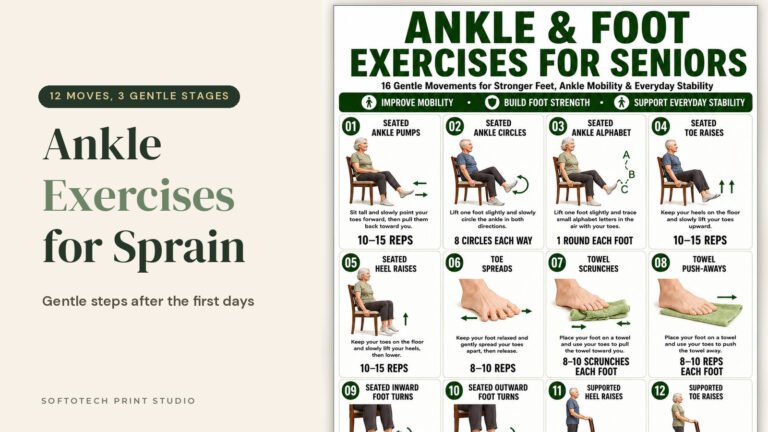 Senior FitnessAnkle Exercises for Sprain Recovery: 12 Gentle Moves in 3 Stages, Once Your Clinician Says It’s Time
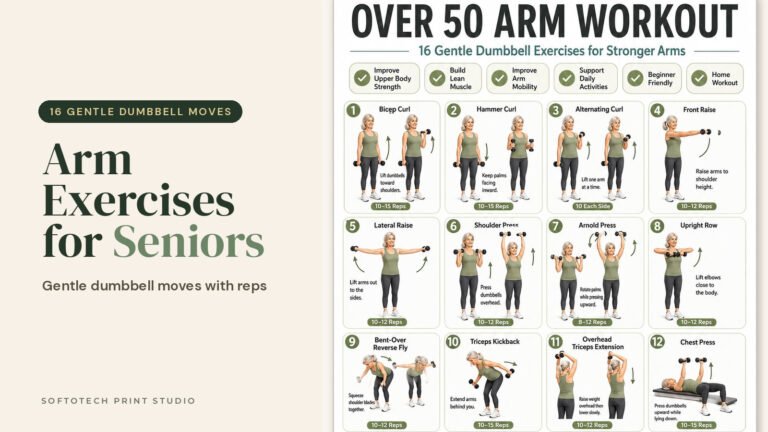 Senior FitnessArm Exercises for Seniors: 16 Gentle Dumbbell Moves and 20 Seated Moves With Reps