Walking plan for seniors searches usually start with a simple goal: you want to move more, feel steadier on your feet, and build fitness without a gym, special equipment, or workouts that leave you sore for days. A walking plan for seniors solves that by spreading short, gentle walks across four weeks, so your body adapts gradually and walking becomes a habit instead of a chore.
Walking is one of the most accessible forms of exercise for older adults. It needs no membership, it is easy on the joints compared with running, and you can do it almost anywhere — around your block, in a park, at a shopping mall on a rainy day, or on a treadmill at home. The secret is not intensity; it is consistency, plus a plan you can actually follow.
In this guide, you will get a complete beginner walking plan for seniors: how to prepare safely, a week-by-week schedule with rest days, how to walk with good form, and simple ways to stay motivated for all four weeks. You will also find a printable senior fitness chart from SoftoTech Print Studio to track your walks.
In this guide:
- Why Walking Is Ideal Exercise for Seniors
- Before You Start: Shoes, Safety and a Quick Check-In
- The 4-Week Walking Plan for Seniors
- How to Walk With Good Form
- How to Make Walking a Habit That Sticks
- Troubleshooting: Sore Knees, Bad Weather and Low Motivation
- Frequently Asked Questions


The printable from this guide
30-Day Indoor Walking Challenge for Seniors
- 30-day gentle progressive walking and stepping plan
- Senior fitness tracker chart — mark each walk as you go
- Instant download · Print at home · A4 · US Letter · A5
Use code BLOG10 for 65% OFF at Etsy checkout!
Get the Walking Challenge Chart on Etsy →
Instant download · Print at home
Why Walking Is Ideal Exercise for Seniors
Health organizations such as the Centers for Disease Control and Prevention (CDC) recommend that older adults aim for regular aerobic activity, such as brisk walking, spread across the week — alongside muscle-strengthening and balance activities on some days. Walking fits the aerobic part of that guidance better than almost anything else, because most people can start at their current level, even if that level is just five or ten minutes.
Regular walking may help support heart health, steadier blood sugar after meals, stronger bones and leg muscles, and better balance and mood. Many walkers also notice that a short walk after dinner helps them sleep more comfortably. These are general wellness benefits of staying active — walking is not a treatment for any condition, and the right amount for you depends on your own health, which is why the plan below starts gently and builds slowly.
If balance is a worry, pair this plan with our standing balance exercises for seniors, which use a chair for support so you can practise steadiness safely at home on your non-walking days.
Before You Start: Shoes, Safety and a Quick Check-In
Check in with your doctor first if needed. If you have a heart condition, uncontrolled blood pressure, joint replacements, dizziness, or you have not exercised in a long time, talk to your doctor before starting this or any new routine — see the note at the end of this guide.
Choose supportive shoes. You do not need expensive gear, but you do need closed-toe walking shoes with a firm heel, good grip, and enough room for your toes. Worn-out slippers and smooth-soled dress shoes are the most common cause of avoidable slips.
Pick a safe route. Flat, even ground is best for the first two weeks: a quiet street with sidewalks, a park path, a track, or even a large indoor space. Avoid routes with cracked pavement, steep hills, or heavy traffic until your confidence grows. Carry a phone, tell someone where you are going, and walk in daylight or well-lit areas where possible.
Warm up and cool down. Start every walk with two or three minutes of slower walking, and finish the same way. After your walk, a few gentle stretches — calves, thighs, and hips — can help you stay comfortable. Our 10-minute morning routine for older adults is a kind option on rest days, and our gentle neck and shoulder stretches for seniors can ease the upper-body stiffness many walkers notice after using a cane or holding a dog lead.
The 4-Week Walking Plan for Seniors
This walking plan for seniors uses time, not distance, because time is easier to follow. Walk at a pace where you can still hold a conversation — the “talk test.” You should breathe a little faster than at rest, but never be gasping. If you cannot talk in short sentences, slow down.
| Week | Walking Days | Minutes Per Walk | Focus for the Week |
|---|---|---|---|
| Week 1 | 4 days (e.g. Mon, Tue, Thu, Sat) | 10–15 minutes | Get comfortable: flat route, easy pace, learn your warm-up |
| Week 2 | 4–5 days | 15–20 minutes | Add a few minutes; try one slightly longer weekend walk |
| Week 3 | 5 days | 20–25 minutes | Add short 1-minute brisker intervals in the middle of your walk |
| Week 4 | 5 days | 25–30 minutes | Settle into your new routine; add a gentle hill only if you feel steady |
How a walking day works: 2–3 minutes slow warm-up, your planned minutes at a comfortable-to-brisk pace, then 2–3 minutes slow cool-down. Rest days are part of the plan, not a failure — your muscles and joints adapt on the days between walks. On rest days, gentle movement still helps: light housework, gardening, or the seated routine in our seated leg exercises for seniors with bad knees if standing work does not suit you that day.
How to progress after week 4: Repeat week 4 until it feels easy, then add about five minutes to one or two walks per week, or add a sixth walking day. A common general target many active older adults work toward over time is around 30 minutes of walking on most days — but your own best target is the one you can repeat week after week without pain or exhaustion.
Tracking makes a real difference. Mark each walk on a calendar or chart the day you finish it; seeing four weeks of checkmarks is often the motivation that carries people into month two.
Keep walking at home
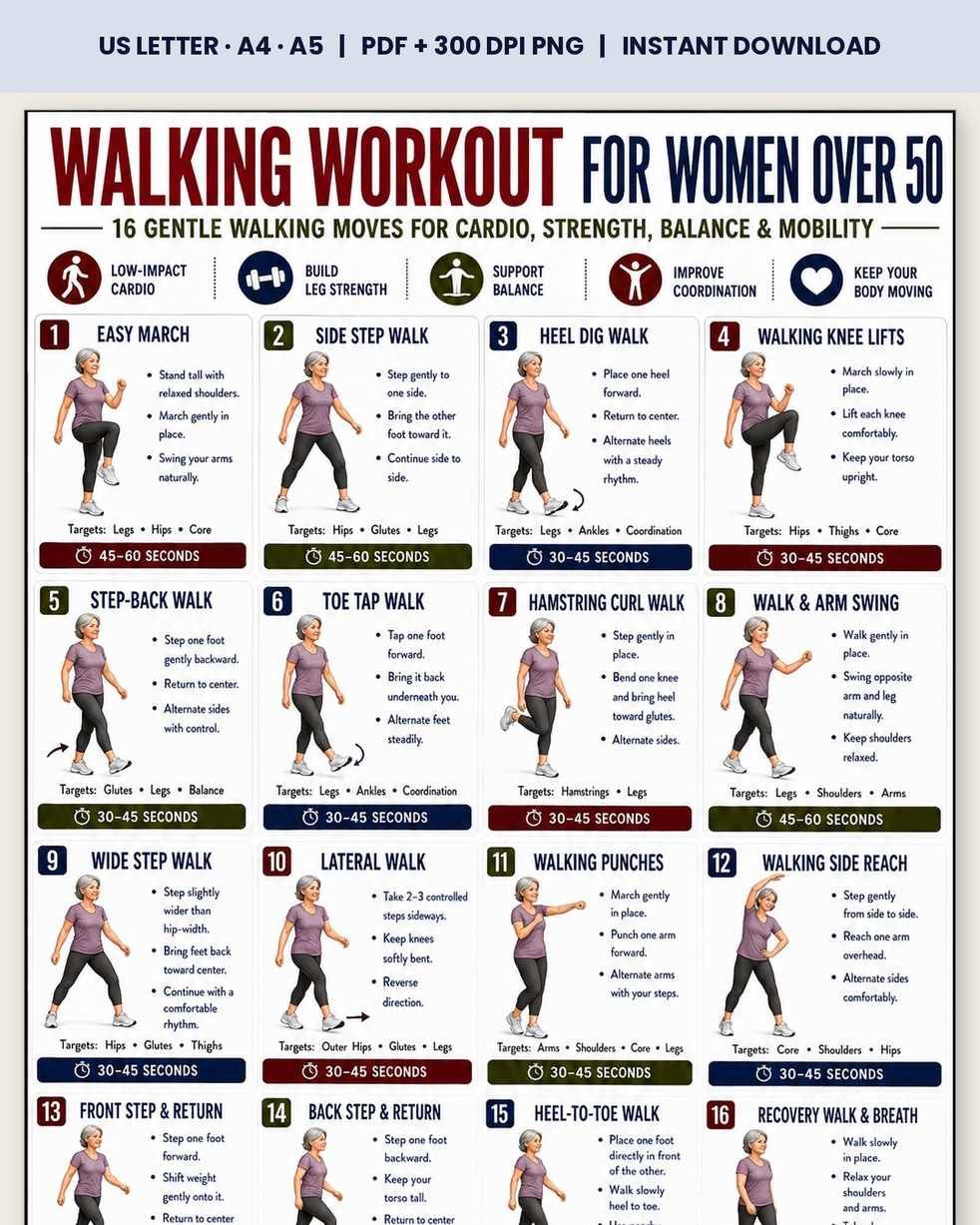
Walking Workout for Women Over 50
- 16 gentle indoor cardio exercises for women over 50
- Low-impact strength and balance routine for rainy days
- Instant download · Print at home · A4 · US Letter · A5
Use code BLOG10 for 65% OFF at Etsy checkout!
Get the Walking Workout Chart on Etsy →
Instant download · Print at home
How to Walk With Good Form
Good form makes walking more comfortable and helps you stay balanced:
- Stand tall. Imagine a string gently lifting the crown of your head. Look ahead, not down at your feet, and keep your chin level.
- Relax your shoulders. Drop them away from your ears and let your arms swing naturally, with a soft bend at the elbow.
- Step heel to toe. Land lightly on your heel, roll through the foot, and push off with your toes. Shorter, quicker steps are steadier than long strides.
- Engage your middle lightly. A gentle brace through your stomach and back muscles supports your balance as you walk.
- Breathe steadily. Breathe in through your nose and out through your mouth in a rhythm that matches your steps.
If you use a walking aid, use it — a cane or walking poles are tools for confidence, not signs of weakness. Poles in particular can take a little pressure off knees and give your arms a workout at the same time. Make sure a cane is adjusted to wrist height when your arm hangs by your side, and ask a physiotherapist to check the fit if you are unsure.
How to Make Walking a Habit That Sticks
Attach your walk to something you already do. Walk right after breakfast, after lunch, or after your favourite morning programme. A walk with a fixed trigger needs far less willpower than a walk you have to schedule fresh each day.
Walk after meals. A gentle 10-minute walk after lunch or dinner is a popular habit: it breaks up long sitting, and many people find it helps them feel less sluggish after eating. In this plan, a post-meal walk can simply be one of your planned walks — just keep the pace easy for the first few minutes.
Make it social, or make it interesting. Walk with a spouse, friend, neighbour, or walking group when you can. On solo days, music, a podcast, an audiobook, or simply a route past gardens and familiar faces keeps the minutes passing pleasantly.
Prepare the night before. Leave your shoes, socks, and a light jacket by the door. Removing small frictions in the morning is a quiet but powerful habit tool — the same planning idea behind our free printables and starter charts.
Troubleshooting: Sore Knees, Bad Weather and Low Motivation
Sore knees or feet. Mild tiredness in your legs after a walk is normal in week 1; sharp pain, swelling, or pain that changes how you walk is not. Shorten your walks, check your shoes, try softer or flatter ground, and build up more slowly. If pain persists, stop and check with your doctor or a physiotherapist rather than pushing through.
Bad weather. Have an indoor option ready so a rainy week does not end your streak: a mall, a large supermarket route, a community centre, a treadmill, or simply marching gently in place at home during a television programme, holding a chair back for balance if needed.
Low motivation days. Use the 5-minute rule: promise yourself just five minutes, with full permission to stop after that. Most days, starting is the hard part, and you will finish the walk. On the days you still stop at five minutes, you kept the habit alive — that counts.
Missed a week? Do not try to “catch up.” Simply restart at the last week that felt comfortable, even if that is week 1. Progress that repeats is worth more than a heroic week followed by quitting.
Who Should Check With a Doctor First?
Walking is a general wellness activity for most adults, but check with your doctor before starting this plan if you have chest pain or a diagnosed heart condition, you feel dizzy or faint when you exert yourself, you have had a recent fall, surgery, or joint replacement, or you have a condition such as severe arthritis or neuropathy that affects your feet or balance. Stop walking and seek advice promptly if you get chest pain, unusual breathlessness, palpitations, or dizziness during a walk.
Frequently Asked Questions
How far should a senior walk each day?
There is no single distance that fits everyone. This walking plan for seniors builds by time instead — from 10–15 minutes in week 1 to 25–30 minutes by week 4 — because time is easier to follow and kinder to judge. Many active older adults eventually settle around 30 minutes of walking on most days, but the best amount is the one you can repeat comfortably, without pain, week after week.
What is a good walking pace for seniors?
Use the talk test: walk fast enough that your breathing quickens and you feel warm, but you can still speak in short sentences. If you cannot talk, slow down; if you could sing, you can gently pick up the pace. Comfort and steadiness matter more than any number on a watch.
Is it better to walk every day or take rest days?
For beginners, rest days help. This plan uses 4–5 walking days per week so joints and muscles can adapt, with gentle movement like stretching or seated exercises on the other days. As walking feels easier over the weeks, many people naturally add a day — listen to your body rather than forcing a perfect streak.
Can walking help with balance?
Regular walking strengthens the legs and practises the stepping and weight-shifting your body uses to stay upright, and health guidance for older adults commonly pairs walking with dedicated balance activities. For extra support, add chair-supported balance exercises on rest days and always choose flat, even routes while your confidence is building.
What should I do if my knees hurt when I walk?
First check the basics: supportive shoes, a flat route, shorter walks, and a slower build-up. Mild muscle tiredness is normal early on, but sharp pain, swelling, or limping is a signal to stop and get advice from your doctor or a physiotherapist. Seated leg exercises can keep your legs moving gently on days when walking does not suit you.
Two short strength sessions a week make this walking plan work harder. Our leg exercises for seniors guide gives a 16 move chart routine for thighs, hips and calves, with a simple weekly plan that slots the strength days between your walking days.
Related Guides
- 7 Standing Balance Exercises Using a Chair for Support
- 10-Minute Morning Routine for Older Adults
- Seated Leg Exercises for Seniors with Bad Knees
- Gentle Neck and Shoulder Stretches for Seniors
Sources
Sources: CDC — Physical Activity for Older Adults, Mayo Clinic — Walking: Trim your waistline, improve your health, National Institute on Aging (NIH) — Exercise and Physical Activity
This guide is for general wellness and is not medical advice. Check with your doctor before starting a new routine.