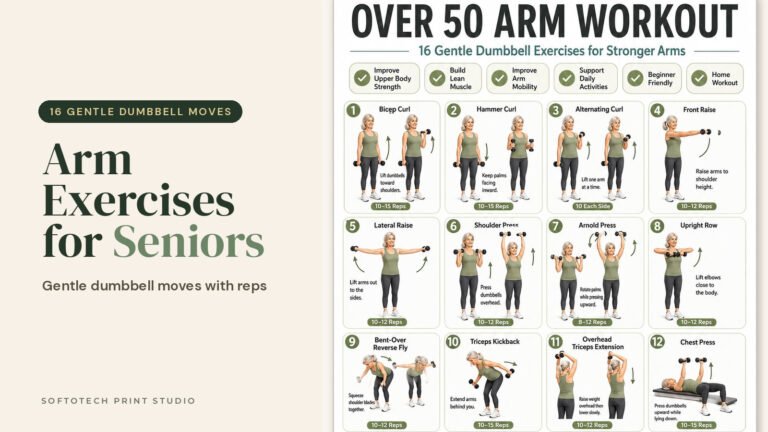
A challenge works because it takes the guesswork out of tomorrow. A tai chi challenge gives you one gentle move a day for four weeks, so instead of wondering what to practise, you just look at the chart, find today’s square and do it. By day 28 you’ve built up a short sequence of your own, at a pace slow enough that almost anyone can keep up.
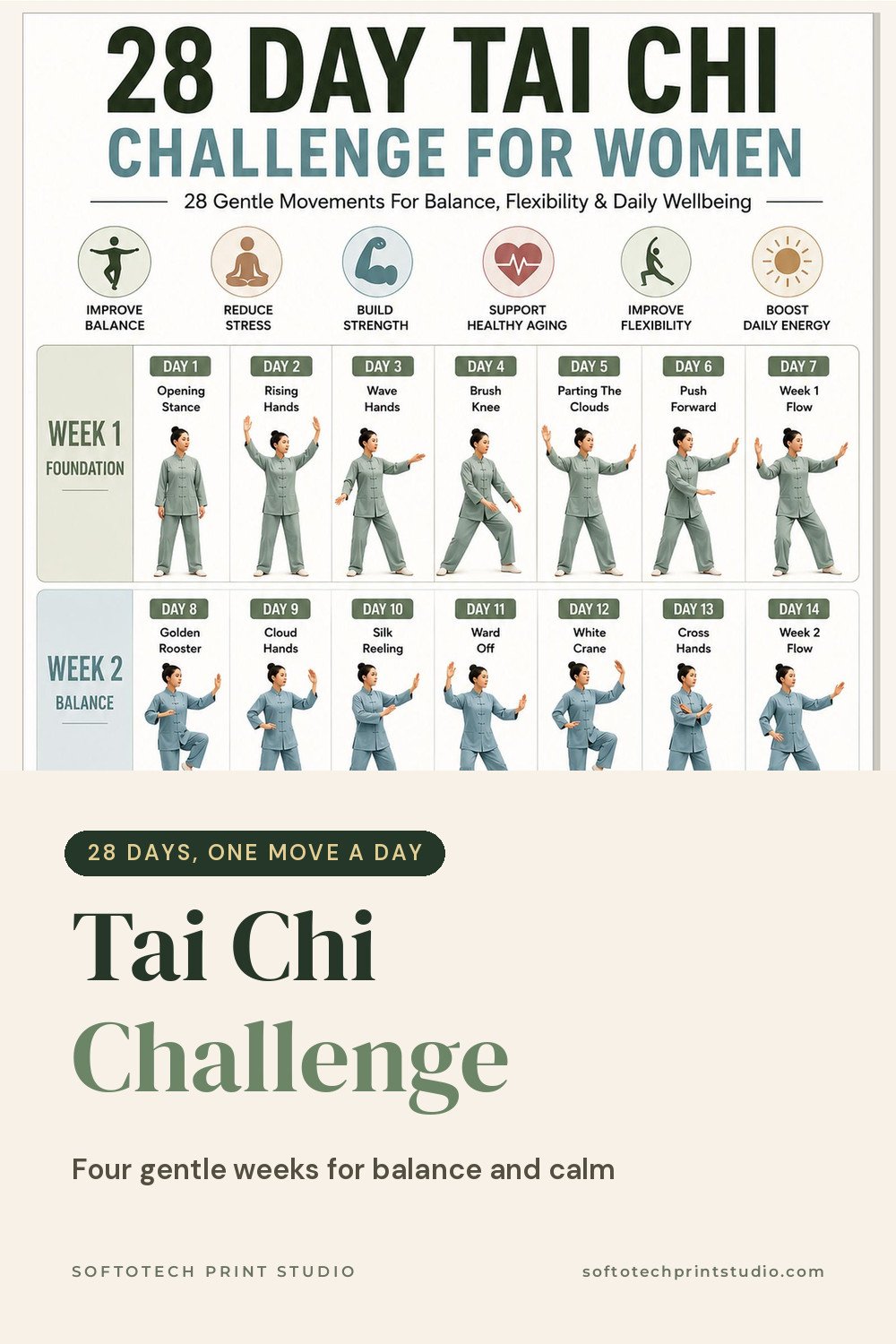
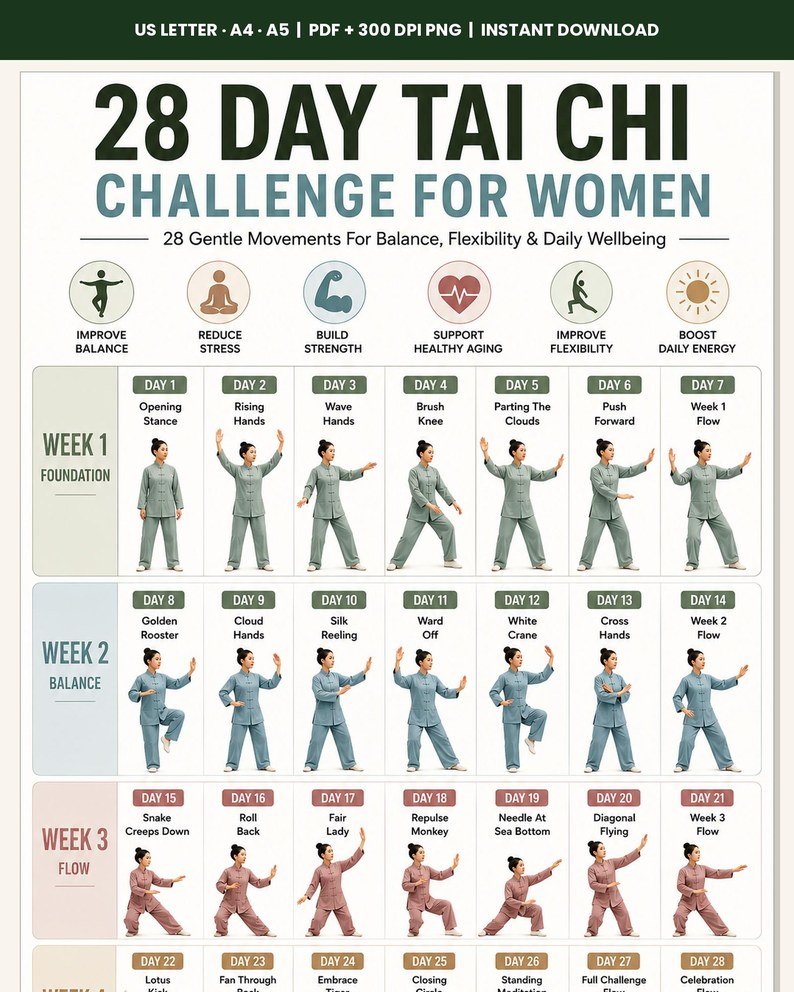
The main chart in this guide is the 28 Day Tai Chi Challenge for Women, subtitled 28 Gentle Movements for Balance, Flexibility and Daily Wellbeing. It’s laid out as a calendar: four rows, one per week, seven days in each, with a small drawing of a woman in a tai chi suit doing that day’s move. Week 1 is Foundation, week 2 is Balance, week 3 is Flow and week 4 is Mastery.
Two things are worth knowing before you print it. First, the chart has no reps, timings or written instructions for each move, only the name and the picture. The listing says an instruction guide comes with it, but I’ve only seen the chart, so the timings in this guide are my own suggestions. Second, not every day is a new move. Days 7, 14 and 21 are labelled Week 1 Flow, Week 2 Flow and Week 3 Flow, and days 27 and 28 are the Full Challenge Flow and Celebration Flow. So there are 23 named moves, plus five days where you link together what you’ve learned.
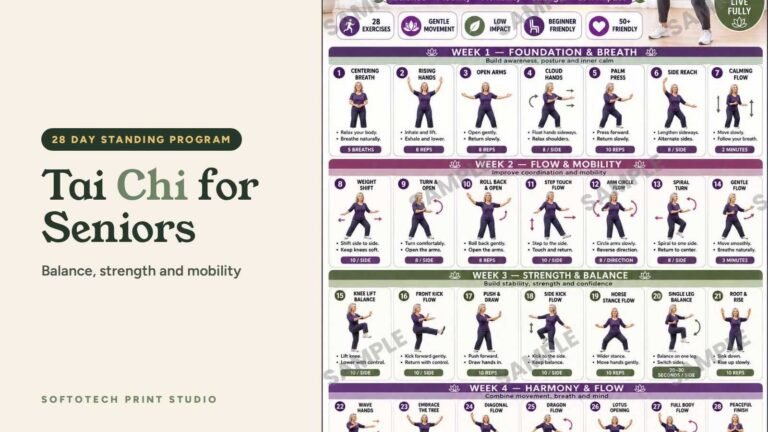
The second chart is a 50+ version, and it’s more detailed. The listing calls it a 28-day tai chi challenge for seniors 50+, though the chart itself is titled Tai Chi for Women 50+, 28 Gentle Full Body Exercises. Every move on that one has a rep count or a time, which some people will find easier to follow.
Tai chi is gentle, but it is still exercise on your feet. If you’ve had a fall, a fracture or surgery recently, if you get dizzy, or if you have heart or lung problems, check with your doctor before you start, and keep a sturdy chair close by for the balance days.
In this guide:
- The 28 Day Tai Chi Challenge, Week by Week
- Worked Week: How to Run Week 1 Day by Day
- The 50+ Challenge With Reps and Timings
- Staying Safe and Sticking With the Challenge
- Frequently Asked Questions
- A 28 day tai chi challenge with one gentle, illustrated movement for each day
- Four weekly themes: Foundation, Balance, Flow and Mastery
- Moves include Opening Stance, Wave Hands, Golden Rooster, White Crane, Repulse Monkey and Embrace Tiger
- A weekly progress tracker, a benefits tracker and a daily reminder: move slowly, breathe deeply, flow with intention
- Print sizes US Letter, A4 and A5 PDFs, delivered as 2 ZIP files with an instruction guide per the listing
- Instant download · Print at home · US Letter · A4 · A5
Use code BLOG10 for 65% OFF at Etsy checkout!
The 28 Day Tai Chi Challenge, Week by Week
Above the calendar, six round icons list what the challenge is meant to help with: improve balance, reduce stress, build strength, support healthy aging, improve flexibility and boost daily energy. Below it are three small panels. There’s a weekly progress tracker with a box for each week complete, a benefits tracker where you rate better balance, less stress, more energy, better flexibility and better posture with stars, and a daily reminder that says move slowly, breathe deeply, flow with intention.
Week 1, Foundation. Day 1 is Opening Stance, standing tall with the feet apart and the arms relaxed. Day 2 is Rising Hands, lifting both arms up overhead. Day 3 is Wave Hands. Day 4 is Brush Knee, a step forward with one hand sweeping past the knee. Day 5 is Parting the Clouds, with both arms rising and opening wide. Day 6 is Push Forward, a gentle push with the arms reaching ahead. Day 7 is Week 1 Flow.
These are the building blocks. Most of them are about learning how to stand, shift your weight and move your arms slowly without tensing your shoulders. Harvard Health describes tai chi movements as circular and never forced, with relaxed muscles and joints that are never fully straightened or bent. That’s a good picture to keep in mind all through week 1.
Week 2, Balance. Day 8 is Golden Rooster, a one-leg stand with the knee lifted. Day 9 is Cloud Hands. Day 10 is Silk Reeling. Day 11 is Ward Off, drawn with the arms raised in front of the body. Day 12 is White Crane, drawn with one arm raised high and one knee lifted. Day 13 is Cross Hands, and day 14 is Week 2 Flow.
Golden Rooster and White Crane are the ones to be careful with. Stand next to a kitchen counter or the back of a chair, and keep the lifted foot low at first. It’s fine if it only just leaves the floor.
Week 3, Flow. Day 15 is Snake Creeps Down, drawn as a low, wide lunge. Day 16 is Roll Back. Day 17 is Fair Lady. Day 18 is Repulse Monkey, drawn in a low stance with one hand pushing forward. Day 19 is Needle at Sea Bottom, drawn as the deepest lunge on the chart with one arm reaching forward. Day 20 is Diagonal Flying, an open diagonal stretch. Day 21 is Week 3 Flow.
This is the hardest week, because almost every move is drawn in a low, wide stance. Most beginners won’t get anywhere near as low as the pictures, and you don’t need to. Bend the knees a few inches, keep your back long, and come up slowly. If your knees complain, stand taller.
Week 4, Mastery. Day 22 is Lotus Kick, drawn as a high kick with one leg raised well above hip height. Day 23 is Fan Through Back. Day 24 is Embrace Tiger. Day 25 is Closing Circle, drawn in a wide stance with both arms raised in a circle overhead. Day 26 is Standing Meditation, simply standing still and breathing. Day 27 is Full Challenge Flow and day 28 is Celebration Flow.
The chart doesn’t say which moves belong in each flow day, so here’s a simple rule. On days 7, 14 and 21, run through that week’s six moves in order, slowly, two or three times. On day 27, string together a favourite move or two from each week. On day 28, do whatever flow you enjoy most, and finish with a minute of standing meditation from day 26.
If you’ve done tai chi before and want a slower, more structured standing programme alongside this one, our guide to tai chi for seniors sets out another 28 days of gentle standing moves.
Worked Week: How to Run Week 1 Day by Day
Here’s how a challenge day might look in practice. The idea is simple: a short warm-up, a few minutes learning the new move, then a quick run through the moves you already know. As the days go on, the review part gets longer and the session grows naturally from about 8 minutes to about 15.
For the warm-up, use the easy loosening moves that Harvard Health says a tai chi class often starts with: shoulder circles, turning the head gently from side to side, and rocking back and forth from heels to toes. A minute or two is enough.
| Day | New move | What to practise | Suggested time |
|---|---|---|---|
| 1 | Opening Stance | Feet hip-width, knees soft, arms relaxed, slow breathing | About 8 minutes |
| 2 | Rising Hands | Both arms float up overhead as you breathe in, lower as you breathe out, then Opening Stance | About 8 to 10 minutes |
| 3 | Wave Hands | Slow side to side arm waves with a gentle weight shift, then days 1 and 2 | About 10 minutes |
| 4 | Brush Knee | Small step forward, one hand brushes past the knee, switch sides, then days 1 to 3 | About 10 minutes |
| 5 | Parting the Clouds | Both arms rise and open wide, then days 1 to 4 | About 12 minutes |
| 6 | Push Forward | Gentle push forward with the weight moving onto the front foot, then days 1 to 5 | About 12 minutes |
| 7 | Week 1 Flow | All six moves in order, slowly, two or three times through | About 12 to 15 minutes |
The descriptions in the table come from the drawings on the chart and the move names. They’re not a full lesson. If a move’s name is new to you, the instruction guide that the listing says comes with the challenge, or a beginner class, will help you get the shape right.
A few tips make week 1 easier. Keep your knees slightly bent all the time, never locked. Let your breathing set the speed, so one movement takes one slow breath in or out. Keep your shoulders down, and let your hands stay soft rather than flat and stiff. And if you lose your place, just stop, stand in Opening Stance, breathe, and start the move again.
Weeks 2 to 4 follow the same pattern: warm up, learn today’s move, then review that week’s moves so far. On the flow days, don’t add anything new. Just put the week together. Tick the weekly progress box at the end of each week and fill in the benefits stars. It’s a small thing, but seeing four ticks at the end is satisfying.
If you miss a day, don’t start over. Carry on from where you stopped. A 28 day challenge that takes you five weeks is still a success. The point is the habit, and a habit survives the odd missed day.
Some people like to pair a movement challenge with something calmer for the mind. Our 30-day nervous system reset challenge has short daily calming steps that fit well alongside tai chi.
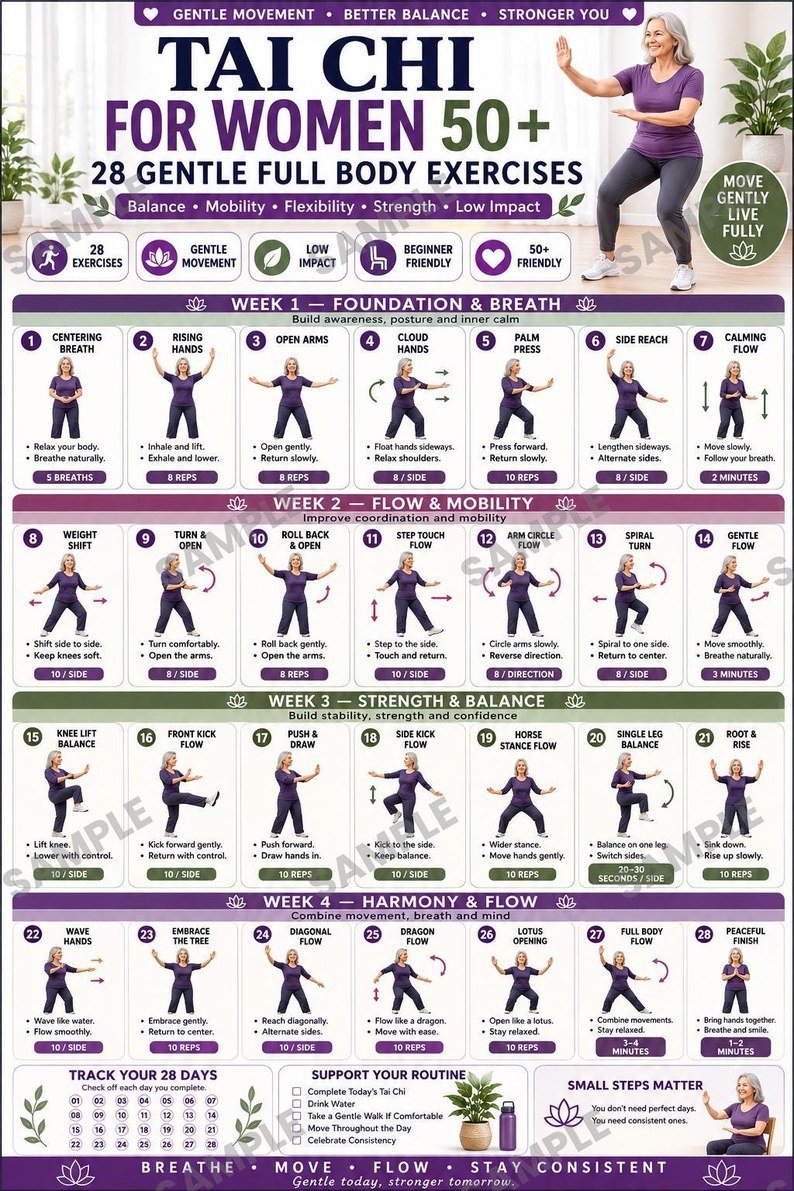
- 28 gentle full body tai chi exercises for women 50+, one for each day of the challenge
- Four weeks: Foundation and Breath, Flow and Mobility, Strength and Balance, Harmony and Flow
- Every move has a count on the chart, like 5 breaths, 8 reps, 10 per side or 2 minutes
- Moves include Centering Breath, Weight Shift, Knee Lift Balance, Horse Stance Flow and Peaceful Finish
- Print sizes US Letter, A4 and A5, as 3 PDFs and 2 ZIP files per the listing
- Instant download · Print at home · US Letter · A4 · A5
Use code BLOG10 for 65% OFF at Etsy checkout!
The 50+ Challenge With Reps and Timings
The second chart covers 28 days too, but every move has a count, two short cues and a clear weekly goal. The badges across the top read 28 exercises, gentle movement, low impact, beginner friendly and 50+ friendly. The woman drawn on it has grey hair and wears a purple top. The main listing photo has SAMPLE watermarks across it, which won’t be on the file you print.
Week 1, Foundation and Breath, to build awareness, posture and inner calm. Centering Breath: relax your body and breathe naturally, 5 breaths. Rising Hands: inhale and lift, exhale and lower, 8 reps. Open Arms: open gently and return slowly, 8 reps. Cloud Hands: float the hands sideways and relax the shoulders, 8 per side. Palm Press: press forward and return slowly, 10 reps. Side Reach: lengthen sideways and alternate sides, 8 per side. Calming Flow: move slowly and follow your breath, 2 minutes.
Week 2, Flow and Mobility, to improve coordination and mobility. Weight Shift: shift side to side with soft knees, 10 per side. Turn and Open: turn comfortably and open the arms, 8 per side. Roll Back and Open: roll back gently and open the arms, 8 reps. Step Touch Flow: step to the side, touch and return, 10 per side. Arm Circle Flow: circle the arms slowly and reverse direction, 8 per direction. Spiral Turn: spiral to one side and return to centre, 8 per side. Gentle Flow: move smoothly and breathe naturally, 3 minutes.
Week 3, Strength and Balance, to build stability, strength and confidence. Knee Lift Balance: lift the knee and lower with control, 10 per side. Front Kick Flow: kick forward gently and return with control, 10 per side. Push and Draw: push forward and draw the hands in, 10 reps. Side Kick Flow: kick to the side and keep your balance, 10 per side. Horse Stance Flow: take a wider stance and move the hands gently, 10 reps. Single Leg Balance: balance on one leg and switch sides, 20 to 30 seconds per side. Root and Rise: sink down and rise up slowly, 10 reps.
Week 4, Harmony and Flow, to combine movement, breath and mind. Wave Hands: wave like water and flow smoothly, 10 per side. Embrace the Tree: embrace gently and return to centre, 10 reps. Diagonal Flow: reach diagonally and alternate sides, 10 per side. Dragon Flow: flow like a dragon and move with ease, 10 reps. Lotus Opening: open like a lotus and stay relaxed, 10 reps. Full Body Flow: combine movements and stay relaxed, 3 to 4 minutes. Peaceful Finish: bring the hands together, breathe and smile, 1 to 2 minutes.
The bottom of the chart has a Track Your 28 Days grid with a circle for each day to check off. Beside it, a Support Your Routine list says complete today’s tai chi, drink water, take a gentle walk if comfortable, move throughout the day and celebrate consistency. A small panel called Small Steps Matter says you don’t need perfect days, you need consistent ones. The footer reads Breathe, Move, Flow, Stay Consistent, with Gentle today, stronger tomorrow underneath.
How do the two charts compare? The 50+ chart is more of a daily workout, with clear counts and a strength week that includes kicks and a one-leg balance. The main challenge is closer to learning a traditional tai chi form, one named move at a time. You could follow either, or do the 50+ chart first for structure and the main chart after for the classic moves.
Week 3 of the 50+ chart is where balance really gets tested. If Knee Lift Balance or Single Leg Balance feels wobbly, do them holding a counter. Our standing balance exercises for seniors guide has more chair-supported balance moves that are a good warm-up for that week.
Staying Safe and Sticking With the Challenge
Clear your space. You need room to step forward, back and to the side, a non-slip floor and good light. Bare feet on a grippy floor or flat, supportive shoes both work. Move rugs, cables and pets out of the way.
Keep a support close by. A kitchen counter or a heavy chair is your friend on balance days. There’s no prize for not holding on. Using support lets you practise the move properly without worrying about tipping over.
Keep the moves small at first. Deep stances like Snake Creeps Down or Horse Stance, and leg lifts like Lotus Kick (which the chart draws far higher than most beginners should try), Front Kick Flow or Side Kick Flow, are easy to overdo. Harvard Health suggests that beginners, especially older or less fit people, start with a short form of smaller, slower movements. Make the move smaller and you can still keep the shape.
Breathe slowly and never hold your breath. If you feel dizzy, light-headed, short of breath or have chest discomfort, stop, sit down, and get medical advice if it doesn’t settle.
If standing isn’t safe for you right now, you don’t have to miss out. Our chair tai chi for seniors guide has 16 gentle seated moves you can use as your daily challenge instead.
And keep it in perspective. Tai chi is a gentle, generally safe habit that many people find calming. It isn’t a treatment for a medical problem, so don’t use it as a reason to put off seeing your doctor about a new pain, dizziness or repeated falls.
Frequently Asked Questions
What is a 28 day tai chi challenge?
It is a four week plan that adds one gentle tai chi move each day. The main chart in this guide groups the days into Foundation, Balance, Flow and Mastery, and days 7, 14, 21, 27 and 28 are flow days where you link the moves you have learned so far.
How long should each day of the tai chi challenge take?
The main chart does not give times or reps. About 10 to 15 minutes a day is a sensible target: a short warm-up, a few slow minutes on the new move, then a run through earlier moves. The 50+ chart does give counts, such as 8 reps, 10 per side or 2 minutes.
Is the tai chi challenge suitable for beginners and seniors?
Yes, both charts are written for all levels and start with simple standing moves. A few later moves are harder, like Snake Creeps Down and Lotus Kick on the main chart. Keep those small, hold a chair or counter for balance moves, and use a chair tai chi routine instead if standing is not safe for you.
When should I check with a doctor before a tai chi challenge?
Talk to your doctor first if you have had a recent fall, fracture or surgery, get dizzy, have heart or lung problems or uncontrolled blood pressure, or have joint pain that is getting worse. Stop any move that causes pain, dizziness or chest discomfort.
What sizes do the tai chi challenge charts print in?
Both charts print in US Letter, A4 and A5. Per the listings, the main challenge comes as 2 ZIP files with PDFs and an instruction guide, and the 50+ chart comes as 3 PDFs and 2 ZIP files, as an instant download.
This guide is for general wellness and is not medical advice. Check with your doctor before starting a new routine.
Related Guides
- Tai Chi for Seniors
- Chair Tai Chi for Seniors
- Standing Balance Exercises for Seniors
- 30-Day Nervous System Reset Challenge
Sources
Sources: Harvard Health, The Health Benefits of Tai Chi, Mayo Clinic Press, The Healing Art of Tai Chi