
Core exercises for women over 50 are gentle moves that strengthen the muscles around your middle, your deep abdominals, obliques, lower back and hips, so you stand taller, balance better and find everyday tasks easier. The best ones for this age don’t involve crunches. They’re slow, controlled moves like abdominal bracing, marching in place, bird dog and glute bridges.
A lot of core advice still looks like it was written for a 25 year old at the gym. Sit ups, long planks, hanging leg raises. After 50, most women want something different: a stronger back, steadier balance, less of that slumped feeling at the end of a long day, and moves that don’t hurt the neck.
This guide is built on the Core Exercises for Women Over 50 chart from SoftoTech Print Studio. It has 16 gentle core exercises with cues, target muscles and holds or reps printed on it. I’ll walk through all 16, group them into standing, chair and floor moves, give you a 15 minute standing first routine, and set out a simple 4 week plan.
A quick safety note. If you have osteoporosis, back pain, a recent surgery, a hernia or a pelvic floor problem, check with your doctor or a physiotherapist before you start. Stop any move that causes sharp pain, and breathe the whole way through.
In this guide:
- The 16 Core Exercises on the Chart
- Worked Routine: 15 Minutes, Standing First
- A 4 Week Core Plan, Including Chair Days
- How to Train Your Core Safely After 50
- Frequently Asked Questions
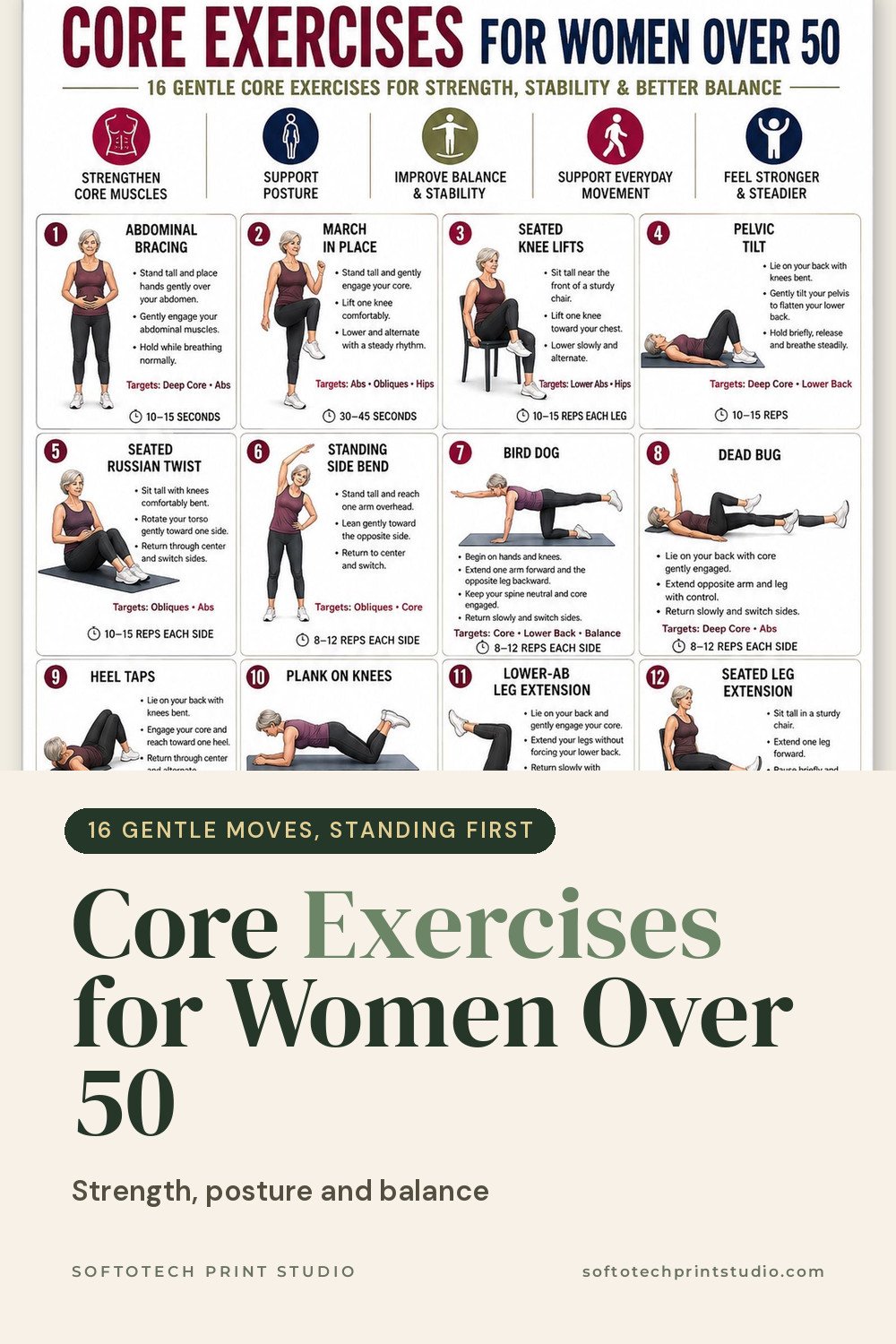
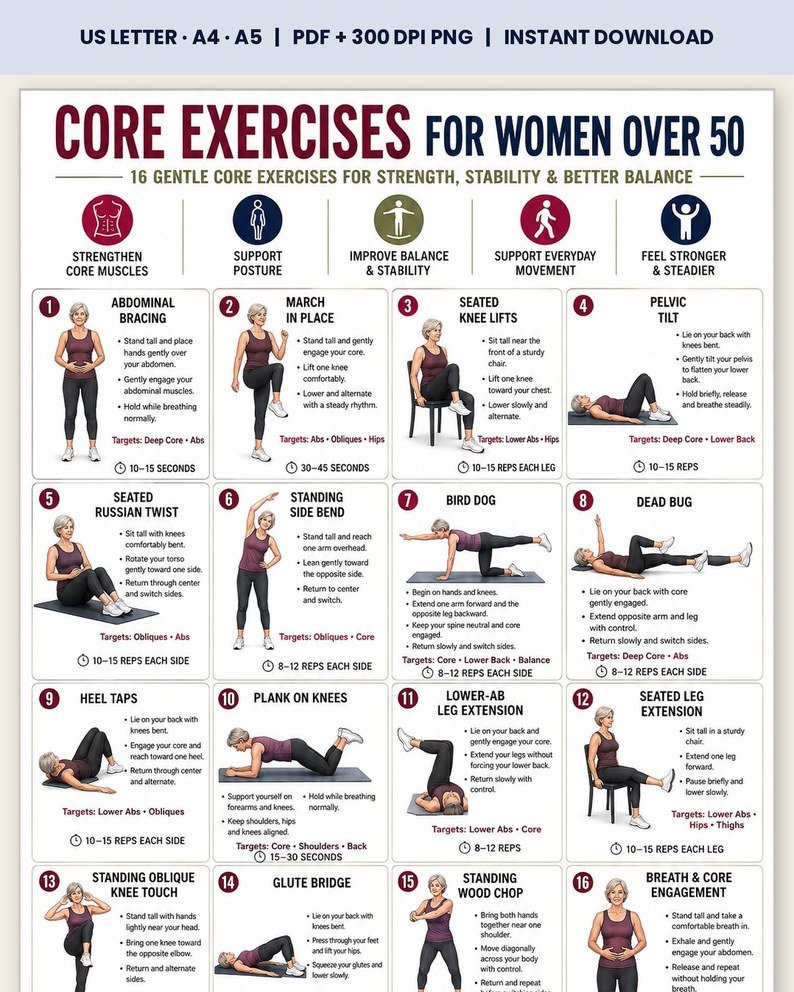
- 16 gentle core exercises for strength, stability and better balance, each with an illustration, cues and the muscles it targets
- Standing moves include abdominal bracing, march in place, standing side bend, standing oblique knee touch and standing wood chop
- Floor and chair options include pelvic tilt, bird dog, dead bug, heel taps, plank on knees, glute bridge and seated leg extension
- Holds and reps printed on the chart, such as abdominal bracing 10 to 15 seconds and march in place 30 to 45 seconds
- Print sizes US Letter, A4 and A5, as a PDF plus a 300 DPI PNG per the listing
- Instant download · Print at home · US Letter · A4 · A5
Use code BLOG10 for 65% OFF at Etsy checkout!
The 16 Core Exercises on the Chart
The chart is titled Core Exercises for Women Over 50, with the line “16 gentle core exercises for strength, stability and better balance”. Across the top it lists five goals: strengthen core muscles, support posture, improve balance and stability, support everyday movement, and feel stronger and steadier. Here are the 16 moves in chart order, with the targets and counts it prints.
| # | Move | Position | Targets (chart) | Hold or reps (chart) |
|---|---|---|---|---|
| 1 | Abdominal bracing | Standing | Deep core, abs | 10 to 15 seconds |
| 2 | March in place | Standing | Abs, obliques, hips | 30 to 45 seconds |
| 3 | Seated knee lifts | Chair | Lower abs, hips | 10 to 15 reps each leg |
| 4 | Pelvic tilt | Floor, on your back | Deep core, lower back | 10 to 15 reps |
| 5 | Seated Russian twist | Floor, sitting | Obliques, abs | 10 to 15 reps each side |
| 6 | Standing side bend | Standing | Obliques, core | 8 to 12 reps each side |
| 7 | Bird dog | Floor, hands and knees | Core, lower back, balance | 8 to 12 reps each side |
| 8 | Dead bug | Floor, on your back | Deep core, abs | 8 to 12 reps each side |
| 9 | Heel taps | Floor, on your back | Lower abs, obliques | 10 to 15 reps each side |
| 10 | Plank on knees | Floor, forearms and knees | Core, shoulders, back | 15 to 30 seconds |
| 11 | Lower ab leg extension | Floor, on your back | Lower abs, core | 8 to 12 reps |
| 12 | Seated leg extension | Chair | Lower abs, hips, thighs | 10 to 15 reps each leg |
| 13 | Standing oblique knee touch | Standing | Cut off on the listing photo | Cut off |
| 14 | Glute bridge | Floor, on your back | Cut off on the listing photo | Cut off |
| 15 | Standing wood chop | Standing | Cut off on the listing photo | Cut off |
| 16 | Breath and core engagement | Standing | Cut off on the listing photo | Cut off |
A note on moves 13 to 16. The bottom row of the chart runs off the edge of the listing photo, so I can read the cues for these four but not their targets or counts. Where I give counts for them below, they’re my suggestion, matched to similar moves higher up the chart.
The cues, in plain words. For abdominal bracing, stand tall, place your hands gently over your abdomen, engage your abdominal muscles and hold while breathing normally. For march in place, stand tall, gently engage your core, lift one knee comfortably, then lower and alternate with a steady rhythm. For the standing side bend, reach one arm overhead, lean gently toward the opposite side, return to center and switch.
For the standing oblique knee touch, stand tall with your hands lightly near your head, bring one knee toward the opposite elbow, then return and alternate sides. For the standing wood chop, bring both hands together near one shoulder and move diagonally across your body with control. And for breath and core engagement, stand tall, take a comfortable breath in, exhale and gently engage your abdomen, then release and repeat without holding your breath.
On the floor, the bird dog starts on hands and knees: extend one arm forward and the opposite leg back, keep your spine neutral, return slowly and switch. The dead bug is the same idea on your back, extending opposite arm and leg with your core gently engaged. The plank on knees supports you on forearms and knees with shoulders, hips and knees in a line. The lower ab leg extension asks you to extend your legs without forcing your lower back, which is the cue that matters most.
The standing count. Six of the 16 are standing moves: 1, 2, 6, 13, 15 and 16. Two use a chair (3 and 12). The other eight are on a mat. That standing group is what makes this chart different from most core posters, and it’s why the routine below starts there.
Worked Routine: 15 Minutes, Standing First
This routine uses the chart’s own counts where it gives them. The order and the rest times are mine. Do it two or three days a week, never two days in a row. Stand next to a kitchen counter or the back of a sturdy chair for the standing part.
| Block | Moves | How much | Time |
|---|---|---|---|
| Warm up | March in place (2), breath and core engagement (16) | 45 seconds marching, then 5 slow breaths | 2 minutes |
| Standing block | Abdominal bracing (1), standing side bend (6), standing oblique knee touch (13), standing wood chop (15) | Bracing 10 to 15 seconds x 3, side bend 8 to 12 each side, knee touch and wood chop 8 each side (my count) | 5 minutes |
| Chair block | Seated knee lifts (3), seated leg extension (12) | 10 to 15 each leg | 3 minutes |
| Floor block (optional) | Pelvic tilt (4), glute bridge (14), dead bug (8) | Tilts 10 to 15, bridges 10 (my count), dead bug 8 to 12 each side | 4 minutes |
| Cool down | Breath and core engagement (16) | 5 slow breaths | 1 minute |
No floor today? Skip the floor block and do the standing block twice. You’ll still get around 12 minutes of core work, and it’s a good option if getting down to the floor and back up is hard right now.
How it should feel. Warm, a bit shaky in the middle, never sharp. You should be able to talk in short sentences. If you notice yourself holding your breath, which is very common during bracing, slow down and breathe out as you tighten. The National Institute on Aging says not to hold your breath during strength exercises: breathe out during the effort and breathe in as you relax.
Where it fits. If you already follow our workout plan for women over 50, this core routine can slot in after your walking days or replace the core part of a strength day. And if you love the floor work, our pilates for women over 50 guide builds on the same breathing and control.
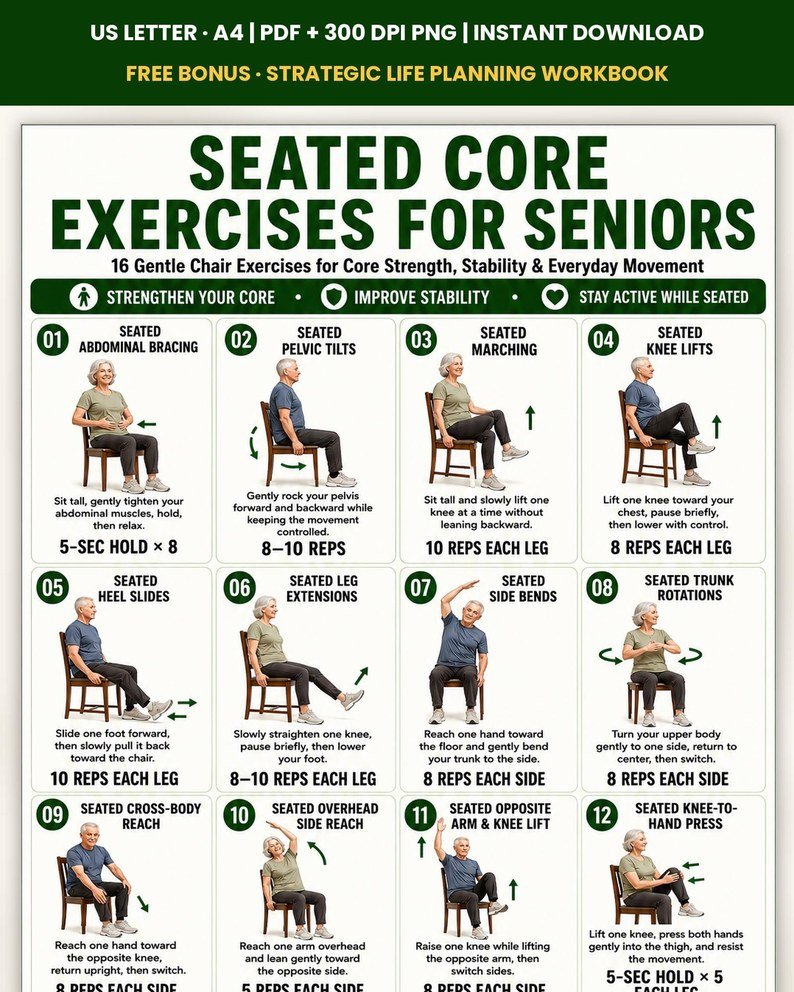
- 16 gentle chair exercises to strengthen the core, improve stability and stay active while seated
- Moves include abdominal bracing, pelvic tilts, seated marching, trunk rotations, a bicycle march and a tall posture hold
- Each move has an illustration and suggested reps
- Chair based, with no floor work, for days when getting down to a mat is not an option
- Made for adults over 50 and seniors, per the listing
- Instant download · Print at home · US Letter · A4
Use code BLOG10 for 65% OFF at Etsy checkout!
A 4 Week Core Plan, Including Chair Days
The second printable here is the Over 50 Seated Core Exercises chart, 16 gentle chair movements to strengthen your core and improve stability while seated. It includes abdominal bracing, pelvic tilts, seated marching, trunk rotations, a bicycle march and a tall posture hold. We walk through it move by move in our core exercises for seniors guide, so I won’t repeat it here. In this plan it’s your backup for tired days, sore knees or days when you’d rather not get on the floor.
This 4 week plan is my suggestion. It builds from standing only to the full routine, and swaps in the seated chart once a week.
| Week | Day A | Day B | Day C |
|---|---|---|---|
| 1 | Warm up plus standing block once | Seated core chart, 6 moves | Warm up plus standing block once |
| 2 | Warm up, standing block, chair block | Seated core chart, 8 moves | Warm up, standing block, chair block |
| 3 | Full 15 minute routine | Seated core chart, all 16 | Full routine, add bird dog (7) |
| 4 | Full routine, add plank on knees (10) | Seated core chart, all 16 | Full routine, add heel taps (9) and lower ab leg extension (11) |
How to progress. Move up a week only when the current one feels comfortable. Then add one thing at a time: a few more reps, a slightly longer hold, or one new move. Don’t add all three at once. The plank on knees, for example, can start at 15 seconds and creep toward the chart’s 30 seconds over several sessions.
Rest days count. The National Institute on Aging suggests strength work at least two days a week and says to avoid working the same muscle group on two days in a row, so your muscles can recover. Walking, gardening or stretching on the days between is perfect. Our stretching exercises for women over 50 guide pairs well with this plan.
Track it simply. Tick each session on the printed chart or a calendar. After four weeks, try the standing block and notice what changed. Maybe the wood chop feels smoother, or the side bend reaches further. Small changes like those are exactly what this kind of training is for.
How to Train Your Core Safely After 50
Why bother. Harvard Health Publishing describes your core as the sturdy central link in a chain connecting your upper and lower body. Bending to put on shoes, turning to look behind you, sitting in a chair, even standing still, all rely on your core. Harvard also says a strong core enhances balance and stability and can lessen your risk of falling, and that weak core muscles contribute to slouching.
Don’t only train your abs. The same Harvard article warns against aiming all your effort at the abdominal muscles while ignoring the back and hips, because it can set you up for injury. The chart handles that well. Bird dog and glute bridge work the back and hips. Side bends and wood chops work the sides. Bracing and dead bug work the deep front muscles.
Breathe out on the effort. As the NIA advises, breathe out as you work and in as you relax. Move 16 on the chart is entirely about this, which is why it opens and closes the routine.
Mind your neck and back. On the floor moves, keep your head resting on the mat and let your core do the work. For the lower ab leg extension, follow the chart’s cue: extend your legs without forcing your lower back. If your back arches off the floor, bend your knees more or skip the move for now.
Pelvic floor and bone health. Many women over 50 have some pelvic floor weakness or low bone density. If you leak when you cough, or you’ve been told you have osteoporosis, see a physiotherapist before doing twisting or bending moves like the Russian twist and side bend. They can tell you which of the 16 suit you.
Stop if. You feel sharp or shooting pain, dizziness, chest pain or pressure, or pain that lingers the next day. Gentle muscle tiredness is normal. Pain isn’t. And if you’re unsure about any movement, the NIA suggests asking your doctor or physical therapist.
Balance the week. The NIA says research shows it’s important to get all three types of exercise: aerobic, muscle strengthening and balance, and it suggests building up to at least 150 minutes of moderate aerobic activity, such as brisk walking, a week. Core work supports balance, but it doesn’t replace walking, so keep both.
Frequently Asked Questions
What are the best core exercises for women over 50?
Gentle moves that train the deep core without strain: abdominal bracing, march in place, standing side bends, standing wood chops, pelvic tilts, bird dog, dead bug and a glute bridge. The chart in this guide has 16 of them, and six can be done standing, so you don’t need to get down on the floor every day.
How often should I do core exercises after 50?
Two or three short sessions a week is a good start. The National Institute on Aging suggests muscle strengthening at least two days a week, without working the same muscle group two days in a row, and about three sessions of balance exercise a week. A 15 minute core routine can count toward both.
Can I do core exercises standing up?
Yes. Abdominal bracing, march in place, standing side bend, standing oblique knee touch, standing wood chop and breath and core engagement are all standing moves on the chart. Stand near a counter or a sturdy chair so you have something to hold if you wobble.
Are crunches safe for women over 50?
The chart doesn’t use crunches at all. It uses moves like the dead bug, heel taps, pelvic tilts and bird dog, which train the core while your spine stays supported. If you have osteoporosis, back pain or a pelvic floor problem, ask your doctor or a physiotherapist which moves suit you.
What sizes does the core exercises chart print in?
The listing offers US Letter, A4 and A5, as a PDF plus a 300 DPI PNG, as an instant download. The seated core chart prints in US Letter and A4.
This guide is for general wellness and is not medical advice. Check with your doctor before starting a new routine, especially if you have osteoporosis, back pain or a pelvic floor problem.
Related Guides
- Workout Plan for Women Over 50
- Pilates for Women Over 50
- Stretching Exercises for Women Over 50
- Core Exercises for Seniors
Sources
Sources: National Institute on Aging, Three Types of Exercise Can Improve Your Health and Physical Ability, Harvard Health Publishing, The real-world benefits of strengthening your core
 Home WorkoutsVibration Plate for Seniors: What It Can and Can’t Do, Who Should Avoid It, and a Safe 10 Minute Routine
 Home WorkoutsUpper Body Home Exercises: 20 Moves for Chest, Back, Shoulders and Arms, With a 25 Minute Workout
 Home WorkoutsWorkout Plan for Women Over 50: A Gentle 28 Day Start, Then a Weekly Plan for Strength, Balance and Walking