
A cable machine workout is one of the most flexible ways to train in a gym. The cables give you constant tension through the whole move, the weight stack changes with a pin, and one machine can train the back, chest, arms, legs and core without ever walking to another station. That is why so many women build their gym routine around the cables: the setup is fast, the moves are joint friendly, and the session stays in one place.
A 30 day challenge makes the cable machine even easier to use, because it removes the daily question of what to do. Each day is printed on the calendar: a small set of moves, a theme for the week, and recovery days already placed where they belong. You walk in, find the day, and train. Over four weeks the moves repeat just enough to feel familiar, with new variations arriving each week so the work keeps progressing.
This guide is built around one printed chart: a 30 day cable machine challenge for women, with a 16 move glute chart as the companion. One honest note first: no generic “Cable Machine Workout” chart exists in the shop, and the chart in this guide is the 30 day cable machine challenge, the closest match, while the second box below is the 16 move cable glute chart. Below you will find the moves in the challenge and what each week trains, how the cable machine works, the gym tips that keep cable training safe, a worked Week 1 walkthrough from the chart day by day, and the matching printable chart from SoftoTech Print Studio.
In this guide:
- The 30 Day Challenge, Week by Week
- How the Cable Machine Works
- Gym Tips for Cable Training
- Worked Example: Week 1, Day by Day
- Frequently Asked Questions
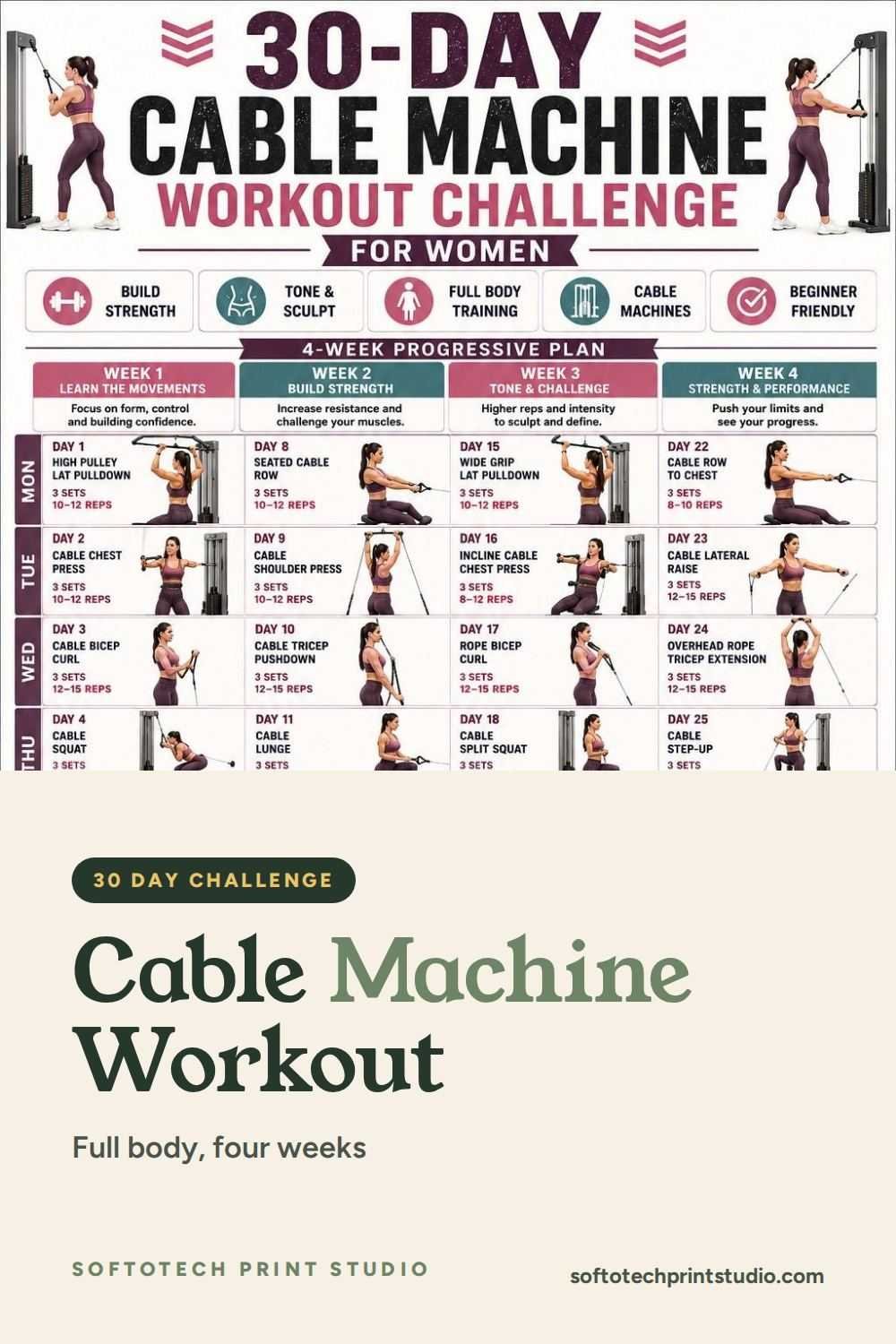
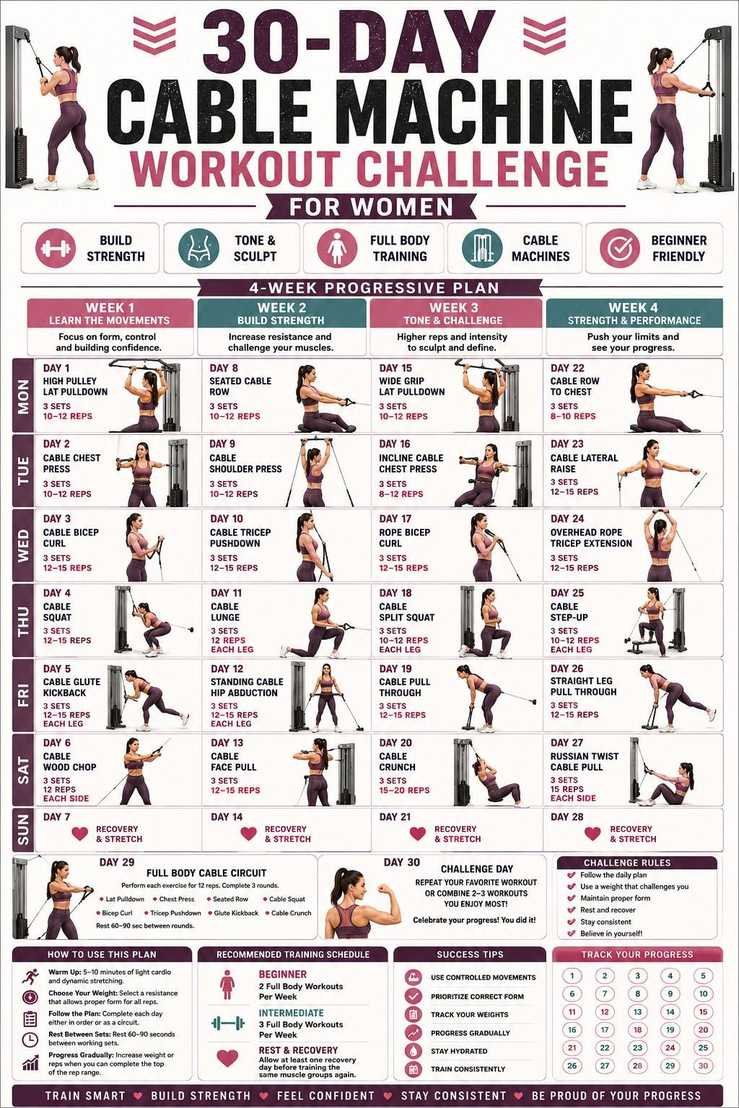
The printable from this guide
30 Day Cable Machine Workout Challenge for Women
- A 30 day full body cable challenge in four weeks: Week 1 Learn the Movements, Week 2 Build Strength, Week 3 Tone and Challenge, Week 4 Strength and Performance, with recovery and stretch days each week and a full body circuit on Day 29 and a challenge day on Day 30
- Week 1 moves: High Pulley Lat Pulldown, Cable Chest Press, Cable Bicep Curl, Cable Squat, Cable Glute Kickback and Cable Wood Chop
- The Week 1 walkthrough in this guide follows the chart day by day
- Print sizes US Letter and A4, as 3 PDFs plus a PNG per the listing (banner does not mention A5)
- Instant download · Print at home · US Letter · A4
Use code BLOG10 for 65% OFF at Etsy checkout!
Get the 30 Day Cable Machine Challenge on Etsy →
Instant download · Print at home
The 30 Day Challenge, Week by Week
The printable chart in this guide, the 30 Day Cable Machine Workout Challenge for Women, runs for 30 days across four themed weeks, with a recovery and stretch day at the end of each week. Week 1 is Learn the Movements, Week 2 is Build Strength, Week 3 is Tone and Challenge, and Week 4 is Strength and Performance. The challenge ends with a full body circuit on Day 29 and a challenge day on Day 30.
| Week | Theme | Moves from the chart |
|---|---|---|
| Week 1 | Learn the Movements | High Pulley Lat Pulldown, Cable Chest Press, Cable Bicep Curl, Cable Squat, Cable Glute Kickback, Cable Wood Chop |
| Week 2 | Build Strength | Seated Cable Row, Cable Shoulder Press, Cable Tricep Pushdown, Cable Lunge, Standing Cable Hip Abduction, Cable Face Pull |
| Week 3 | Tone and Challenge | Wide Grip Lat Pulldown, Incline Cable Chest Press, Rope Bicep Curl, Cable Split Squat, Cable Pull Through, Cable Crunch |
| Week 4 | Strength and Performance | Cable Row to Chest, Cable Lateral Raise, Overhead Rope Tricep Extension, Cable Step-Up, Straight Leg Pull Through, Russian Twist Cable Pull |
Week 1 teaches the six foundation moves, one per day: a pulldown for the back, a chest press, a bicep curl, a squat, a glute kickback and a wood chop for the trunk. Week 2 adds load and new patterns: a seated row, a shoulder press, a tricep pushdown, a lunge, a hip abduction and a face pull. Week 3 changes the angles: a wide grip pulldown, an incline chest press, a rope curl, a split squat, a pull through and a cable crunch. Week 4 brings the work together with a row to the chest, a lateral raise, an overhead tricep extension, a step up, a straight leg pull through and a Russian twist pull.
Every week ends with a recovery and stretch day, which is part of the plan, not a gap in it. Recovery days let the muscles rebuild and the joints settle, and they keep the challenge sustainable for a full month. Day 29 is a full body cable circuit that revisits the patterns of the month, and Day 30 is the challenge day, a final test of what four weeks of steady cable work has built. If you are new to the gym, our kettlebell workout for beginners guide is a useful home based starting point, and the 20 minute no equipment home workout for beginners teaches the squat, lunge and push patterns with bodyweight only.
How the Cable Machine Works
A cable machine is a weight stack connected by a cable to a handle, with pulleys you can set high, low, or anywhere in between. Move the pin to change the weight, choose the handle for the move, set the pulley height, and pull. Because the cable pulls in a straight line from the pulley, the resistance stays constant through the whole range of the move, which is different from a dumbbell, where the load feels heaviest at one point and lightest at another.
That constant tension is the cable machine’s main strength. On a Cable Chest Press, the chest works from the first centimetre to the last. On a Cable Glute Kickback, the glute works through the full kick. On a Cable Wood Chop, the trunk works against the same pull for the whole diagonal. It also makes the machine forgiving: if a weight is too heavy, you lower the pin and try again in seconds, with no plates to change and no bar to re-rack.
Learn the pulley positions for the moves in your week. High pulley for pulldowns and face pulls, chest height for presses and rows, low pulley for kickbacks, pull throughs and curls from the floor. Stand far enough from the machine that the cable stays taut at the start of the move, and close enough that you are not pulled off balance when the weight lifts. Most gyms have a trainer on the floor who can show you the pin, the pulley and the handles in one minute, and that minute is worth asking for on your first visit.

The cable glute chart
Cable Machine Glute Workout for Women
- 16 glute and lower body cable exercises: Cable Glute Kickback, Standing Cable Hip Abduction, Cable Pull-Through, Cable Squat, Cable Romanian Deadlift, Cable Reverse Lunge, Cable Lateral Lunge, Cable Step-Up, Cable Bulgarian Split Squat, Cable Front Squat, Cable Sumo Squat, Cable Single-Leg Romanian Deadlift, Cable Curtsy Lunge, Standing Cable Leg Curl, Standing Cable Hip Extension and Cable Donkey Kick
- The lower body half of the cable work, with a tracker on the chart
- Print sizes US Letter, A4 and A5, as 2 PDFs plus a PNG per the listing
- Instant download · Print at home · US Letter · A4 · A5
Use code BLOG10 for 65% OFF at Etsy checkout!
Get the Cable Glute Chart on Etsy →
Instant download · Print at home
Gym Tips for Cable Training
Four tips cover most of cable training. First, keep the trunk braced and the stance athletic on every move: feet shoulder width apart, knees soft, ribs down. A cable pulls you toward the machine, so your core works on every rep even when the move is for the arms or chest. Second, move slowly on the return half of the rep. Letting the weight stack crash down between reps is noisy, hard on the joints, and it throws away half the training. Two to three seconds back to the start is the right pace.
Third, keep the shoulders down and away from the ears on presses, pulldowns and raises, and keep the wrists straight on curls and pushdowns. The handle should sit in the palm, not in the fingers, so the forearm does not tire before the target muscle does. Fourth, pick a weight that lets you finish the set with clean form. The stack changes with a pin, so there is no excuse for grinding through a set with a weight that pulls you out of position: drop the pin one plate and finish well.
Warm up for five minutes before the first set: easy walking or cycling, arm circles, hip circles, and a set of the first move with a light weight. Cool down with walking and gentle stretching for the shoulders, chest, hips and legs. The CDC notes that muscle strengthening activity for all major muscle groups on at least two days a week is part of the adult guidance, and a cable session like this one covers that work with the added benefit of constant tension through every move. For dumbbell work at home, our dumbbell arm workout for women guide covers the same pressing and curling patterns, and the full body dumbbell workout at home 5 day plan for beginners spreads the work across a week.
Worked Example: Week 1, Day by Day
Here is how Week 1 of the challenge runs, day by day, following the chart exactly. Day 1 is High Pulley Lat Pulldown, which trains the back: set the pulley high, sit or kneel under the cable, and pull the bar down to the upper chest with the elbows driving down and back. Day 2 is Cable Chest Press, which trains the chest and shoulders: set the pulleys at chest height behind you, step forward, and press the handles forward until the arms are extended, then return slowly.
Day 3 is Cable Bicep Curl, which trains the front of the upper arms: set the pulley low, stand facing the machine, and curl the handle up toward the shoulder with the elbow pinned at your side. Day 4 is Cable Squat, which trains the legs and glutes: hold the low pulley handle at your chest or at your sides, sit back into a squat, and drive up through the heels. Day 5 is Cable Glute Kickback, which trains the glutes: set the pulley low, attach the ankle strap, and kick the leg back with control, squeezing the glute at the end of the move.
Day 6 is Cable Wood Chop, which trains the trunk: set the pulley high, hold the handle with both hands, and pull it diagonally down across the body, from one shoulder to the opposite hip, turning the trunk with the move. Day 7 is Recovery and Stretch: easy walking, gentle stretching for the hips, chest and shoulders, and a look at the chart to tick off the week. By the end of Week 1 you will have trained the back, chest, arms, legs, glutes and trunk, one move at a time, and every one of those moves will feel familiar when it returns in a harder form in Week 2. The glute chart in the second box below is the natural companion for this challenge: sixteen glute and lower body cable exercises with a tracker, for the days when you want the lower body half of the cable work on its own.
Frequently Asked Questions
What is a cable machine workout?
A cable machine workout is strength training on a cable machine, where a weight stack pulls through pulleys to give constant tension through the whole move. The 30 day challenge in this guide covers the back, chest, arms, legs, glutes and core across four themed weeks, with a recovery day at the end of each week.
Is the cable machine good for beginners?
Yes, the cable machine is one of the most beginner friendly tools in a gym, because the weight changes with a pin, the pulleys set the direction of the pull, and the moves are joint friendly. Week 1 of the challenge is called Learn the Movements for exactly that reason: six foundation moves, one per day, before the load builds in Week 2.
How long does a cable machine session take?
Most challenge days take about 30 to 45 minutes including a short warm up, because each day trains one move well rather than a long list of exercises. Recovery and stretch days are shorter. The full challenge runs for 30 days, with a full body circuit on Day 29 and a challenge day on Day 30.
Can you do a full body workout on the cable machine?
Yes, one cable machine can train the whole body: pulldowns and rows for the back, presses for the chest and shoulders, curls and pushdowns for the arms, squats and lunges for the legs, kickbacks and pull throughs for the glutes, and wood chops and crunches for the core. This challenge covers all of those groups across its four weeks.
What size is the printable cable machine chart?
The SoftoTech Print Studio 30 Day Cable Machine Workout Challenge for Women is an instant download that prints at home in US Letter and A4 sizes, as 3 PDFs plus a PNG per the listing. It shows the full 30 day calendar, four weeks of moves, recovery days, a full body circuit on Day 29 and a challenge day on Day 30.
This guide is for general wellness and is not medical advice. Check with your doctor before starting a new routine.
Cables are one part of the machine floor: our gym machine workout guide sets out 16 machine exercises, from leg press to cable curls, with a beginner schedule.
Related Guides
- Kettlebell Workout for Beginners
- Dumbbell Arm Workout for Women
- 20-Minute No-Equipment Home Workout for Beginners
- Full Body Dumbbell Workout at Home: 5-Day Plan for Beginners
Sources
Sources: CDC: Physical Activity Guidelines for Adults, Mayo Clinic: Exercise, 7 Benefits of Regular Physical Activity
 Home WorkoutsWorkout Plan for Women Over 50: A Gentle 28 Day Start, Then a Weekly Plan for Strength, Balance and Walking
 Home WorkoutsFace Yoga for Jowls: A 10 Minute Jaw and Neck Routine From a 12 Exercise Chart, With Honest Expectations
 Home WorkoutsMilitary Workout Routine: A 3 Level Bodyweight Plan From Beginner to Advanced, With a Weekly Schedule