
Good PCOS breakfast ideas pair protein with fiber and keep fruit and starch modest: scrambled eggs and tomatoes, plain Greek yogurt with berries or nuts, chia pudding with cinnamon, a vegetable frittata, or avocado toast with seeds on whole grain bread. They’re filling, they don’t rely on sugar, and none of them takes long.
Breakfast with PCOS can feel like a minefield. Cereal is out, toast is suspicious, smoothies are confusing, and every second post online says something different about oats. It doesn’t have to be that complicated. A handful of breakfasts you like, built on the same simple pattern, will do most of the work.
This guide uses two printables from SoftoTech Print Studio. The PCOS 30-Day Meal Plan is organized by week, and our PCOS diet meal plan guide already names the Week 1 and Week 2 breakfasts. Here I’m picking up the 16 breakfasts from Day 15 to Day 30, which covers Weeks 3, 4 and the short Week 5. Then the PCOS Eat, Limit, Avoid Chart helps sort common breakfast foods, and a simple formula lets you build your own.
A quick note on names: the NHS now calls PCOS polyendocrine metabolic ovarian syndrome, or PMOS. Most people still search for PCOS, so that’s the term I use here. Everything in this guide is general information, not a treatment plan.
In this guide:
- Breakfast Matters Because of Insulin, Not Willpower
- 16 Breakfasts From Days 15 to 30
- The Eat, Limit, Avoid Chart at the Breakfast Table
- A Breakfast Formula You Can Use Anywhere
- Frequently Asked Questions
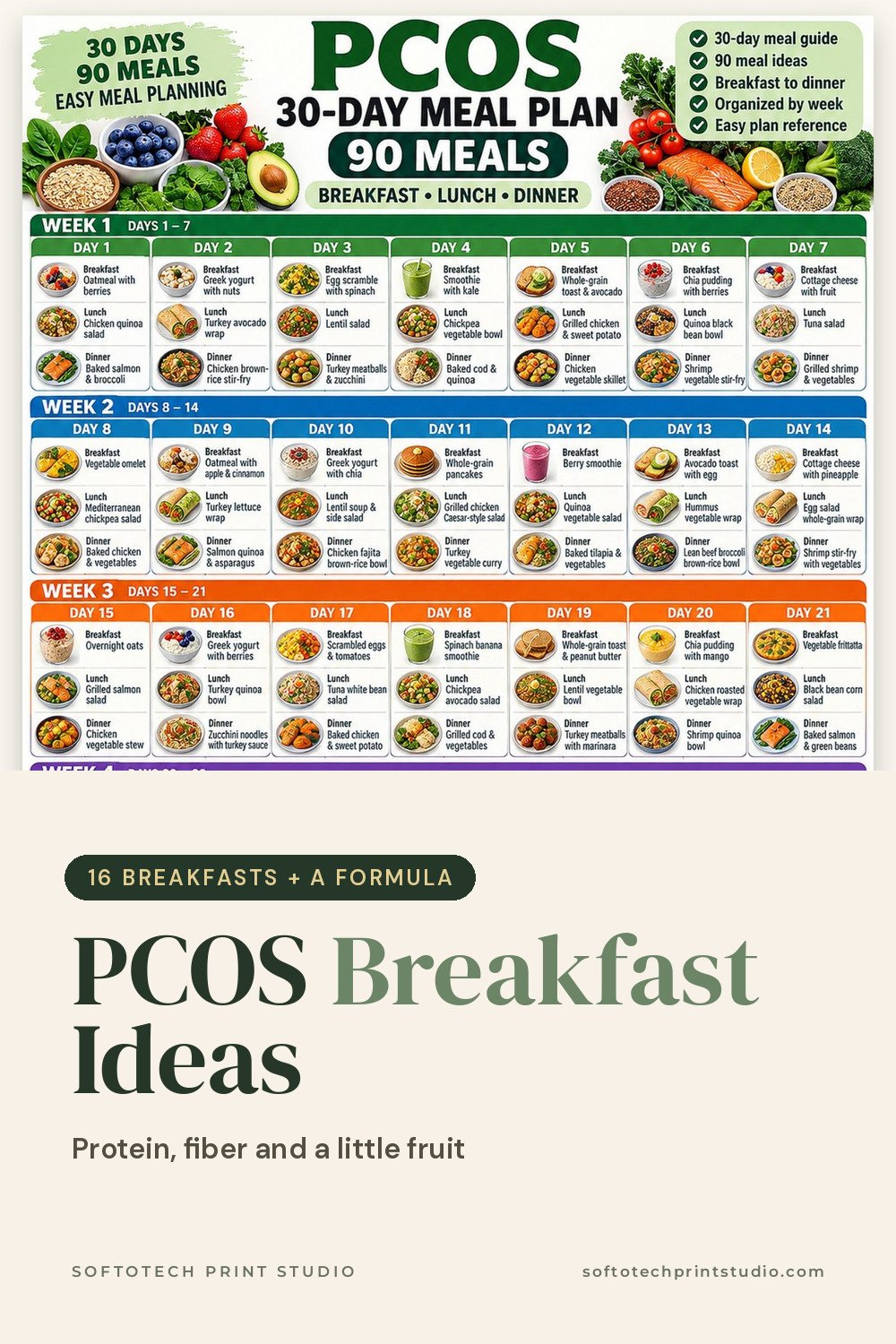
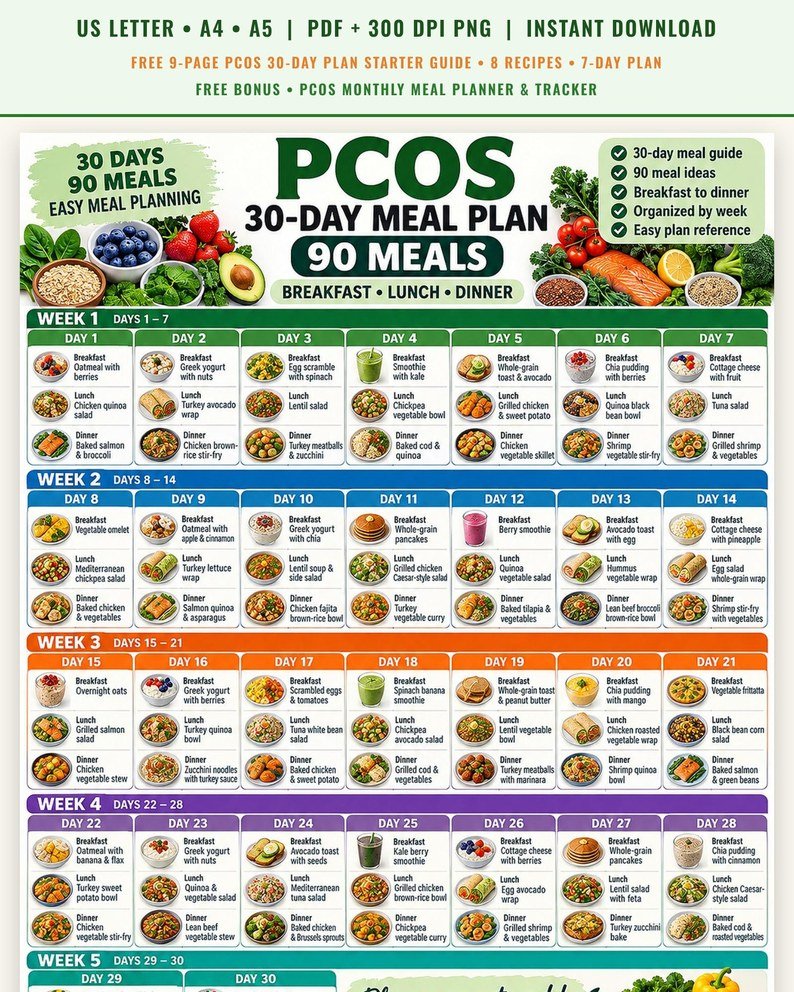
- 90 meals across 30 days, breakfast, lunch and dinner, organized by week in color-coded blocks
- Breakfasts include Greek yogurt with berries, scrambled eggs and tomatoes, vegetable frittata and chia pudding with cinnamon
- Lunches and dinners include lentil salads, turkey wraps, baked salmon, chicken fajita bowls and chickpea curry
- Comes with a 9-page starter guide (8 recipes, 7-day plan, grocery list, swaps, meal prep) and a monthly meal planner and tracker, per the listing
- Guide recipes include Chicken Fajita Brown-Rice Bowl and Mediterranean Chickpea Salad
- Instant download · Print at home · US Letter · A4 · A5
Use code BLOG10 for 65% OFF at Etsy checkout!
Breakfast Matters Because of Insulin, Not Willpower
The Office on Women’s Health (OWH) says high levels of insulin are one of the things linked to PCOS. Insulin resistance is when the body’s cells don’t respond normally to insulin, so insulin levels in the blood become higher than normal. The OWH says many women with PCOS have insulin resistance, and that over time it can lead to type 2 diabetes.
The NHS says the cause of PMOS is unknown but may be to do with hormones such as insulin and testosterone not working properly. Its list of things you can do includes eating a healthy, balanced diet, exercising regularly and trying to lose weight if you’re overweight.
What that means at breakfast. A breakfast that’s mostly fast carbs, like sweetened cereal, a pastry, juice or a big fruit smoothie, gives you a lot of sugar with little to slow it down. A breakfast with protein and fiber alongside a modest portion of whole grain or fruit is the steadier choice. That’s not a medical rule, just the pattern the 30 day plan follows.
About weight. The OWH says that losing weight may help lower blood glucose, improve the way the body uses insulin and help hormones reach normal levels, and that even a 10% loss in body weight, for example 15 pounds for a 150 pound woman, can help make periods more regular. Not everyone with PCOS is overweight, and nobody needs a crash diet. A good breakfast helps either way.
Not just food. The NHS lists medicines that are sometimes used for PMOS symptoms, including the combined pill, metformin and others. Breakfast works alongside whatever plan you and your doctor have agreed.
16 Breakfasts From Days 15 to 30
On the chart, each day box lists breakfast, lunch and dinner, with Week 3 in orange, Week 4 in purple and the two day Week 5 in teal. Here are the 16 breakfasts for Days 15 to 30. The names and day numbers are the chart’s. The anchor column is my note on what makes each one filling.
| Day | Breakfast on the chart | Protein or fiber anchor |
|---|---|---|
| 15 | Overnight oats | Oats; add Greek yogurt or chia |
| 16 | Greek yogurt with berries | Greek yogurt |
| 17 | Scrambled eggs & tomatoes | Eggs |
| 18 | Spinach banana smoothie | Add Greek yogurt or kefir for protein |
| 19 | Whole-grain toast & peanut butter | Whole grain bread, peanut butter |
| 20 | Chia pudding with mango | Chia seeds |
| 21 | Vegetable frittata | Eggs, vegetables |
| 22 | Oatmeal with banana & flax | Oats, flaxseed |
| 23 | Greek yogurt with nuts | Greek yogurt, nuts |
| 24 | Avocado toast with seeds | Whole grain bread, seeds, avocado |
| 25 | Kale berry smoothie | Add Greek yogurt or kefir for protein |
| 26 | Cottage cheese with berries | Cottage cheese |
| 27 | Whole-grain pancakes | Whole grain; add eggs or yogurt on the side |
| 28 | Chia pudding with cinnamon | Chia seeds |
| 29 | Scrambled eggs with spinach | Eggs, spinach |
| 30 | Greek yogurt with fruit | Greek yogurt |
The pattern. Four are yogurt or cottage cheese breakfasts, three are egg dishes, two are oat bowls, two are chia puddings, two are smoothies, and three are toast or pancakes. Berries show up three times. There’s no cereal, no pastry and no juice.
Days 18, 20, 22 and 25 need a little care. Those four use banana, mango or a fruit smoothie, and the shop’s own Eat, Limit, Avoid Chart puts large bananas, mangoes and smoothies with fruit in its Limit column. That isn’t a contradiction so much as a portion note: half a banana in the oatmeal, a few spoonfuls of mango on the chia pudding, and a smoothie made mostly of greens and yogurt with a small handful of fruit.
Eggs are the quiet workhorse. Scrambled eggs and tomatoes on Day 17, the vegetable frittata on Day 21 and scrambled eggs with spinach on Day 29 all put eggs next to a vegetable. If mornings are rushed, cook a frittata at the weekend, cut it into squares, and keep them in the fridge for quick breakfasts with a slice of whole grain toast.
Yogurt bowls are the fastest. Greek yogurt with berries, with nuts or with fruit, and cottage cheese with berries, take two minutes. Plain is the version the chart puts in Eat, so add flavor with the fruit, a pinch of cinnamon or a spoon of seeds rather than a flavored pot.
For more PCOS meals beyond breakfast, see our PCOS diet meal ideas guide.
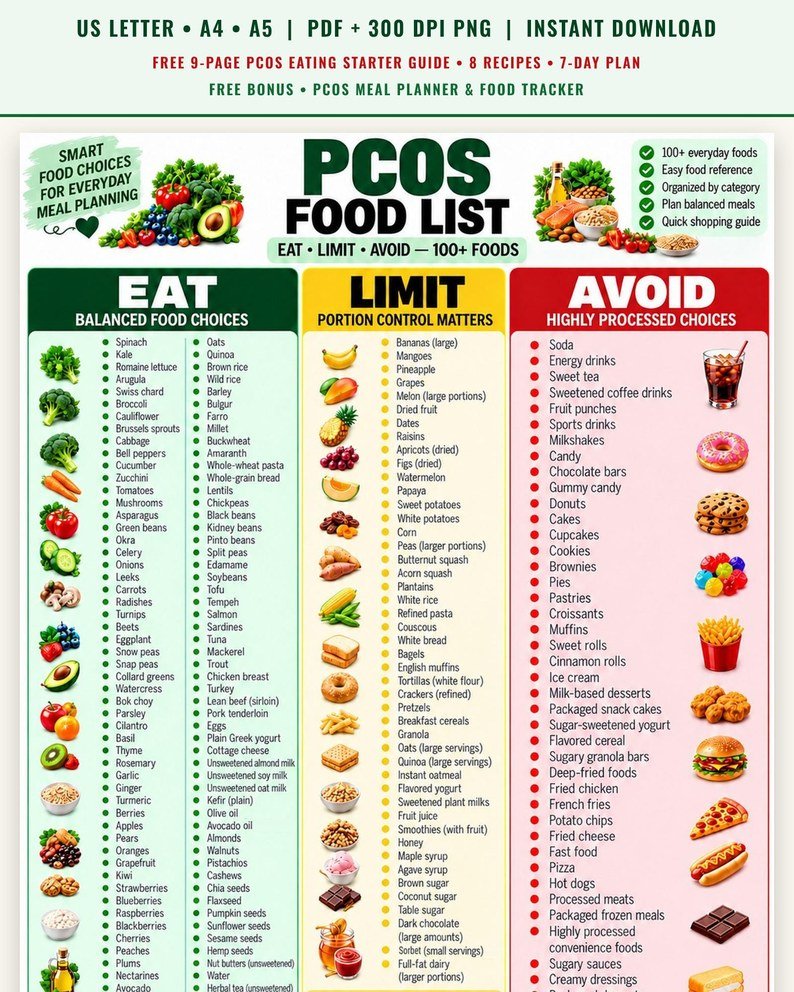
- Three color-coded columns: green Eat (balanced food choices), yellow Limit (portion control matters) and red Avoid (highly processed choices)
- Eat includes oats, eggs, plain Greek yogurt, cottage cheese, berries, chia seeds, flaxseed and unsweetened nut butters
- Limit includes large bananas, mangoes, granola, instant oatmeal, flavored yogurt and fruit juice
- Avoid includes sweetened coffee drinks, pastries, croissants, muffins, flavored cereal and sugar-sweetened yogurt
- Comes with a 9-page PCOS eating starter guide, 8 recipes, a 7-day plan and a meal planner and food tracker, per the listing
- Instant download · Print at home · US Letter · A4 · A5
Use code BLOG10 for 65% OFF at Etsy checkout!
The Eat, Limit, Avoid Chart at the Breakfast Table
The listing title for the PCOS Eat, Limit, Avoid Chart says 190+ foods, set out in three columns: green Eat for balanced food choices, yellow Limit where portion control matters, and red Avoid for highly processed choices. Here are the foods that turn up at breakfast, sorted by column. The columns are the chart’s.
| Column | Breakfast foods on the chart |
|---|---|
| Eat | Oats, whole-grain bread, eggs, plain Greek yogurt, cottage cheese, kefir (plain), unsweetened almond, soy and oat milk, berries, strawberries, blueberries, raspberries, apples, pears, kiwi, spinach, tomatoes, avocado, chia seeds, flaxseed, pumpkin seeds, walnuts, almonds, unsweetened nut butters, herbal tea, water |
| Limit | Bananas (large), mangoes, pineapple, dried fruit, white bread, bagels, English muffins, breakfast cereals, granola, oats (large servings), instant oatmeal, flavored yogurt, sweetened plant milks, fruit juice, smoothies (with fruit), honey, maple syrup |
| Avoid | Sweetened coffee drinks, donuts, pastries, croissants, muffins, sweet rolls, cinnamon rolls, flavored cereal, sugary granola bars, sugar-sweetened yogurt |
Oats are in two columns. Plain oats sit in Eat, while oats in large servings and instant oatmeal sit in Limit. That’s a useful way to think about oats generally: the food is fine, the portion and the packet are what change things.
Yogurt is in all three. Plain Greek yogurt is in Eat, flavored yogurt in Limit and sugar-sweetened yogurt in Avoid. Same food, very different breakfasts. Buy plain and add your own berries and cinnamon.
The coffee shop problem. Almost everything in a coffee shop cabinet is in the Avoid column: croissants, muffins, pastries, cinnamon rolls and sweetened coffee drinks. If you often grab breakfast out, a plain coffee or tea with a pot of Greek yogurt or a boiled egg is the easiest swap.
The full chart, with lunch and dinner foods too, is covered in our PCOS diet food list guide.
A Breakfast Formula You Can Use Anywhere
When you’re away from the chart, in a hotel or at a friend’s, a simple formula helps. Every breakfast from Day 15 to Day 30 fits it, with a tweak or two. The formula is my summary, built only from foods in the chart’s Eat column.
- Start with protein. Eggs, plain Greek yogurt, cottage cheese, plain kefir or tofu.
- Add fiber. A modest portion of oats or whole-grain bread, or vegetables like spinach, tomatoes or kale.
- Add a little healthy fat. Avocado, nuts, unsweetened nut butter, chia, flax or pumpkin seeds.
- Finish with fruit, if you like. Berries, apple, pear or kiwi, in a small portion.
| Protein | Fiber | Fat | Fruit |
|---|---|---|---|
| 2 eggs, scrambled | Spinach and tomatoes, 1 slice whole-grain toast | Half an avocado | None needed |
| Plain Greek yogurt | A spoon of oats | Walnuts, ground flaxseed | Blueberries |
| Cottage cheese | Sliced cucumber or tomato | Pumpkin seeds | Kiwi |
| Plain kefir | Chia seeds, soaked overnight | Almonds | Raspberries |
| Tofu scramble | Spinach and mushrooms | Olive oil | Apple slices on the side |
Plan the week, not the morning. Pick three breakfasts and rotate them. Make chia pudding or overnight oats on Sunday night for Monday and Tuesday, and bake a vegetable frittata to slice for later in the week.
Keep it realistic. You don’t need sixteen different breakfasts. Most people do well with three or four they actually enjoy, plus a backup for busy days, such as a pot of plain Greek yogurt and a handful of nuts. If you’re hungry by mid morning, add a little more protein next time rather than more fruit or toast.
Watch the drinks. Fruit juice and sweetened plant milks are in Limit and sweetened coffee drinks in Avoid. Water, herbal tea and unsweetened almond, soy or oat milk are in Eat.
When to get more help. The NHS suggests seeing a GP if you think you might have PMOS or your symptoms are affecting your everyday life, and says tests can include blood tests for hormone levels and insulin resistance. A dietitian can help tailor breakfasts to your blood results, medicines and goals. If insulin resistance or prediabetes is part of your picture, our prediabetes breakfast ideas guide follows a similar approach.
Frequently Asked Questions
What is a good breakfast for PCOS?
A breakfast with protein, fiber and a modest amount of fruit or whole grain: eggs with vegetables, plain Greek yogurt with berries and seeds, chia pudding, or whole grain toast with nut butter. The PCOS Eat, Limit, Avoid chart puts eggs, plain Greek yogurt, oats, berries, chia and flaxseed in its Eat column.
Is oatmeal good for PCOS?
The PCOS chart lists oats in its Eat column and oats in large servings in its Limit column, with instant oatmeal also in Limit. So a modest bowl of plain oats with seeds or nuts and berries fits, while a huge bowl or sweetened instant sachets don’t.
Are smoothies OK for PCOS breakfast?
The chart puts smoothies with fruit in its Limit column, along with large bananas, mangoes and fruit juice. The 30 day plan does include a spinach banana smoothie and a kale berry smoothie, so keep the fruit small, add Greek yogurt or kefir for protein, and treat it as one of several breakfast options, not every day.
Should I skip breakfast if I have PCOS?
There’s no one rule for everyone. The NHS advice for PCOS, which it now calls polyendocrine metabolic ovarian syndrome (PMOS), is to eat a healthy, balanced diet and exercise regularly. If skipping breakfast leaves you overeating later, a planned protein breakfast may suit you better. Talk to your doctor or a dietitian.
Can diet alone treat PCOS?
No. The NHS says there’s no cure, but treatments and lifestyle changes can help symptoms, and medicines such as the pill, metformin and others are sometimes used. The Office on Women’s Health says healthy eating and regular physical activity can help relieve PCOS related symptoms. Food works alongside care from your doctor.
This guide is general information and is not medical advice. Check with your doctor or a registered dietitian before changing your diet, especially if you take medicine for PCOS, diabetes or insulin resistance.
Related Guides
Sources
Sources: NHS, Polyendocrine metabolic ovarian syndrome (PMOS), formerly PCOS, Office on Women’s Health, Polycystic ovary syndrome
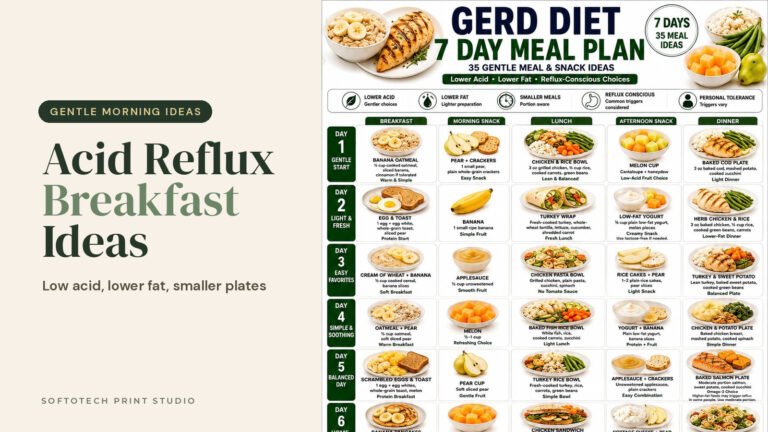 Diet & Food ListsAcid Reflux Breakfast Ideas: What to Leave Out, 7 Gentle Plan Breakfasts and How to Build Your Own
 Diet & Food ListsAnti Inflammatory Dinner Ideas: 24 Dinners From a 30 Day Plan, What to Limit at Night and a Weeknight Plan
 Diet & Food ListsLow Sodium Breakfast Ideas: 24 DASH Breakfasts Sorted by How Much Label Reading They Need