
Breakfast is the meal people find hardest to make Mediterranean, because the usual pictures of the diet are all grilled fish, salads and bean stews. But Mediterranean breakfast ideas are simpler than that. Think oats with fruit and nuts, plain yogurt with fruit and nuts, toast with tomato or white beans, eggs with vegetables, and the odd savory plate of hummus and cucumber.
This guide is built around the 50 Mediterranean Breakfast Ideas chart from SoftoTech Print Studio. It sorts 50 breakfasts into five groups of ten: oats and whole grains, yogurt and fruit bowls, toasts and pitas, eggs and vegetables, and savory breakfast plates. Every idea has its own small photo.
I’ll go through all 50, group by group. Then there’s a worked week of breakfasts, a look at a second printable, a Mediterranean diet 7-day meal plan that carries the same style through lunch and dinner, and a last section on what makes a breakfast Mediterranean in the first place, using what Oldways and Harvard’s Nutrition Source say.
If you’ve read our Mediterranean diet meal ideas guide, you’ll know we touched on this chart there, but only named a handful of the breakfasts. This time all 50 are here, along with a week to follow.
A plain limit, as always. The chart gives names and photos, not recipes or portions. Its own footer calls it Mediterranean-style meal inspiration, not full recipes, and says to adapt it to your dietary needs. If you’re following a set calorie level or managing a condition like diabetes, a dietitian can help you size the portions.
In this guide:
- The 50 Mediterranean Breakfasts in 5 Groups
- A Worked Week of Mediterranean Breakfasts
- Carrying It Through the Day With the 7-Day Meal Plan
- What Makes a Breakfast Mediterranean
- Frequently Asked Questions

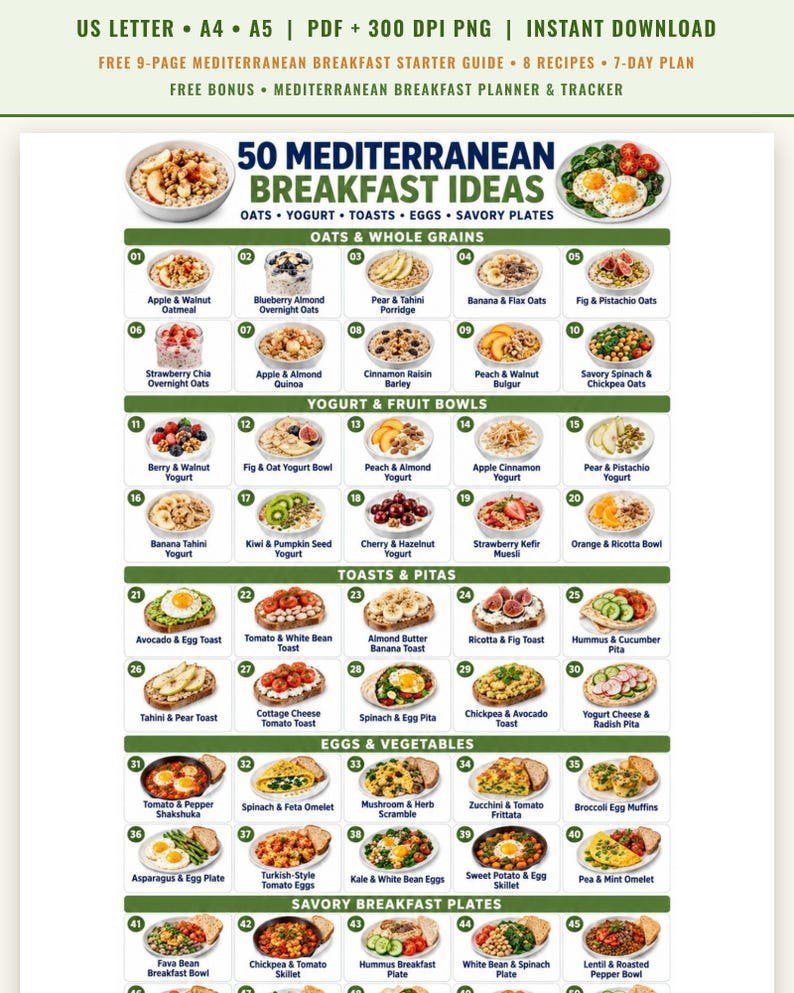
- 50 numbered breakfasts in 5 groups of 10, each with a photo
- Oats and whole grains, yogurt and fruit bowls, toasts and pitas, eggs and vegetables, savory plates
- Ideas like pear and tahini porridge, tomato and white bean toast and pea and mint omelet
- A footer on whole grains, plain dairy, unsalted nuts and unsweetened nut butters
- US Letter, A4 and A5 PDFs plus a 300 DPI PNG, per the listing
- Instant download · Print at home · US Letter · A4 · A5
Use code BLOG10 for 65% OFF at Etsy checkout!
The 50 Mediterranean Breakfasts in 5 Groups
The chart is titled 50 Mediterranean Breakfast Ideas, with the line oats, yogurt, toasts, eggs and savory plates under it. It’s a grid of 50 numbered squares, each with a photo and the name of the breakfast. Here’s the whole list.
Oats and whole grains, 1 to 10. Apple and walnut oatmeal. Blueberry almond overnight oats. Pear and tahini porridge. Banana and flax oats. Fig and pistachio oats. Strawberry chia overnight oats. Apple and almond quinoa. Cinnamon raisin barley. Peach and walnut bulgur. Savory spinach and chickpea oats.
This group is more varied than it first looks. Oats are the base for six of them, but quinoa, barley and bulgur each get a turn. Barley and bulgur for breakfast might sound odd, but they’re everyday grains around the Mediterranean, and cooked the night before they reheat in a couple of minutes. The last one, savory spinach and chickpea oats, is worth trying if you don’t have a sweet tooth in the morning. Treat oats like a risotto with greens and a spoon of chickpeas.
Yogurt and fruit bowls, 11 to 20. Berry and walnut yogurt. Fig and oat yogurt bowl. Peach and almond yogurt. Apple cinnamon yogurt. Pear and pistachio yogurt. Banana tahini yogurt. Kiwi and pumpkin seed yogurt. Cherry and hazelnut yogurt. Strawberry kefir muesli. Orange and ricotta bowl.
Every bowl here follows the same pattern: a dairy base, a fruit and a nut or seed. Once you’ve got that pattern you can make dozens more from whatever’s in season. Tahini with banana is the interesting one. It’s sesame paste, slightly bitter, and it works with sweet fruit the same way peanut butter does.
Toasts and pitas, 21 to 30. Avocado and egg toast. Tomato and white bean toast. Almond butter banana toast. Ricotta and fig toast. Hummus and cucumber pita. Tahini and pear toast. Cottage cheese tomato toast. Spinach and egg pita. Chickpea and avocado toast. Yogurt cheese and radish pita.
These are the fastest breakfasts on the chart. Toast or warm a whole-grain pita, spread or pile something on it, and eat. The tomato and white bean toast is one I’d point you to first. Mash a few canned white beans with olive oil, lemon and pepper, spread it on toast, and top with sliced tomato. Yogurt cheese, in number 30, is thick strained yogurt, sometimes sold as labneh.
Eggs and vegetables, 31 to 40. Tomato and pepper shakshuka. Spinach and feta omelet. Mushroom and herb scramble. Zucchini and tomato frittata. Broccoli egg muffins. Asparagus and egg plate. Turkish-style tomato eggs. Kale and white bean eggs. Sweet potato and egg skillet. Pea and mint omelet.
Every egg dish has at least one vegetable in it. That’s the Mediterranean habit in one line. The broccoli egg muffins and the frittata are the ones for batch cooking. Make a tray on Sunday and you’ve got three or four breakfasts in the fridge. Shakshuka, eggs poached in a pepper and tomato sauce, is a good weekend breakfast with some bread to mop up the sauce.
Savory breakfast plates, 41 to 50. Fava bean breakfast bowl. Chickpea and tomato skillet. Hummus breakfast plate. White bean and spinach plate. Lentil and roasted pepper bowl. Savory cottage cheese plate. Baked falafel breakfast plate. Savory tofu breakfast wrap. Sardine and tomato breakfast. Savory yogurt and chickpea bowl.
This is the group that feels least like a typical Western breakfast, and it’s the most traditional. Beans for breakfast are common in parts of the Mediterranean and the Middle East. A fava bean bowl with olive oil, cumin and lemon is a classic in Egypt. If that sounds like too much first thing, start with the hummus breakfast plate. Hummus, cucumber, tomato, a few olives and a piece of whole-grain pita.
The footer of the chart sums up the approach in two lines. Choose whole grains, plain lower-fat dairy, unsalted nuts and unsweetened nut butters. Enjoy varied portions of fruit, vegetables, legumes and eggs across your week. That’s a good rule to keep even when you’ve stopped looking at the chart.
For the Mediterranean shopping list behind all of these, our Mediterranean diet food list sorts the foods into what to eat often, sometimes and less often.
A Worked Week of Mediterranean Breakfasts
Fifty breakfasts is a lot to pick from. Here’s a week that uses one idea from each group at least once, with quick ones on weekdays and slower ones at the weekend. The numbers match the chart.
| Day | Breakfast from the chart | Prep tip |
|---|---|---|
| Monday | 2. Blueberry almond overnight oats | Make the jar on Sunday night |
| Tuesday | 11. Berry and walnut yogurt | Plain Greek yogurt, berries, a few walnuts |
| Wednesday | 22. Tomato and white bean toast | Mash half a can of rinsed white beans, keep the rest for Saturday |
| Thursday | 35. Broccoli egg muffins | Baked on Sunday, reheated |
| Friday | 25. Hummus and cucumber pita | Two minutes, eat on the move |
| Saturday | 44. White bean and spinach plate | Warm the beans with garlic and spinach, add an egg if you like |
| Sunday | 31. Tomato and pepper shakshuka | Make enough sauce for two, bake the egg muffins while it simmers |
Sunday does the work. Most of the week is set up on Sunday. Make the shakshuka for breakfast. While the sauce simmers, mix eggs with chopped broccoli and bake them in a muffin tin. Before bed, stir oats, milk or yogurt, blueberries and a few almonds in a jar for Monday.
Midweek is quick. Tuesday’s yogurt bowl and Friday’s pita each take a couple of minutes. Wednesday’s bean toast uses one can of white beans, and the other half goes into Saturday’s plate, so nothing goes to waste.
A simple shopping list covers the whole week: oats, milk, a big tub of plain Greek yogurt, blueberries and mixed berries, almonds and walnuts, whole-grain bread, whole-grain pitas, hummus, a cucumber, tomatoes, a red pepper, broccoli, spinach, garlic, a can of white beans, eggs, olive oil and lemons.
Swap freely. If you don’t like one, swap it for another from the same group. Banana and flax oats for the overnight oats. Peach and almond yogurt for the berry bowl. Spinach and egg pita for the hummus pita. The groups are built so that any two ideas in the same group are about as much work as each other.
Watch the extras. The Mediterranean style isn’t low in fat, but the fats are mostly olive oil, nuts and seeds. Where people go wrong is the extras: sweetened yogurt, sugary granola, salted nuts and big pours of honey. The chart’s footer already steers you away from those, with plain dairy, unsalted nuts and unsweetened nut butters.
If you’re new to the diet and want a gentle introduction to the whole day, our Mediterranean diet 7-day meal plan for beginners walks through a full week from breakfast to dinner.
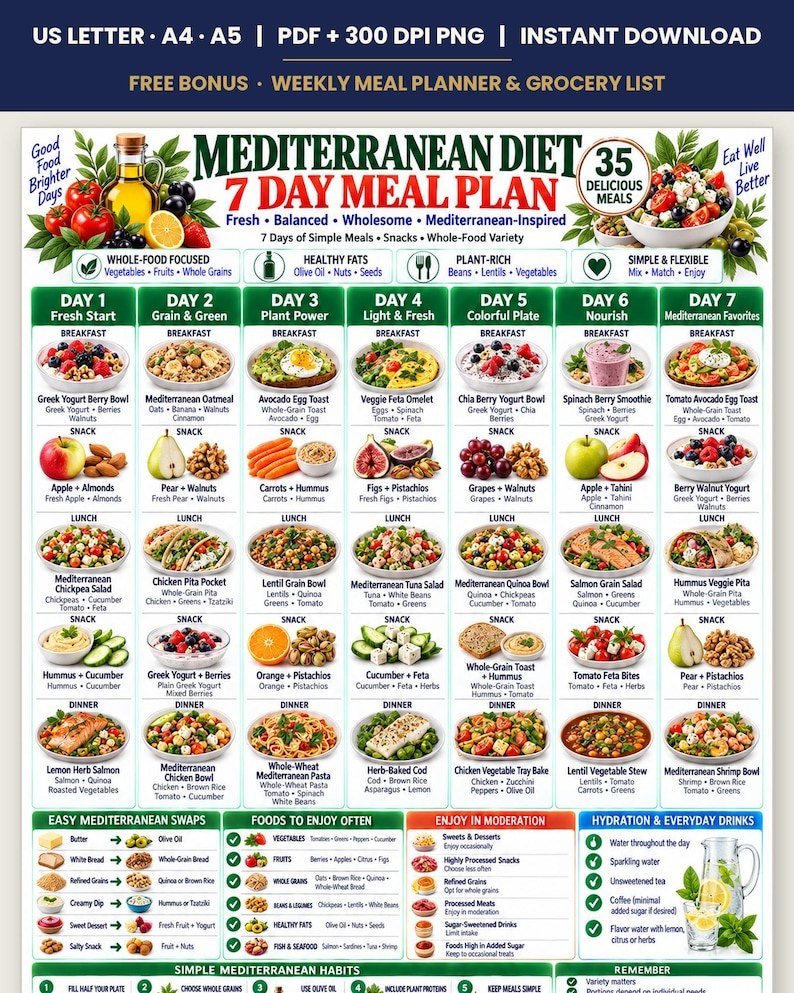
- 7 days with breakfast, 2 snacks, lunch and dinner, 35 meals in all
- Breakfasts like Mediterranean oatmeal and a veggie feta omelet
- Dinners like lemon herb salmon, herb-baked cod and lentil vegetable stew
- Easy swaps, hydration ideas and simple daily habits
- US Letter, A4 and A5 PDF plus a 300 DPI PNG, per the listing
- Instant download · Print at home · US Letter · A4 · A5
Use code BLOG10 for 65% OFF at Etsy checkout!
Carrying It Through the Day With the 7-Day Meal Plan
Breakfast sorted, the next question is usually what to eat for the rest of the day. That’s what the second printable covers. It’s the shop’s Mediterranean Diet 7-Day Meal Plan, with 35 meals across a week: breakfast, a morning snack, lunch, an afternoon snack and dinner each day. Every day has its own name, from Fresh Start on Day 1 to Mediterranean Favorites on Day 7.
Its breakfasts overlap nicely with the 50 ideas chart. Day 1 is a Greek yogurt berry bowl with walnuts. Day 2 is Mediterranean oatmeal with banana, walnuts and cinnamon. Day 3 is avocado egg toast. Day 4 is a veggie feta omelet with spinach and tomato. Day 5 is a chia berry yogurt bowl. Day 6 is a spinach berry smoothie with Greek yogurt. Day 7 is tomato avocado egg toast.
The lunches and dinners follow the same building blocks. A Mediterranean chickpea salad with cucumber, tomato and feta. A lentil grain bowl. A Mediterranean tuna salad with white beans. Lemon herb salmon with quinoa and roasted vegetables. Herb-baked cod with brown rice, asparagus and lemon. Lentil vegetable stew. And a Mediterranean shrimp bowl to finish the week.
The snacks are a good pattern to copy: fruit with nuts, or a vegetable with a dip. Apple and almonds, pear and walnuts, carrots and hummus, figs and pistachios, cucumber and feta, apple and tahini.
The plan also prints a short list of easy swaps that suit breakfast just as well. Butter to olive oil. White bread to whole-grain bread. Refined grains to quinoa or brown rice. Creamy dip to hummus or tzatziki. Sweet dessert to fresh fruit with yogurt. Salty snack to fruit and nuts. Under hydration it lists water, sparkling water, unsweetened tea, coffee with minimal added sugar, and water flavored with lemon, citrus or herbs.
A good way to use the two charts together is to follow the 7-day plan for lunches and dinners, and use the 50 breakfast ideas whenever you get bored of the plan’s breakfasts. They clearly come from the same kitchen, so they mix well. For more meal ideas in the same style, our Mediterranean diet meal ideas guide covers lunches and dinners.
What Makes a Breakfast Mediterranean
There’s no official Mediterranean breakfast. The diet is a pattern of eating, not a set menu, and breakfasts differ a lot from Greece to Morocco to southern Italy. But a few principles run through all of them, and both sources behind this guide spell them out.
Plants first. Oldways, the nonprofit behind the Mediterranean diet food pyramid, says to base every meal on fruits, vegetables, whole grains, legumes, beans, nuts, seeds, healthy oils, herbs and spices. At breakfast that means oats or whole-grain bread as the base, fruit or vegetables alongside, and nuts, seeds or beans for staying power.
Dairy in moderate amounts. Oldways says fermented dairy is common in the Mediterranean and suggests plain Greek yogurt and smaller amounts of traditional cheeses. Its pyramid puts poultry, eggs, cheese and yogurt at moderate portions, daily to weekly. That’s why the yogurt bowls on the chart use plain yogurt, and why the feta and ricotta show up as toppings rather than the main event.
Eggs are fine. Harvard’s Nutrition Source describes the Mediterranean diet as including poultry, eggs and dairy in smaller portions, either daily or a few times a week. Two eggs in a vegetable omelet a few mornings a week fits that well.
Fish, even at breakfast. Harvard says the diet chooses fish as the preferred animal protein at least twice a week. Breakfast isn’t the usual place for it, but the chart’s sardine and tomato breakfast is a quick way to get oily fish in. Sardines on toast with sliced tomato and a squeeze of lemon takes about three minutes.
Less meat, fewer sweets. Harvard notes that red meat is limited to a few times a month in the Mediterranean pattern, and Oldways puts meats and sweets at the top of its pyramid as foods to eat less often. So the bacon, sausage and pastries of a typical Western breakfast don’t really fit. You won’t find them anywhere on the chart.
Water, tea or coffee. Harvard says the diet uses water as the main daily drink. Its own Healthy Eating Plate advice is to drink water, tea or coffee with little or no sugar, and to keep juice to a small glass a day. A big glass of juice with breakfast is one of the easiest things to drop.
A sample breakfast from Harvard. Harvard’s own sample Mediterranean menu starts the day with 1 cup of cooked steel-cut oats mixed with 2 tablespoons of chopped walnuts, three-quarters of a cup of blueberries, and a sprinkle of cinnamon. That’s almost exactly idea number 1 on the chart, apple and walnut oatmeal, with a different fruit. It’s reassuring when a printable and a university nutrition site land in the same place.
The simplest way to sum it up: whole grains or beans, a fruit or vegetable, a little protein from yogurt, eggs, nuts or fish, and olive oil where you’d normally use butter. Anything built like that is a Mediterranean breakfast, whether it’s on the chart or not. If you’d like to go further with an anti-inflammatory angle, our anti-inflammatory food list overlaps a lot with the Mediterranean pattern.
For more ideas in the same spirit, see these anti inflammatory breakfast ideas built around oats, eggs, yogurt, chia and berries.
Frequently Asked Questions
What is a typical Mediterranean breakfast?
There’s no single one, but most are built from whole grains or bread, fruit or vegetables, and a little protein from yogurt, eggs, cheese, beans or nuts, with olive oil. Oatmeal with fruit and walnuts, yogurt with berries, tomato toast and vegetable omelets are all common.
Are eggs allowed on the Mediterranean diet?
Yes. Harvard’s Nutrition Source describes the diet as including poultry, eggs and dairy in smaller portions, daily or a few times a week. The chart has ten egg breakfasts, all with vegetables, like spinach and feta omelet and tomato and pepper shakshuka.
Is Greek yogurt Mediterranean?
Yes. Oldways says fermented dairy is common in the Mediterranean and suggests plain Greek yogurt with smaller amounts of traditional cheeses. Plain yogurt with fruit and nuts is one of the easiest Mediterranean breakfasts.
What can I eat for a savory Mediterranean breakfast?
Try a hummus breakfast plate, tomato and white bean toast, a fava bean breakfast bowl, a chickpea and tomato skillet, or sardine and tomato on toast. The chart has a whole group of ten savory plates.
Is oatmeal good on the Mediterranean diet?
Yes. Oats are a whole grain, and Harvard’s own sample Mediterranean menu starts with steel-cut oats, walnuts, blueberries and cinnamon. Choose plain oats and add your own fruit and nuts rather than buying sweetened packets.
This guide is for general wellness and is not medical advice. Check with your doctor before starting a new routine.
Related Guides
- Mediterranean Diet Food List
- Mediterranean Diet 7-Day Meal Plan for Beginners
- Mediterranean Diet Meal Ideas
- Anti-Inflammatory Food List
Sources
Sources: Oldways, Mediterranean Diet, Harvard T.H. Chan School of Public Health, The Nutrition Source: Diet Review, Mediterranean Diet
 Diet & Food ListsLow Cholesterol Lunch Ideas: 30 Soups, Bowls, Wraps and Salads From a 30 Day Meal Plan, With Swaps and a Prep Week
 Diet & Food ListsPrediabetes Breakfast Ideas: 7 Balanced Breakfasts From a Weekly Meal Plan, Plus Swaps From an Eat, Limit and Avoid List
 Diet & Food ListsAnti Inflammatory Lunch Ideas: 24 Bowls, Salads, Soups and Wraps From a 30 Day Meal Plan, With a Packed Lunch Week