
Most of us lean on a short list of feeling words, like fine, stressed, tired and annoyed. A feelings wheel is a simple round chart that gives you a much longer list, arranged so you can start with a broad feeling and work your way out to a more exact one. It sounds almost too basic to help, but it often does.
Say you come home and snap at someone. Your first answer to “what’s wrong?” might be “I’m angry.” Look at the wheel, though, and you might find that the truer word is disrespected, or let down, or overwhelmed. Those are different problems with different fixes, and naming the right one changes the conversation.
This guide walks through the Feelings Wheel Printable Bundle from SoftoTech Print Studio. It’s one wheel with 6 core emotions in the center, 30 feelings in the middle ring and 60 in the outer ring, which makes 96 words altogether. The listing says “60 in total”, and that number matches the outer ring alone, so don’t be surprised when you count more. The bundle comes in four color versions of the same wheel.
It’s written for adults first, since the outer ring has words like disillusioned and indignant, but I’ll also cover how families and classrooms can use it, and when a picture chart works better for younger children. A feelings wheel is a self-awareness tool. It isn’t therapy and it won’t fix anything on its own, but it can make it easier to understand yourself and to tell other people what’s going on.
In this guide:
- What Is on the Feelings Wheel: 6 Core Emotions and 90 More Words
- How to Use a Feelings Wheel: A Worked Example
- A Simpler Feelings Chart for Children
- Ways to Use the Wheel at Home, at Work and in Therapy
- Frequently Asked Questions
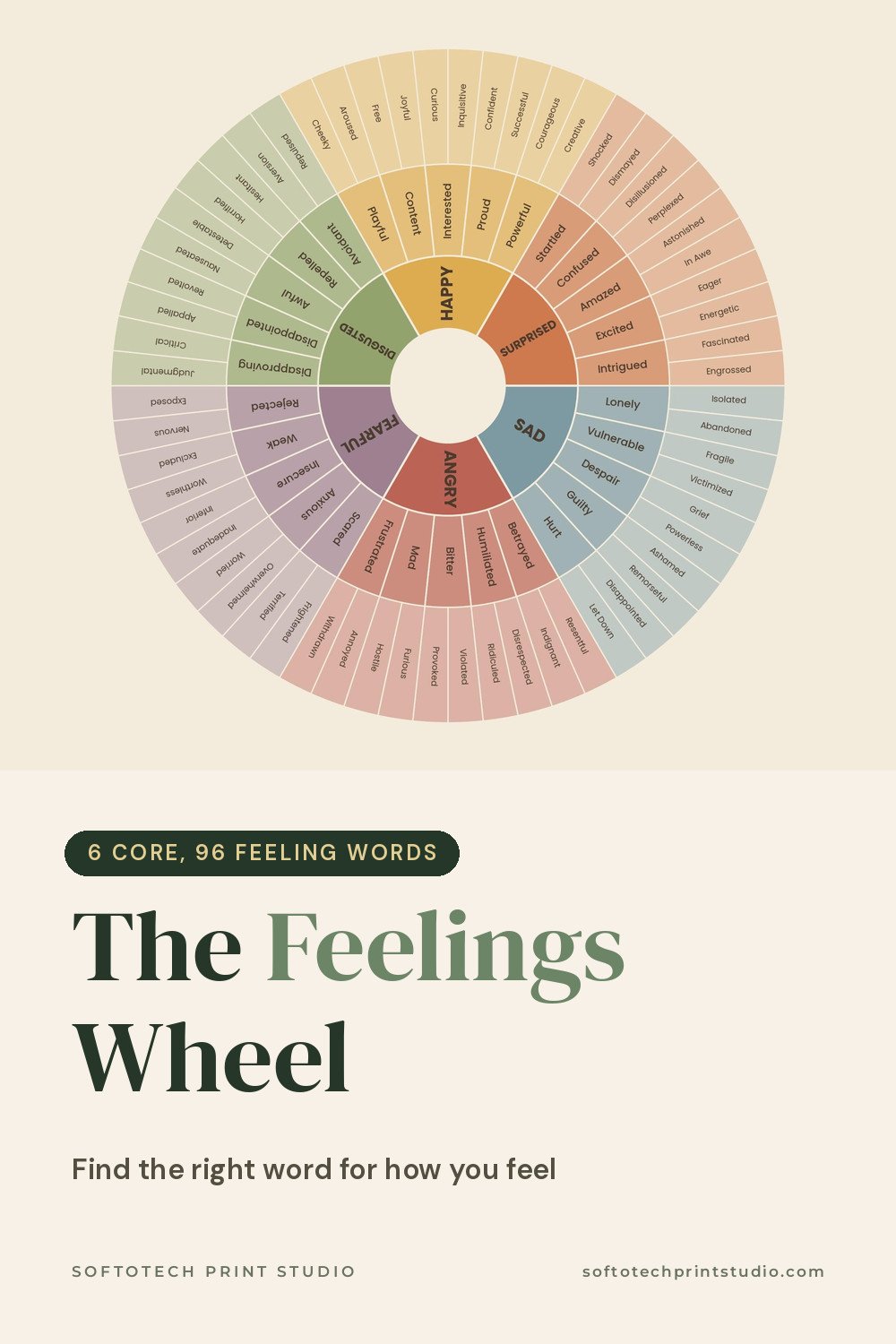
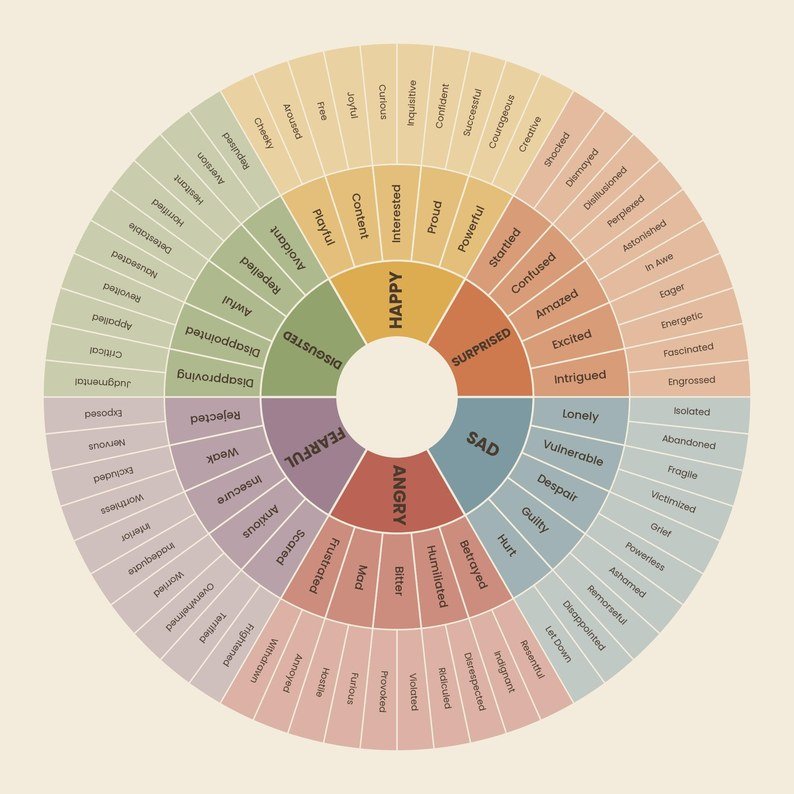
- A round feelings wheel with 6 core emotions in the center: happy, surprised, sad, angry, fearful and disgusted
- 30 more specific feelings in the middle ring, five per core emotion, such as playful, lonely, betrayed and anxious
- 60 detailed words in the outer ring, from curious and in awe to let down and overwhelmed
- Four color versions of the same wheel: warm earthy tones, soft pastels, bright colors and a dark background
- Two sizes per color, A4 and US Letter; Etsy lists 4 PNG files plus 1 other file, while the description mentions 8 PDFs
- Instant download · Print at home · US Letter · A4
Use code BLOG10 for 65% OFF at Etsy checkout!
What Is on the Feelings Wheel: 6 Core Emotions and 90 More Words
The wheel has three rings. In the center are six core emotions, each in its own colored slice: happy, surprised, sad, angry, fearful and disgusted. That’s very close to the set the APA Dictionary of Psychology gives as typical core feelings, with fearful standing in for scared. Each core emotion then splits into five more specific feelings in the middle ring, and each of those splits again into two words in the outer ring. So every core slice holds 16 words from the center to the edge.
Here is everything on the wheel, read from the chart, slice by slice.
Happy. Middle ring: playful, content, interested, proud and powerful. Outer ring: cheeky, aroused, free, joyful, curious, inquisitive, confident, successful, courageous and creative. Happy is the slice people tend to skip, because nobody worries about feeling good. But it’s worth a look. Knowing that you feel proud rather than just happy, or curious rather than just fine, tells you something about what you enjoy and what to make room for.
Surprised. Middle ring: startled, confused, amazed, excited and intrigued. Outer ring: shocked, dismayed, disillusioned, perplexed, astonished, in awe, eager, energetic, fascinated and engrossed. This slice is interesting because it mixes pleasant and unpleasant feelings. Being in awe and being dismayed both start with surprise, and they couldn’t feel more different.
Sad. Middle ring: lonely, vulnerable, despair, guilty and hurt. Outer ring: isolated, abandoned, fragile, victimized, grief, powerless, ashamed, remorseful, disappointed and let down. Notice that guilty and ashamed both live here. They’re often lumped together, but guilt tends to be about something you did, while shame tends to feel like something is wrong with you. Telling them apart can be a big step.
Angry. Middle ring: betrayed, humiliated, bitter, mad and frustrated. Outer ring: resentful, indignant, disrespected, ridiculed, violated, provoked, furious, hostile, annoyed and withdrawn. Withdrawn might seem an odd fit for anger, but plenty of people go quiet rather than loud when they’re upset. This slice is often the most useful one, because anger is frequently the first word that comes to mind and the least specific.
Fearful. Middle ring: scared, anxious, insecure, weak and rejected. Outer ring: frightened, terrified, overwhelmed, worried, inadequate, inferior, worthless, excluded, nervous and exposed. Many people who say they’re stressed land somewhere in this slice. Overwhelmed and worried are common everyday picks.
Disgusted. Middle ring: disapproving, disappointed, awful, repelled and avoidant. Outer ring: judgmental, critical, appalled, revolted, nauseated, detestable, horrified, hesitant, aversion and repulsed. Disappointed shows up here as well as in the sad slice, which is fair. Being disappointed in someone can feel closer to disapproval, while being disappointed by something can feel more like sadness.
A few small things to know about the wording. Some outer-ring entries aren’t strictly feelings in the grammar sense. Grief, aversion and despair are nouns, and detestable describes a thing rather than how you feel. None of this gets in the way of using it, but I’d rather you heard it from me than spotted it on your wall. The outer ring also includes aroused, which is worth knowing if you plan to hang the wheel in a classroom.
The four color versions carry the same words. One uses warm, earthy tones on a cream background. One is very soft pastel with a white center. One is brighter, with stronger yellows, oranges, blues and purples. The fourth is set on a dark background with light text, which looks smart on a wall but uses a lot of ink if you print it at home.
How to Use a Feelings Wheel: A Worked Example
The Cleveland Clinic suggests a simple method. Start at the center to find the broad emotion that fits, then move out to the middle and outer rings to get more specific. You can also just scan the whole wheel and pick any words that jump out. After that, notice what’s happening in your body and decide what you want to do with the feeling, whether that’s writing it down, talking to someone or taking it to a therapist.
That’s the whole method. It’s easier to see it in action, so here’s a worked example of a fairly ordinary bad afternoon.
| Step | What you ask yourself | Example answer |
|---|---|---|
| 1. Center ring | Which of the six core emotions is closest? | Angry |
| 2. Middle ring | Which of the five words in that slice fits better? | Frustrated, maybe humiliated |
| 3. Outer ring | Which outer word is closest of all? | Disrespected |
| 4. Scan other slices | Is anything else in there too? | Fearful, then inadequate |
| 5. Body check | Where do I feel it? | Tight jaw, hot face, can’t settle |
| 6. Next step | What would help right now? | Write it down, then talk to my manager tomorrow |
Here’s the story behind those answers. Imagine a colleague presented your idea in a meeting as if it were theirs, and nobody noticed. On the drive home, you feel angry. That’s step one, and most people stop there.
In the angry slice, the middle ring offers betrayed, humiliated, bitter, mad and frustrated. Mad is true but vague. Betrayed feels a bit strong for a coworker. Humiliated and frustrated both fit. Step three takes you to the outer ring, where frustrated sits beside words like disrespected and ridiculed. Disrespected is the one that lands.
Now scan the rest of the wheel. Is anger the whole picture? Often it isn’t. In the fearful slice you might find insecure, and next to it inadequate. That’s a quieter feeling sitting under the anger: a worry that your work doesn’t count, or that you should have spoken up. The Cleveland Clinic makes the same point, that emotions aren’t mutually exclusive and you can feel several at once.
Then the body check. Where do you feel it? A clenched jaw, a hot face and a restless feeling are common with anger. A heavy chest or a sinking stomach might go with the inadequate feeling. Noticing these signals is useful in itself, because next time you might catch the feeling earlier, before it comes out sideways at home.
Finally, the next step. “I’m furious” might lead you to vent or stew. “I felt disrespected, and a bit inadequate” points to something you can actually act on, such as a calm word with your manager, or making sure your name is on the next idea you share. It also explains your mood to your family far better than slamming a cupboard does.
Not every check-in needs all six steps. On a normal day, you might just glance at the wheel over coffee and think, “content, a bit eager.” That takes ten seconds, and it builds the habit, so the wheel is familiar when you need it for something harder.
If you find that strong feelings sometimes knock you completely off balance, so that thinking clearly isn’t possible at all, our guide to the window of tolerance and how to stay inside it explains what’s going on and what can help. The wheel tends to work best once you’re calm enough to think. In the middle of a panic, it’s fine to put it down and come back later.
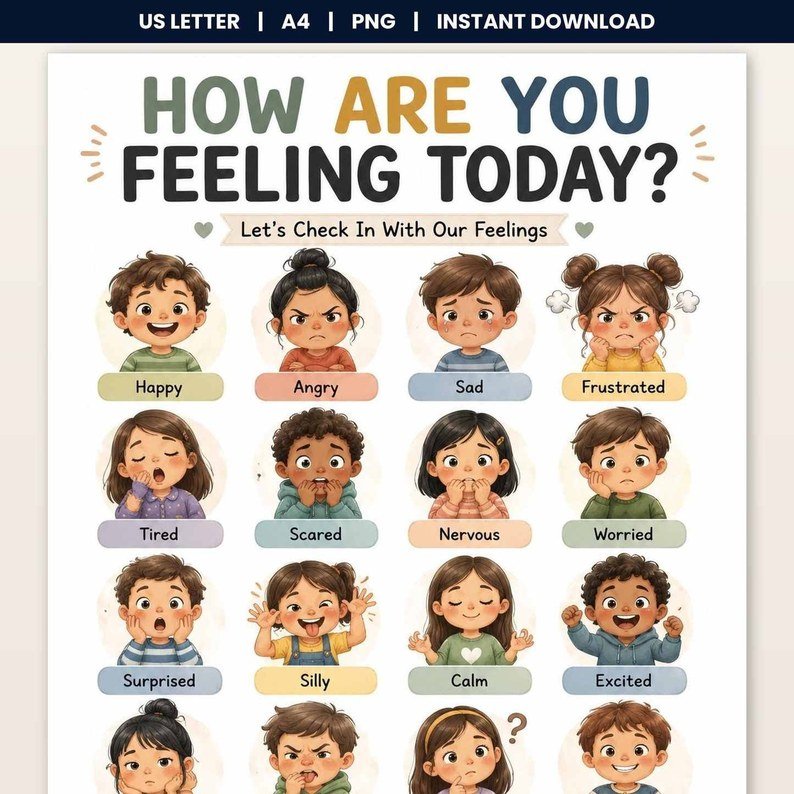
- A feelings faces poster headed How Are You Feeling Today?, with the line Let’s Check In With Our Feelings
- Illustrated children’s faces, each with a name label underneath
- Faces include Happy, Angry, Sad, Frustrated, Tired, Scared, Nervous and Worried
- More faces: Surprised, Silly, Calm and Excited, with a further row below
- Made for a quick daily check-in at home, in a classroom or in a calm corner; US Letter and A4 plus a PNG (A5 is not stated)
- Instant download · Print at home · US Letter · A4
Use code BLOG10 for 65% OFF at Etsy checkout!
A Simpler Feelings Chart for Children
The wheel has a lot of words, and some of them are hard. Disillusioned, indignant and inadequate aren’t in most young children’s vocabulary. For little ones, a picture chart is usually a better place to start, and the wheel can come later when they’re older.
The second printable here is a feelings faces chart from the same shop. The poster is headed How Are You Feeling Today?, with the line Let’s Check In With Our Feelings underneath. Below that is a grid of illustrated children’s faces, each with a name label. The faces I can read on the product image are happy, angry, sad, frustrated, tired, scared, nervous, worried, surprised, silly, calm and excited. There’s a further row of faces below those, but it’s cut off in the product photo, so I can’t tell you what those faces are called. One small flag: the listing calls it the Today I Am Feeling Emotions Chart, while the poster itself says How Are You Feeling Today? It’s the same product either way.
Some of the faces map neatly onto the wheel. Happy, angry, sad and surprised are core emotions on both charts. Scared and frustrated are in the wheel’s middle ring. Nervous and worried are in its outer ring, under fearful. That overlap makes the faces chart a nice stepping stone. A child who’s comfortable saying “I’m nervous” can later find nervous on the wheel and see the words around it, like exposed and excluded.
The faces chart also adds feelings the wheel doesn’t have, such as tired, silly and calm. Tired isn’t strictly an emotion, but it changes how children (and adults) feel about everything else, so it’s helpful to have on a kids’ chart. Calm is useful as a goal, a place to get back to.
A simple routine with the faces chart works like this. Once a day, at breakfast or after school, ask your child to point to the face that matches how they feel. Don’t correct them or argue with the choice. Just say something like, “You’re feeling frustrated. Thanks for telling me.” If they want to talk, listen. If they don’t, that’s fine too. The aim is to make naming feelings ordinary, not to turn it into a quiz. Our longer guide to using a feelings chart for kids has a full daily check-in routine and ideas for what to say after a child names a feeling.
Older children and teens can often handle the wheel with a bit of help. The middle ring is a good place for them to start, with the outer ring as a stretch. If they ask what a word means, look it up together, or describe a time you felt that way. That kind of conversation is half the value.
Adults benefit from the faces chart too, oddly enough. On a stressful day, the simple version can be a relief. And if you’re the one doing the asking, it helps to answer the question yourself out loud: “I’m feeling a bit tired and worried today.” Children learn far more from watching adults name feelings calmly than from any chart on the wall.
Ways to Use the Wheel at Home, at Work and in Therapy
Put it where you’ll actually see it. The Cleveland Clinic’s first tip is to keep the wheel somewhere visible and easy to reach. The fridge, a home office wall, inside a kitchen cupboard door or the front of a journal all work. A wheel tucked away in a drawer won’t get used.
Use it for journaling. If you keep a journal, try starting each entry with three words from the wheel. Over a few weeks you’ll see patterns. Maybe Sunday evenings bring up worried and overwhelmed. Maybe days with a walk outside bring content and energetic. Those patterns can tell you what to change, or what to protect.
Use it in couples or family talks. The Cleveland Clinic notes the wheel is often used in couples counseling to help partners say how they feel. You don’t need a counselor to try it. During a tense conversation, each person can point to the word that fits. It’s harder to keep arguing about who left the dishes when one of you points at let down and the other at overwhelmed. It turns a fight into a problem you’re solving together.
Use it at work, carefully. Some teams use a feelings wheel in check-ins at the start of a meeting. It can help, but keep it optional. Not everyone wants to share feelings with coworkers, and that’s their right. A quiet personal check-in at your desk is just as useful.
Use it alongside stress tools. Naming a feeling is often the first step, not the last. Once you know you’re anxious or frightened, a calming technique can help your body settle. Our guide to breathwork for anxiety covers simple breathing patterns you can try at home. And if you notice that your reactions often look like running away, shutting down or people-pleasing, the guide on fight, flight, freeze and fawn stress responses explains those patterns in plain terms.
Bring it to therapy. The APA Dictionary of Psychology describes the feelings wheel as a common tool in cognitive behavioral therapy, dialectical behavior therapy and other counseling. If you see a therapist, bringing a wheel with a few circled words can make it easier to start a session, especially if you find it hard to get talking. Your therapist may also have their own version they prefer.
Pick the right color version. For a classroom or a shared space, the bright version is easiest to read from a distance. The pastel one is gentle and saves ink. The earthy version suits a calm home office, and the dark version looks striking framed but is ink-heavy, so it’s better printed at a print shop or kept on screen as a phone wallpaper.
Know when to get more help. A feelings wheel is a tool for everyday self-awareness. If you notice the same heavy words coming up for weeks, like despair, worthless or isolated, or if feelings are getting in the way of sleep, work or relationships, talk to your doctor or a mental health professional. As the Cleveland Clinic’s psychologist puts it, a pattern of difficult emotions that’s hard to cope with is a sign therapy may help. If you ever feel unsafe, contact emergency services or a crisis line straight away.
Frequently Asked Questions
What is a feelings wheel?
A feelings wheel is a round chart of emotion words. The broadest feelings sit in the center and more specific ones fan out toward the edge. You start in the middle with a word like sad, then move outward to find a closer match, such as lonely or let down. The original version was created by psychologist Gloria Willcox in 1982.
How many feelings are on this feelings wheel?
The wheel in this guide has 96 words in three rings. There are 6 core emotions in the center, 30 more specific feelings in the middle ring and 60 detailed words in the outer ring. The listing mentions 60 feelings in total, which matches the outer ring on its own.
Can kids use a feelings wheel?
Older children and teens often can, with an adult nearby to explain words they don’t know. Some outer-ring words, like disillusioned or indignant, are aimed at adults. For younger children, a feelings faces chart with pictures and a smaller set of words is usually easier, and you can move up to the wheel later.
When should I talk to a doctor or therapist about my feelings?
Talk to your doctor or a mental health professional if hard feelings keep coming back, last for weeks, or get in the way of sleep, work, school or relationships. If you ever feel unsafe or have thoughts of harming yourself, contact emergency services or a crisis line straight away.
What sizes does the feelings wheel print in?
The Feelings Wheel Printable Bundle comes in A4 and US Letter, two sizes for each of the four colors. Etsy’s file summary says 4 PNG files and 1 other file, while the description says 8 PDFs, so check the download when it arrives. The feelings faces chart prints in US Letter and A4, plus a PNG.
This guide is for general wellness and is not medical advice. Check with your doctor before starting a new routine.
Related Guides
- Feelings Chart for Kids
- Window of Tolerance: What It Is and How to Stay Inside It
- Fight, Flight, Freeze, Fawn: Spot Your Stress Response
- Breathwork for Anxiety
Sources
Sources: Cleveland Clinic, How To Use a Feelings Wheel, APA Dictionary of Psychology, Feelings Wheel