
Vagus nerve stimulation at home searches usually start in a stressed moment: your shoulders are up around your ears, your breathing is shallow, and you want a gentle, drug-free way to help your body settle. Vagus nerve stimulation at home uses simple techniques — cold water, humming, gargling, slow breathing — that may help nudge your nervous system from “on alert” toward “rest and digest,” using nothing more than things you already have in your kitchen and bathroom.
The vagus nerve is the longest nerve in your body. It runs from your brainstem down through your neck, chest, and belly, connecting to your heart, lungs, and digestive system along the way. It is a main pathway of your parasympathetic nervous system — the branch responsible for slowing your heart rate, supporting digestion, and helping you feel calm and safe after stress passes.
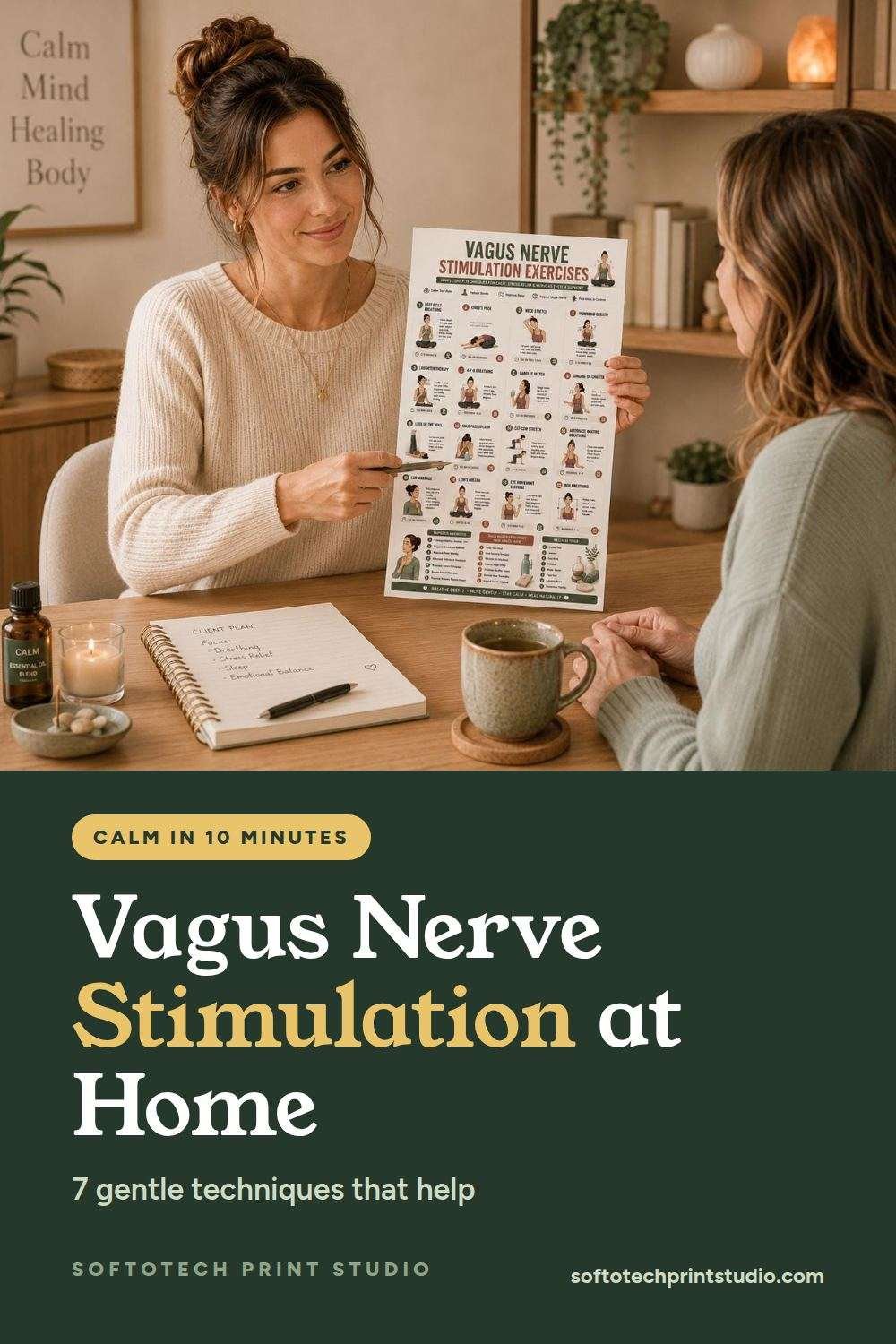
In this guide, you will learn seven gentle vagus nerve stimulation techniques you can try at home, how to combine them into a short daily routine, how to do each one safely, and when to stop and talk to a clinician instead. You will also find a printable nervous system chart from SoftoTech Print Studio to keep the routine where you will actually see it.
In this guide:
- What Is the Vagus Nerve and Why Does It Matter?
- Signs Your Nervous System Could Use Support
- 7 Gentle Ways to Try Vagus Nerve Stimulation at Home
- A Simple 10-Minute Daily Vagus Routine
- Safety: How to Practise Gently and When to Skip a Technique
- Daily Habits That Support Vagal Tone
- Frequently Asked Questions
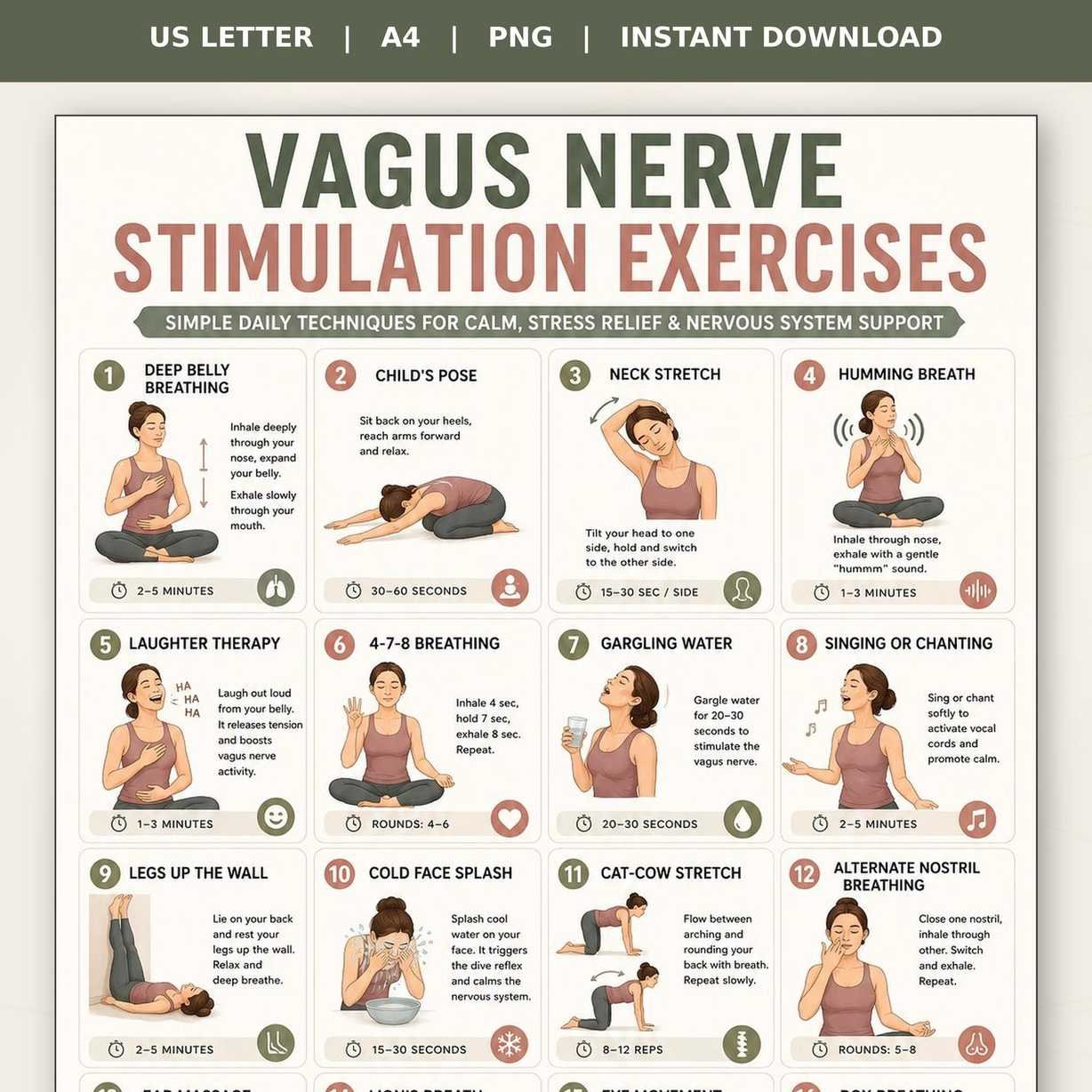
The printable from this guide
Vagus Nerve Stimulation Exercises Poster
- Stimulation exercises and somatic routine poster
- Nervous system reset and relaxation routine chart
- Instant download · Print at home · A4 · US Letter · A5
Use code BLOG10 for 65% OFF at Etsy checkout!
Get the Vagus Stimulation Poster on Etsy →
What Is the Vagus Nerve and Why Does It Matter?
Think of your nervous system as having two broad modes. The sympathetic branch is your accelerator — it prepares you to act under pressure, raising heart rate and alertness. The parasympathetic branch, working largely through the vagus nerve, is your brake — it slows things down so you can rest, digest food, and recover. Both modes are healthy and necessary; the difficulty comes when the brake is hard to reach and you stay revved up long after the stressful moment has passed.
Clinicians sometimes describe “vagal tone” — how effectively the vagus nerve helps your body shift back toward calm. Medical vagus nerve stimulation, using an implanted device, is an approved treatment for certain conditions such as epilepsy and some cases of depression, as described by sources such as the Mayo Clinic and Cleveland Clinic. The at-home techniques in this guide are different: they are gentle wellness practices that work with the same nerve pathways through breath, sound, cold, and the throat and ear areas — they are not medical treatment, and they do not replace care from your clinician.
If you want the fuller picture first, our guide to vagus nerve exercises for anxiety explains the daily exercise side in depth, and our polyvagal theory explained simply post walks through the three nervous-system states in plain language.
Signs Your Nervous System Could Use Support
Everyone feels stressed sometimes, but a nervous system that struggles to settle may show up as: a racing or tight feeling that lingers after stress has passed, shallow breathing and frequent sighing, jaw, neck, and shoulder tension, a churning or “knotted” stomach before ordinary events, trouble winding down at night even when you are tired, or feeling wired and exhausted at the same time.
These are common, human experiences — and they are also symptoms that can have medical causes, from thyroid issues to sleep apnea to anxiety disorders. The techniques below are a gentle first step for everyday stress, not a diagnosis or a substitute for medical care. If symptoms are strong, new, or getting worse, talk to your doctor; see the notes at the end of this guide.
A helpful companion practice is noticing your state in the first place. Our 5-minute morning nervous system reset routine teaches a quick body check-in you can use before choosing a technique, and our breathwork for anxiety guide covers the breathing patterns in more detail.
7 Gentle Ways to Try Vagus Nerve Stimulation at Home
Start with one or two techniques, not all seven at once. Notice how you feel before and after — slower breathing, a natural sigh, softer shoulders, or a quieter stomach are all signs your body is shifting gears.
1. Cold water on your face
Splash cold water on your face, hold a cold damp cloth across your cheeks and forehead for 15–30 seconds, or end your shower with 15–30 seconds of cooler water. Brief, mild cold is a classic way to trigger the body’s “dive reflex,” which slows the heart rate. Keep it gentle and brief — this is a cool splash, not an ice bath challenge.
2. Humming
The vagus nerve passes close to the vocal cords, and humming vibrates the throat where those pathways run. Breathe in comfortably, then hum on a long, slow exhale — five to ten breaths — letting the sound buzz gently in your throat and chest. There is no tune to get right; a low, steady “mmm” is perfect.
3. Gargling
Vigorous gargling with plain water works the throat muscles connected to vagus pathways. Take a sip of water, tilt your head back slightly, and gargle firmly for about 20–30 seconds, once or twice a day — many people simply add it to their tooth-brushing routine.
4. Slow breathing with a long exhale
Breathe in for a count of about 4 and out for a count of about 6, for two to five minutes. The long, slow exhale is the part that speaks most directly to the calming branch of your nervous system. Keep it comfortable — never force the breath or strain to hit a count.
5. Singing or chanting
Singing in the shower, in the car, or along with a favourite song combines the throat vibration of humming with long, musical exhales. It is the most enjoyable technique on this list for many people, and enjoyment matters: a practice you like is a practice you will repeat.
6. Gentle neck and ear touch
Slow, light massage along the sides of the neck and gentle rubbing or tugging of the outer ear can feel soothing for many people. Use very light pressure on the front and sides of the neck only — never press hard into the throat or the pulse points, and stop if you feel dizzy. If neck touch does not feel right for you, simply skip this one.
7. A mindful yawn and sigh
Open your mouth wide, stretch gently, and let out a long audible sigh — the natural release your body already uses when stress breaks. Two or three deliberate sighs between tasks can punctuate a tense day surprisingly well, and yawning often follows on its own.
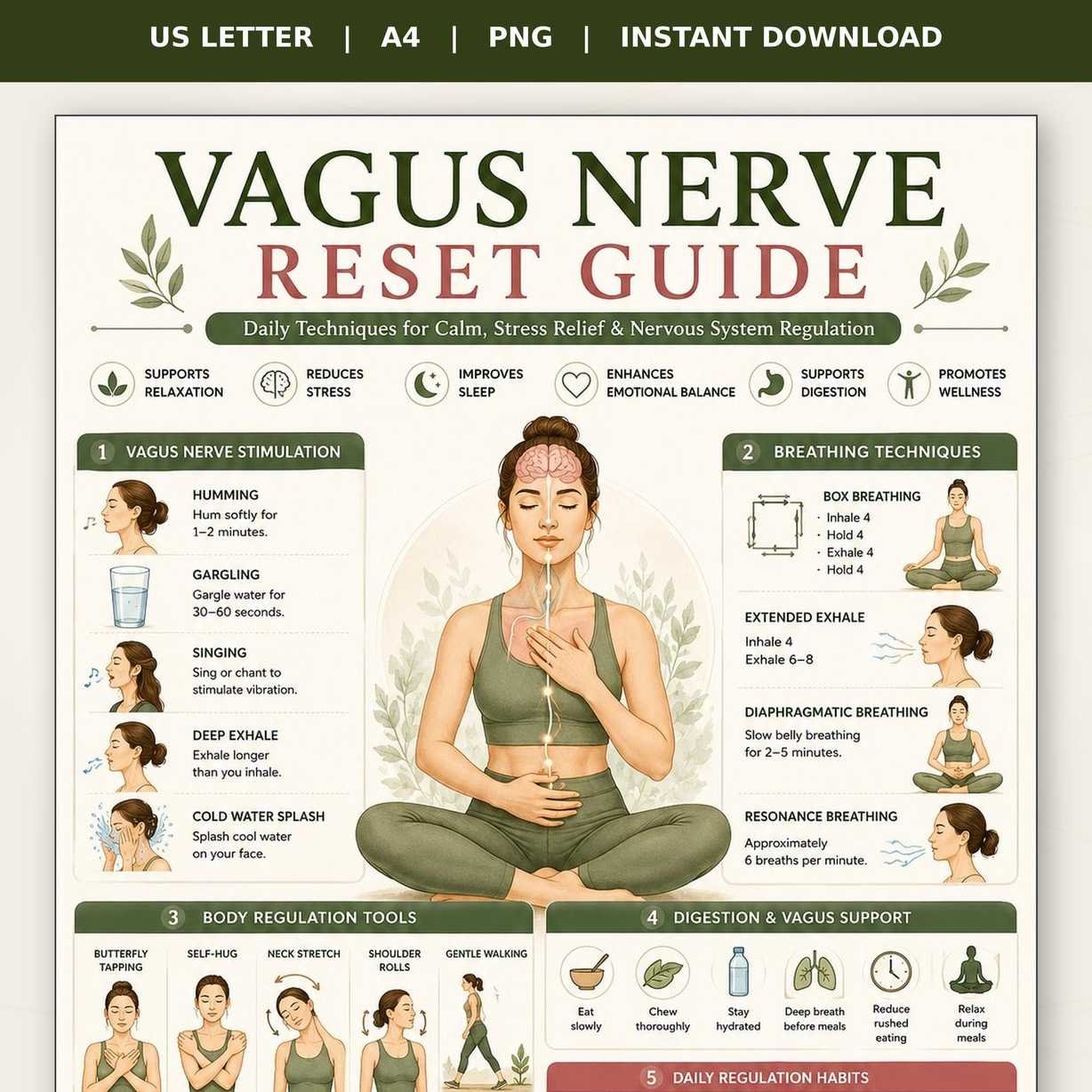
The complete reset guide
Vagus Nerve Reset Guide Poster
- Nervous system regulation chart and stress relief routine
- Wellness and mental health printable wall reference
- Instant download · Print at home · A4 · US Letter · A5
Use code BLOG10 for 65% OFF at Etsy checkout!
Get the Vagus Reset Guide on Etsy → Instant download · Print at home
A Simple 10-Minute Daily Vagus Routine
Once you know which techniques suit you, combine them into a short routine you can repeat daily — morning and evening versions both work:
- Minute 0–1 — Arrive. Sit comfortably, feet on the floor. Notice your breathing, shoulders, jaw, and stomach without judging them.
- Minutes 1–4 — Breathe. Slow breathing, in for about 4, out for about 6. Let your shoulders drop a little more with each exhale.
- Minutes 4–6 — Hum. Five to ten humming exhales, low and steady. If humming is not for you, sing one gentle song instead, any time of day.
- Minutes 6–8 — Soften. One mindful yawn-and-sigh, then a slow scan: unclench your jaw, drop your shoulders, loosen your hands, soften your belly.
- Minutes 8–10 — Cold finish. Splash cold water on your face or hold a cool cloth to your cheeks, then gargle once while you are at the sink. Notice how you feel compared with minute zero.
Ten minutes is a guide, not a rule — a two-minute version (breathing plus a cold splash) still counts on a busy day. Body-based practices like these pair well with the 12 somatic exercises to calm your nervous system, which use movement and grounding when sitting still feels hard. And you can browse our free printables for a starter chart to try the routine with before printing a full guide.
Safety: How to Practise Gently and When to Skip a Technique
Keep everything mild. At-home vagus techniques should feel calming or neutral — never painful, frightening, or extreme. Skip ice baths and prolonged cold exposure; they are unnecessary for this routine and can be risky for people with heart or circulation conditions.
Be careful with the neck. Never press firmly on the front of the throat or on the pulse at the side of the neck, and never use any device or “hack” that presses on the neck. Light surface touch only, and stop at once if you feel light-headed.
Check with your doctor first if you have a heart condition or a slow heart rate, low blood pressure or fainting episodes, a pacemaker or any implanted device, epilepsy, or if you are pregnant — some techniques, like cold exposure and throat practices, may not be suitable for you. Stop any technique that makes you feel dizzy, nauseous, or worse, and breathe normally until the feeling passes.
Know what this is not. Implanted medical vagus nerve stimulation is a clinical treatment prescribed and monitored by specialists. At-home techniques are general wellness practices; they do not treat depression, epilepsy, anxiety disorders, or any other condition.
Daily Habits That Support Vagal Tone
Techniques work best on a foundation of ordinary, unglamorous habits. Regular sleep — going to bed and rising at similar times — steadies the nervous system more than almost any single exercise. Daily movement, even a gentle walk, gives stress hormones somewhere to go and helps your body practise shifting between effort and recovery. Meals eaten slowly, without a screen when you can manage it, let the “rest and digest” system do its digestive job in peace. Time with people you feel safe with is also a genuine nervous-system input: relaxed conversation, laughter, and singing together all nudge the same calming pathways these techniques use.
None of this needs to be perfect. Pick the technique and the habit that feel easiest, repeat them for two weeks, and notice what changes — calmer evenings, an easier wind-down, a quieter stomach. Small, repeatable signals of safety are exactly what your nervous system learns from.
Who Should Check With a Doctor First?
Check with your doctor before practising vagus nerve stimulation at home if you have a heart condition, an unusually slow heartbeat, low blood pressure or a history of fainting, a pacemaker or other implanted device, or epilepsy, or if you are pregnant. Seek medical advice promptly if anxiety, low mood, palpitations, dizziness, or digestive symptoms are persistent, new, or interfering with your daily life — these deserve a proper evaluation, not just a home routine.
Frequently Asked Questions
What is the fastest way to stimulate the vagus nerve at home?
For most people, the quickest gentle options are a cold splash — cool water on the face or a cold cloth on the cheeks for 15–30 seconds — combined with slow breathing and a longer exhale. Humming on the exhale adds throat vibration at the same time. Keep everything mild and brief, and stop if you feel dizzy.
Does humming really stimulate the vagus nerve?
Humming vibrates the throat and vocal cords, an area the vagus nerve serves, and it naturally stretches the exhale — both of which are linked with the calming, parasympathetic branch of the nervous system. It is a gentle wellness practice rather than a medical treatment, but many people find a few minutes of humming noticeably settling, which is why it is a staple of home vagus routines.
How often should I practise vagus nerve stimulation at home?
A short daily routine — even 5–10 minutes — is a sensible pattern, plus brief techniques in stressed moments: a sigh and long exhales between meetings, gargling while you brush your teeth, a cold splash when you feel wired. Consistency matters more than duration; a small routine you repeat daily teaches your nervous system more than a long session once a month.
Is at-home vagus nerve stimulation safe?
The gentle techniques in this guide — cold water on the face, humming, gargling, slow breathing, singing — are low-intensity wellness practices for most adults when kept mild. Skip extreme cold, never press hard on the neck or throat, and check with your doctor first if you have a heart condition, low blood pressure, fainting, an implanted device, epilepsy, or you are pregnant.
What is the difference between home techniques and medical vagus nerve stimulation?
Medical vagus nerve stimulation uses an implanted device, prescribed and monitored by specialists, and is approved for certain cases of epilepsy and depression. Home techniques work with the same nerve pathways gently — through breath, sound, cold, and touch — as everyday wellness practices. They are not a treatment for any condition and do not replace medical care.
Related Guides
- Vagus Nerve Exercises for Anxiety
- Breathwork for Anxiety: 4-7-8 and Box Breathing Guide
- 5-Minute Morning Nervous System Reset Routine
- Polyvagal Theory Explained Simply (Printable Chart)
Sources
Sources: Cleveland Clinic — Vagus Nerve: Gastrointestinal, Autonomic, and Sensory Functions, Mayo Clinic — Vagus Nerve Stimulation, National Center for Complementary and Integrative Health (NIH) — Relaxation Techniques for Health
This guide is for general wellness and is not medical advice. Check with your doctor before starting a new routine.


