
Upper body home exercises are moves you can do in your living room to strengthen your chest, back, shoulders and arms, using your body weight, a chair, a wall, a resistance band or a pair of light dumbbells. The core set is simple: push-ups for the chest, pull-aparts and reverse flies for the back, presses and raises for the shoulders, and curls, dips and kickbacks for the arms.
A lot of “arm” workouts at home end up being curls and more curls. That trains the front of the arm and little else. A proper upper body session needs pushing, pulling and pressing, so your posture improves and your shoulders stay balanced, not just your biceps.
This guide uses two charts from SoftoTech Print Studio. The Arm Flab Workout chart has 16 toning exercises, most with light dumbbells or a band. The No-Equipment Arm Workout for Women chart has 16 body weight moves, including four push-up variations and a superman arm lift for the upper back. Between them they cover the whole upper body. I’ve picked 20 moves, grouped them by muscle, and built a 25 minute workout and a weekly plan.
If you have a shoulder, neck or wrist injury, high blood pressure or a heart condition, check with your doctor or a physiotherapist before you start. Stop any move that causes sharp pain.
In this guide:
- 20 Upper Body Moves, Grouped by Muscle
- Worked Workout: 25 Minutes, Push, Pull, Press, Arms
- The No Equipment Version and a Weekly Plan
- Form Tips That Protect Your Shoulders
- Frequently Asked Questions
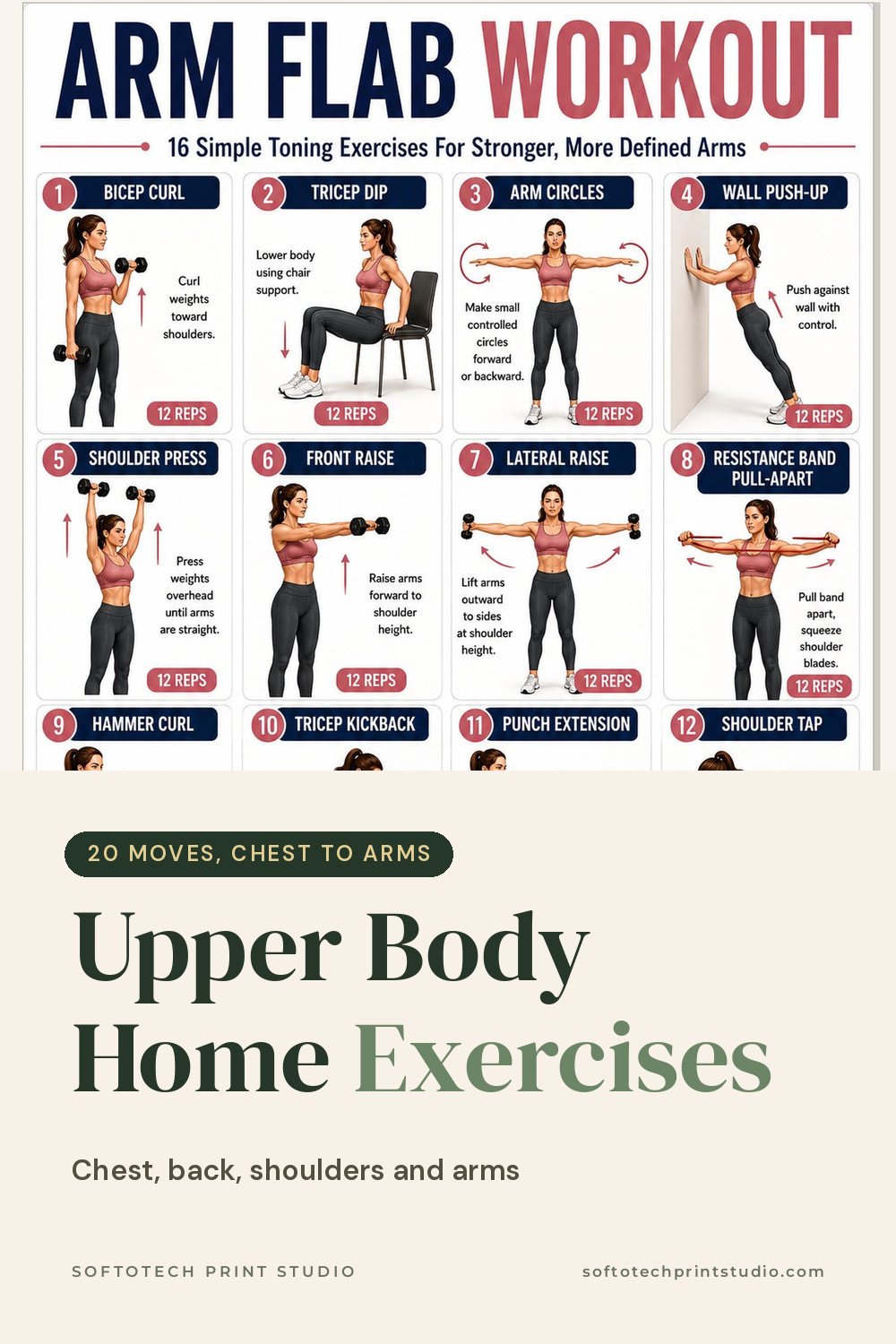
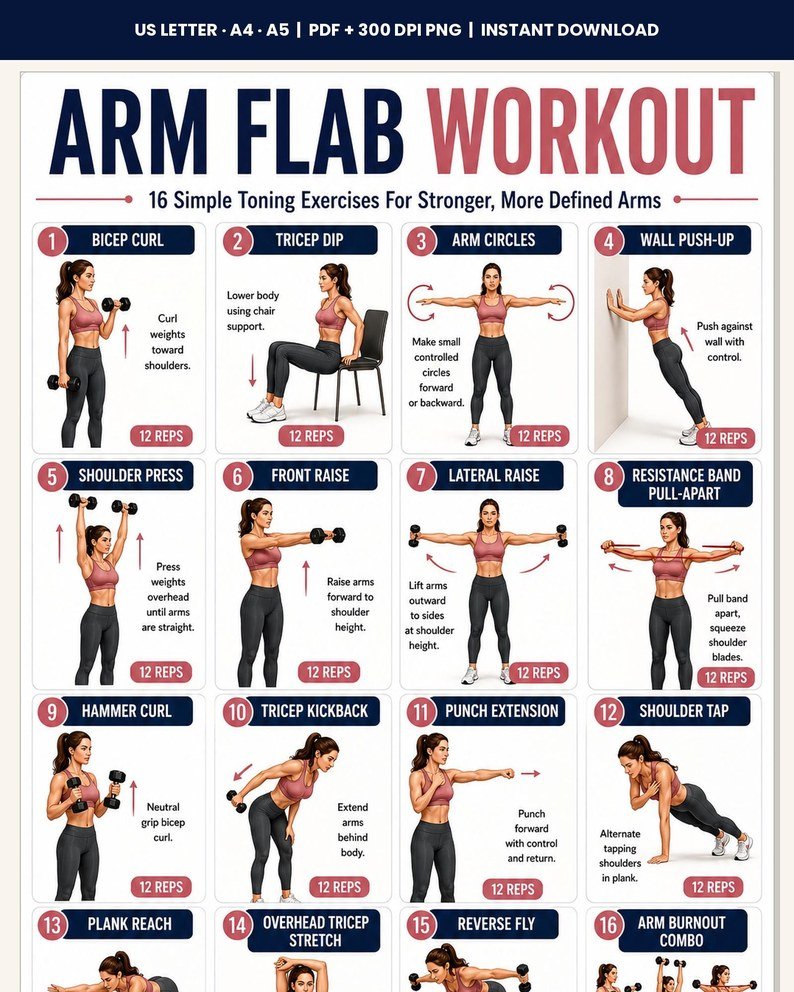
- 16 simple toning exercises for stronger, more defined arms, each with an illustration and a short cue
- Moves include bicep curl, tricep dip, wall push-up, shoulder press, lateral raise, hammer curl and tricep kickback
- Back and shoulder moves include the resistance band pull-apart and reverse fly
- 12 reps for each of moves 1 to 12 on the chart
- US Letter, A4 and A5 PDFs plus a 300 DPI PNG, per the listing
- Instant download · Print at home · US Letter · A4 · A5
Use code BLOG10 for 65% OFF at Etsy checkout!
20 Upper Body Moves, Grouped by Muscle
The Arm Flab Workout chart is headed “16 simple toning exercises for stronger, more defined arms”. Moves 1 to 12 each show 12 reps. Moves 13 to 16 (plank reach, overhead tricep stretch, reverse fly and arm burnout combo) sit at the bottom edge of the listing photo, so their counts are cut off. The No-Equipment chart is headed “16 effective bodyweight exercises for stronger, toned arms” and gives each move a target muscle and a count. Here are the 20 I’ve chosen, with the chart each comes from.
| Muscle group | Move | Chart and count |
|---|---|---|
| Chest | 1. Wall push-up | No equipment chart, targets chest and triceps, 10 to 15 reps |
| Chest | 2. Incline push-up | No equipment chart, chest, triceps and shoulders, 10 to 15 reps |
| Chest | 3. Close grip push-up | No equipment chart, triceps and chest (count cut off on the photo) |
| Back | 4. Resistance band pull-apart | Arm flab chart, “pull band apart, squeeze shoulder blades”, 12 reps |
| Back | 5. Reverse fly | Arm flab chart (count cut off on the photo) |
| Back | 6. Superman arm lift | No equipment chart, upper back and arms (count cut off on the photo) |
| Shoulders | 7. Shoulder press | Arm flab chart, “press weights overhead until arms are straight”, 12 reps |
| Shoulders | 8. Front raise | Arm flab chart, raise arms forward to shoulder height, 12 reps |
| Shoulders | 9. Lateral raise | Arm flab chart, lift arms out to the sides at shoulder height, 12 reps |
| Shoulders | 10. Arm circles | Arm flab chart, small controlled circles, 12 reps; no equipment chart, 30 to 45 seconds each way |
| Shoulders and core | 11. Plank shoulder taps | No equipment chart, 20 taps (10 each side) |
| Shoulders and core | 12. Bear hold | No equipment chart, 20 to 30 seconds |
| Biceps | 13. Bicep curl | Arm flab chart, curl weights toward shoulders, 12 reps |
| Biceps | 14. Hammer curl | Arm flab chart, neutral grip bicep curl, 12 reps |
| Triceps | 15. Tricep dip | Arm flab chart, lower body using chair support, 12 reps |
| Triceps | 16. Tricep kickback | Arm flab chart, extend arms behind body, 12 reps |
| Triceps | 17. Diamond push-up | No equipment chart, triceps and chest, 8 to 12 reps |
| Arms and shoulders | 18. Punch extension | Arm flab chart, punch forward with control and return, 12 reps |
| Arms, shoulders, core | 19. Side plank with reach | No equipment chart, 10 to 12 reps each side |
| Stretch | 20. Overhead tricep stretch | Arm flab chart (hold cut off on the photo) |
What you need. A sturdy chair without wheels, a clear wall, a mat, a light resistance band and a pair of light dumbbells. The NHS suggests filled water bottles as light weights for curls, which is a fine way to start before you buy anything.
Why the push and pull split matters. Most daily life is pushing and reaching forward: typing, driving, carrying shopping. The back of the shoulders and the upper back get little work. That’s why I’ve given the back three moves, all of which squeeze the shoulder blades together. If you only have time for one back move, do the band pull-apart.
Worked Workout: 25 Minutes, Push, Pull, Press, Arms
This session uses the charts’ counts where they give them. The order, rounds and rest are mine. Do 2 rounds of each block, resting about 30 to 45 seconds between moves.
| Block | Moves | Reps or time | About |
|---|---|---|---|
| Warm up | Arm circles forward and back, punch extension, 5 slow wall push-ups | 30 seconds each way, 12 punches, 5 push-ups | 3 minutes |
| Push (chest) | Wall or incline push-up, then tricep dip | 10 to 15 push-ups, 12 dips | 5 minutes |
| Pull (back) | Band pull-apart, reverse fly, superman arm lift | 12 pull-aparts, 10 reverse flies and 8 superman lifts (my counts where the chart is cut off) | 5 minutes |
| Press (shoulders) | Shoulder press, lateral raise, plank shoulder taps | 12, 12, 20 taps | 5 minutes |
| Arms | Bicep curl or hammer curl, tricep kickback | 12 and 12 | 4 minutes |
| Cool down | Overhead tricep stretch, gentle shoulder rolls | 20 to 30 seconds each arm (my hold) | 3 minutes |
How hard? The NHS says that to get health benefits from strength exercises, you should do them to the point where you need a short rest before repeating. So the last two or three reps of each set should feel like real work. If 12 shoulder presses feel easy, use slightly heavier weights or slow the lowering down. If you can’t get to 8 with good form, go lighter.
Choosing your push-up. Start at the wall. When 15 wall push-ups feel easy, move your hands to a kitchen counter or sturdy table for incline push-ups. Lower surfaces are harder. Floor push-ups, diamond and close grip versions are the far end of the scale, and not everyone needs to get there.
For a full arms only session from the no equipment chart in chart order, see our arm workout for women guide.
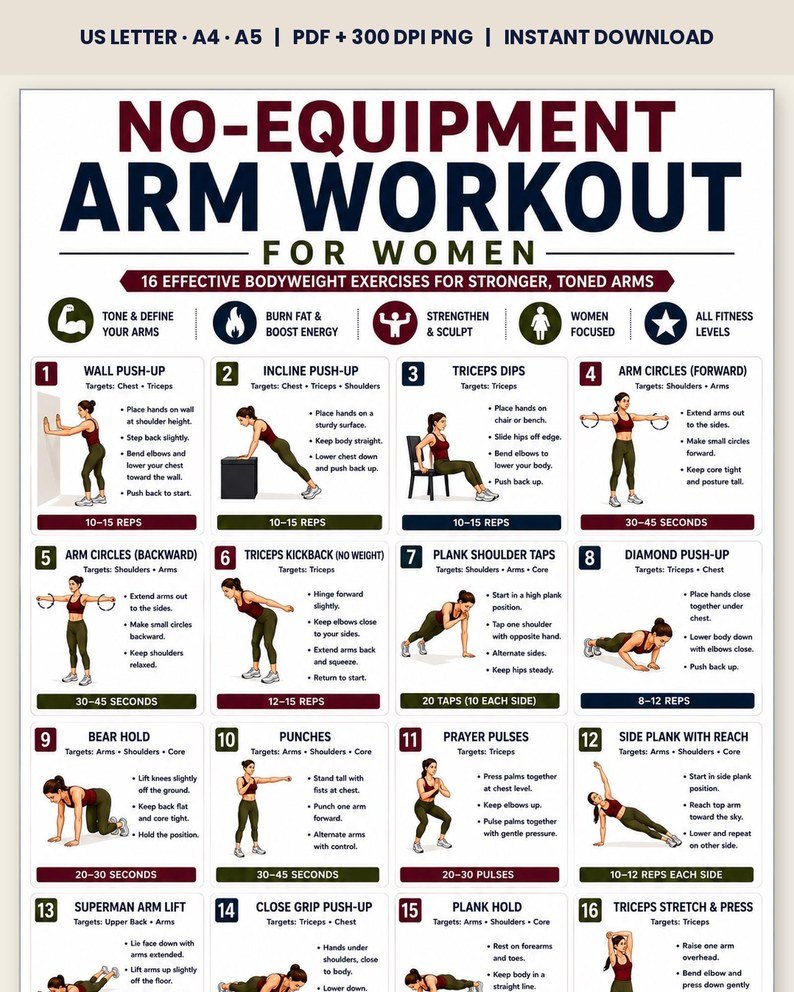
- 16 bodyweight exercises with cues, target muscles and a rep or time target for each
- Chest moves: wall push-up, incline push-up, diamond push-up and close grip push-up
- Back and shoulder moves: superman arm lift, plank shoulder taps, bear hold and side plank with reach
- Counts on the chart such as wall push-up 10 to 15 reps and arm circles 30 to 45 seconds
- US Letter, A4 and A5 PDFs plus a 300 DPI PNG, per the listing
- Instant download · Print at home · US Letter · A4 · A5
Use code BLOG10 for 65% OFF at Etsy checkout!
The No Equipment Version and a Weekly Plan
The second printable is the No-Equipment Arm Workout for Women chart. Across the top it lists five aims: tone and define your arms, burn fat and boost energy, strengthen and sculpt, women focused, and all fitness levels. All 16 moves use body weight only. Here’s how to run the 25 minute workout when you have no band or weights at all. The swaps are mine.
- Band pull-apart: swap for superman arm lift, lying face down with arms extended and lifting them slightly off the floor, as the chart describes.
- Reverse fly: do it with empty hands, hinged forward, squeezing your shoulder blades at the top.
- Shoulder press: swap for a bear hold, 20 to 30 seconds on the chart, which loads the shoulders.
- Lateral and front raise: use filled water bottles, or swap for arm circles for 30 to 45 seconds.
- Bicep curl: use filled water bottles, the NHS idea for light weights, or a small bag of shopping.
- Tricep kickback: the chart’s triceps kickback (no weight), 12 to 15 reps: hinge forward slightly, keep elbows close to your sides, extend your arms back and squeeze.
A weekly plan. The NHS guideline for adults aged 19 to 64 is strengthening activities that work all the major muscle groups (legs, hips, back, abdomen, chest, shoulders and arms) on at least 2 days a week, plus at least 150 minutes of moderate activity or 75 minutes of vigorous activity. This plan, my suggestion, fits that.
| Day | Session |
|---|---|
| Monday | Upper body, 25 minute workout |
| Tuesday | Brisk walk, 30 minutes |
| Wednesday | Lower body or full body session |
| Thursday | Brisk walk, 30 minutes |
| Friday | Upper body, no equipment version |
| Saturday | Longer walk, cycle or swim |
| Sunday | Rest or gentle stretching |
For the Wednesday session, our full body workout at home guide works well. If you’re brand new to exercise, our 20 minute no equipment home workout for beginners is a gentler place to start. And if you enjoy body weight training, our calisthenics workout for women guide takes it further.
How to progress. Change one thing at a time, every week or two: an extra round, a harder push-up, a heavier weight, or a slower lowering. Write it on the printed chart so you can see the progress. Most people notice the difference first in daily life, lifting a full laundry basket or a suitcase into the car, well before they see it in the mirror.
Form Tips That Protect Your Shoulders
Breathe out on the effort. Exhale as you push, press or pull, and inhale as you lower. Don’t hold your breath, especially on planks and push-ups.
Keep your shoulders down. During presses, raises and curls, think about keeping your shoulders away from your ears. Shrugging up shifts the work onto your neck.
Raise only to shoulder height. The arm flab chart’s cues for the front raise and lateral raise both say to shoulder height. There’s no need to go higher, and it’s kinder to the shoulder joint.
Straight line on push-ups. On wall and incline push-ups, keep your body in one line from head to heels. If your hips sag or pike, move to a higher surface.
Dips are hard on the shoulders. The arm flab chart’s tricep dip uses chair support. Keep the chair against a wall so it can’t slide, keep your back close to the seat, and only lower as far as feels comfortable. If dips bother your shoulders, swap in kickbacks.
Wrists on the floor. Planks, shoulder taps and bear holds load the wrists. If they ache, try the moves on your fists or forearms, or swap planks for wall push-ups for a while.
Stop if. You feel sharp pain in a joint, pins and needles down an arm, chest pain, or dizziness. Muscle burn is normal. Joint pain isn’t. The NHS also suggests speaking to your GP first if you haven’t exercised for some time or have medical conditions or concerns.
Frequently Asked Questions
What are the best upper body home exercises?
A mix that covers pushing, pulling and pressing: push-ups (from wall to incline to floor) for the chest, band pull-aparts, reverse flies and superman arm lifts for the back, a shoulder press and lateral raise for the shoulders, and curls, dips and kickbacks for the arms. The two charts in this guide hold 32 moves between them; this guide picks 20.
Can I build upper body strength at home without weights?
Yes. Push-up variations, triceps dips on a chair, plank shoulder taps, bear holds and superman arm lifts all use body weight. The NHS lists exercises that use your own body weight, such as push-ups, as one way to strengthen muscles. Filled water bottles work as light weights, and the NHS suggests them for bicep curls.
How often should I do an upper body workout?
The NHS says adults should do strengthening activities that work all the major muscle groups, including the back, chest, shoulders and arms, on at least 2 days a week. Two or three upper body sessions on non consecutive days is a good start.
How do I work my back at home?
Pulling moves are the hardest to do at home, so lean on the resistance band pull-apart and reverse fly from the arm flab chart and the superman arm lift from the no equipment chart. All three squeeze the shoulder blades together. A cheap resistance band makes a big difference.
What sizes do the arm workout charts print in?
Both listings offer US Letter, A4 and A5 PDFs plus a 300 DPI PNG, as instant downloads.
This guide is for general wellness and is not medical advice. Check with your doctor before starting a new routine, especially if you have a shoulder, neck or wrist problem.
Related Guides
- Arm Workout for Women
- Calisthenics Workout for Women
- 20 Minute No Equipment Home Workout for Beginners
- Full Body Workout at Home
Sources
Sources: NHS, Strength exercises, NHS, Physical activity guidelines for adults aged 19 to 64
 Home WorkoutsVibration Plate for Seniors: What It Can and Can’t Do, Who Should Avoid It, and a Safe 10 Minute Routine
 Home WorkoutsCore Exercises for Women Over 50: 16 Gentle Moves, Standing First, With a 15 Minute Routine and a 4 Week Plan
 Home WorkoutsWorkout Plan for Women Over 50: A Gentle 28 Day Start, Then a Weekly Plan for Strength, Balance and Walking