
Ankle exercises for sprain recovery are gentle movements that bring back range of motion first, then strength, then balance, once the first painful, swollen days are over and a clinician has checked the injury. Think seated ankle pumps and ankle circles in week one, towel scrunches and heel raises after that, and supported standing work last.
Please read this part first. A sprained ankle and a broken ankle can look and feel very similar. If you can’t put weight on your foot, if the swelling or bruising is large or getting worse, or if the ankle looks the wrong shape, get it checked before you do any exercise. The NHS and the American Academy of Orthopaedic Surgeons both list these warning signs, and I’ve set them out in full below.
For most mild sprains, though, gentle movement is part of getting better. The NHS says that when you can move the injured area without pain stopping you, you should try to keep moving it so the joint doesn’t become stiff.
This guide uses the Over 50 Ankle and Foot Exercises for Seniors chart from SoftoTech Print Studio. It has 16 gentle movements for stronger feet, ankle mobility and everyday stability. I’ve picked 12 that I can read clearly and arranged them into three stages that follow the recovery order orthopaedic surgeons describe. It’s written for adults of any age, and especially for older adults who want a slow, seated start.
In this guide:
- The First Days After a Sprain, and the Warning Signs
- The 12 Ankle Exercises on the Chart
- Worked Plan: 3 Stages From Seated to Standing
- Getting Back to Walking and Preventing Another Sprain
- Frequently Asked Questions
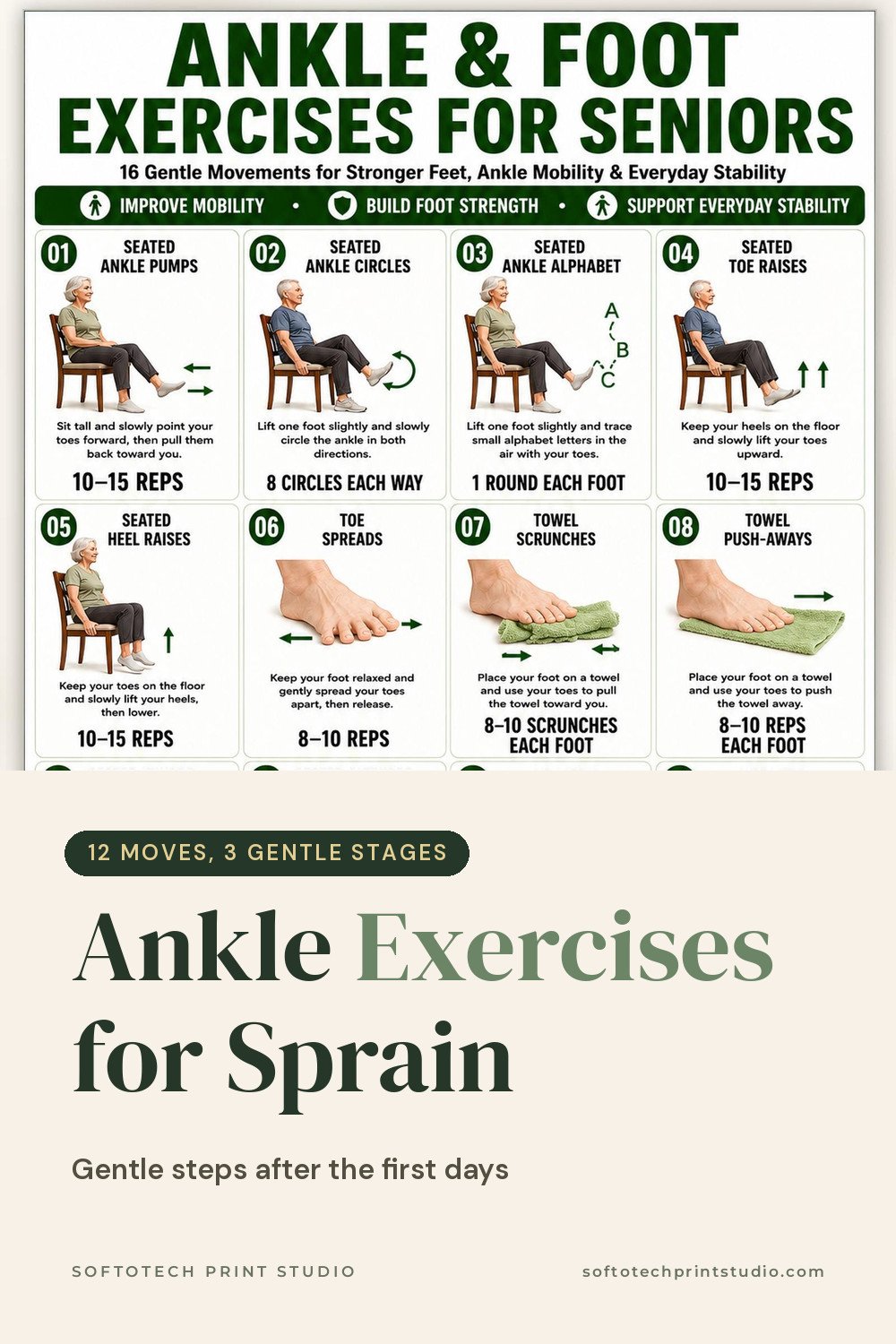
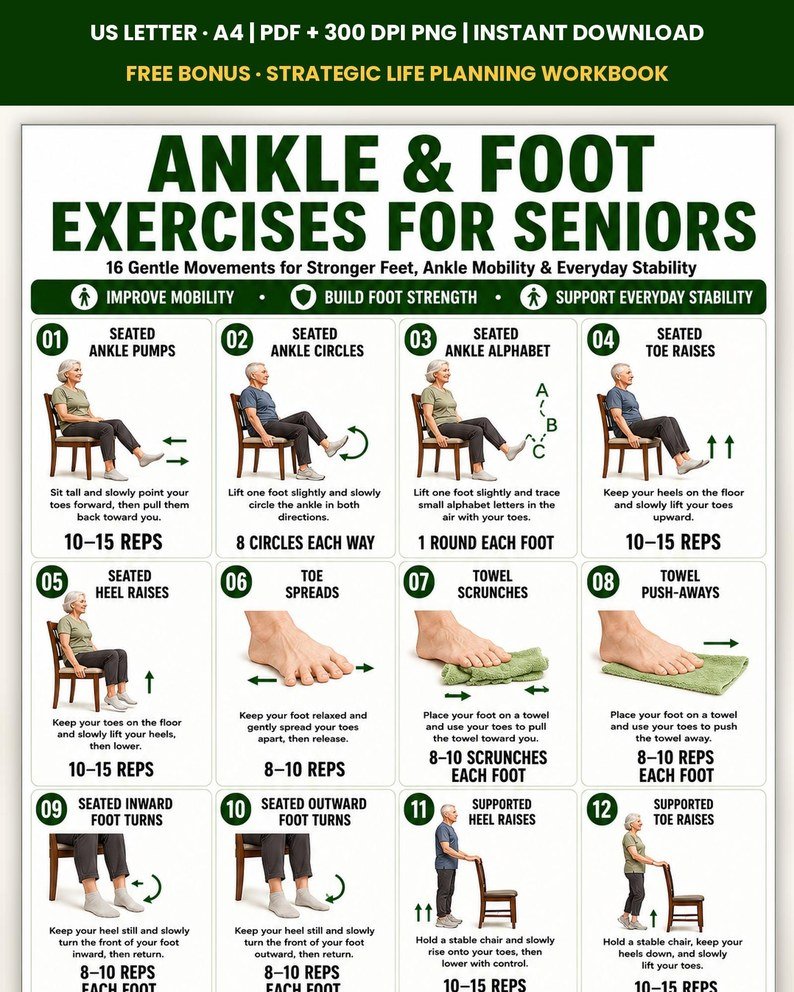
- 16 gentle movements for stronger feet, ankle mobility and everyday stability, each with an illustration and a cue
- Seated moves include ankle pumps, ankle circles, the ankle alphabet, toe raises, heel raises and inward and outward foot turns
- Foot moves include toe spreads, towel scrunches and towel push-aways
- Supported standing heel raises and toe raises at a stable chair, 10 to 15 reps each
- US Letter and A4 PDFs plus a 300 DPI PNG, per the listing
- Instant download · Print at home · US Letter · A4
Use code BLOG10 for 65% OFF at Etsy checkout!
The First Days After a Sprain, and the Warning Signs
PRICE for 2 to 3 days. The NHS advises following PRICE therapy for the first 2 to 3 days after a sprain:
- Protection: protect the injury, for example with a support or shoes that support your ankle.
- Rest: stop exercise and try not to put weight on it.
- Ice: an ice pack or a bag of frozen vegetables wrapped in a tea towel, for up to 20 minutes every 2 to 3 hours.
- Compression: a bandage around the ankle to support it during the day.
- Elevation: keep it raised on a pillow as much as possible.
The NHS also suggests avoiding heat, such as hot baths and heat packs, alcohol and massage for the first couple of days, to help prevent swelling.
See a doctor or urgent care if. The NHS lists these reasons to get help: a large amount of swelling or bruising, or swelling and bruising that’s getting worse; you can’t put any weight on the ankle or walk more than a few steps; it isn’t feeling better after treating it yourself; or you have a very high temperature or feel hot, cold or shivery. OrthoInfo adds that you may need to be seen if your ankle stays swollen or painful for several weeks, or you have trouble putting weight on it.
Go to A&E or call emergency services if. The NHS says call 999 or go to A&E if the injured part has changed shape or points at an odd angle, is numb or tingling, or the skin has turned blue or grey or feels cold. Don’t drive yourself.
Why the check matters. OrthoInfo explains that a severe sprain can be as painful, bruised and swollen as a fracture, which makes the two hard to tell apart without an exam and sometimes an X-ray. It also warns that a severe sprain that isn’t treated and rehabilitated properly can weaken the ankle and make another sprain more likely. So if in doubt, get it looked at.
The 12 Ankle Exercises on the Chart
The chart is titled Ankle and Foot Exercises for Seniors, with the line “16 gentle movements for stronger feet, ankle mobility and everyday stability”. Moves 1 to 12 are clear on the listing photo. Moves 13 to 16 sit below the edge of the image, so I haven’t used them. The listing description mentions a single leg stance among the moves. Here are the 12, with the chart’s cues and counts.
| # | Move | Chart cue | Chart count |
|---|---|---|---|
| 1 | Seated ankle pumps | Sit tall, slowly point your toes forward, then pull them back toward you | 10 to 15 reps |
| 2 | Seated ankle circles | Lift one foot slightly and slowly circle the ankle in both directions | 8 circles each way |
| 3 | Seated ankle alphabet | Lift one foot slightly and trace small alphabet letters in the air with your toes | 1 round each foot |
| 4 | Seated toe raises | Keep your heels on the floor and slowly lift your toes upward | 10 to 15 reps |
| 5 | Seated heel raises | Keep your toes on the floor and slowly lift your heels, then lower | 10 to 15 reps |
| 6 | Toe spreads | Keep your foot relaxed and gently spread your toes apart, then release | 8 to 10 reps |
| 7 | Towel scrunches | Place your foot on a towel and use your toes to pull the towel toward you | 8 to 10 scrunches each foot |
| 8 | Towel push-aways | Place your foot on a towel and use your toes to push the towel away | 8 to 10 reps each foot |
| 9 | Seated inward foot turns | Keep your heel still and slowly turn the front of your foot inward, then return | 8 to 10 reps each foot |
| 10 | Seated outward foot turns | Keep your heel still and slowly turn the front of your foot outward, then return | 8 to 10 reps each foot |
| 11 | Supported heel raises | Hold a stable chair and slowly rise onto your toes, then lower with control | 10 to 15 reps |
| 12 | Supported toe raises | Hold a stable chair, keep your heels down and slowly lift your toes | 10 to 15 reps |
Why these suit sprain recovery. OrthoInfo describes rehabilitation as focusing on range of motion exercises, isometric strengthening and proprioception, or balance, retraining. Moves 1 to 3 are pure range of motion. Moves 4 to 10 build strength in the foot and around the ankle with the body weight taken off. Moves 11 and 12 bring weight back on, with a chair for support, which is the bridge to balance work.
A word on foot turns. OrthoInfo explains that an ankle sprain often involves the ligaments on the outside of the ankle. Turning the foot inward (move 9) stretches those ligaments. Keep that move small and slow, stop well before pain, and leave it out entirely if your clinician has told you to avoid it for now.
Our ankle strengthening exercises for seniors guide uses the same chart for everyday ankle strength rather than injury recovery, if you’d like a longer term routine once you’re healed.
Worked Plan: 3 Stages From Seated to Standing
This plan follows the recovery order OrthoInfo describes, using the chart’s moves and counts. The timings are a rough guide for a mild sprain only. OrthoInfo says the whole program can take 2 weeks for minor sprains and 6 to 12 weeks for more severe injuries, so your clinician or physiotherapist may move you faster or slower.
| Stage | Rough timing (mild sprain) | Moves from the chart | Move on when |
|---|---|---|---|
| 1. Gentle range of motion | Once PRICE days are over and you can move the ankle without pain stopping you | Ankle pumps (1), ankle circles (2), ankle alphabet (3), toe spreads (6); 1 to 2 times a day | All four feel easy and pain stays low during and after |
| 2. Seated strength | Often from the end of the first week | Add toe raises (4), heel raises (5), towel scrunches (7), towel push-aways (8), outward foot turns (10), then gently inward turns (9) | You can walk around the house without limping |
| 3. Supported standing | Often from week 2 or 3 | Add supported heel raises (11) and supported toe raises (12) at a sturdy chair, both hands on at first | Ten slow raises with one hand on the chair feel steady |
How it should feel. Mild stretching, gentle effort, perhaps a little ache that settles within an hour. Not sharp pain. If the ankle swells more or aches more the next morning, drop back to the previous stage for a few days.
A sample stage 2 session. Sit on a firm chair without wheels. Do 10 ankle pumps, 8 circles each way, one alphabet round, 10 toe raises, 10 heel raises, 8 towel scrunches and 8 push-aways each foot, then 8 outward and a few small inward foot turns. That’s about 10 minutes. Ice afterward if the ankle feels warm or puffy.
Calves and the sole of the foot. After a sprain, the calf often tightens because you’ve been walking stiffly. The second chart, Plantar Fasciitis Exercises, has a calf stretch and an Achilles stretch, each held 20 to 30 seconds per leg, and a big toe stretch at 15 to 20 seconds per foot. Those are useful in stage 2 or 3, as long as they don’t hurt the ankle itself.
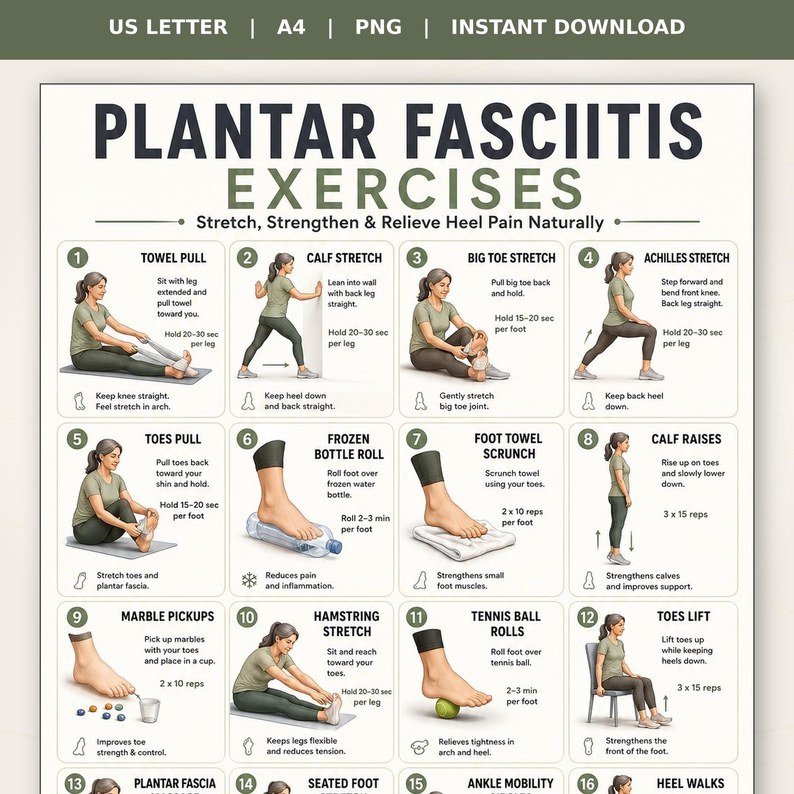
- 16 foot and heel exercises with hold times and rep counts printed on the chart
- Stretches include the towel pull, calf stretch, big toe stretch and Achilles stretch, 15 to 30 seconds each
- Strength moves include foot towel scrunch, calf raises, marble pickups and toes lift
- Made for plantar fasciitis, heel pain and arch discomfort, per the listing
- US Letter and A4 PDFs plus a 300 DPI PNG, per the listing
- Instant download · Print at home · US Letter · A4
Use code BLOG10 for 65% OFF at Etsy checkout!
Getting Back to Walking and Preventing Another Sprain
The plantar fasciitis chart, used for recovery. The second printable is a 16 move chart for foot and heel pain, with holds and reps printed on it. Its stretches include the towel pull and calf stretch at 20 to 30 seconds per leg, and the big toe stretch at 15 to 20 seconds per foot. Its strength moves include the foot towel scrunch at 2 sets of 10 reps per foot, calf raises at 3 sets of 15, marble pickups at 2 sets of 10 and the toes lift at 3 sets of 15. It’s made for plantar fasciitis, not sprains, but those calf and foot moves help once your ankle tolerates them. We walk the whole chart in our plantar fasciitis exercises guide.
Balance is the step people skip. OrthoInfo says poor balance often leads to repeat sprains and ankle instability, and that balance training is part of rehabilitation. Its example is standing on the injured foot with the other foot raised, eventually with eyes closed. For most older adults, the safe version is standing on the injured foot next to a kitchen counter, fingertips resting on it, for 10 to 20 seconds. Our standing balance exercises for seniors guide is a good next step once single leg standing at the counter feels steady.
Ease back into activity. The NHS says most sprains feel better after 2 weeks, but recommends avoiding strenuous exercise such as running for up to 8 weeks because of the risk of further damage. OrthoInfo describes a gradual return, starting with activities that don’t involve turning or twisting the ankle, and only later sports with sudden turns, such as tennis or basketball. A simple order: flat walking, then longer walks, then stairs and slopes, then anything with turns.
Don’t forget the knee and hip. If you limped for a week or two, the muscles further up the leg can weaken too. Gentle knee and hip work keeps the whole leg balanced. Our knee exercises for seniors guide has seated options that pair well with stage 2.
Supportive shoes. The NHS mentions shoes that support your ankle as part of protection. In the weeks after a sprain, a well fitting shoe with a firm heel counter is a better choice than slippers, flip flops or high heels.
If it keeps happening. OrthoInfo warns that repeated ankle sprains can lead to long term problems, including chronic ankle pain, arthritis and instability. If your ankle keeps giving way, or it’s still painful or swollen 6 to 8 weeks after the injury, see a doctor or physiotherapist. The NHS notes that physiotherapy may help when a sprain is taking longer than usual to get better.
Frequently Asked Questions
When should I start ankle exercises after a sprain?
Only once a clinician has checked the injury, or you’re sure it’s a mild sprain and the first 2 to 3 days of protection, rest, ice, compression and keeping it raised are behind you. The NHS says that when you can move the injured area without pain stopping you, try to keep moving it so the joint doesn’t get stiff. Start with gentle seated moves.
What are the best exercises for a sprained ankle?
Recovery usually moves from range of motion, to strength, to balance. On the chart, that means seated ankle pumps, circles and the ankle alphabet first, then towel scrunches, foot turns and heel raises, then supported standing heel and toe raises. OrthoInfo describes the same order: range of motion, strengthening and proprioception (balance) training.
How long does a sprained ankle take to heal?
The NHS says most sprains feel better after 2 weeks, but advises avoiding strenuous exercise such as running for up to 8 weeks. OrthoInfo says a full treatment program can take 2 weeks for minor sprains and up to 6 to 12 weeks for more severe ones. Severe sprains can take months.
When should I see a doctor for a sprained ankle?
The NHS advises getting help if there’s a lot of swelling or bruising, or it’s getting worse, if you can’t put weight on it or walk more than a few steps, or it isn’t improving. Go to A&E or call emergency services if the ankle has changed shape, is numb or tingling, or the skin looks blue or grey or feels cold.
What sizes does the ankle and foot exercises chart print in?
The listing offers US Letter and A4 PDFs plus a 300 DPI PNG. The plantar fasciitis chart comes in the same sizes.
This guide is general information and is not medical advice. See a doctor or physiotherapist about any ankle injury before starting these exercises, and stop if pain or swelling gets worse.
Related Guides
- Ankle Strengthening Exercises for Seniors
- Plantar Fasciitis Exercises
- Standing Balance Exercises for Seniors
- Knee Exercises for Seniors
Sources
Sources: NHS, Sprains and strains, American Academy of Orthopaedic Surgeons, OrthoInfo, Sprained Ankle
 Senior FitnessBreathing Exercises to Increase Lung Capacity: 8 Techniques, a 10 Minute Routine and What They Can Really Do
 Senior FitnessArm Exercises for Seniors: 16 Gentle Dumbbell Moves and 20 Seated Moves With Reps
 Senior FitnessMobility Exercises for Shoulders: 16 Gentle Seated, Wall and Chair Moves