
A military workout routine is bodyweight training done the way a drill instructor would set it: push-ups, squats, lunges, planks, burpees and crawls, in sets, with short rests and no equipment. It’s simple, it works anywhere, and it scales. The same moves that suit a beginner on day one are still useful, done harder and faster, months later.
This guide is built on the Military Calisthenics bundle from SoftoTech Print Studio. It has six posters: a Beginner, an Intermediate and an Advanced workout, plus a progress tracker for each. I’ll go through each level with its moves, sets and reps as printed, then put them into a weekly schedule, show how to know when to move up, and finish with form and safety rules from the NHS.
If you’ve been inactive for a while, have a heart or joint condition, or are recovering from injury, check with your doctor before starting. Military style sessions get hard quickly, and the advanced level is genuinely tough.
The sets, reps and times below are the chart’s. Where I suggest a schedule or a swap, I’ll say so.
In this guide:
- The Three Levels on the Military Calisthenics Charts
- A Weekly Military Workout Schedule by Level
- Moving Up Levels and the 30 Day Challenge
- Form, Recovery and Safety Rules
- Frequently Asked Questions

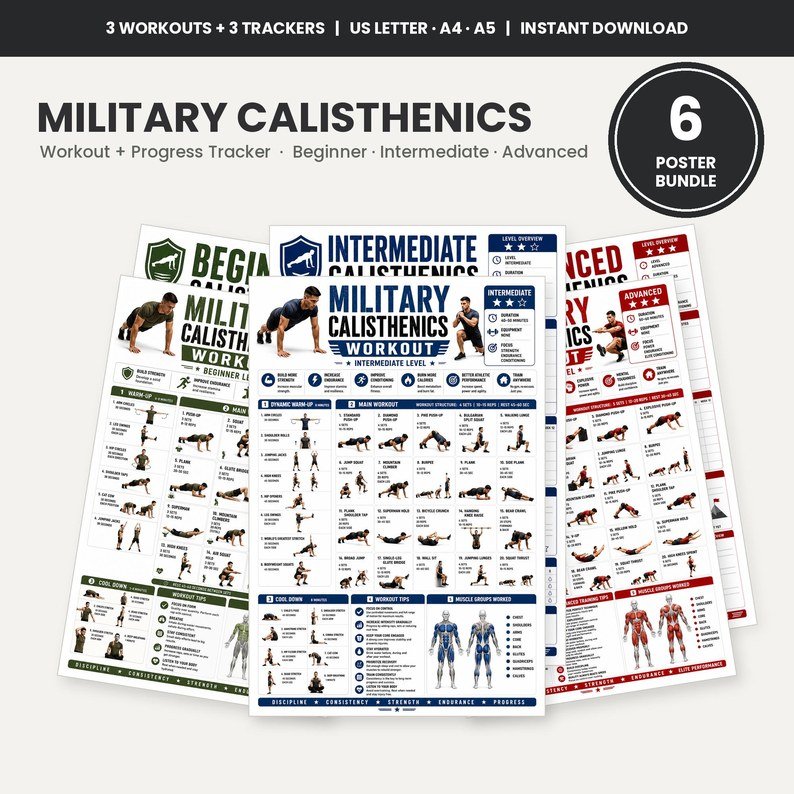
- 6 printable posters: Beginner, Intermediate and Advanced military calisthenics workouts plus a matching progress tracker for each level
- Beginner: 16 moves, 3 sets, 30 to 40 minutes; Intermediate: 20 moves, 4 sets of 10 to 15 reps, 40 to 50 minutes; Advanced: 20 moves, 5 sets of 12 to 20 reps, 50 to 60 minutes
- Every level has a warm-up, a main workout, a cool-down, workout tips and a muscle groups worked panel
- Trackers include a 12 week progress calendar, a weekly training log and a performance tracker
- US Letter, A4 and A5, per the listing
- Instant download · Print at home · US Letter · A4 · A5
Use code BLOG10 for 65% OFF at Etsy checkout!
The Three Levels on the Military Calisthenics Charts
All three workout posters share a layout: a level badge with duration, equipment and focus, a numbered warm-up, a main workout grid, a cool-down, a tips panel and a muscle groups worked diagram. The footer runs Discipline, Consistency, Strength, Endurance. Each level has its own color: green for Beginner, navy for Intermediate, red for Advanced.
Beginner, level one. Duration 30 to 40 minutes, equipment none, focus foundation strength and body control. The warm-up takes 6 to 8 minutes: arm circles for 30 seconds, leg swings for 30 seconds each leg, hip circles for 30 seconds each direction, shoulder taps for 30 seconds, cat cow for 30 seconds in each position, and jumping jacks for 30 seconds.
The main workout runs 20 to 25 minutes, with 16 moves, all at 3 sets and 45 to 60 seconds of rest between sets:
- Push-up, incline push-up and bent knee push-up, 8 to 12 reps each.
- Squat and glute bridge, 12 to 15 reps. Walking lunge and step-up, 10 reps each leg.
- Plank and air squat hold, 20 to 30 seconds. Side plank, 20 to 30 seconds each side.
- Superman and bodyweight good morning, 12 to 15 reps.
- Mountain climbers, 20 reps total. High knees, 30 seconds. Calf raise, 15 to 20 reps.
- Bear crawl, 20 steps forward and back.
Then a 5 to 8 minute cool-down of stretches ending with a minute of deep breathing. The tips panel says focus on form, breathe, stay consistent, progress gradually and listen to your body.
Intermediate, level two. Duration 40 to 50 minutes, focus strength, endurance and conditioning. The dynamic warm-up is 8 minutes: arm circles and shoulder rolls for 30 seconds, jumping jacks, high knees and hip openers for 45 seconds, leg swings and the world’s greatest stretch for 30 seconds each side, and bodyweight squats for 45 seconds.
The main workout has 20 moves, with the structure 4 sets, 10 to 15 reps, 45 to 60 seconds rest. The moves are standard push-up, diamond push-up, pike push-up, Bulgarian split squat, walking lunge, jump squat, mountain climber, burpee, plank, side plank, plank shoulder tap, superman hold, bicycle crunch, hanging knee raise, bear crawl, broad jump, single leg glute bridge, wall sit, jumping lunges and squat thrust. Holds are 30 to 45 seconds, and the wall sit is 45 to 60 seconds. The cool-down is 8 minutes, from child’s pose and hamstring stretches to cat-cow and a minute of deep breathing.
One honest note. The chart says equipment none, but the hanging knee raise needs a bar to hang from. If you don’t have one, a lying leg raise on the floor works the same area.
Advanced, level three. Duration 50 to 60 minutes, focus power, endurance and elite conditioning. The warm-up is 10 minutes and adds butt kicks, dynamic lunges and inchworms. The main workout has 20 moves at 5 sets, 12 to 20 reps, and only 30 to 45 seconds of rest. It brings in archer push-ups, decline push-ups, explosive push-ups, burpee push-ups, V-ups, side plank reach, a hollow hold, and a 30 second high knees sprint alongside the jump squats, Bulgarian split squats and bear crawls. The tips panel adds move explosively and quality always beats speed.
The step from level to level is clear. Sets go from 3 to 4 to 5. Rest drops from 45 to 60 seconds down to 30 to 45. Push-ups go from incline and bent knee, to diamond and pike, to archer and explosive. That’s how bodyweight training gets harder without adding weight.
A Weekly Military Workout Schedule by Level
The posters give you a session, not a week. Here’s how I’d lay out a week at each level. The sessions are the charts’. The days and the easy day content are my suggestions.
| Day | Beginner | Intermediate | Advanced |
|---|---|---|---|
| Monday | Full beginner session | Full intermediate session | Full advanced session |
| Tuesday | Walk 20 to 30 minutes | Walk or easy run | Easy run or cycle |
| Wednesday | Rest or mobility | Full intermediate session | Full advanced session |
| Thursday | Full beginner session | Walk and stretch | Mobility and the cool-down routine |
| Friday | Walk 20 to 30 minutes | Full intermediate session | Full advanced session |
| Saturday | Optional third session or walk | Long walk or sport | Intermediate session as a lighter day |
| Sunday | Rest | Rest | Rest |
Why this shape. The NHS advises adults to do strengthening activities that work all the major muscle groups, legs, hips, back, abdomen, chest, shoulders and arms, on at least 2 days a week, plus at least 150 minutes of moderate activity or 75 minutes of vigorous activity a week. Two beginner sessions plus three walks covers that comfortably. Three intermediate or advanced sessions add a lot of vigorous work on top.
Never two hard days in a row at first. Bodyweight training is still training. Your legs and shoulders need a day to recover after a session of squats, lunges and push-ups. The easy days in the table keep you moving without stacking hard sessions.
A beginner session, start to finish. Clear a space the size of a yoga mat and find a sturdy step for step-ups. Run through the six warm-up moves, 30 seconds each. Then work through the 16 moves in order, one set at a time. I’d do it as three rounds of the whole list rather than three sets of each move in a row, so no muscle gets hammered. Rest 45 to 60 seconds between moves when you need it. Finish with the stretches and a minute of slow breathing. Tick the day on the beginner tracker.
Using the trackers. The beginner tracker has a 12 week progress calendar and a weekly performance tracker. The intermediate one is a training log with a weekly overview and personal records. The advanced one is a performance tracker. Write down your push-up count, plank time and how hard the session felt. It’s the easiest way to see progress you’d otherwise miss.
If even the beginner chart looks like too much, our 20 minute no equipment home workout for beginners is a gentler first step. For a general full body plan that isn’t military style, see our full body workout at home guide.
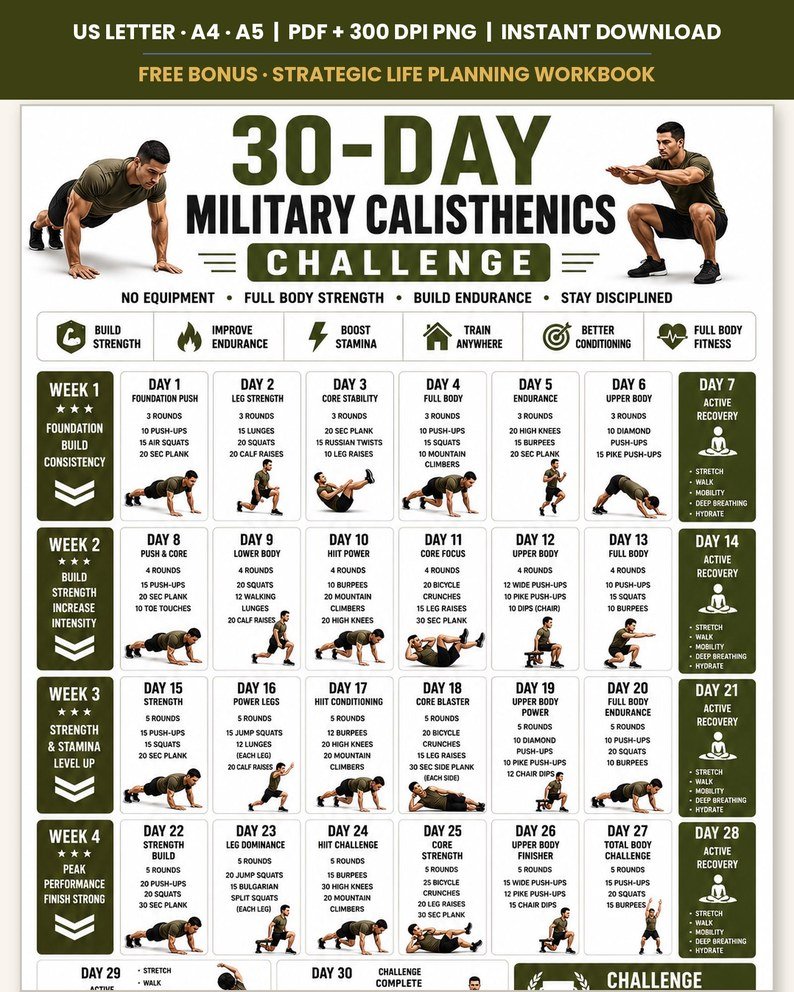
- A 30 day calendar in 4 weeks: Foundation, Build Strength, Strength and Stamina, and Peak Performance
- Each training day names its rounds and reps, such as 3 rounds of 10 push-ups, 15 air squats and a 20 second plank on Day 1
- Active recovery on Days 7, 14, 21 and 28: stretch, walk, mobility, deep breathing and hydrate
- No equipment except a chair for dips on the upper body days
- US Letter, A4 and A5, as PDF plus a 300 DPI PNG, per the listing
- Instant download · Print at home · US Letter · A4 · A5
Use code BLOG10 for 65% OFF at Etsy checkout!
Moving Up Levels and the 30 Day Challenge
The hardest question in any program is when to move up. Too early and you get sore, sloppy and hurt. Too late and you get bored. Here’s a simple test I’d use. It’s my suggestion, not the chart’s.
Beginner to Intermediate. Move up when you can finish the full beginner session, all 16 moves for 3 sets, at the top of each rep range, with good form, and you aren’t wrecked the next day. Two weeks in a row is a good signal. A rough benchmark: 12 clean standard push-ups and a 30 second plank without sagging.
Intermediate to Advanced. Move up when the intermediate session feels hard but controlled at 4 sets and 15 reps, and you can do diamond and pike push-ups without your form breaking down. The advanced chart cuts rest to 30 to 45 seconds, so your conditioning needs to be there, not just your strength.
Mix levels if you need to. You don’t have to jump a whole level at once. Keep the beginner chart’s lower body moves while you try the intermediate push-ups, or use intermediate moves at 3 sets instead of 4. The NHS advice for strength work is to build up slowly and increase the repetitions over time.
Where the 30 day challenge fits. The 30 Day Military Calisthenics Challenge is a calendar rather than a session chart. Week 1 is Foundation, week 2 Build Strength, week 3 Strength and Stamina, and week 4 Peak Performance. Each day has a theme and a short list, such as Day 1, Foundation Push: 3 rounds of 10 push-ups, 15 air squats and a 20 second plank. Days 7, 14, 21 and 28 are active recovery: stretch, walk, mobility, deep breathing and hydrate.
The challenge sessions are shorter than the level charts, so it works well in two ways. Use it as a month long on ramp before the intermediate chart. Or, once you’re training at intermediate level, run it for a month when time is tight, since each day takes far less than 40 minutes. Our military calisthenics workout guide walks the whole 30 day calendar, and our calisthenics workout for women guide has a 28 day bodyweight plan written for women training at home.
Form, Recovery and Safety Rules
Military training has a reputation for pushing through. At home, with no instructor watching, that’s how people get hurt. These rules matter more than the rep count.
Form first. The beginner chart’s first tip is focus on form, quality over quantity. The advanced chart says quality always beats speed. A push-up with sagging hips isn’t a push-up. If your form slips, stop the set or drop to the easier version.
Work hard enough, then rest. The NHS says strength exercises bring health benefits when you do them to the point where you need a short rest before repeating. That’s the chart’s rest period. Use it. Rushing through sets with no rest turns a strength session into a sloppy cardio session.
Use the easier versions. Incline and bent knee push-ups, step-ups instead of jump squats, and marching in place instead of high knees are all fine. Jumping moves like burpees, broad jumps and jumping lunges are hard on knees and ankles. Leave them out until the rest of the session is easy.
Warm up and cool down every time. Every chart has both, and they’re not optional. Cold muscles and tendons don’t like explosive moves.
Stop and get advice if you feel chest pain, unusual breathlessness, dizziness or sharp joint pain. Normal muscle soreness a day or two later is expected when you start. Pain in a joint during a move is not.
Talk to a doctor or physiotherapist first if:
- You have high blood pressure, a heart condition or diabetes that affects your exercise.
- You have knee, hip, back, wrist or shoulder problems, or have had surgery on any of them.
- You’re pregnant or have recently had a baby.
- You’ve been mostly inactive for a long time.
Make it stick. Pin your level’s chart and its tracker side by side where you train. Pick your three days, write them on the tracker, and treat them like appointments.
Frequently Asked Questions
What is a military workout routine?
It’s a bodyweight training plan in the style of basic training: push-ups, squats, lunges, planks, burpees and similar moves done in sets, with short rests and no equipment. The Military Calisthenics Workout charts set it out in three levels, from a 30 to 40 minute beginner session to a 50 to 60 minute advanced one.
How many days a week should I do a military workout?
Two or three full sessions a week is a sensible start, with a rest or easy day between them. The NHS advises adults to do strengthening activities that work all the major muscle groups on at least 2 days a week, alongside 150 minutes of moderate activity or 75 minutes of vigorous activity.
Can a beginner do military calisthenics?
Yes, if you start at the right level. The beginner chart uses incline and bent knee push-ups, a glute bridge, step-ups and 20 to 30 second planks, all at 3 sets. Stay there until the full session feels controlled before moving up.
Do I need any equipment?
The charts say equipment none. In practice the beginner step-up and the 30 day challenge’s dips need a sturdy step or chair, and the intermediate hanging knee raise needs a pull-up bar. Swap the knee raise for a lying leg raise if you don’t have a bar.
What sizes do the charts come in?
The bundle listing states US Letter, A4 and A5, and the 30 day challenge listing states US Letter, A4 and A5 as a PDF plus a 300 DPI PNG. Both are instant downloads.
This guide is for general fitness and is not medical advice. Check with your doctor before starting, especially if you have a heart condition, high blood pressure, joint problems or have been inactive for a while.
Related Guides
- Military Calisthenics Workout
- 20 Minute No Equipment Home Workout for Beginners
- Calisthenics Workout for Women
- Full Body Workout at Home
Sources
Sources: NHS, Physical activity guidelines for adults aged 19 to 64, NHS, Strength exercises
 Home WorkoutsWorkout Plan for Women Over 50: A Gentle 28 Day Start, Then a Weekly Plan for Strength, Balance and Walking
 Home WorkoutsFace Yoga for Jowls: A 10 Minute Jaw and Neck Routine From a 12 Exercise Chart, With Honest Expectations
 Home WorkoutsKettlebell Exercises for Abs: 12 Core Moves From a Kettlebell Abs Chart and a 20 Minute Core Session