
Some days, the smallest things send you over the edge — a sharp tone, a change of plans. And on other days, you feel strangely flat, as if you are watching your own life from behind a pane of glass.
Neither reaction means something is wrong with you. Both are signs that your nervous system has slipped outside its comfort zone — what therapists call the window of tolerance. Inside it, you can think clearly and handle everyday stress.
The good news is that you can learn to notice when you are drifting out of your window and practice simple ways to return. Over time, your window can grow wider, so stress rattles you less.
This guide is for general wellness and is not medical advice. Check with your doctor before starting a new routine.
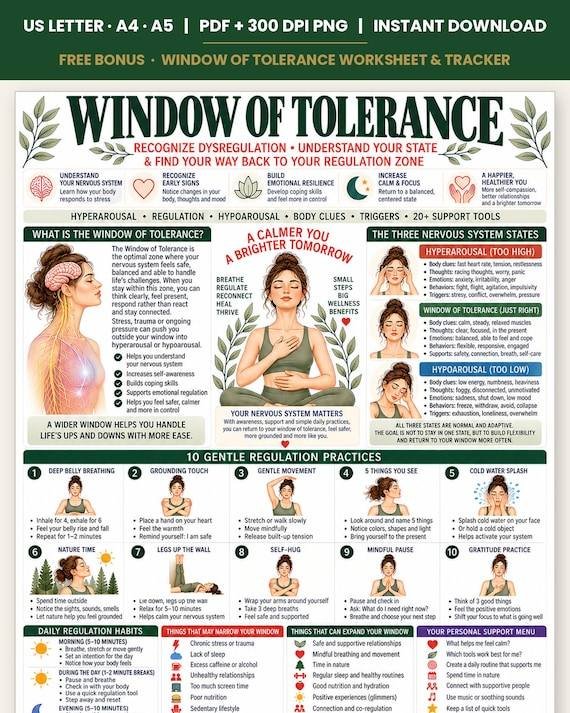
Here is the short answer: your window of tolerance is the range of stress your nervous system can handle while you still think clearly and feel steady. Inside it, you can cope with a bad day, a hard conversation, or a change of plans without snapping or shutting down. Above it, you feel wired, anxious, or irritable. Below it, you feel numb, flat, or foggy. The goal is not to stay inside your window all the time — it is to notice when you leave it and know how to return.
Staying inside your window comes down to three habits: noticing your body’s early signals, using a calming tool in the moment, and protecting the basics that keep your window wide. A one-minute body check-in each morning tells you where you are starting from. Slow breathing, grounding, or a short walk can bring you back when you drift out. And steady sleep, regular meals, and small daily connections widen your window over time, so the same stress rattles you less.
Printable guide
Window of Tolerance Poster
- Hyperarousal vs. hypoarousal signs, body cues, and triggers at a glance
- 20+ body-based regulation tools, daily habits, and a bonus tracker worksheet
- A4 · US Letter · A5, instant PDF download
What Is the Window of Tolerance?
Think of your window of tolerance as the zone where your nervous system feels safe — an idea from psychiatrist Dr. Dan Siegel. Inside the window, you are calm, present, and flexible, able to solve problems and bounce back from small upsets.
When life pushes you out of the window, you go in one of two directions: upward into hyperarousal — the revved-up fight-or-flight state — or downward into hypoarousal — the shut-down freeze state. Both are automatic nervous system responses.
Most of us leave our window several times a day. That is normal. The goal is simply to notice when you have left and know your way back.
Above the Window: Hyperarousal
Hyperarousal is the “too much” state. Your sympathetic nervous system hits the gas, and your body prepares for danger even when no real threat is present.
- A racing heart or pounding chest
- Tight jaw, shoulders, or stomach
- Restlessness, or feeling you must keep moving
- Irritability, snapping, or impatience
- Racing thoughts or a sense of dread
- Trouble falling or staying asleep
Many women describe this state as feeling “wired but tired.” You are exhausted, yet you cannot seem to slow down.
Below the Window: Hypoarousal
Hypoarousal is the “too little” state. Your system slams the brakes instead. Energy drops, and you start to disconnect from yourself and others.
- Feeling numb, empty, or “not quite here”
- Heavy limbs or deep, dragging fatigue
- Brain fog and trouble concentrating
- Withdrawing from people you care about
- Procrastination or loss of motivation
- Feeling hopeless, flat, or “meh”
People often mistake this state for laziness. It is not. It is your nervous system protecting you by powering down.
Why Your Window Gets Narrower (or Wider)
Your window is not fixed. Poor sleep, skipped meals, and constant multitasking narrow it. That is why the same traffic jam that barely bothers you on a rested Sunday can bring you to tears on a sleepless Thursday.
Rest, connection, gentle movement, and steady routines widen it. A visual reference helps too — this window of tolerance printable maps exactly what expands your window and what shrinks it, so you can start spotting your own patterns.
Big life seasons — grief, illness, caregiving, money stress — can narrow anyone’s window for a while. If that is you right now, be extra patient with yourself.
How to Widen Your Window Over Time
Quick tools help in the moment, but widening your window is a longer project built on small, steady habits.
- Protect your sleep. Go to bed and wake up at roughly the same time each day. A rested nervous system is a resilient one.
- Move gently every day. Walking, stretching, or easy yoga tells your body it is safe. You do not need intense workouts.
- Eat regularly. Blood sugar crashes feel a lot like anxiety. Steady meals keep your system on an even keel.
- Set small boundaries. Saying no to one draining commitment can do more for your window than any technique.
- Build in micro-moments of connection. A short call with a friend signals safety to your system.
- Limit your inputs. Constant news and endless scrolling keep your nervous system on high alert. Give it real breaks.
Do not try all of these at once. Pick one, practice it for two weeks, then add another.
Daily Practices That Help You Stay Inside It
Staying inside your window is easier when you check in with your body before it reaches the extremes.
- Morning body check-in. Before you touch your phone, pause for one minute. Notice your breathing, your shoulders, your mood. Name what you feel.
- Slow breathing. Inhale through your nose for four counts, then exhale for six. A longer exhale tells your system to settle.
- Grounding touch. Place a hand on your chest or give yourself a firm hug. Warm, steady pressure is calming.
- Movement breaks. Stand up every hour or two. Roll your shoulders, stretch your neck, walk to the window.
- Gentle self-massage. A few minutes of lymphatic drainage massage at home can quiet a buzzing nervous system and ease tension you did not know you were holding.
- Evening wind-down. Dim the lights an hour before bed. Stretch, breathe slowly, or follow a fascia release and lymph flow routine to release the day.
Choose two or three and repeat them daily. Consistency matters more than perfection.
What to Do When You Have Already Left Your Window
Sometimes you notice too late — you are already snapping at everyone, or staring blankly at the wall. Here is how to find your way back.
If you are revved up (hyperarousal), try one of these:
- Lengthen your exhale: breathe in for 4, out for 8.
- Splash cold water on your face or hold something cold.
- Press your feet into the floor and name five things you can see.
- Step outside for fresh air, even for two minutes.
If you are shut down (hypoarousal), try one of these:
- Stand up and move gently — shake your hands, march in place.
- Drink something warm and hold the mug.
- Get sunlight on your face or turn on bright lights.
- Listen to upbeat music or call a friend.
A stressed brain does not brainstorm well, which is why a ready-made list matters. The dysregulation coping tools chart gathers more than 20 body-based tools on one printable page, so you never have to think — you just pick one.
Who This Is For
This framework — and the printable that goes with it — is especially helpful if you are:
- A busy woman juggling work, family, or caregiving who feels stretched thin.
- Someone who swings between anxious and numb and wants to understand why.
- In therapy and looking for a simple visual reminder of what you are learning.
- A teacher, coach, or wellness practitioner who explains regulation to others.
If that sounds like you, this guide was written with you in mind.
Common Mistakes to Avoid
- Trying to think your way out of dysregulation. When you are outside your window, the thinking brain goes partly offline. Work with your body first — breath, movement, senses — and the thoughts will follow.
- Using “calm down” tools when you are shut down. A flat, numb state needs gentle activation — light, warmth, movement — not more stillness.
- Expecting instant results. Widening your window takes weeks of small, repeated practice. Celebrate tiny shifts instead of chasing overnight change.
- Skipping the basics. No breathing technique can replace sleep, food, and rest. Cover the foundations before adding fancy tools.
- Going it alone. If you often feel overwhelmed or shut down, support from a therapist or a trusted person can make all the difference.
Printable guide
Window of Tolerance Poster
- Hyperarousal vs. hypoarousal signs, body cues, and triggers at a glance
- 20+ body-based regulation tools, daily habits, and a bonus tracker worksheet
- A4 · US Letter · A5, instant PDF download
Get the printable on Etsy →Instant download · Print at home
If you struggle to put a name to what you feel, a printable feelings wheel can help you find a more exact word.
Frequently Asked Questions
What is the window of tolerance in simple terms?
It is the zone where your nervous system feels safe and you can handle stress without shutting down or blowing up. Inside the window, you think clearly and feel your emotions.
What are the signs of hyperarousal and hypoarousal?
Hyperarousal brings a racing heart, muscle tension, irritability, and racing thoughts. Hypoarousal brings numbness, fatigue, brain fog, and withdrawal. Noticing these cues early is the first step back.
Can you widen your window of tolerance?
Yes. Regular sleep, gentle movement, steady routines, healthy boundaries, and supportive relationships gradually widen your window. Small, consistent habits matter more than one big change.
What helps you get back inside your window quickly?
For hyperarousal, try a long slow exhale, cold water on your face, or grounding through your senses. For hypoarousal, try gentle movement, sunlight, or upbeat music. A printable coping-tools list helps you choose fast.
How do I know if I am inside or outside my window?
Inside your window, you can think clearly, feel your emotions, and handle setbacks without overreacting or shutting down. Outside it, you may notice a racing heart, irritability, or restlessness (hyperarousal), or numbness, fogginess, and fatigue (hypoarousal). A quick body check-in — noticing your breathing, muscles, and mood — usually tells you which state you are in.
Your window of tolerance is not a test you pass or fail. It is a map. The more you use it, the faster you find your way back to calm.
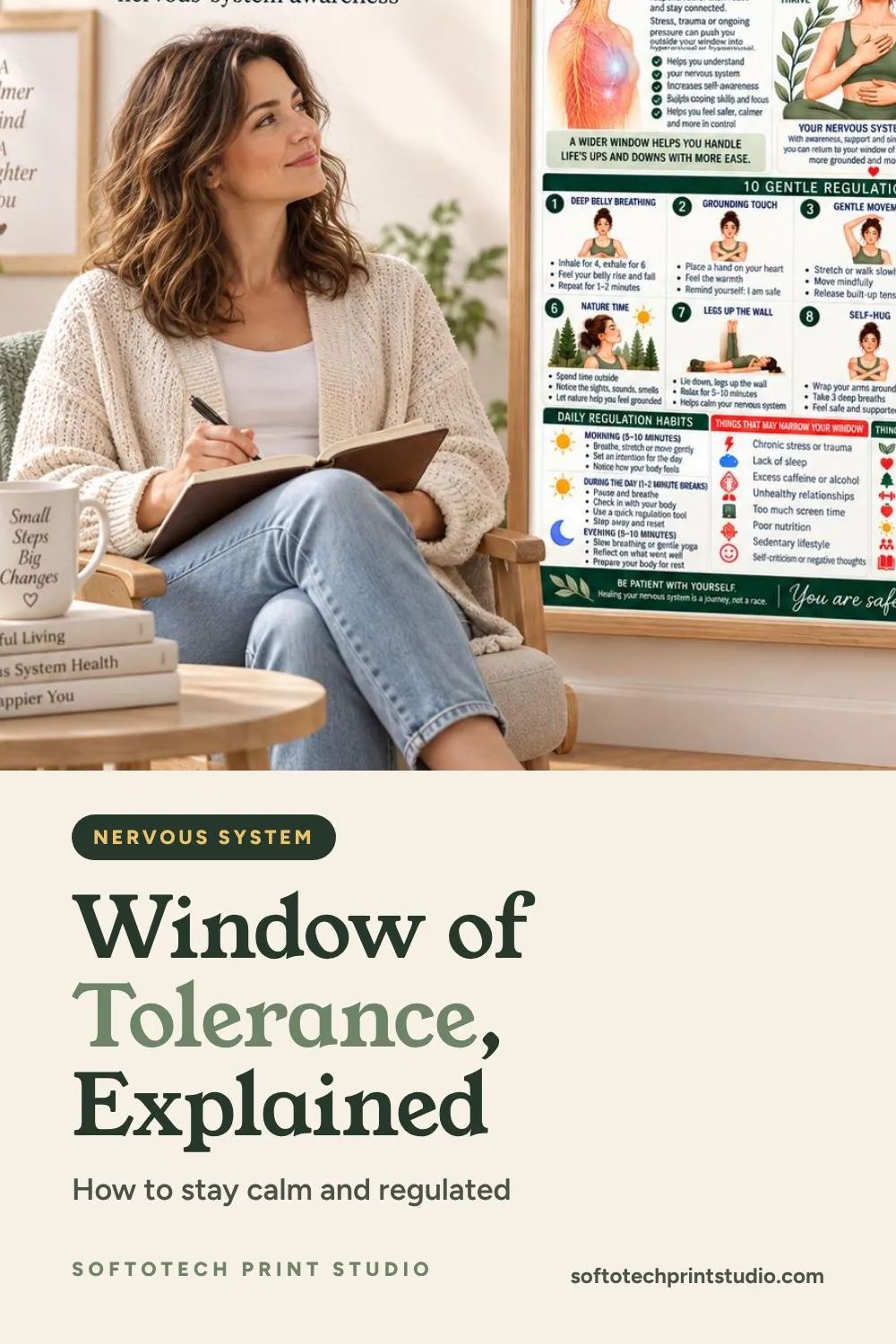
If a daily visual reminder would help, keeping a window of tolerance poster somewhere you will see it — your desk, your fridge, your bedroom wall — can make the whole practice easier. Be gentle with yourself as you learn. Your nervous system is doing its best to protect you.
Related Guides
- 12 Somatic Exercises to Calm Your Nervous System in 5 Minutes
- Fight, Flight, Freeze, Fawn: Spot Your Stress Response
Sources
Sources: NIH, Harvard Health, Cleveland Clinic


