
Being told you have type 2 diabetes usually comes with a leaflet and a head full of questions about bread, fruit and what’s left to eat. A diabetes diet food list won’t answer every one of those, but it gives you something solid to stand on in the kitchen and at the shop. You can see at a glance which foods to build meals around, which to keep to smaller portions, and which to save for rare occasions.
This guide covers two printable charts from SoftoTech Print Studio. The first is the Diabetes Food List, a traffic-light chart with Eat, Limit and Avoid columns and 21 food groups, seven in each column, each with a photo. The second is another Diabetes Food List in a plainer, text-heavy style, with Eat, Limit and Avoid columns and short notes about portions and carbs.
The two charts don’t sort every food the same way, and I’ll say so plainly as we go. The biggest difference: the first chart puts whole grains, most fruits and legumes in Eat, while the second puts whole grains and starches, whole fruit and legumes in Limit, with the note that they contain carbs and portions matter. Neither is wrong. They’re two ways of showing the same idea, which is that carb-containing foods need watching even when they’re healthy.
Before the lists, a word of caution. Diabetes needs vary a lot from person to person, depending on your type of diabetes, your medicines, your blood sugar readings and your other health conditions. This guide is general information, not a meal plan prescribed for you. Check with your doctor, diabetes nurse or a registered dietitian before you make big changes, especially if you take insulin or tablets that can cause low blood sugar.
In this guide:
- The Diabetes Food List Chart: 21 Groups in Three Columns
- Worked Grocery List: A Week From the Eat Column
- The Second Chart: A Stricter Take on Carbs
- How to Use These Charts at Home
- Frequently Asked Questions
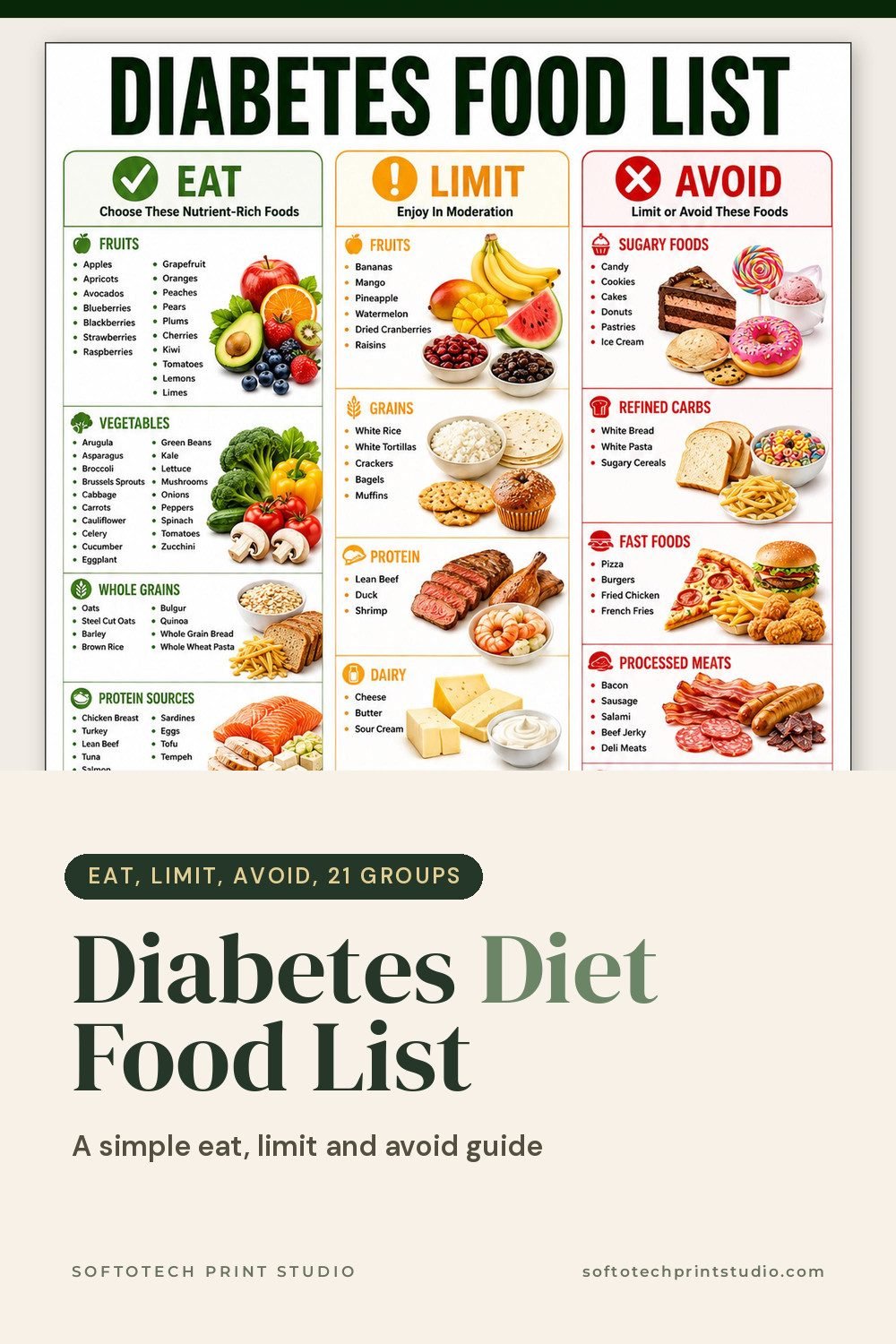
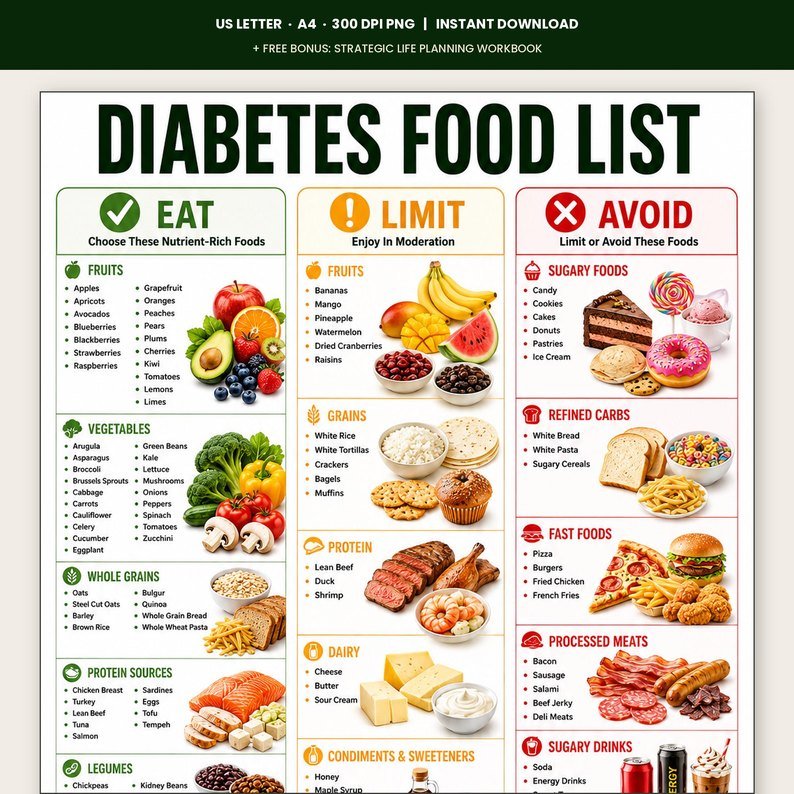
- A traffic-light Eat, Limit and Avoid chart with 21 food groups, seven in each column, each with a food photo
- Eat groups: fruits, vegetables, whole grains, protein sources, legumes, dairy, and healthy fats and seeds
- Eat foods include blueberries, broccoli, spinach, oats, quinoa, salmon, lentils, Greek yogurt and walnuts
- Also on the chart: six diabetes-friendly habits and a best choices row of oatmeal, avocado, salmon, leafy greens, lentils and water
- Print sizes US Letter and A4, as 2 PDFs plus a 300 DPI PNG and a ZIP per the listing (A5 is not stated)
- Instant download · Print at home · US Letter · A4
Use code BLOG10 for 65% OFF at Etsy checkout!
The Diabetes Food List Chart: 21 Groups in Three Columns
The main chart has a green Eat column headed Choose These Nutrient-Rich Foods, an orange Limit column headed Enjoy In Moderation, and a red Avoid column headed Limit or Avoid These Foods. Each column has seven food groups. Along the bottom are six diabetes-friendly habits and a row of six best choices.
The Eat column starts with fruits: apples, apricots, avocados, blueberries, blackberries, strawberries, raspberries, grapefruit, oranges, peaches, pears, plums, cherries, kiwi, tomatoes, lemons and limes. Then vegetables: arugula, asparagus, broccoli, Brussels sprouts, cabbage, carrots, cauliflower, celery, cucumber, eggplant, green beans, kale, lettuce, mushrooms, onions, peppers, spinach, tomatoes and zucchini. Tomatoes appear in both lists, which is fair enough, since people argue about which they are.
Whole grains on the Eat side are oats, steel cut oats, barley, brown rice, bulgur, quinoa, whole grain bread and whole wheat pasta. Protein sources are chicken breast, turkey, lean beef, tuna, salmon, sardines, eggs, tofu and tempeh. Legumes are chickpeas, lentils, black beans, kidney beans, soybeans and edamame. Dairy is cottage cheese, Greek yogurt and kefir. Healthy fats and seeds are chia seeds, flax seeds, pumpkin seeds, pistachios, walnuts and almonds.
The Limit column covers foods that are fine in smaller amounts. Fruits: bananas, mango, pineapple, watermelon, dried cranberries and raisins. These are the sweeter or more concentrated fruits. Grains: white rice, white tortillas, crackers, bagels and muffins. Protein: lean beef, duck and shrimp. Dairy: cheese, butter and sour cream. Condiments and sweeteners: honey, maple syrup, ketchup and BBQ sauce. Snacks: granola bars, pretzels and popcorn. Beverages: fruit juice, sweetened tea and flavored drinks.
One small mismatch inside this chart. Lean beef is listed under protein sources in Eat and again under protein in Limit. I’d read that as “lean beef is fine, just keep the portion modest”, which is how most of us eat it anyway. It’s a quirk of the chart rather than a rule.
The Avoid column is the clearest part. Sugary foods: candy, cookies, cakes, donuts, pastries and ice cream. Refined carbs: white bread, white pasta and sugary cereals. Fast foods: pizza, burgers, fried chicken and French fries. Processed meats: bacon, sausage, salami, beef jerky and deli meats. Sugary drinks: soda, energy drinks, sweet tea and sugary coffee drinks. High sugar additions: corn syrup, artificial sweeteners and sweetened sauces. Other foods to avoid: instant noodles, fried foods, frozen meals and high sodium packaged foods.
Artificial sweeteners in the Avoid column may surprise some readers, since many people with diabetes use them to cut sugar. The chart groups them with corn syrup and sweetened sauces. Some health groups see them as an occasional swap for sugar, others suggest cutting back, so this is a good one to ask your dietitian about rather than take from a poster.
The habits strip along the bottom lists six things: choose whole foods, eat more fiber, stay hydrated, exercise regularly, maintain a healthy weight, and check portion sizes. The best choices row shows oatmeal, avocado, salmon, leafy greens, lentils and water. The footer says Eat Smart, Manage Blood Sugar, Live Healthy.
A note on numbers. The listing describes this chart as 180+ foods across 21 food groups. The 21 groups match what’s on the chart. I count about 124 named foods, though, so the 180+ figure looks generous. The chart is still a full, useful list. I just don’t want you expecting more than is printed.
If you’d like to go further with carbs, our low-carb food list for beginners covers the same Eat side in more depth. Some people with type 2 diabetes find a lower-carb pattern easier to manage, though it isn’t right for everyone.
Worked Grocery List: A Week From the Eat Column
Here is a sample weekly shop built from the main chart’s Eat column. It isn’t a meal plan. It’s a basket that gives you enough to make a week of simple, balanced meals. Every food below is on the chart. Quantities depend on your household, so I’ve left them out.
| Food group | What to buy from the Eat column | How the second chart sorts it |
|---|---|---|
| Vegetables | Spinach, broccoli, cauliflower, peppers, zucchini, cucumber, mushrooms, onions | Eat (non-starchy vegetables) |
| Fruits | Blueberries, strawberries, apples, oranges, pears, lemons | Limit (whole fruit) |
| Whole grains | Oats, brown rice, quinoa, whole grain bread | Limit (whole grains and starches) |
| Protein | Chicken breast, salmon, tuna, eggs, tofu | Eat (lean protein foods) |
| Legumes | Chickpeas, lentils, black beans | Eat and Limit (listed in both) |
| Dairy | Greek yogurt, cottage cheese, kefir | Eat (plain, lower-sugar dairy) |
| Fats and seeds | Walnuts, almonds, chia seeds, flax seeds | Eat (nuts, seeds and healthy fats) |
Start in the vegetable aisle and fill most of the trolley there. Spinach and broccoli for cooking, cucumber and peppers for raw snacks, mushrooms and onions for flavour, cauliflower and zucchini for bulking out meals. These are the foods both charts agree on, and they’re the ones you can eat most freely. A bag of frozen broccoli or spinach counts just as well as fresh, and it lasts longer.
Fruit next. Berries, apples, oranges and pears are all in the main chart’s Eat column. They’re also whole fruit, which the second chart moves to Limit with the note that portions and glucose response vary. So buy them, enjoy them, but think of one piece or one small bowl at a time, ideally with a meal or with some yogurt or nuts rather than on their own.
For grains, pick one or two: oats for breakfast and brown rice or quinoa for dinners, plus a loaf of whole grain bread. Again, the charts disagree on where grains belong. The first chart puts them in Eat, the second in Limit. In practice, both are saying the same thing. Choose whole grains over white, and keep the portion to about a quarter of the plate.
Protein is simple. Chicken breast, a couple of salmon fillets or tins of tuna, a box of eggs, a block of tofu if you like it. Legumes too: a tin of chickpeas, a bag of lentils, a tin of black beans. Beans and lentils bring protein and fiber together, which is why they appear in the best choices row as lentils. The second chart reminds you that they also contain carbs, so count them as part of your carb portion.
Finish with plain Greek yogurt or cottage cheese, a bag of walnuts or almonds, and some chia or flax seeds to sprinkle on oats. Skip the flavoured yogurts, which are often sweetened. Plain yogurt with a few berries is the chart’s Eat column in one bowl.
Now a sample day from that basket. Breakfast: oats with a handful of blueberries, a spoon of chia seeds and some Greek yogurt. Lunch: a big salad of spinach, cucumber and peppers with chickpeas and tuna, plus a slice of whole grain bread. Dinner: baked salmon with broccoli and a small portion of brown rice. Snacks: an apple with a few almonds, or cottage cheese with strawberries. All of it is from the Eat column, and none of it needs a recipe. If fiber is your next focus, our high-fiber foods list for gut health covers many of the same foods from a different angle.
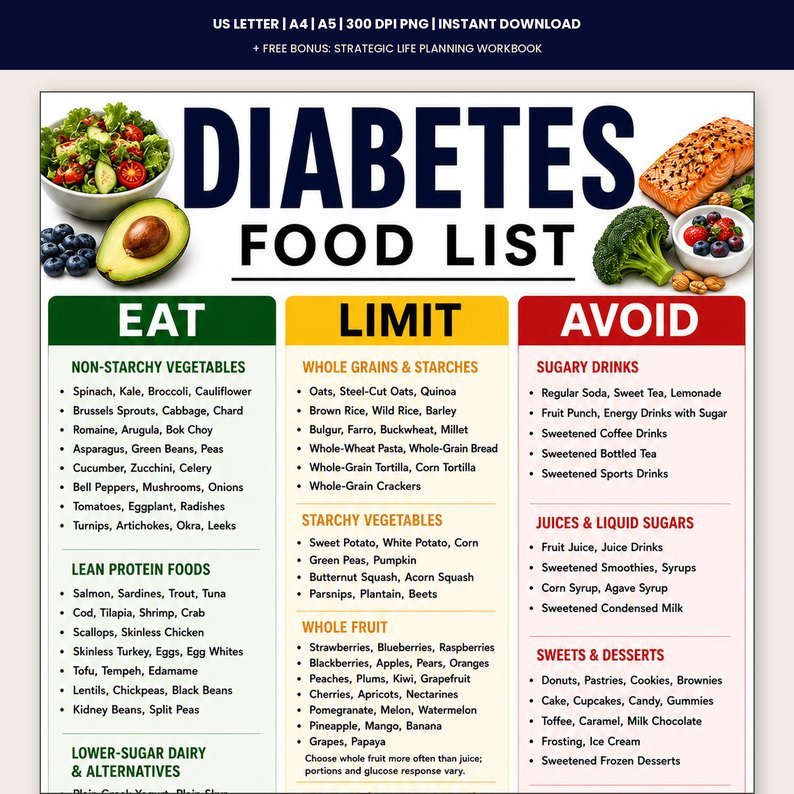
- A text-based Eat, Limit and Avoid chart with short notes on carbs and portions
- Eat: non-starchy vegetables, lean protein foods, lower-sugar dairy and alternatives, and nuts, seeds and healthy fats
- Limit: whole grains and starches, starchy vegetables, whole fruit, legumes, higher fat foods and sweeter foods
- Avoid: sugary drinks, juices and liquid sugars, sweets and desserts, refined grains and highly processed snacks
- Print sizes US Letter, A4 and A5, as 3 PDFs plus a PNG and a ZIP per the listing
- Instant download · Print at home · US Letter · A4 · A5
Use code BLOG10 for 65% OFF at Etsy checkout!
The Second Chart: A Stricter Take on Carbs
The second chart is titled Diabetes Food List, with big Eat, Limit and Avoid headers. It’s written as lists of foods, several to a line, with a short note under some groups. At the bottom is a box headed General Educational Reference Only, Not Medical Advice. It says food choices, portions and carbohydrate needs vary according to diabetes type, medications, glucose response, health conditions and individual nutrition needs. It also says the chart does not replace an individualized diabetes meal plan, and to follow guidance from your healthcare professional or RD. I like that it says this on the chart itself.
The Eat column has four groups. Non-starchy vegetables: spinach, kale, broccoli, cauliflower, Brussels sprouts, cabbage, chard, romaine, arugula, bok choy, asparagus, green beans, peas, cucumber, zucchini, celery, bell peppers, mushrooms, onions, tomatoes, eggplant, radishes, turnips, artichokes, okra and leeks. Lean protein foods: salmon, sardines, trout, tuna, cod, tilapia, shrimp, crab, scallops, skinless chicken, skinless turkey, eggs, egg whites, tofu, tempeh, edamame, lentils, chickpeas, black beans, kidney beans and split peas.
Lower-sugar dairy and alternatives: plain Greek yogurt, plain skyr, plain kefir, cottage cheese, unsweetened soy milk and unsweetened almond milk. Nuts, seeds and healthy fats: almonds, walnuts, pistachios, pecans, peanuts, chia seeds, flaxseeds, pumpkin seeds, sunflower seeds, avocado, olive oil, olives, natural peanut butter and natural almond butter.
The Limit column is where this chart differs most from the first. Whole grains and starches: oats, steel-cut oats, quinoa, brown rice, wild rice, barley, bulgur, farro, buckwheat, millet, whole-wheat pasta, whole-grain bread, whole-grain tortilla, corn tortilla and whole-grain crackers. Starchy vegetables: sweet potato, white potato, corn, green peas, pumpkin, butternut squash, acorn squash, parsnips, plantain and beets. Whole fruit: strawberries, blueberries, raspberries, blackberries, apples, pears, oranges, peaches, plums, kiwi, grapefruit, cherries, apricots, nectarines, pomegranate, melon, watermelon, pineapple, mango, banana, grapes and papaya, with the note “Choose whole fruit more often than juice; portions and glucose response vary.”
Limit carries on with legumes, marked “contain carbs”: lentils, chickpeas, black beans, kidney beans, pinto beans, navy beans and black-eyed peas, described as nutritious sources of fiber and protein that also contribute carbohydrate. Higher fat foods: cheddar, full-fat cheese, cream cheese, butter, cream, higher-fat red meat and sausage, with the note to limit frequency and portion. Sweeter foods, occasionally: dark chocolate, flavored yogurt, granola, dried fruit, honey and maple syrup, with “smaller portions, check carbs”.
There are two small overlaps to know about. Lentils, chickpeas and black beans appear under lean protein in Eat and under legumes in Limit. Peas are in the non-starchy vegetables in Eat, and green peas are in starchy vegetables in Limit. The chart’s own note explains the logic: they’re good foods that also bring carbs, so the portion is what you watch. Shrimp moves between charts too. It’s in Limit on the first chart and in Eat, as lean protein, on this one.
The Avoid column has five groups. Sugary drinks: regular soda, sweet tea, lemonade, fruit punch, energy drinks with sugar, sweetened coffee drinks, sweetened bottled tea and sweetened sports drinks. Juices and liquid sugars: fruit juice, juice drinks, sweetened smoothies, syrups, corn syrup, agave syrup and sweetened condensed milk. Sweets and desserts: donuts, pastries, cookies, brownies, cake, cupcakes, candy, gummies, toffee, caramel, milk chocolate, frosting, ice cream and sweetened frozen desserts. Refined grains: white bread, white bagels, sweet rolls, croissants, sugary muffins, pastries, refined breakfast cereals and white-flour crackers. Highly processed snacks: potato chips, cheese puffs, sweet crackers, snack cakes, sugary cereal bars and frosted breakfast bars.
So which chart should you follow? If you’re newly diagnosed and want a friendly, picture-led overview, the first chart is easier to take in. If you’re counting carbs or your team has asked you to watch portions of grains and fruit closely, the second chart matches that approach better. You could also print both: the first for the fridge, the second for planning the week. For anyone on a GLP-1 medicine as well, our GLP-1 diet food list covers what to eat alongside that treatment.
How to Use These Charts at Home
Use the plate as your guide. A common approach, used by the CDC and many diabetes teams, is the plate method: fill half the plate with non-starchy vegetables, a quarter with lean protein, and a quarter with carb foods such as whole grains, starchy vegetables, beans or fruit. That fits both charts neatly. The vegetables come from the Eat column, the protein from Eat, and the quarter of carb foods from whichever column your chart puts them in.
Shop from the chart, not from memory. Stick the main chart on the fridge and take a photo of it on your phone for the shop. When you’re tired and hungry in the supermarket, the Avoid column is the easiest reminder to walk past the sugary drinks and snack cakes. Most of those foods are the things that end up in the trolley by habit.
Swap rather than ban. If you love white rice, try brown rice or quinoa a few nights a week. Swap sugary cereal for oats, juice for whole fruit, and a sweetened coffee drink for a plain coffee with milk. Swap crisps for a handful of nuts or pumpkin seeds. The charts make the swaps obvious, because the healthier version of most foods sits in a different column from the less healthy one.
Watch drinks especially. Both charts put sugary drinks in Avoid, and the second chart adds fruit juice and smoothies. Drinks raise blood sugar quickly and don’t fill you up. Water is in the main chart’s best choices row for a reason. Unsweetened tea and coffee are fine for most people, too.
Keep an eye on salt and saturated fat as well as sugar. Diabetes raises the risk of heart problems, and the main chart’s Avoid column includes processed meats and high sodium packaged foods, and the second chart puts higher-fat foods in Limit. Our cholesterol diet food list is a useful companion if your doctor has mentioned your cholesterol too.
Check your own response. Everyone reacts a little differently to the same food. If you test your blood sugar, note what you ate and what your reading was a couple of hours later. Over a few weeks you’ll see which foods from the Limit column suit you and which don’t. Take those notes to your next appointment. They’re more useful to your diabetes team than any chart.
And take care with lows. If you take insulin or certain tablets, eating fewer carbs can make your blood sugar drop too low. Talk to your doctor or diabetes nurse before cutting carbs sharply, so your medicine can be adjusted if needed.
Once you know which foods to choose, a 7-day diabetes diet meal plan shows how they fit together across a full week.
For between-meal ideas built from these foods, see our type 2 diabetes snacks guide with 62 snacks and simple pairings.
Frequently Asked Questions
What foods are on a diabetes diet food list?
The main chart sorts foods into Eat, Limit and Avoid across 21 groups. Eat includes vegetables like broccoli and spinach, fruits like berries and apples, whole grains like oats and quinoa, lean proteins, legumes, plain dairy and nuts and seeds. Limit includes bananas, white rice, cheese and honey. Avoid includes sugary foods and drinks, refined carbs, fast food and processed meats.
Why do the two charts sort grains and fruit differently?
The first chart puts whole grains, most fruits and legumes in Eat. The second puts them in Limit, noting that they contain carbs and that portions and glucose response vary. Both agree they are healthier choices than refined grains and juice. The difference is how closely you watch the portion, which your diabetes team can advise on.
Can I eat fruit with diabetes?
Most people with diabetes can eat fruit. The main chart lists apples, berries, oranges, pears and more in Eat, and puts sweeter fruits like bananas, mango and pineapple in Limit. The second chart puts whole fruit in Limit and says to choose whole fruit more often than juice. A piece or small bowl at a time, ideally with a meal, is a common approach.
When should I talk to my doctor before changing my diet?
Talk to your doctor, diabetes nurse or dietitian before making big changes, especially if you take insulin or tablets that can cause low blood sugar, since eating fewer carbs may mean your medicine needs adjusting. Also get advice if your readings are often high or low, or if you have kidney or heart problems.
What sizes do the diabetes food list charts print in?
The main Diabetes Food List chart prints in US Letter and A4, as 2 PDFs plus a 300 DPI PNG and a ZIP per the listing, with no A5 stated. The second chart prints in US Letter, A4 and A5, as 3 PDFs plus a PNG and a ZIP per the listing. Both are instant downloads.
This guide is for general wellness and is not medical advice. Check with your doctor before starting a new routine.
Related Guides
- Low-Carb Food List for Beginners
- High-Fiber Foods List for Gut Health
- GLP-1 Diet Food List
- Cholesterol Diet Food List
Sources
Sources: CDC, Diabetes Meal Planning, American Diabetes Association, Diabetes Superstar Foods
 Diet & Food ListsMediterranean Diet for Seniors: A Simple Guide With an Eat, Limit, Avoid List and a 7 Day Plan
 Diet & Food ListsHigh Protein Foods for Muscle Gain: How Much You Need, the Best Picks per Meal and a Worked Training Day
 Diet & Food ListsLow Sodium Dinner Ideas: 24 DASH Style Dinners, a Sodium Budget per Plate and Sauce and Seasoning Swaps