
Stress has a way of following you to bed, with your mind still running long after the lights go out. A cortisol reset is the popular name for the opposite: small daily habits that help your body settle after stress, so mornings feel steadier and nights feel calmer. It isn’t a cleanse, a supplement or a quick fix. It’s a set of ordinary habits, done most days.
The chart in this guide is called Cortisol Reset, with the subtitle Daily Habits for Stress Recovery, Better Sleep and Hormonal Balance. It puts 12 cortisol balancing habits down one side and a 10-step evening wind-down routine down the other. In the middle you’ll find emotional regulation tips, cortisol-lowering lifestyle habits, a list of burnout triggers, a set of wellness tools and a short daily reset mantra. It’s a busy chart, in a good way. You can read it in pieces.
The second chart is a companion rather than a second cortisol chart. The shop has only one cortisol listing, so I’ve paired it with the Vagus Nerve Exercises chart, which has 16 simple calming techniques like belly breathing, humming and legs up the wall. It doesn’t mention cortisol at all. It’s here because its moves are a practical way to do the “deep breathing reset” and “nervous system calming” habits the cortisol chart talks about.
A plain note before we start. Cortisol is a real hormone with real jobs, and the habits on these charts are general wellness habits, not treatment. If you are dealing with ongoing anxiety, poor sleep that won’t shift, unexplained weight change, very low energy, or you think you might have a hormone problem, talk to your doctor. Needs vary from person to person, and this guide is general information only.
In this guide:
- What Is on the Cortisol Reset Chart
- Worked Day: A Cortisol Reset Day From Morning to Bed
- The Vagus Nerve Routine as a Calming Companion
- When Stress Needs More Than a Chart
- Frequently Asked Questions

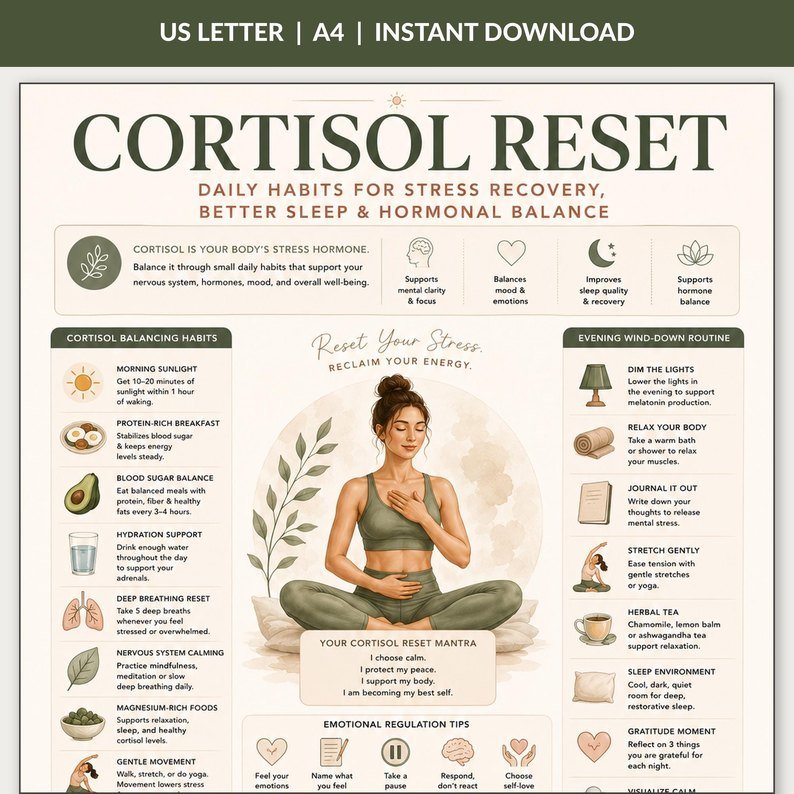
- An infographic poster of daily habits for stress recovery, better sleep and hormonal balance
- 12 cortisol balancing habits, from morning sunlight and a protein-rich breakfast to a screen detox before bed
- A 10-step evening wind-down routine: dim the lights, journal it out, herbal tea, gratitude moment and more
- Also on the chart: emotional regulation tips, lifestyle habits, burnout triggers, wellness tools and a daily reset mantra
- Print sizes A4 and US Letter, as 2 PDFs per the listing (the listing does not state A5, a PNG or a ZIP)
- Instant download · Print at home · US Letter · A4
Use code BLOG10 for 65% OFF at Etsy checkout!
What Is on the Cortisol Reset Chart
The chart opens with one plain line: cortisol is your body’s stress hormone. It then says you can balance it through small daily habits that support your nervous system, hormones, mood and overall well-being. Four small icons sit next to that: supports mental clarity and focus, balances mood and emotions, improves sleep quality and recovery, and supports hormone balance. Those are the chart’s own words. I’d read them as goals rather than promises.
The left column is Cortisol Balancing Habits, 12 of them. Morning sunlight: get 10 to 20 minutes of sunlight within 1 hour of waking. Protein-rich breakfast: it stabilizes blood sugar and keeps energy levels steady. Blood sugar balance: eat balanced meals with protein, fiber and healthy fats every 3 to 4 hours. Hydration support: drink enough water throughout the day to support your adrenals. Deep breathing reset: take 5 deep breaths whenever you feel stressed or overwhelmed. Nervous system calming: practice mindfulness, meditation or slow deep breathing daily.
The column carries on. Magnesium-rich foods: the chart says they support relaxation, sleep and healthy cortisol levels. Gentle movement: walk, stretch or do yoga, because movement lowers stress and supports mood. Evening routine: create a consistent wind-down routine to signal safety. Sleep hygiene: keep a regular sleep schedule and optimize your sleep environment. Screen detox: reduce screen time, especially 1 to 2 hours before bed. Calming bedtime habits: herbal tea, reading, journaling or gentle stretching before bed.
A quick note on the wording. The line about water supporting your adrenals, and the line about magnesium-rich foods and healthy cortisol levels, are how the chart puts it. I wouldn’t lean on either as a medical claim. Drinking enough water and eating some leafy greens, nuts or beans are sensible habits anyway, and that’s reason enough to keep them on the list.
The right column is the Evening Wind-Down Routine, 10 steps. Dim the lights: lower the lights in the evening to support melatonin production. Relax your body: take a warm bath or shower to relax your muscles. Journal it out: write down your thoughts to release mental stress. Stretch gently: ease tension with gentle stretches or yoga. Herbal tea: chamomile, lemon balm or ashwagandha tea to support relaxation. Sleep environment: a cool, dark, quiet room for deep, restorative sleep. Gratitude moment: reflect on 3 things you are grateful for each night. Visualize calm: imagine a place or moment that makes you feel safe. Let go of the day: release what you cannot control. Affirm and reset: speak kind, calming words to yourself.
One word on the herbal teas. Ashwagandha is an herb, and herbs can interact with medicines or not suit everyone, including people who are pregnant. If you take regular medication, ask your pharmacist or doctor before adding it. Chamomile or a plain warm drink does the same job of marking the end of the day.
In the centre of the chart sits the cortisol reset mantra: I choose calm. I protect my peace. I support my body. I am becoming my best self. Above it, a script line reads Reset your stress, reclaim your energy. Below it are five emotional regulation tips: feel your emotions, name what you feel, take a pause, respond, don’t react, and choose self-love.
Then comes a block of ten cortisol-lowering lifestyle habits: spend time in nature, laugh and do things you love, connect with supportive people, practice daily gratitude, set boundaries that protect your peace, take breaks without guilt, say no to over-commitment, keep your space calm and clean, listen to calming music, and move your body daily.
Along the bottom are two boxes I find especially useful. Burnout Triggers lists ten things: chronic stress, poor sleep, excess caffeine, dehydration, skipping meals, over-stimulation, screen overload, lack of movement, emotional exhaustion and over-working. Wellness Tools to Support You lists ten more: herbal tea, a magnesium supplement, a water bottle, an eye mask, a journal, a candle, a diffuser, calming music, a yoga mat and sleep essentials. The footer reads Small habits. Big change. Lasting results.
The magnesium supplement in the tools box is the one item I’d check with a doctor or pharmacist first, especially if you have kidney problems or take other medicines. Everything else on the chart is a habit or an object you probably already own. If the habits feel like a lot, our guide to nervous system regulation explains the calming side of this in plain terms.
Worked Day: A Cortisol Reset Day From Morning to Bed
The chart doesn’t give a timetable, so here is one way to lay its habits across a normal weekday. Every habit below is on the chart. The times are my suggestion. Move them to fit your own day, and don’t try to do all 22 habits on day one.
| Time of day | Habit from the chart | What the chart says |
|---|---|---|
| On waking | Morning sunlight | 10 to 20 minutes of sunlight within 1 hour of waking |
| Breakfast | Protein-rich breakfast | Stabilizes blood sugar and keeps energy steady |
| Mid-morning | Hydration support | Drink enough water throughout the day |
| Lunch | Blood sugar balance | Balanced meals with protein, fiber and healthy fats every 3 to 4 hours |
| Stressful moment | Deep breathing reset | Take 5 deep breaths when stressed or overwhelmed |
| Afternoon | Gentle movement | Walk, stretch or do yoga |
| Early evening | Screen detox | Reduce screen time, especially 1 to 2 hours before bed |
| Evening | Dim the lights, herbal tea, journal it out | Lower the lights, a calming tea, write down your thoughts |
| Bedtime | Gratitude moment, let go of the day | Reflect on 3 things you are grateful for, release what you cannot control |
Morning first. The chart’s first habit is 10 to 20 minutes of sunlight within an hour of waking. In practice that can be your coffee by an open window, a short walk to the shop, or standing in the garden while the kettle boils. It doesn’t need to be a workout. Then a protein-rich breakfast. Eggs are the obvious choice, but plain yogurt with nuts or beans on toast fit the idea too.
Through the day, the chart asks for balanced meals with protein, fiber and healthy fats every 3 to 4 hours, plus enough water. That’s the steady-energy part of the plan. Long gaps without food and a lot of coffee are both on the chart’s burnout trigger list, so this is where the two halves of the chart meet. If you usually skip lunch and run on caffeine until four, start there.
Keep the deep breathing reset in your pocket for the hard moments. Five deep breaths when you feel stressed or overwhelmed. Before a difficult phone call. In the car before you walk into the house. After an email that makes your shoulders climb. It takes under a minute, and it’s an easy one to remember.
Afternoon is a good time for gentle movement, and the chart keeps it simple: walk, stretch, or do yoga. A ten-minute walk after lunch counts. So do a few stretches between meetings. The chart says movement lowers stress and supports mood. You don’t need a hard workout for this. Gentle is the word on the chart.
The evening is where the right-hand column takes over. One to two hours before bed, cut back on screens. Dim the lights. Have a warm bath or shower if you can. Make a cup of chamomile or lemon balm tea. Write a few lines in a notebook about what’s on your mind, so it’s on paper and not in your head. Do a couple of gentle stretches. Then, once you’re in bed, the last three steps: think of three things you’re grateful for, picture a place where you feel safe, and let go of what you can’t control tonight.
For a ready-made start to the day built on the same idea, our morning nervous system reset routine is five minutes long and fits neatly before the sunlight habit. And if the deep breathing reset helps, the breathwork for anxiety guide has seven more breathing exercises to try.
Pick three habits for the first week. A good trio is morning sunlight, the five deep breaths, and the screen detox before bed. Add one more habit each week. By the end of a month you’ll have most of the chart in your day without having had to change everything at once. Our 30-day nervous system reset challenge works the same way, one small step a day.

- A companion chart: 16 simple techniques to support calm, relaxation and nervous system wellness
- Techniques include deep belly breathing, humming, cold face splash, alternate nostril breathing and legs up the wall
- Timings on the chart: deep belly breathing 10 breaths, humming 30 seconds, legs up the wall 3 minutes
- A daily calm tracker, a wellness benefits box and safety notes, per the listing
- Print sizes US Letter, A4 and A5, as 3 PDFs plus a 300 DPI PNG and a ZIP per the listing
- Instant download · Print at home · US Letter · A4 · A5
Use code BLOG10 for 65% OFF at Etsy checkout!
The Vagus Nerve Routine as a Calming Companion
The second chart is not about cortisol. It’s called Vagus Nerve Exercises, with the subtitle 16 Simple Techniques To Support Calm, Relaxation and Nervous System Wellness. Across the top it lists six aims: promote relaxation, reduce stress, support nervous system, improve calm, better sleep support, and mind-body wellness. I’ve included it because the cortisol chart tells you to practise deep breathing and nervous system calming every day, but it doesn’t go into much detail. This chart does.
Techniques 1 to 4 are quick resets. Deep belly breathing: breathe deeply into the belly, for 10 breaths. Humming: create a gentle humming vibration, for 30 seconds. Cold face splash: splash cool water onto your face, for 10 seconds. Gargling water: gargle firmly and slowly, for 30 seconds. All four take less than two minutes together, and three of them can be done at a bathroom sink.
Techniques 5 to 8 slow things down. Eye movement exercise: look left and right slowly, for 10 reps. Alternate nostril breathing: alternate nostrils while breathing, for 1 minute. Neck stretch: stretch gently side to side, for 20 seconds per side. Slow walking: walk slowly with mindful breathing, for 2 minutes.
Techniques 9 to 12 are the gentle, slightly playful ones. Singing: sing or hum your favorite song, for 1 minute. Ear massage: massage your outer ears gently, for 30 seconds. Legs up the wall: rest your legs up a wall comfortably, for 3 minutes. Chest tapping: tap your chest lightly and rhythmically, for 30 seconds. Singing in the kitchen counts, and I’d say it’s one of the nicer habits on either chart.
Techniques 13 to 16 close the routine. Positive visualization: imagine yourself in a peaceful place, for 1 minute. Gentle yoga stretch: perform a slow seated stretch, for 30 seconds. Laughter exercise: smile and laugh on purpose, for 1 minute. Mindful meditation: focus quietly on breathing, for 3 minutes. The banner along the bottom reads Small daily practices can create big calm.
The listing’s print preview shows three more panels below the techniques. A daily calm tracker with a box for each day from Monday to Sunday and the line “Consistency creates calm. Small steps lead to lasting change.” A wellness benefits box: support relaxation, calm the nervous system, reduce daily stress, improve emotional balance, support better sleep, and improve mind-body awareness. And a safety notes box: practice gently, stay comfortable, breathe naturally, stop if dizzy, and consult a healthcare professional if needed. One of the listing photos shows a framed version without these three panels, so the exact layout may differ slightly between the print files.
How the two charts fit together. Use the cortisol chart as the plan for your day, and the vagus nerve chart as the toolkit for the moments in between. When the cortisol chart says deep breathing reset, do technique 1. When it says nervous system calming, pick any three from techniques 1, 2, 6 and 16. When the evening wind-down says stretch gently, technique 11, legs up the wall, is a lovely three minutes before bed. You don’t need all 16 techniques. You’ll probably settle on four or five favourites.
A short evening combination that works well: humming for 30 seconds, alternate nostril breathing for 1 minute, legs up the wall for 3 minutes, then mindful meditation for 3 minutes. That’s under eight minutes, straight from the chart, and it slots into the cortisol chart’s wind-down between the herbal tea and the gratitude moment.
When Stress Needs More Than a Chart
Everyday stress is normal, and small habits can help you recover from it. But some signs mean it’s time to talk to a professional rather than add another habit. See your doctor if you feel low or anxious most days for more than a couple of weeks, if sleep problems carry on despite a good routine, or if stress is affecting your work, relationships or eating. If you ever have thoughts of harming yourself, contact emergency services or a crisis line straight away.
Cortisol itself can be affected by medical conditions and by some medicines, such as steroid tablets. Symptoms like rapid weight gain around the middle, easy bruising, muscle weakness, or extreme tiredness and dizziness are reasons to see a doctor, not to try harder with a chart. Only a doctor can test cortisol properly. Online quizzes and social media “cortisol face” posts can’t.
Be gentle with the vagus nerve techniques too. Stop if you feel dizzy, as the chart’s safety notes say. Breathing exercises can make some people light-headed, especially at first, so sit down for them and keep the breaths relaxed rather than forced. Skip the cold face splash if you have a heart condition, and check with your doctor first if you’re unsure. Legs up the wall isn’t for everyone, either. Ask your doctor first if you’re pregnant, have glaucoma, or have a back or neck problem.
Watch the caffeine and screens. Both are on the burnout trigger list, and they’re the two things most people can change this week. Try a cut-off time for coffee in the early afternoon, and keep your phone out of the bedroom. Those two changes will probably do more for your evenings than anything in the wellness tools box.
And keep it kind. The point of a reset is not to add pressure. If you miss a day, pick up the next morning with the sunlight habit and carry on. The chart’s footer says small habits, big change, lasting results. The habits are small on purpose.
Frequently Asked Questions
What is a cortisol reset?
A cortisol reset is a popular name for building small daily habits that help your body recover from stress, such as morning sunlight, regular balanced meals, gentle movement and a calm evening routine. It is not a cleanse or a medical treatment. The chart in this guide lists 12 daytime habits and a 10-step evening wind-down.
What habits are on the cortisol reset chart?
The daytime habits are morning sunlight, a protein-rich breakfast, blood sugar balance, hydration, a deep breathing reset, nervous system calming, magnesium-rich foods, gentle movement, an evening routine, sleep hygiene, a screen detox and calming bedtime habits. The evening routine adds steps like dimming the lights, journaling, herbal tea and a gratitude moment.
Why is a vagus nerve chart paired with a cortisol chart?
The shop has one cortisol chart, and it tells you to practise deep breathing and nervous system calming daily without showing how. The vagus nerve chart fills that gap with 16 simple techniques, such as deep belly breathing for 10 breaths, humming for 30 seconds and legs up the wall for 3 minutes. It does not mention cortisol itself.
When should I see a doctor about stress or cortisol?
See a doctor if you feel low or anxious most days for more than a couple of weeks, if poor sleep carries on despite a good routine, or if you have symptoms like rapid weight gain around the middle, muscle weakness or extreme tiredness and dizziness. Only a doctor can test cortisol properly. Seek urgent help if you have thoughts of harming yourself.
What sizes do the cortisol reset and vagus nerve charts print in?
The cortisol reset chart prints in A4 and US Letter, as 2 PDFs per the listing, with no A5 stated. The vagus nerve chart prints in US Letter, A4 and A5, as 3 PDFs plus a 300 DPI PNG and a ZIP per the listing. Both are instant downloads you print at home.
This guide is for general wellness and is not medical advice. Check with your doctor before starting a new routine.
Related Guides
- Nervous System Regulation
- Morning Nervous System Reset Routine
- Breathwork for Anxiety
- 30-Day Nervous System Reset Challenge
Sources
Sources: Cleveland Clinic, How to Reduce Cortisol, NIH PubMed Central, Sleep and Circadian Regulation of Cortisol