
Nervous system regulation sounds like a big phrase for something most of us do without thinking about it. A slow breath before a hard call. A walk round the block when the day gets loud. A cup of tea and ten quiet minutes. Those small moves are regulation in action. They are the body shifting out of a wired or shut down state and back toward calm, and this guide walks through a chart that puts them in one place, so you can see them, pick one, and use it when you need it.
The chart in this guide is a toolkit poster from SoftoTech Print Studio. It starts with three zones, green, yellow and red, then gives quick tools you can use in a few minutes, a short section on vagus nerve activation, and a daily reset. It prints at home in US Letter and A4 sizes, and it works best on a wall or a fridge where you can see it in the moment, not in a drawer where you have to go looking for it. A poster you can see is a tool you can reach for. A poster you cannot see is just paper.
One honest note before we start. Two parts of this chart are cut off on the listing image. Section 3, vagus nerve activation, is cut off below Gargling, so this guide quotes only the legible parts, humming and singing. Section 4, the daily reset, is cut off after the morning items, so this guide quotes only the morning items and does not guess at the rest. The second box below is a vagus nerve exercises chart with 16 techniques, and its last four techniques are named by title only because their durations were cut off. This is a general regulation guide, and it is distinct from the morning reset routine post and the polyvagal explainer already live on this blog. For a related starting point, our breathwork for anxiety guide covers breathing in more detail.
In this guide:
- Know Your Three Zones
- Quick Regulation Tools You Can Use Anywhere
- Vagus Nerve Activation and the 16 Techniques Chart
- Worked Example: A Calmer Day, Built From the Chart
- Frequently Asked Questions

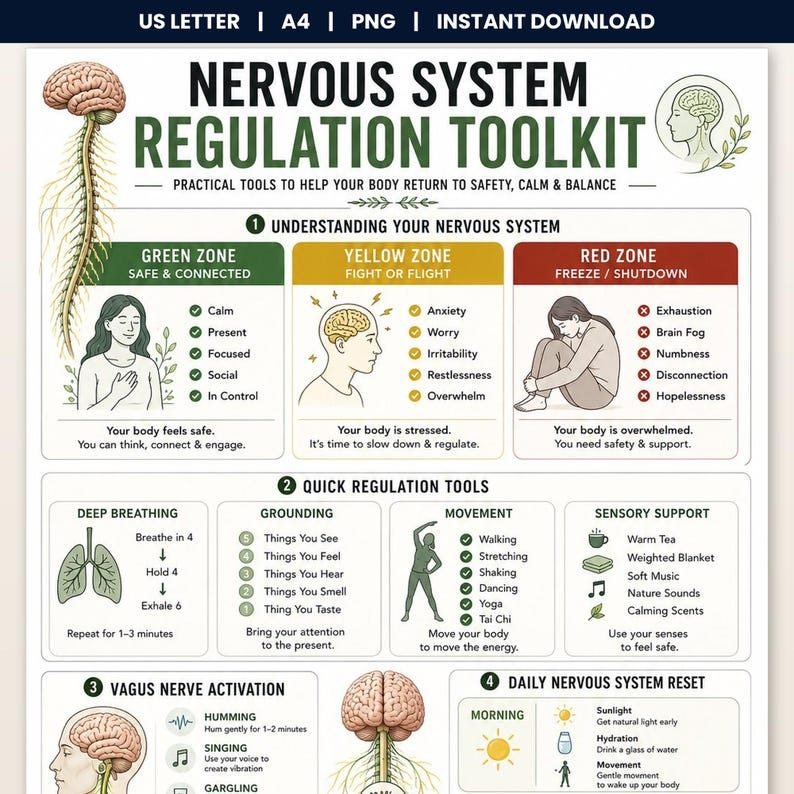
- A regulation toolkit poster: the three zones (green safe and connected, yellow fight or flight, red freeze and shutdown), quick regulation tools, vagus nerve activation and a daily reset
- Green zone signs: calm, present, focused, social, in control; yellow zone signs: anxiety, worry, irritability, restlessness, overwhelm; red zone signs: exhaustion, brain fog, numbness, disconnection, hopelessness
- Quick tools on the chart: deep breathing (in 4, hold 4, exhale 6, repeat 1-3 minutes), grounding through the five senses, movement and sensory support
- Vagus nerve activation on the chart: humming for 1-2 minutes and singing to activate calm
- Print sizes US Letter and A4, as 4 PDFs plus a PNG per the listing (the listing does not state A5)
- Instant download · Print at home · US Letter · A4
Use code BLOG10 for 65% OFF at Etsy checkout!
Know Your Three Zones
The first section of the chart is called Understanding Your Nervous System, and it sorts how we feel into three zones. The green zone is safe and connected. The signs on the chart are calm, present, focused, social and in control. That is the state most of us want to spend the day in, not because it feels exciting, but because it feels steady. Work gets done, conversations feel easy, and the body is not braced for trouble.
The yellow zone is fight or flight. The signs are anxiety, worry, irritability, restlessness and overwhelm. The body is revved up, the mind is racing, and small things feel bigger than they are. Most of us know this zone well. A deadline, a difficult message, a noisy house, a day with too much in it. Yellow is not a failure. It is a signal, and the tools in the next section are for this zone most of all, because yellow is where a short pause can still change the direction of the day.
The red zone is freeze or shutdown. The signs are exhaustion, brain fog, numbness, disconnection and hopelessness. This is the flat, heavy end of the scale, where everything feels like too much and even small tasks feel out of reach. Red needs a gentler approach than yellow. A long walk or a loud workout may be too much. A glass of water, some light, a short stretch, or a quiet minute with music may be the right size. The chart does not rank the zones, and neither does this guide. They are states, not grades, and the point is to notice which one you are in before you pick a tool.
Noticing is the skill that makes the rest work. It does not need a long journal entry. A quick check, am I green, yellow or red right now, takes a few seconds, and it changes what you reach for. Yellow calls for something that slows the breath and the body down. Red calls for something small and kind, something that brings you back into the room. Green calls for nothing at all, except maybe noticing that you are there and enjoying it for a minute. Our morning nervous system reset routine guide gives a short morning version of this check, for readers who want to start the day with it.
| Zone on the chart | What it is called | Signs on the chart |
|---|---|---|
| Green | Safe and connected | Calm, present, focused, social, in control |
| Yellow | Fight or flight | Anxiety, worry, irritability, restlessness, overwhelm |
| Red | Freeze and shutdown | Exhaustion, brain fog, numbness, disconnection, hopelessness |
If the red zone is where you spend most days, or if the feelings are strong and do not lift, that is worth talking about with a doctor or a mental health professional. A poster can help with everyday stress, but it is not a substitute for support when things feel stuck. The same goes for anxiety that keeps you from work, sleep or the people you care about. This guide is general wellness information, and the disclaimer at the end says so in plain words.
Quick Regulation Tools You Can Use Anywhere
The second section of the chart is called Quick Regulation Tools, and it is the most useful part for a busy day. It has four groups, and each one is short enough to do in a few minutes. The first is deep breathing: breathe in for 4, hold for 4, exhale for 6, and repeat for 1 to 3 minutes. The long exhale is the key part. It is slow, it is steady, and it gives the body a clear signal to settle. Try it once now, if you like. In for 4, hold for 4, out for 6. One round takes seconds. Three minutes of it can change the feel of an afternoon.
The second group is grounding through the five senses: things you see, hear, feel, smell and taste. Name one thing for each sense, quietly, in your head or out loud. The chair under you, the sound of traffic, the warmth of a cup, the smell of tea, the taste of water. It sounds simple, and it is, which is why it works when the mind is racing. Grounding pulls attention back to the room you are actually in, rather than the worry you are carrying around in your head.
The third group is movement: walking, stretching, shaking, dancing, yoga and tai chi. Movement does not have to mean exercise. A walk round the block counts. So does a stretch at the desk, a shake of the hands, or a slow turn of the shoulders. The body holds tension, and moving it, even gently, lets some of it go. The fourth group is sensory support: warm tea, a weighted blanket, soft music, nature sounds and calming scents. These are comfort tools, and there is nothing weak about them. A warm drink and a quiet song can be the difference between a day that keeps spiralling and a day that settles.
Pick one tool before you need it. That sounds odd, but it helps. When you are already yellow or red, choosing is hard. When you are green, choosing is easy. So pick one now, breathing or grounding or a short walk, and decide when you will use it. After lunch, before a call, when the house gets loud. A tool with a time attached to it gets used. A tool with no time attached stays on the poster. Our polyvagal theory explained simply with printable chart guide explains the science behind the three zones in plain words, for readers who want the why as well as the how.
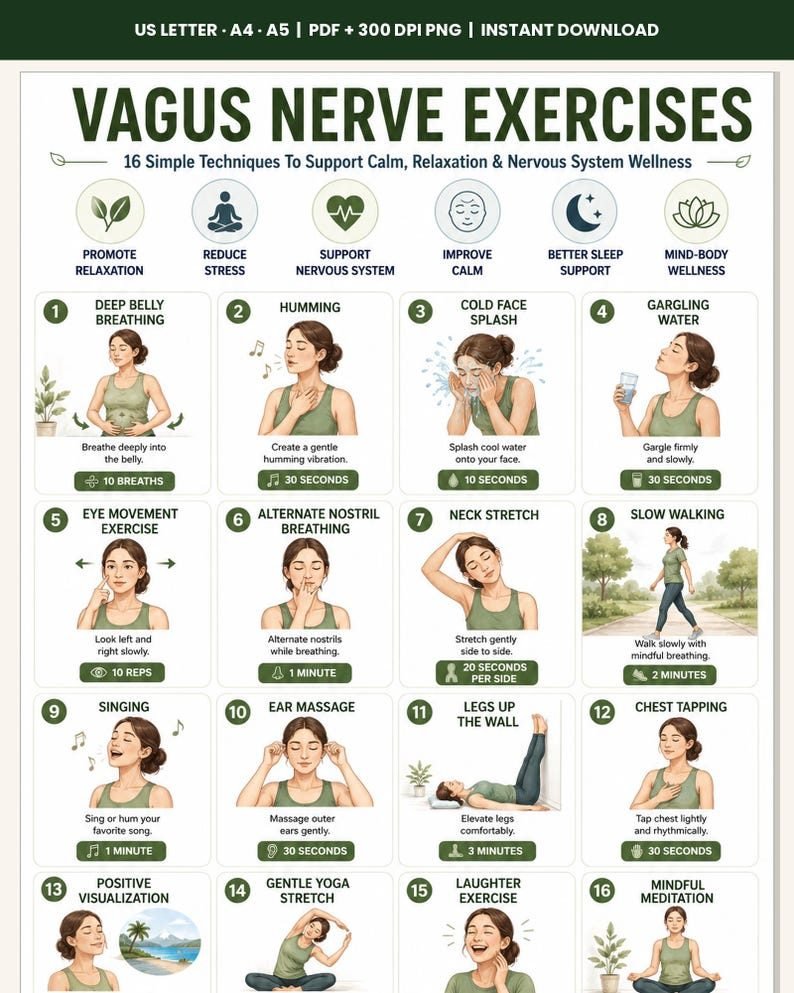
- 16 nervous system regulation techniques on one chart, from breathing and humming to cold face splash and legs up the wall
- The first 12 techniques with times: Deep Belly Breathing 10 breaths, Humming 30 seconds, Cold Face Splash 10 seconds, Gargling Water 30 seconds, Eye Movement Exercise 10 reps, Alternate Nostril Breathing 1 minute
- Neck Stretch 20 seconds per side, Slow Walking 2 minutes, Singing 1 minute, Ear Massage 30 seconds, Legs Up The Wall 3 minutes, Chest Tapping 30 seconds
- The last four techniques are Positive Visualization, Gentle Yoga Stretch, Laughter Exercise and Mindful Meditation; their durations were cut off on the chart, so they are named by title only
- Print sizes US Letter, A4 and A5, as 3 PDFs plus a PNG and a ZIP per the listing
- Instant download · Print at home · US Letter · A4 · A5
Use code BLOG10 for 65% OFF at Etsy checkout!
Vagus Nerve Activation and the 16 Techniques Chart
The third section of the toolkit poster is called Vagus Nerve Activation. The vagus nerve runs from the brain down through the body, and it plays a part in the calm side of the nervous system. The chart lists humming, hum gently for 1 to 2 minutes, and singing, use your voice to activate calm. Then the text is cut off below Gargling, so this guide does not quote what comes after it. Humming and singing are easy to try, and they are easy to fit into a normal day. Hum while you make tea. Sing along to a song in the car. The sound itself, low and steady, is the point, not the tune.
The second box above is a vagus nerve exercises chart with 16 nervous system regulation techniques, from breathing and humming to cold face splash and legs up the wall. The first 12 techniques come with times, and they are listed here as printed. Deep Belly Breathing, 10 breaths. Humming, 30 seconds. Cold Face Splash, 10 seconds. Gargling Water, 30 seconds. Eye Movement Exercise, 10 reps. Alternate Nostril Breathing, 1 minute. Neck Stretch, 20 seconds per side. Slow Walking, 2 minutes. Singing, 1 minute. Ear Massage, 30 seconds. Legs Up The Wall, 3 minutes. Chest Tapping, 30 seconds.
The last four techniques are Positive Visualization, Gentle Yoga Stretch, Laughter Exercise and Mindful Meditation. Their durations were cut off on the chart, so they are named by title only. That matters, because it would be easy to invent a time for them, and this guide does not do that. If you want to try one, use the time that feels right for the moment, a minute or two, and stop if it does not help. The chart also carries six small icons at the top: promote relaxation, reduce stress, support nervous system, improve calm, better sleep support and mind-body wellness. Those are the aims of the chart, not promises. A technique can help you feel calmer in the moment, and that is enough to ask of it.
Cold face splash deserves a note, because it is the most surprising one on the list. Ten seconds of cold water on the face is short, sharp and very physical, and for some people it breaks a spiral of worry faster than breathing alone. It is not for everyone, and it is not a medical treatment. Try it once on a calm day, see how it feels, and keep it in the toolkit only if it helps. Legs up the wall is the opposite end of the scale, three quiet minutes with your legs resting up a wall, which suits an evening better than a work break. The chart gives you both ends, fast and slow, and the skill is picking the one that fits the moment you are in.
Our 12 somatic exercises to calm your nervous system in 5 minutes guide covers body based moves in the same spirit, short exercises you can do in five minutes when the day feels too much. The two charts work well together, one for noticing the zone and picking a tool, the other for moving the body through it.
Worked Example: A Calmer Day, Built From the Chart
Here is a worked day built only from the toolkit poster, with the vagus nerve chart used for the evening. It is a normal weekday, not a retreat, and every step comes from the chart. Nothing here needs special equipment, and nothing here takes more than a few minutes at a time.
Morning reset. The fourth section of the poster is called Daily Nervous System Reset, and only its morning items are legible. Sunlight, get natural light early. Hydration, drink a glass of water. Movement, gentle movement to wake up your body. The rest of the section is cut off, so this guide stops there and does not guess at the rest. Three items is enough for a morning. Step outside for a minute or stand by a window. Drink a glass of water before the tea. Stretch for a minute, shoulders, neck, a slow turn each way. Then check the zone. Green, yellow or red, just a quick note to yourself, and pick one tool for the day.
Through the day, use the quick tools. Before a hard call, do the breathing pattern from the chart, in for 4, hold for 4, exhale for 6, repeat for 1 to 3 minutes. Between tasks, try grounding through the five senses, one thing you see, hear, feel, smell and taste. If the afternoon feels flat and heavy, that is the red zone asking for something small, warm tea, soft music, or a short walk rather than a hard push. If the afternoon feels wired and restless, that is yellow, and a walk, a stretch or a shake of the hands fits better. The tool changes with the zone, and the zone check takes seconds.
Evening, a vagus nerve activation moment. Pick one technique from the 16 technique chart. Humming for 30 seconds is a good one, quiet and easy. Singing for 1 minute works too, along to a song you like. Legs Up The Wall for 3 minutes suits the end of the day, legs resting up the wall while you breathe slowly. Or try Ear Massage for 30 seconds, slow and gentle. One technique is enough. The point is not to do all 16, it is to do one, properly, and notice how the body feels after it.
That is the whole day. Morning light, water and gentle movement. Quick tools through the day, matched to the zone. One vagus nerve technique in the evening. A poster on the wall, a check that takes seconds, and a tool picked before you need it. If a day goes badly despite all of it, that is normal too. Regulation is a practice, not a switch, and a bad day does not mean the tools failed. It means the day was hard, and tomorrow is another chance to try them again.
If stress keeps you wired at night, our cortisol reset guide turns small daily habits and an evening wind-down into one printable chart.
Frequently Asked Questions
What is nervous system regulation?
Nervous system regulation is the everyday work of helping your body shift back toward calm when stress, worry or exhaustion push it off balance. The chart in this guide sorts those states into three zones, green for safe and connected, yellow for fight or flight, red for freeze and shutdown, and gives quick tools for each one, from breathing to grounding and gentle movement.
How do I know which zone I am in?
Check the signs on the chart. Green feels calm, present, focused, social and in control. Yellow feels like anxiety, worry, irritability, restlessness and overwhelm. Red feels like exhaustion, brain fog, numbness, disconnection and hopelessness. A quick check, green, yellow or red, takes a few seconds, and it tells you which tool fits the moment.
What is the breathing pattern on the nervous system regulation chart?
The chart gives a simple pattern for nervous system regulation: breathe in for 4, hold for 4, exhale for 6, and repeat for 1 to 3 minutes. The long exhale is the key part. Try it before a hard call or when the afternoon feels wired, and see how the body feels after a few rounds.
What vagus nerve techniques are on the chart?
The vagus nerve exercises chart lists 16 nervous system regulation techniques. The first 12 with times are Deep Belly Breathing for 10 breaths, Humming for 30 seconds, Cold Face Splash for 10 seconds, Gargling Water for 30 seconds, Eye Movement Exercise for 10 reps, Alternate Nostril Breathing for 1 minute, Neck Stretch for 20 seconds per side, Slow Walking for 2 minutes, Singing for 1 minute, Ear Massage for 30 seconds, Legs Up The Wall for 3 minutes and Chest Tapping for 30 seconds. The last four are named by title only, because their durations were cut off.
What size is the printable nervous system regulation toolkit?
The SoftoTech Print Studio Nervous System Regulation Toolkit is an instant download that prints at home in US Letter and A4 sizes, as 4 PDFs plus a PNG per the listing. The listing does not state A5. Put it where you can see it in the moment, on a wall or a fridge, so the tools are easy to reach for.
This guide is for general wellness and is not medical advice. Check with your doctor before starting a new routine.
Related Guides
- Breathwork for Anxiety
- Morning Nervous System Reset Routine
- Polyvagal Theory Explained Simply with Printable Chart
- 12 Somatic Exercises to Calm Your Nervous System in 5 Minutes
Sources
Sources: National Institute of Mental Health, CDC: Stress