
Good cheese board ideas all follow the same hidden formula: a small number of cheeses chosen from different styles, something fresh, something crunchy, something sweet, something briny, and crackers to carry it all. Once you see the formula, you stop standing in the cheese aisle guessing, and any board, for two people or twenty, becomes a five minute decision.
The boards that fail usually fail in one of two ways: five cheeses that are all basically the same, or a random pile with nothing to eat them on. That is why this guide is built around one printed chart: a cheese board builder that prints the formula and the six cheese styles on a single page, with a companion guide to 80 plus cheese varieties when you want to go deeper.
Below you will find the board formula, the six cheese styles on the chart and how to pick from them, accompaniment rules, a worked example that builds a four cheese board for a dinner party, and the matching printable charts from SoftoTech Print Studio.
In this guide:
- The Cheese Board Formula
- The Six Cheese Styles: Soft, Semi-Soft, Hard, Aged, Blue, Fresh
- Accompaniments: Fresh, Crunchy, Sweet, Briny
- Worked Example: A Four Cheese Board for Six
- Frequently Asked Questions

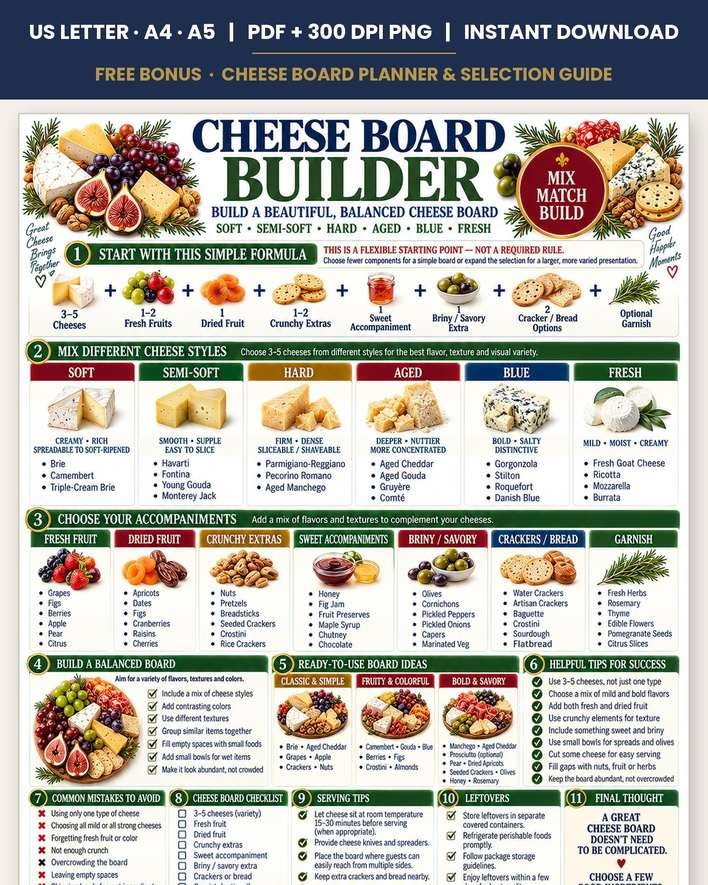
The printable from this guide
Cheese Board Builder: Build a Beautiful Balanced Selection
- The board formula on one chart: 3 to 5 cheeses plus fruits, crunchy extras, a sweet accompaniment, a briny extra and crackers or bread
- Cheese styles covered: Soft, Semi-Soft, Hard, Aged, Blue and Fresh, with a build a balanced board walkthrough
- The worked board for six in this guide fills one slot from four of these styles
- Free bonus shown on the listing: Cheese Board Planner and Selection Guide
- Print sizes US Letter, A4 and A5, as 3 PDFs plus a 300 DPI PNG
- Instant download · Print at home · US Letter · A4 · A5
Use code BLOG10 for 65% OFF at Etsy checkout!
Get the Cheese Board Builder on Etsy →
The Cheese Board Formula
The printable chart in this guide, the Cheese Board Builder, prints the formula at the top: start with 3 to 5 cheeses, then add fruits, crunchy extras, a sweet accompaniment, a briny extra, and crackers or bread. That single line is the whole method. Three cheeses is the right number for a small board, four or five for a party board, and more than five usually means two cheeses end up ignored.
The formula works because it assigns every item a job. Cheese is the centre, fruit refreshes, crunch contrasts the softness, sweet balances salt, briny cuts richness, and crackers deliver all of it. When a board feels wrong, one job is missing or doubled. Our cheese pairing guide takes the next step, matching specific cheeses with specific partners, and the general grazing method behind both is in our charcuterie board ideas for beginners.
The Six Cheese Styles: Soft, Semi-Soft, Hard, Aged, Blue, Fresh
The chart groups cheeses into six styles: Soft, Semi-Soft, Hard, Aged, Blue and Fresh. The picking rule is simple: choose your cheeses from different styles, never two from the same style unless one is a deliberate star. A classic party selection takes one Soft, one Hard or Aged, one Blue, and one Fresh or Semi-Soft, which gives guests a creamy, a firm, a bold and a mild option on the same board.
| Style on the chart | Character | Board job |
|---|---|---|
| Soft | Creamy, spreadable, rich | The luxury centre of the board |
| Semi-Soft | Smooth, mild, easy slicing | The crowd pleaser everyone can eat |
| Hard | Firm, savoury, sliceable | Structure and salty depth |
| Aged | Concentrated, crystalline, complex | The connoisseur pick, used in smaller amounts |
| Blue | Bold, tangy, veined | The strong accent a little of goes far |
| Fresh | Light, milky, gentle | The reset bite between stronger cheeses |
The second chart in this guide, the Ultimate Cheese Guide, lists 80 plus cheeses in categories from Fresh and Unripened through Bloomy Rind, Semi-Soft, Washed Rind, Firm, Aged and Hard, to Blue and Veined, with serving notes. Use the builder to choose the board, and the guide to choose which specific cheese fills each style slot, especially when you want to try something new without gambling the whole board on it.

The cheese variety reference
Ultimate Cheese Guide: 80+ Types and Varieties Chart
- 80 plus cheeses organised in categories: Fresh and Unripened, Bloomy-Rind Soft-Ripened, Semi-Soft and Supple, Washed-Rind Aromatic, Firm and Nutty, Aged and Hard, Blue and Veined, with serving notes
- Use it to fill each style slot on the builder with a specific cheese, including one new cheese per board
- Free bonus shown on the listing: Cheese Tasting Journal and Cheeses To Try List
- Print sizes US Letter, A4 and A5, as 3 PDFs plus a 300 DPI PNG
- Instant download · Print at home · US Letter · A4 · A5
Use code BLOG10 for 65% OFF at Etsy checkout!
Get the Ultimate Cheese Guide on Etsy → Instant download · Print at home
Accompaniments: Fresh, Crunchy, Sweet, Briny
With the cheeses chosen, the formula asks for four supporting groups. Fresh: grapes, apple or pear slices, figs or berries, placed in two or three clusters so every part of the board has a fresh bite nearby. Crunchy: nuts and sturdy snacks that contrast the cheese textures. Sweet: honey, jam or dried fruit, the classic partner for salty and blue cheeses. Briny: olives or pickles, whose acidity resets the palate. Then crackers and bread in at least two forms, one plain and one seeded or flavoured, in stacks at the edges where hands reach them easily.
Two serving rules from the chart are worth following exactly. Take cheeses out of the fridge well before serving so they are cool rather than fridge cold when guests eat them, because flavour and texture both open up as cheese loses its chill. And give every cheese its own knife or spreader: a soft cheese dragged through the blue will flavour everything it touches, and the board will look cared for for much longer.
Quantities follow the same grazing maths as any board: our portions per person guide gives amounts for appetizer and main course boards for 2 to 50 guests. Cheese boards served as the main event need the main course column, not the appetizer one.
Worked Example: A Four Cheese Board for Six
Here is the formula run once, for six people before dinner. Slot one, Soft: the creamy centre. Slot two, Aged: a firm, complex wedge in smaller quantity. Slot three, Blue: the bold accent, kept in one corner. Slot four, Fresh: the light option that keeps the board approachable. Accompaniments by job: grapes and figs as fresh clusters, nuts as the crunchy scatter, honey in a small pot beside the blue, olives as the briny bowl, and two crackers, plain and seeded, along both long edges.
Assembly takes ten minutes. Cheeses down first, spaced apart, with room around each. Bowls for honey and olives next. Crackers in fans and stacks at the edges. Fruit in clusters between the cheeses. Nuts and any dried fruit last, into every gap, which is what makes a board read as generous. Add the small printable labels from the builder listing if guests will want to know what they are eating, and they usually do with cheese. When this board grows into a full grazing table, the charcuterie board ingredients checklist covers the wider shopping list, and the Thanksgiving charcuterie board guide shows the formula wearing fall flavours.
For the fruit layer of your board, our guide to fruits for charcuterie board covers 104 fruit ideas, eight cheese pairings and how much to buy.
Frequently Asked Questions
How many cheeses should be on a cheese board?
Three to five, chosen from different styles. The builder chart in this guide groups cheese into six styles, Soft, Semi-Soft, Hard, Aged, Blue and Fresh, and its formula starts with 3 to 5 cheeses plus fruit, crunchy extras, a sweet accompaniment, a briny extra and crackers or bread. More than five cheeses usually means some are ignored.
What should I serve with a cheese board?
One item for each job: something fresh such as grapes, apple or figs, something crunchy such as nuts, something sweet such as honey or jam, something briny such as olives or pickles, and crackers or bread in at least two forms. Each cheese should have its own knife so flavours do not cross.
Should cheese be served cold or at room temperature?
Cool, not fridge cold. Take cheeses out of the fridge well before serving so they lose their chill: texture softens and flavour opens up. Keep the board out of direct heat, refresh perishable accompaniments as needed, and return leftovers to the fridge promptly after serving.
How do I choose a cheese I have never tried?
Choose by style slot, not by name. Decide which slot is open, for example the Aged slot, then use a reference like the Ultimate Cheese Guide in this post, which lists 80 plus cheeses in categories with serving notes, to pick one cheese for that slot. The rest of the board stays familiar, so one new cheese is an adventure, not a gamble.
What size is the printable cheese board chart?
The SoftoTech Print Studio Cheese Board Builder is an instant download that prints at home in US Letter, A4 and A5 sizes, as 3 PDFs plus a 300 DPI PNG per the listing. It prints the board formula and the six cheese styles, and comes with a free bonus Cheese Board Planner and Selection Guide.
This guide is for general wellness and is not medical advice. Check with your doctor before starting a new routine.
Related Guides
- Cheese Pairing Guide
- Charcuterie Board Ideas for Beginners
- Charcuterie Board Ingredients: The Complete Checklist
- How Much Charcuterie Per Person: Portions for 2 to 50 Guests
- Thanksgiving Charcuterie Board
Sources
Sources: USDA Food Safety and Inspection Service: Food Safety Basics, FDA: Buy, Store and Serve Safe Food
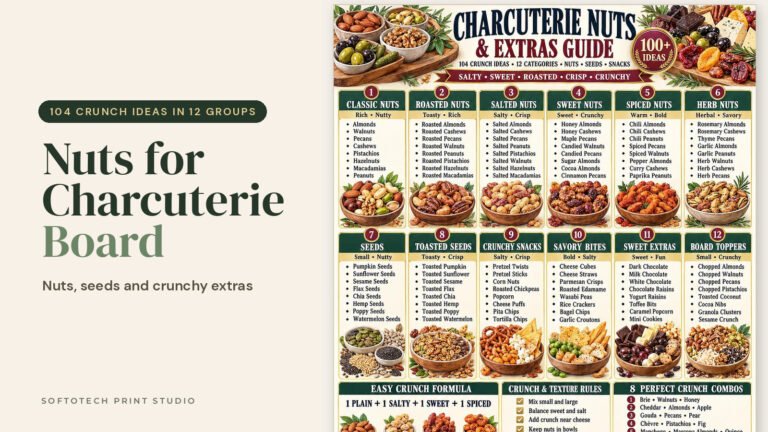 Charcuterie & EntertainingNuts for Charcuterie Board: 104 Crunchy Ideas in 12 Groups, 8 Pairings and How Much to Buy
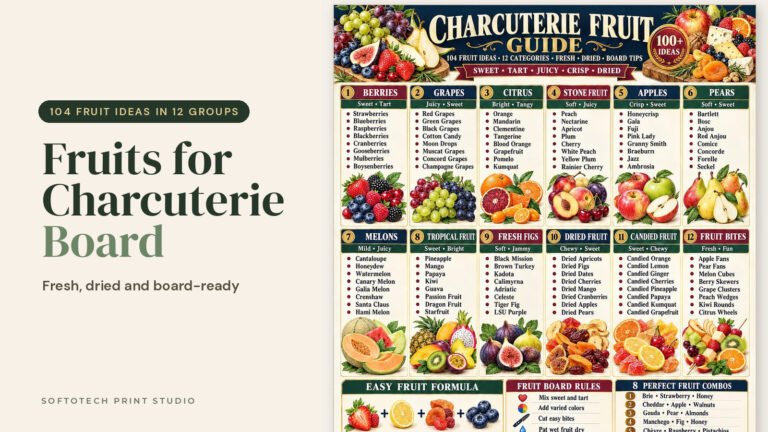 Charcuterie & EntertainingFruits for Charcuterie Board: 104 Ideas in 12 Groups, Pairings and Quantities
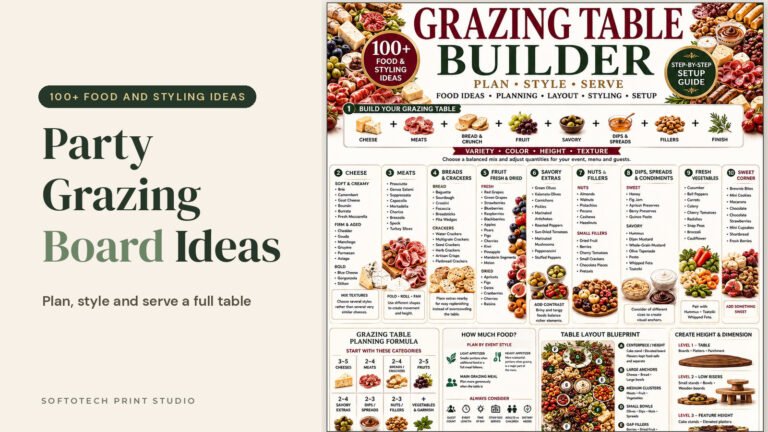 Charcuterie & EntertainingParty Grazing Board Ideas: 100+ Foods and a Simple Setup Plan