
Lunch is the meal that falls apart first, which is why heart healthy lunch ideas are worth having on paper. Breakfast is easy to repeat and dinner usually gets cooked at home, but lunch happens at work, on the move, or standing at the counter with whatever’s in the fridge. This guide gives you 50 salads, bowls, wraps and soups for that, most of which pack into a tub and travel well.
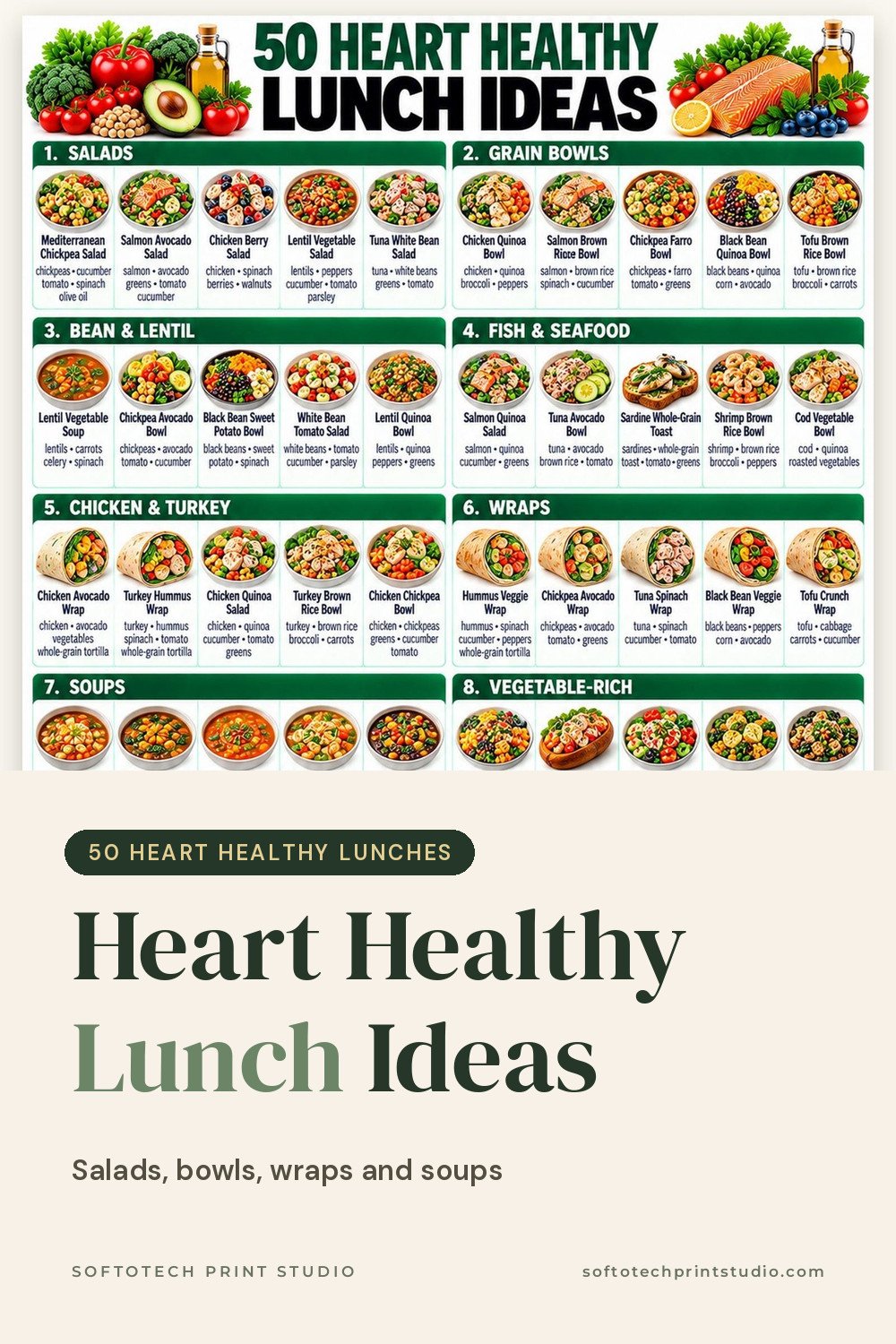
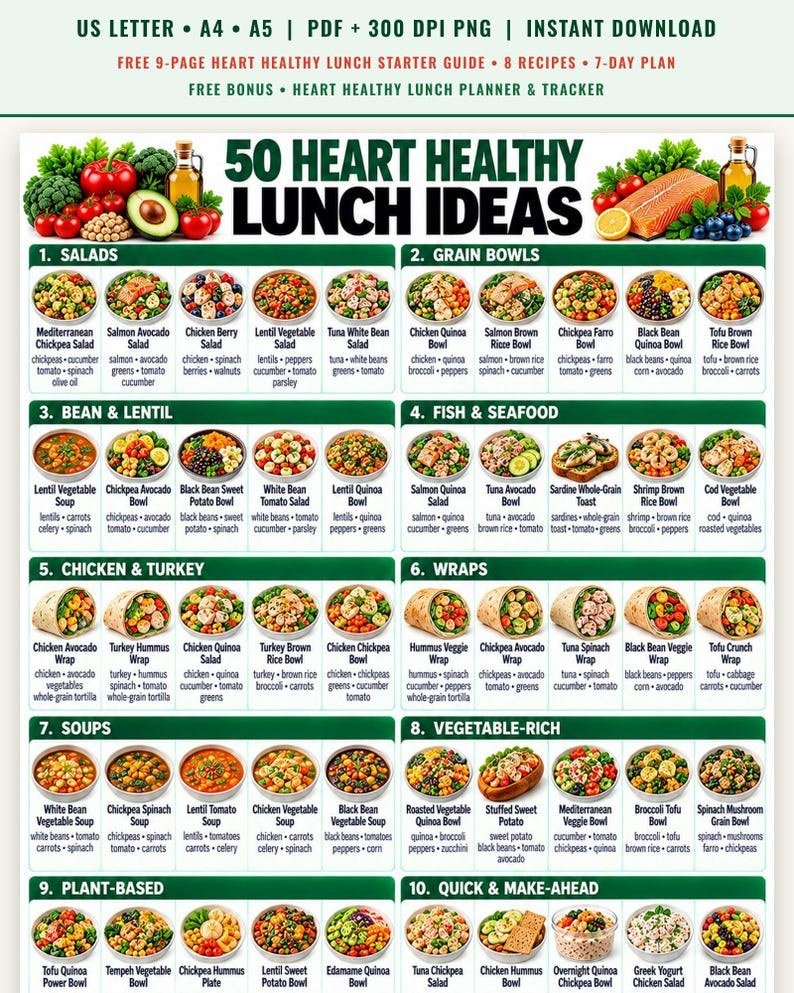
The guide is built around the 50 Heart Healthy Lunch Ideas chart from SoftoTech Print Studio. It’s a single page of 50 lunches in ten color-coded groups of five, each with a small photo, a name and its key ingredients. The second printable is the shop’s Heart Healthy 7-Day Meal Plan, which puts lunches like these into a full week with breakfast, dinner and snacks.
I’ll go through all 50 lunches first, group by group. Then there’s a worked week of packed lunches with a simple Sunday prep plan, a look at the 7-day plan, and a last section on what makes a lunch heart healthy and how to read a label quickly, using NHLBI’s DASH eating plan and the FDA’s guide to the Nutrition Facts label.
If you’ve read our heart healthy diet meal plan, you’ll have seen this chart there as a second printable. This guide goes further on lunch in particular, with a packing plan, a Sunday prep routine and label checks for the shop-bought parts of a lunch, like bread, wraps, hummus and canned fish.
A plain limit. The chart is a lunch ideas page, not a meal plan, and it doesn’t print portions, calories or sodium figures. The listing calls it a low sodium lunch chart, but the lunches are lower in salt because of the foods they use, not because anything has been measured. If you have a heart condition, high blood pressure or high cholesterol, your doctor or a dietitian can tell you about portions and any sodium limit that applies to you.
In this guide:
- The 50 Heart Healthy Lunches in 10 Groups
- A Worked Week of Packed Lunches and a Sunday Prep Plan
- Fitting Lunch Into the Heart Healthy 7-Day Meal Plan
- What Makes a Lunch Heart Healthy, and How to Read the Label
- Frequently Asked Questions
- 50 heart healthy lunches in 10 color-coded groups of five, on one page
- Salads, grain bowls, bean and lentil, fish and seafood, chicken and turkey, wraps and soups
- Plus vegetable-rich, plant-based, and quick and make-ahead lunches
- Lunches like sardine whole-grain toast, tofu crunch wrap and white bean vegetable soup
- US Letter, A4 and A5 PDFs plus a 300 DPI PNG, per the listing
- Instant download · Print at home · US Letter · A4 · A5
Use code BLOG10 for 65% OFF at Etsy checkout!
The 50 Heart Healthy Lunches in 10 Groups
The chart is titled 50 Heart Healthy Lunch Ideas. The ten groups each have their own color and a row of five lunches. Here’s the whole page, with the ingredients the chart lists for each.
Salads. Mediterranean chickpea salad with chickpeas, cucumber, tomato, spinach and olive oil. Salmon avocado salad with salmon, avocado, greens, tomato and cucumber. Chicken berry salad with chicken, spinach, berries and walnuts. Lentil vegetable salad with lentils, peppers, cucumber, tomato and parsley. Tuna white bean salad with tuna, white beans, greens and tomato. Every salad has a protein in it, which is what stops a lunch salad leaving you hungry by three o’clock.
Grain bowls. Chicken quinoa bowl with broccoli and peppers. Salmon brown rice bowl with spinach and cucumber. Chickpea farro bowl with tomato and greens. Black bean quinoa bowl with corn and avocado. Tofu brown rice bowl with broccoli and carrots. These are the easiest lunches to batch, because the grain can be cooked once for the week.
Bean and lentil. Lentil vegetable soup with lentils, carrots, celery and spinach. Chickpea avocado bowl with tomato and cucumber. Black bean sweet potato bowl with spinach. White bean tomato salad with cucumber and parsley. Lentil quinoa bowl with peppers and greens. Beans are cheap, filling and full of fiber, and they keep well in the fridge.
Fish and seafood. Salmon quinoa salad with cucumber and greens. Tuna avocado bowl with brown rice and tomato. Sardine whole-grain toast with tomato and greens. Shrimp brown rice bowl with broccoli and peppers. Cod vegetable bowl with quinoa and roasted vegetables. The sardine toast is the quickest lunch on the whole chart, and a simple way to get oily fish into a weekday.
Chicken and turkey. Chicken avocado wrap with vegetables in a whole-grain tortilla. Turkey hummus wrap with spinach and tomato. Chicken quinoa salad with cucumber, tomato and greens. Turkey brown rice bowl with broccoli and carrots. Chicken chickpea bowl with greens, cucumber and tomato.
Wraps. Hummus veggie wrap with hummus, spinach, cucumber, peppers and a whole-grain tortilla. Chickpea avocado wrap with tomato and greens. Tuna spinach wrap with cucumber and tomato. Black bean veggie wrap with peppers, corn and avocado. Tofu crunch wrap with cabbage, carrots and cucumber. Wraps are the group for eating at a desk or in the car.
Soups. White bean vegetable soup with white beans, tomato, carrots and spinach. Chickpea spinach soup with chickpeas, spinach, tomato and carrots. Lentil tomato soup with lentils, tomatoes, carrots and celery. Chicken vegetable soup with chicken, carrots, celery and spinach. Black bean vegetable soup with black beans, tomatoes, peppers and corn. All five freeze well, so make a big pot and portion it out.
Vegetable-rich. Roasted vegetable quinoa bowl with broccoli, peppers and zucchini. Stuffed sweet potato with black beans, tomato and avocado. Mediterranean veggie bowl with cucumber, tomato, chickpeas and quinoa. Broccoli tofu bowl with brown rice and carrots. Spinach mushroom grain bowl with farro and chickpeas.
Plant-based. Tofu quinoa power bowl. Tempeh vegetable bowl. Chickpea hummus plate. Lentil sweet potato bowl. Edamame quinoa bowl.
Quick and make-ahead. Tuna chickpea salad. Chicken hummus bowl. Overnight quinoa chickpea bowl. Greek yogurt chicken salad. Black bean avocado salad.
For those last two groups I’ve given names only. Their ingredient lines are cut off at the bottom of the main listing photo and are too small to read reliably in the framed preview, so I’d rather not guess. Check them on your own copy.
Read the chart as a whole and the pattern is clear. Almost every lunch is a protein, a whole grain or bean, and at least two vegetables. Fish or seafood appears in ten of the fifty. There’s no red meat, no processed meat and no cheese-heavy dish anywhere on the page. The fats come from olive oil, avocado, nuts and oily fish.
A Worked Week of Packed Lunches and a Sunday Prep Plan
Fifty lunches is a lot of choice. The trick with packed lunches is to pick a few that share ingredients, so one shop and one hour of cooking covers the whole week. Here’s a Monday to Friday plan from the chart that does exactly that.
| Day | Lunch from the chart | Made from | Packs as |
|---|---|---|---|
| Monday | Chicken quinoa bowl with broccoli and peppers | Sunday’s chicken, quinoa and roasted vegetables | One tub |
| Tuesday | Lentil tomato soup | Sunday’s soup pot | Flask or microwave tub |
| Wednesday | Tuna white bean salad | A can of tuna, a can of white beans, greens and tomato | Tub, dressing in a small pot |
| Thursday | Chicken avocado wrap | The rest of Sunday’s chicken, whole-grain tortilla, avocado, vegetables | Wrapped in foil |
| Friday | Mediterranean veggie bowl | Leftover quinoa, chickpeas, cucumber and tomato | One tub |
The Sunday prep, in about an hour
Put the soup on first. Lentils, canned no-salt-added tomatoes, carrots and celery in a big pot with garlic and herbs. It simmers while you do everything else. You’ll get Tuesday’s lunch plus three or four portions to freeze.
Cook a big pot of quinoa. It goes into Monday’s bowl and Friday’s veggie bowl. Cooked quinoa keeps in the fridge for a few days.
Roast a tray. Two or three chicken breasts on one side, broccoli and sliced peppers on the other, with olive oil, pepper and a squeeze of lemon. Half the chicken goes into Monday’s bowl, the rest into Thursday’s wrap.
Leave the fresh things. Avocado, cucumber, greens and tomato are cut on the day, so they don’t go soggy. Wednesday’s salad is a five-minute assembly from cans.
Keep the dressing separate. A small pot of olive oil and lemon juice, or oil and vinegar, keeps salads fresh until you eat them. It also keeps you away from bottled dressing, which is often salty.
Some packing tips that help. Use tubs with tight lids and a small ice pack for anything with fish, chicken or yogurt. Put wet ingredients, like tomato and dressing, away from bread and tortillas. And if your workplace has a microwave, soups and grain bowls are fine reheated. If not, a flask keeps soup hot until lunchtime.
For swaps, stay inside the same group. Lentil tomato soup can become white bean vegetable soup. Tuna white bean salad can become salmon avocado salad. The chicken avocado wrap can become a hummus veggie wrap if you’d like a meat-free day.
If you’re also watching cholesterol, the oats, beans, nuts and oily fish in these lunches line up well with our cholesterol diet food list.
- 7 days of breakfast, lunch, dinner and a snack, 28 meals in all
- Lunches like a chickpea quinoa bowl, lentil vegetable soup and salmon chickpea salad
- Dinners like a baked salmon plate, baked cod with barley and chickpea curry
- Every nut and nut butter on the snack list marked unsalted
- US Letter, A4 and A5 PDFs plus a 300 DPI PNG, per the listing
- Instant download · Print at home · US Letter · A4 · A5
Use code BLOG10 for 65% OFF at Etsy checkout!
Fitting Lunch Into the Heart Healthy 7-Day Meal Plan
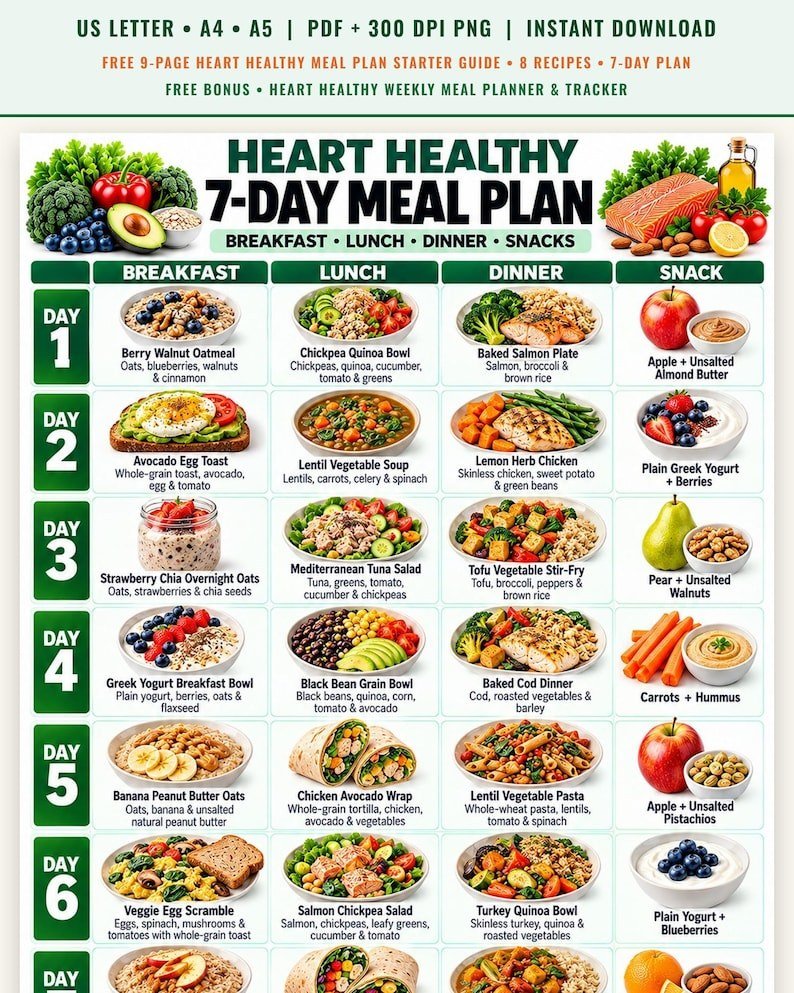
Lunch is only one meal. If you’d like the whole day planned, the second printable does that. The Heart Healthy 7-Day Meal Plan lays out breakfast, lunch, dinner and a snack for seven days, 28 meals in all, in a grid with a photo, a bold name and a short ingredient line for each.
The lunches on the plan are a chickpea quinoa bowl on Day 1, lentil vegetable soup on Day 2, a Mediterranean tuna salad on Day 3, a black bean grain bowl on Day 4, a chicken avocado wrap on Day 5, a salmon chickpea salad on Day 6 and a hummus veggie wrap on Day 7. Several of those match the lunch chart exactly, like the lentil vegetable soup, the chicken avocado wrap and the hummus veggie wrap. The two charts clearly come from the same kitchen.
The rest of the plan follows the same style. Breakfasts lean on oats, with berry walnut oatmeal, strawberry chia overnight oats and apple cinnamon oatmeal, plus avocado egg toast and a veggie egg scramble. Dinners include a baked salmon plate, lemon herb chicken with sweet potato, a tofu vegetable stir-fry, baked cod with barley, and a chickpea vegetable curry. The snacks pair fruit or vegetables with something filling, and every nut on the snack list is marked unsalted.
The easiest way to use the two together is to follow the 7-day plan and treat the lunch chart as your swap list. If the planned lunch doesn’t suit, because you’re out all day or don’t fancy it, pick one from the same lunch group on the chart. A wrap for a wrap. A soup for a soup. A grain bowl for a grain bowl. That keeps the week balanced without any extra planning.
Like the lunch chart, the plan gives foods, not portions or calories. Our full heart healthy diet meal plan guide walks through all 28 meals and how to cook the week.
What Makes a Lunch Heart Healthy, and How to Read the Label
Heart healthy can sound vague. Here’s what NHLBI’s DASH eating plan, which was designed to help lower blood pressure, says it means in practice, and how the FDA suggests checking the shop-bought parts of your lunch.
Build on plants. NHLBI says the DASH plan recommends eating vegetables, fruits and whole grains, and including fat-free or low-fat dairy, fish, poultry, beans, nuts and vegetable oils. That’s almost a description of the lunch chart. Every group on it is built from those foods.
Limit saturated fat and sugary drinks. NHLBI also recommends limiting foods high in saturated fat, such as fatty meats, full-fat dairy and tropical oils like coconut and palm oil, and limiting sugar-sweetened drinks and sweets. So the lunch is only half the story. A can of fizzy drink and a packet of biscuits alongside it undo a lot of the good. Water, unsweetened tea or a piece of fruit fit better.
Watch the sodium. NHLBI’s DASH plan sets a daily sodium target of 2,300 mg, and notes that 1,500 mg lowers blood pressure even further. Lunch can easily turn salty, because it often relies on bread, wraps, deli meats, cheese, canned soup and sauces. The chart avoids deli meat and cheese completely, which helps a lot. The parts left to check are the bread, tortillas, hummus, canned beans and canned fish.
Read the label in the right order. The FDA says that when you look at a Nutrition Facts label, first check the number of servings in the package and the serving size. If you eat two servings, you get double the calories and nutrients shown, so you’d double the numbers. That catches people out with wraps and soup, where the pack often holds more than one serving.
Use the percent Daily Value. The FDA’s general guide is that 5% DV or less of a nutrient per serving is low and 20% DV or more is high. It suggests choosing foods higher in %DV for dietary fiber and potassium, and lower in %DV for saturated fat, sodium and added sugars. In practice that means comparing two loaves, two packs of tortillas or two tubs of hummus, and picking the one with less sodium and more fiber.
A quick checklist for any lunch. Is there a vegetable, ideally two? Is there a protein, like fish, chicken, beans, tofu or yogurt? Is the grain whole, like brown rice, quinoa, farro or whole-grain bread? Is the fat from olive oil, nuts, avocado or fish? And have you checked the label on anything that came in a packet? If the answer is yes to all five, it’s a heart healthy lunch, whether it’s on the chart or not.
If you’d like the full list of heart healthy foods to shop from, our heart healthy diet food list sorts them into groups, and our low sodium food list helps with the salt side of the shop.
If cholesterol is your main focus, see our guide to lunches for lower cholesterol, built around beans, lentils and whole grains.
Frequently Asked Questions
What are some easy heart healthy lunch ideas?
Try a tuna white bean salad, a chicken quinoa bowl with broccoli and peppers, lentil tomato soup, a hummus veggie wrap, a black bean quinoa bowl or sardines on whole-grain toast. Each pairs a protein with whole grains or beans and vegetables.
What is a heart healthy lunch to take to work?
Grain bowls, bean salads, wraps and soups all pack well. Cook a pot of quinoa, a tray of chicken and vegetables and a big soup on Sunday, then assemble a different lunch each day. Keep dressing in a separate pot and use an ice pack for fish or chicken.
Are sandwiches heart healthy?
They can be. Choose whole-grain bread, fill it with home-cooked chicken, canned fish, hummus or beans plus vegetables, and skip deli meats and processed cheese. The FDA suggests checking the serving size and sodium %DV on the bread label.
How much sodium should a heart healthy lunch have?
There’s no set lunch figure. NHLBI’s DASH plan uses a daily target of 2,300 mg and notes that 1,500 mg lowers blood pressure further. The FDA calls 5% DV or less per serving low and 20% DV or more high. Your doctor may give you a personal limit.
Is soup a good heart healthy lunch?
Homemade soup with beans, lentils and vegetables is a great choice and freezes well. Canned soup is often high in sodium, so check the label or choose lower-sodium versions. The chart has five soups, like lentil tomato and white bean vegetable.
This guide is for general wellness and is not medical advice. Check with your doctor before starting a new routine.
Related Guides
- Cholesterol Diet Food List
- Heart Healthy Diet Meal Plan
- Heart Healthy Diet Food List
- Low Sodium Food List
Sources
Sources: NHLBI (NIH), DASH Eating Plan, U.S. Food and Drug Administration, How to Understand and Use the Nutrition Facts Label
 Diet & Food ListsMediterranean Diet for Seniors: A Simple Guide With an Eat, Limit, Avoid List and a 7 Day Plan
 Diet & Food ListsHigh Protein Foods for Muscle Gain: How Much You Need, the Best Picks per Meal and a Worked Training Day
 Diet & Food ListsLow Sodium Dinner Ideas: 24 DASH Style Dinners, a Sodium Budget per Plate and Sauce and Seasoning Swaps